The federal data behind a problem 60 million older Americans know too well
You wake at 2 a.m. Your hip aches where it meets the mattress. Your lower back feels locked. You shift positions, drift off, and wake again an hour later. By morning you feel less rested than when you went to bed. If this sounds familiar, you are not alone — and the federal data backs you up.
CDC arthritis surveillance data shows approximately 25% of U.S. adults have doctor-diagnosed arthritis, with prevalence rising steeply after age 60. Simultaneously, CDC sleep and sleep disorders data reports that approximately 35% of U.S. adults sleep fewer than seven hours per night — the threshold the CDC associates with elevated risk for chronic disease, including cardiovascular disease, diabetes, and worsened musculoskeletal conditions. For older adults navigating both realities at once, the intersection is brutal.
The burden is not just personal. AHRQ HCUP data identifies back pain as one of the most expensive conditions in U.S. healthcare by total inpatient and outpatient cost. AHRQ's Medical Expenditure Panel Survey confirms that adults living with chronic back conditions spend substantially more on healthcare annually than those without. And CMS drug spending data places opioid and non-opioid pain medication among the most expensive Medicare drug categories — a direct reflection of how undertreated and poorly managed chronic pain remains in the older adult population.
This article will not sell you on a mattress as the first answer. What it will do is walk you through the biomechanics of why joint pain worsens at night after 60, surface the free and low-cost interventions that federal health agencies recommend first, flag the clinical red flags that require a doctor rather than a new mattress, and then — for those who have genuinely addressed those earlier steps — explain what mattress constructions actually help and why.
Why joint pain and sleep deteriorate together after 60
The relationship between arthritis, chronic pain, and disrupted sleep is not simply that pain hurts and therefore wakes you. It is a bidirectional physiological feedback loop with specific mechanisms that get worse with age.
The biomechanics of the aging spine and joint surface
After age 50, intervertebral disc hydration declines progressively. Discs that once acted as hydraulic shock absorbers become thinner and less resilient. The facet joints — the small paired joints at the back of each vertebral level — begin to show cartilage thinning characteristic of osteoarthritis. Hip and shoulder joints undergo similar cartilage loss. The net result: a sleeping surface that does not distribute pressure evenly will concentrate load on already-compromised joint surfaces, triggering nociceptive signaling (pain nerve activation) that fragments sleep architecture.
CDC NCHS Data Brief 390 reports that approximately 20% of U.S. adults experience chronic pain, with lower back as the most common pain location. Among adults 60 and older, that prevalence is even higher. Chronic pain specifically — as opposed to acute pain — alters the central nervous system's pain-processing threshold through a process called central sensitization. In practical terms: your nervous system becomes better at detecting pain signals over time, not less sensitive. This is why older adults with long-standing arthritis often report that a mattress that felt fine five years ago now feels intolerably hard.
Nighttime immobility amplifies the pain cycle
During sleep, adults move significantly less than during waking hours. This immobility causes synovial fluid — the lubricant inside joints — to redistribute unevenly. Prolonged pressure on hip or shoulder joints without movement leads to localized ischemia (reduced blood flow) in the joint tissues. The body responds by triggering arousal from sleep to prompt a position change. For a 35-year-old with healthy cartilage, this process is nearly imperceptible. For a 68-year-old with moderate hip osteoarthritis, it produces the 2 a.m. hip ache described at the top of this article.
Sleep loss amplifies pain sensitivity — and vice versa
The feedback loop tightens further because sleep deprivation itself lowers pain thresholds. NIH-funded research has documented that even one night of disrupted sleep increases inflammatory cytokine levels and reduces the descending pain-inhibition signals the brain sends to dampen nociceptive input. Adults already dealing with arthritic inflammation start each sleep-deprived day with both higher baseline inflammation and a nervous system that is less capable of suppressing pain signals. Over months and years, this compounds into the pattern many adults over 60 describe: progressive worsening of both sleep quality and pain intensity, even without a clear change in underlying disease.
SSA Disability Insurance data identifies musculoskeletal disorders as the largest single category of new disability claims annually — a statistic that reflects not just workplace injuries but the cumulative toll of decades of musculoskeletal wear on the aging workforce. And BLS musculoskeletal disorder tracking confirms that the back is the most common body part injured across all U.S. occupations with days away from work, meaning that many adults entering their 60s have already accumulated years of occupational spinal loading on top of age-related joint changes.
The cheapest intervention is the one that does not require buying anything
Before we discuss mattress constructions, firmness ratings, or pressure-map data, let us be direct: the federal health agencies that study pain and sleep do not lead with "buy a new mattress." They lead with behavioral and movement interventions — because for a large proportion of adults with chronic joint pain and disrupted sleep, those interventions produce measurable results without spending a dollar.
The interventions below are drawn directly from NIH, CDC, NIAMS, and OSHA guidance. They are listed in order of evidence strength. If you have not tried these systematically, a new mattress is unlikely to be the decisive variable in your sleep quality.
For readers who have already addressed sleep position, incorporated regular walking, replaced a sagging mattress past its service life, and still wake in pain — the rest of this article is for you. Surface construction, foam density, coil design, and pressure-zone mapping do matter for older adults with arthritis and chronic back pain. The evidence base for specific material choices is real. But it matters most when layered on top of the behavioral and clinical foundations above.
When to see a clinician before shopping for a mattress
Some patterns of back and joint pain in adults over 60 are not sleep-surface problems. They are medical problems that require clinical evaluation. Purchasing a new mattress while an undiagnosed condition progresses is not just a wasted investment — it can delay diagnosis of conditions where timing matters.
Per NIH National Institute of Neurological Disorders and Stroke guidance on back pain, see a clinician promptly if your back or joint pain is accompanied by any of the following: radiating pain below the knee (possible nerve root compression or spinal stenosis, more common after 60); new onset of leg weakness or numbness; bowel or bladder changes; pain that woke you from sleep in the absence of position change; unexplained weight loss; or back pain following any fall or trauma — especially relevant given that falls are the leading cause of injury in adults over 65. These presentations require imaging and examination, not a new mattress.
Additionally, for adults with established osteoporosis — a condition affecting an estimated 10 million Americans, with another 44 million at low bone mass, per NIH data — any new back pain following minor trauma should be evaluated promptly for vertebral compression fracture. Vertebral fractures in older adults can present as back pain that appears to be muscular but is actually structural. A mattress change will not stabilize a fractured vertebra.
If your pain pattern does not include any of the above red flags and your primary complaint is stiffness, pressure-point waking, and morning soreness that improves within 30 minutes of moving — that is the profile where mattress surface and construction genuinely matter.
Where mattress construction becomes a genuine clinical variable
For adults 60 and older with arthritis, chronic back pain, or both, mattress research — though imperfect in study design — consistently points to two competing needs that most mattresses satisfy poorly: adequate pressure relief at the hip and shoulder (the primary contact points for side sleepers) and sufficient lumbar support to prevent spinal flexion (the primary failure mode of soft mattresses for back sleepers).
Firmness is not the answer. It is a trade-off axis. A mattress that is too firm concentrates pressure at the greater trochanter (the bony prominence of the hip) and the acromion (the shoulder point), creating the ischemic tissue load that triggers nighttime arousal. A mattress that is too soft allows the lumbar spine to sag into flexion, increasing compressive load on the posterior disc and facet joints throughout the night. The clinical target for most adults over 60 is what researchers call a "medium-firm with zoned support" — firmer under the lumbar spine and pelvis, softer under the shoulder and hip for lateral pressure relief.
The memory foam approach: contour-based pressure distribution
High-density memory foam addresses the pressure-relief problem through viscoelastic deformation — the foam conforms to the body's contours, distributing load across a larger surface area and reducing peak pressure at bony prominences. For adults with hip or shoulder arthritis, this mechanism is directly relevant. The Saatva Loom & Leaf Memory Foam Mattress is built around this principle with organic cotton quilting, a gel-infused foam layer to address the heat-retention complaint common with traditional memory foam, and a support core engineered specifically for spinal alignment. It comes in Relaxed Firm and Firm variants — for most adults over 60 with arthritis, the Relaxed Firm provides the pressure-relief-plus-support balance the research describes. At $1,695–$3,295 depending on size, it is a significant investment, but one grounded in a construction logic that maps directly to the biomechanical problem.
The heavy-duty approach: durability under sustained load
One issue that rarely gets discussed in mattress coverage for older adults is progressive sagging. A mattress that was adequate when purchased can develop body impressions within three to five years under heavier sleepers or couples with weight concentrated in specific zones. The Saatva HD Mattress, originally engineered for heavier-duty use, features a reinforced coil support system and higher-density foam layers that resist the body-impression development that causes otherwise-acceptable mattresses to become pain-inducing over time. For adults over 60 who have had the experience of buying a mattress that felt fine initially and degraded within a few years, the HD construction directly addresses that durability failure mode. Price range is $2,395–$3,995.
The pressure-mapping approach: grid-based adaptive support
A materially different engineering approach comes from Purple, whose Purple Hybrid Premier Mattress uses a patented hyper-elastic polymer grid rather than traditional foam or latex. The grid collapses under pressure points — hips and shoulders — while remaining supportive under lighter areas like the lumbar zone. In pressure-mapping studies, grid-based surfaces consistently show lower peak-pressure readings at the greater trochanter and shoulder than either foam or innerspring surfaces. For adults with particularly severe hip or shoulder arthritis who have found even medium-firm foam surfaces too hard, the grid approach delivers a qualitatively different pressure-distribution profile. At $2,499–$4,799, it is the premium end of this list, but it addresses a specific subset of the older adult arthritis population that foam-based surfaces do not fully serve.
Mattresses Built for Arthritis Pressure Relief and Spinal Support After 60
These three mattresses were selected specifically for adults over 60 dealing with arthritic joint pain, chronic back pain, or both — based on construction approaches that address the pressure-relief and lumbar-support trade-off documented in musculoskeletal sleep research.

Saatva Loom & Leaf Memory Foam Mattress
$1,695-$3,295
See Price at Saatva →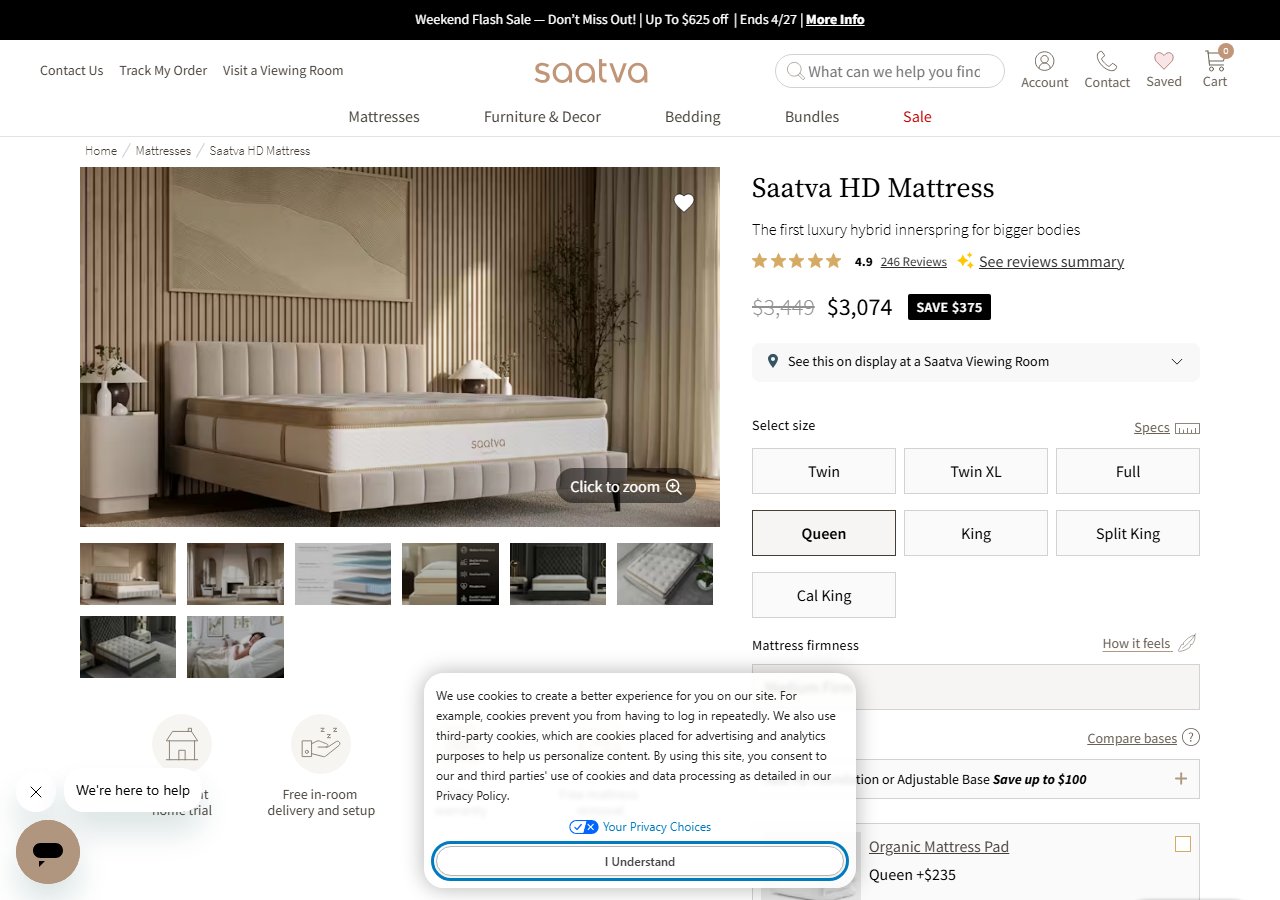
Saatva HD Mattress (Heavy-Duty)
$2,395-$3,995
See Price at Saatva →
Purple Hybrid Premier Mattress
$2,499-$4,799
See Price at Purple →How to use these products as tools, not solutions
The mattress market for adults over 60 with arthritis and chronic back pain is large, lucrative, and full of overclaims. Every mattress manufacturer will tell you their product relieves back pain. The federal data reviewed in this article points toward a more nuanced reality: surface construction matters at the margin — particularly for pressure relief at arthritic joint contact points and for lumbar support during sleep — but it is one variable among many, and not the most powerful one.
The hierarchy the evidence supports looks like this: sleep position first (free, effective, and underused), daily movement second (NIH evidence rates walking as effective as most non-drug clinical interventions for chronic low back pain), clinical evaluation third (rule out conditions that a mattress cannot fix), and surface optimization fourth. A $3,000 mattress on top of poor sleep hygiene, a sedentary lifestyle, and an unmanaged inflammatory condition will underperform a $800 mattress paired with good positioning habits, 30 minutes of daily walking, and appropriate clinical management.
What the Loom & Leaf, the Saatva HD, and the Purple Hybrid Premier have in common is that they were not designed for the median sleeper — they were designed with load distribution, support longevity, and pressure relief as primary engineering constraints. For adults over 60 navigating the intersection of arthritic joint surfaces, reduced spinal disc height, and age-related declines in sleep architecture, those engineering constraints map directly onto the physiological problem.
AHRQ MEPS data documents that adults with chronic back conditions pay substantially more for healthcare annually than those without. If a correctly chosen sleep surface reduces nighttime pain arousal, improves sleep continuity, and reduces the inflammatory cascade that follows poor sleep — the math on a quality mattress investment looks very different than a simple sticker-price comparison.
The summary the data supports
Joint pain after 60 is not an inevitable sentence to poor sleep. It is a biomechanical and physiological problem with specific, evidence-based interventions at multiple levels — behavioral, clinical, and, yes, at the level of sleeping surface. The CDC's chronic pain data showing 20% of adults in persistent pain, the SSA's documentation that musculoskeletal disorders drive the largest share of new disability claims, and the AHRQ cost data on back pain as a top healthcare expenditure all point toward the same conclusion: this is a serious, costly, prevalent problem that deserves serious, evidence-anchored interventions — not just marketing copy about "orthopedic support."
Start with position. Start with movement. Get clinical evaluation if the red flags apply. And if you've done those things and still wake in pain on a mattress older than seven years with visible sag — then the construction details of the Loom & Leaf, the Saatva HD, or the Purple Hybrid Premier are worth your time to evaluate carefully. The evidence is there. Use it.