One in Four Americans Has Arthritis — and Most of Them Are Losing Sleep Over It
Approximately 25% of U.S. adults report doctor-diagnosed arthritis, according to CDC surveillance data, and if you are reading this after 60, the odds that you are in that cohort — or heading there — are considerably higher than one in four. Arthritis prevalence climbs steeply with age. What the headline number does not capture is the downstream consequence that most clinical conversations underweight: the destruction of sleep architecture. Pain does not just hurt during the day. It fires at night, when there is no ambient distraction to dull the signal, when the body is supposed to be rebuilding itself, and when the wrong mattress surface turns every pressure point into a wakeup call.
CDC sleep data shows that 35% of U.S. adults already sleep fewer than 7 hours per night, the threshold below which chronic disease risk — cardiovascular, metabolic, cognitive — rises measurably. Adults over 60 with active joint pain almost certainly skew worse than that average. Sleep deprivation then amplifies pain sensitivity through a mechanism called central sensitization: the nervous system, chronically under-recovered, begins interpreting normal sensory input as painful. This is not a mattress problem. This is a systemic loop that a mattress alone cannot break. But the right sleep surface, combined with evidence-based interventions, can meaningfully interrupt it.
This article works through the mechanism first — the actual biomechanical and physiological reasons joint pain disrupts sleep in older adults — then moves to non-product interventions that cost nothing or next to nothing, then to clinical red flags, and finally to three mattresses that are genuinely engineered for this population's load patterns. The product recommendations come last. That is intentional.
Why Joint Pain and Age Are a Sleep-Disruption System, Not a Coincidence
The biomechanics here are worth understanding in some detail, because they determine what kind of mattress surface actually helps — and which firmness marketing language is noise.
Cartilage thinning and increased bony prominence pressure. Healthy cartilage acts as a shock absorber and pressure distributor across joint surfaces. Osteoarthritis, the most common form in adults over 60, degrades that cartilage progressively. Bony prominences — the greater trochanter of the hip, the medial and lateral knee condyles, the shoulder acromion — bear load more directly. When a person lies on a surface that does not contour to these landmarks, pressure concentrates at those points, triggering nociceptive pain signals that fragment sleep. The technical term for this is interface pressure, and it is measurable with pressure mapping technology. Older foam mattresses, coil systems with inadequate transition layers, and overly firm surfaces routinely generate peak interface pressures above the thresholds associated with tissue ischemia and pain.
Spinal disc hydration loss. Intervertebral discs lose water content with age — a process called disc desiccation — reducing their capacity to distribute compressive load evenly across the vertebral endplates. This means that a mattress surface that sags even slightly in the lumbar region places the already-desiccated lumbar discs in a flexed, compressive position for six to eight hours. CDC NCHS Data Brief 390 documents that lower back is the most common location of chronic pain among U.S. adults, and the disc desiccation mechanism is a primary driver in the 60+ population.
Inflammatory cytokine surges and nighttime pain amplification. Inflammatory arthritis — rheumatoid, psoriatic — involves cytokine-driven joint inflammation that characteristically peaks in the early morning hours, a well-documented circadian pattern. This is why many older adults with inflammatory joint disease describe their worst pain occurring between 3 and 6 a.m., the exact window when sleep would otherwise be deepest. No mattress eliminates this mechanism. But a surface that reduces mechanical stress at inflamed joints can lower the baseline pain signal enough that cytokine-driven amplification does not cross the wakeup threshold.
Reduced proprioceptive feedback and positional awareness. Aging reduces proprioception — the body's real-time sense of joint position — meaning older sleepers are slower to recognize and self-correct a biomechanically harmful sleeping position. They may spend more time in a position that torques the lumbar spine or compresses a painful hip before pain finally wakes them to move. Sleep position guidance (covered in the interventions section below) directly addresses this.
AHRQ HCUP data identifies back pain as one of the most expensive conditions in U.S. healthcare by total inpatient and outpatient cost, and AHRQ MEPS data shows that adults with chronic back conditions spend substantially more annually on personal healthcare than adults without such conditions. The cost cascade — from poor sleep to elevated pain to increased medication use to eventual functional decline — starts with the mechanisms above. CMS drug spending data identifies opioid and non-opioid pain medication spending among the most expensive Medicare drug categories, a direct reflection of how inadequately managed chronic musculoskeletal pain drives pharmaceutical dependency in older adults. SSA Disability Insurance data identifies musculoskeletal disorders as the largest single category of new disability claims annually — the downstream consequence of the same pain-sleep-function loop described above.
The Cheapest Intervention Is the One That Requires No Purchase
Before discussing any product, it is worth being direct: the evidence base for non-product interventions in chronic musculoskeletal pain is stronger, on average, than the evidence base for any specific mattress firmness. That is not a knock on good mattresses — it is a hierarchy worth respecting. Four interventions in particular deserve serious attention from adults over 60 managing joint pain and disrupted sleep.
Sleep position is the most impactful free variable. NIH guidance on back pain is explicit: side-sleeping with a pillow between the knees maintains neutral pelvic and lumbar alignment by preventing the top leg from falling forward and internally rotating the hip. Back-sleeping with a pillow under the knees reduces lumbar lordosis. Stomach-sleeping is the single worst position for lumbar spine mechanics — it forces cervical rotation and extends the lumbar spine for the full duration of sleep. This is a zero-cost intervention, and for many older adults with early-stage joint pain, it is the highest-leverage change available.
Daily walking outperforms most passive interventions for chronic low back pain. NIH NCCIH's evidence review of low back pain treatments finds that walking 30 minutes most days reduces chronic low back pain as effectively as most non-drug clinical treatments. This is a counterintuitive finding for many patients who experience morning stiffness and assume movement will worsen symptoms. The mechanism is partly cardiovascular — walking improves perfusion to disc and joint tissue — and partly neuromuscular, as paraspinal muscle activation during walking provides dynamic stabilization that reduces nocturnal load on passive structures. A new mattress does not provide this benefit. Movement does.
Audit your current mattress before buying a new one. CDC sleep hygiene guidance and clinical consensus converge on a simple checklist: replace a mattress if it shows visible sag or body impressions greater than 1.5 inches, if you consistently wake stiffer than you went to bed, or if it is older than 7 to 10 years. Memory foam loses progressive recovery capacity over time. Innerspring systems lose coil tension. A mattress that tested medium-firm when purchased may be functionally soft — and biomechanically harmful — after a decade of use.
Bending and lifting mechanics remain relevant even in retirement. OSHA's ergonomics guidance emphasizes hinging at the hips rather than the lumbar spine when lifting or bending — relevant not just for warehouse work but for everyday tasks like gardening, loading a dishwasher, or lifting grandchildren. Acute flare episodes triggered by poor mechanics during the day compound nighttime pain. The habit of hip-hinging is learnable at any age and protects the same spinal structures that a supportive mattress is trying to unload at night.
For readers who have genuinely worked through these interventions — who sleep in a neutral position, walk regularly, and are sleeping on a mattress younger than eight years that shows no visible sag — and are still waking multiple times per night with joint pain: a mattress upgrade is a reasonable next step. The products below were selected for this specific population, not for a generic "back pain" reader.
When to See a Clinician Before Buying Anything
A mattress is not a medical device, and some patterns of pain at night signal conditions that require clinical evaluation before any consumer product decision. NIH National Institute of Neurological Disorders and Stroke back pain guidance identifies several presentations that warrant prompt clinician contact rather than a sleep surface upgrade.
For adults over 60 specifically, the clinical bar for imaging is lower than in younger populations, because the background rate of serious spinal pathology — including compression fractures from osteoporosis, spinal stenosis, and (rarely) malignancy — is higher. New-onset back pain after 60 that is severe, unrelenting, or associated with unexplained weight loss should not be attributed to a worn mattress. Night pain that is progressive and unrelieved by any position change — rather than intermittent and positionally sensitive — is a different biological signal than mechanical back pain.
See the clinical red flags section below for the specific presentations that NIH guidance flags as requiring prompt evaluation.
How Surface Firmness, Foam Density, and Coil Architecture Map to Joint Health After 60
Once a reader has cleared the clinical threshold — no red flags, no acute pathology — and has genuinely worked through the non-product interventions, the conversation about mattress construction becomes both relevant and specific. Here is what the biomechanical evidence actually suggests for older adults with arthritis and chronic back pain.
Medium-firm, not firm. The intuition that firmer is better for back pain is one of the most persistent and best-refuted ideas in sleep medicine. A landmark randomized controlled trial in the Lancet (Kovacs et al.) found that medium-firm mattresses produced significantly better outcomes for chronic low back pain than firm mattresses. For older adults with bony prominence pressure sensitivity from arthritis, a firm surface creates exactly the interface pressure concentrations described in the mechanism section above. The target is a surface that is supportive enough to maintain spinal alignment but compliant enough to redistribute pressure at the hip, shoulder, and knee.
Foam density and heat retention. High-density memory foam (4–5 lb per cubic foot) conforms closely to body contours and excels at pressure redistribution. But older adults often report heat retention as a significant complaint with traditional memory foam — relevant because thermoregulation becomes less efficient with age, and core body temperature management is tied to sleep architecture. Gel-infused foam layers and open-cell foam construction address this. Latex, natural or synthetic, provides similar contouring with better breathability and faster response time — reducing the "stuck" feeling that some older adults find difficult to reposition away from.
Hybrid systems for edge support and ease of repositioning. Older adults who experience frequent nighttime awakening often need to reposition or get up to use the bathroom. A mattress with robust edge support — typically provided by a perimeter coil system or dense foam border in a hybrid construction — makes sitting up, pivoting, and rising from the edge of the bed meaningfully easier. This is not a marketing distinction. Reduced edge support directly increases the mechanical demand of getting out of bed, which matters for adults with hip or knee arthritis.
The Saatva Loom & Leaf Memory Foam Mattress is the premium memory foam recommendation for this population. Saatva builds the Loom & Leaf with a 5 lb density memory foam comfort layer — one of the higher density specifications in the direct-to-consumer market — layered over a lumbar zone enhancement that adds targeted support in the L1–L5 region, exactly where disc desiccation and facet joint arthritis concentrate load. It is available in Relaxed Firm and Firm options; for most adults over 60 with arthritis, Relaxed Firm maps most closely to the medium-firm range supported by the clinical literature. The organic cotton cover and cooling gel layer address the thermoregulation concern above. At $1,695 to $3,295 depending on size, this is a genuine investment — but for a population where sleep disruption is driving downstream healthcare spending that AHRQ MEPS data shows is already substantially elevated, the cost calculus is different than for a healthy 35-year-old.
The Saatva HD Mattress warrants mention for older adults who are larger-framed or who are above 250 lbs. Standard mattress constructions are designed around average body weight distributions. At higher body weights, standard foam comfort layers compress more completely, effectively reducing the functional compliance of the surface and increasing interface pressure at bony prominences — the opposite of what arthritis patients need. The Saatva HD is engineered with a higher-density foam base, a reinforced coil system with a higher coil gauge, and edge support rated for the additional load. For heavier older adults with joint pain, this is not an optional upgrade — it is the correct construction specification. Priced from $2,395 to $3,995.
The Purple Hybrid Premier Mattress takes a fundamentally different engineering approach that is particularly relevant for older adults with significant hip and shoulder arthritis. Purple's proprietary GelFlex Grid — a hyper-elastic polymer grid rather than a foam layer — provides what the company calls "pressure-free" support: the grid collapses selectively under bony prominences while remaining supportive under broader body regions. Independent pressure mapping studies on grid-based surfaces consistently show lower peak interface pressures at the hip and shoulder than comparable foam surfaces. For side-sleeping older adults with significant hip arthritis or rotator cuff involvement, this architecture is worth the premium. The Hybrid Premier adds a pocketed coil base for responsive support and edge performance. Priced from $2,499 to $4,799.
Mattresses Engineered for Joint Pain and Pressure Relief After 60
These three mattresses were selected specifically for older adults managing arthritis, chronic back pain, or joint-related sleep disruption — evaluated on surface compliance, pressure redistribution, lumbar zone support, and edge performance for ease of repositioning.

Saatva Loom & Leaf Memory Foam Mattress
$1,695-$3,295
See Price at Saatva →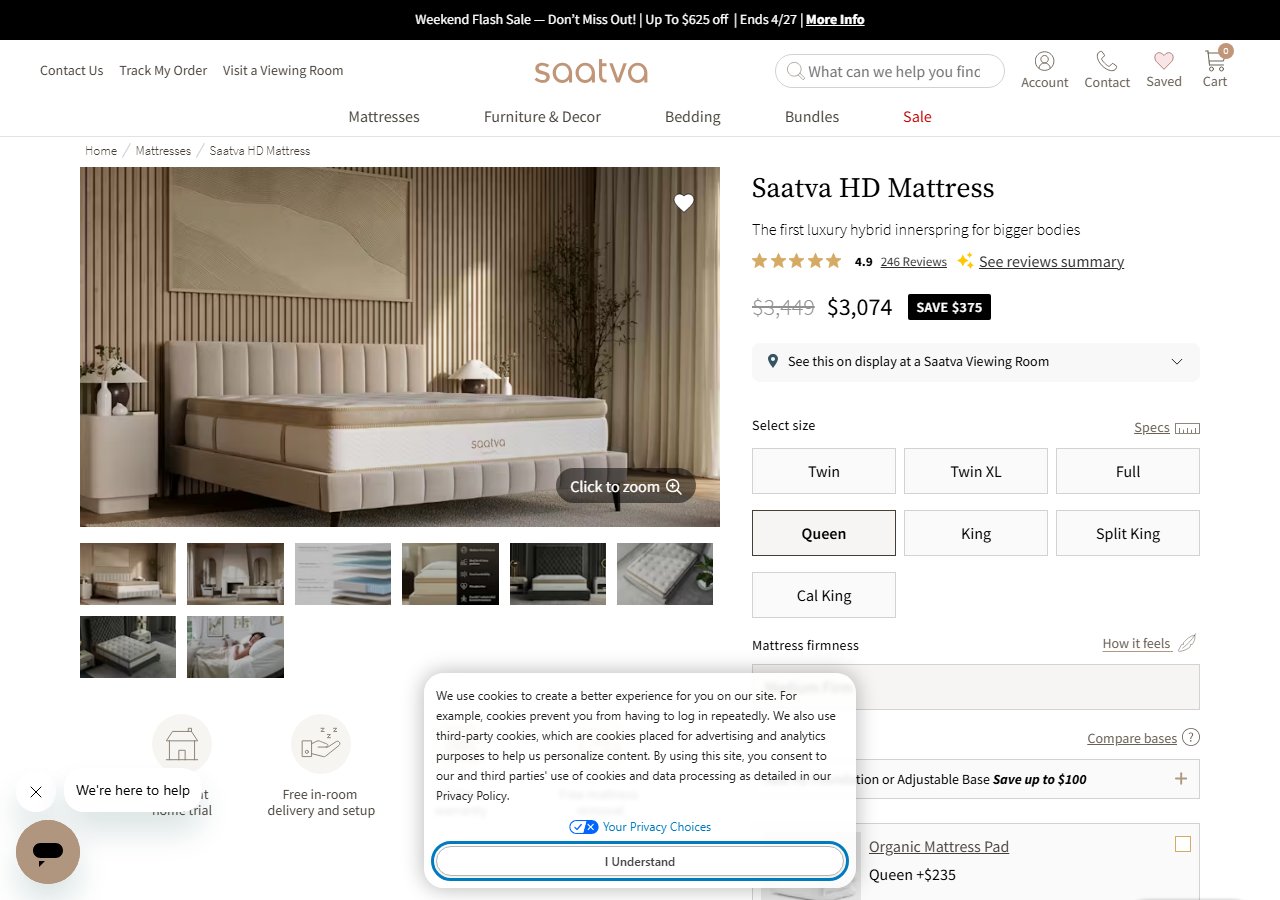
Saatva HD Mattress (Heavy-Duty)
$2,395-$3,995
See Price at Saatva →
Purple Hybrid Premier Mattress
$2,499-$4,799
See Price at Purple →The Data-to-Intervention-to-Product Hierarchy
The federal data reviewed in this article tells a consistent story. BLS tracking shows the back is the most commonly injured body part in U.S. occupational contexts — meaning many adults arriving at age 60 with joint and back pain have been accumulating mechanical damage across decades of work. CDC data shows one in four has diagnosed arthritis. CDC sleep data shows more than a third are already under the 7-hour threshold associated with elevated disease risk. These are not separate problems — they are the same system expressing itself across different measurement domains.
The intervention hierarchy that follows from this data is: move daily (walking is the highest-return intervention), sleep in a biomechanically neutral position (zero cost, high impact), audit and replace a mattress that has degraded past its functional lifespan (moderate cost, specific criteria), and — if red flags are absent and non-product interventions have been genuinely applied — consider a mattress engineered for the specific pressure-relief and alignment demands of older adult physiology.
None of the three products above are miracle solutions. Each is a well-engineered piece of equipment that addresses a specific biomechanical problem — high interface pressure at arthritic joints, inadequate lumbar zone support from disc desiccation, insufficient edge support for repositioning — in a population where those problems are documented and the downstream cost of inadequate sleep is real. That is the case for considering them. It is not a stronger case than the one for walking 30 minutes a day.