Joint Pain After 60 Is Not Just About Aging — The Federal Data Tells a Specific Story
CDC Arthritis Data shows that approximately 25% of U.S. adults have received a doctor-diagnosed arthritis diagnosis — but that number does not tell the full story for adults over 60. Arthritis prevalence climbs steeply with each decade of life, and for most older Americans, it does not arrive in isolation. It arrives alongside years of accumulated spinal loading, a lifetime of sleep positions that were never quite neutral, and joints that no longer have the cartilage buffer they did at 40. The result is a particular kind of nighttime misery: you lie down hoping for relief, and instead you find that stillness amplifies every ache your moving body had been outrunning all day.
CDC sleep data shows that approximately 35% of all U.S. adults sleep fewer than 7 hours per night — a threshold the CDC directly links to elevated chronic disease risk, including cardiovascular disease, diabetes, obesity, and mental health disorders. For adults over 60, insufficient sleep is not just a side effect of pain; it becomes a driver of pain. Research consistently shows that sleep deprivation lowers pain tolerance, increases inflammatory markers, and disrupts the hormonal environment needed for tissue repair. The relationship between joint pain and sleep loss is bidirectional and self-reinforcing, which is why understanding the mechanism — not just the symptom — matters so much for older adults navigating this cycle.
Why Joint Pain Gets Worse at Night After 60: The Biomechanics
Daytime movement keeps synovial fluid circulating around joint surfaces. That circulation acts as both lubrication and shock absorption. When an older adult lies down for 7 to 8 hours in a fixed position, synovial fluid stops moving. For joints already compromised by osteoarthritis or rheumatoid arthritis, that stillness allows inflammatory byproducts to pool around the joint capsule. Morning stiffness — that particular grinding sensation in the hips, knees, and lower back when you first stand up — is largely a product of this overnight fluid redistribution and the drop in endogenous cortisol that typically reaches its nadir around 3 a.m.
The lumbar spine compounds the problem. Intervertebral discs are largely avascular — they absorb nutrients and fluids through diffusion, a process that relies on cyclic loading and unloading. In younger adults, discs rehydrate reasonably well overnight. After 60, disc dehydration is cumulative and progressive, reducing the spine's ability to absorb compressive forces. According to CDC NCHS Data Brief 390, approximately 20% of U.S. adults experience chronic pain, with the lower back as the most common location. For older adults with both disc degeneration and arthritis, the sleeping surface becomes a direct variable: a surface that does not contour to the natural lumbar curve keeps the spine in mild extension for hours, mechanically stressing already-compromised discs and facet joints.
The hip and shoulder joints add another layer of complexity specific to older adults. Side-sleeping — the most common position in adults who experience back pain — compresses the downward hip and shoulder against the mattress. In a younger adult with healthy cartilage and adequate subcutaneous tissue, this is manageable. In an older adult with thinning cartilage, bursitis, or rotator cuff changes, the lateral pressure from an overly firm surface can trigger pain that disrupts sleep architecture — reducing time in the deeper stages where physical restoration actually occurs.
SSA Disability Insurance data identifies musculoskeletal disorders as the largest single category of new disability claims annually, and a significant proportion of those claimants are in their late 50s and early 60s — precisely the demographic crossing the threshold into Medicare eligibility. What the SSA data makes vivid is that chronic joint and back pain is not merely uncomfortable; it is functionally disabling for millions of older Americans, at a scale that drives enormous federal spending.
AHRQ HCUP data confirms that back pain is one of the most expensive conditions in U.S. healthcare by total inpatient and outpatient cost. Meanwhile, AHRQ MEPS data shows that individuals with chronic back conditions carry substantially higher annual personal healthcare expenditures than those without such conditions. And CMS drug spending data identifies opioid and non-opioid pain medications among the most expensive Medicare drug categories — an indirect indicator of how poorly the current clinical system manages chronic musculoskeletal pain in older adults. Sleep surface quality, while not a pharmaceutical intervention, is one of the modifiable variables that older adults often underestimate.
Why Surface Firmness Is Not a Simple Equation for Older Adults
The traditional advice — "firm mattress for back pain" — does not hold up well against the biomechanical reality of adults over 60. A mattress that is too firm does not allow adequate pressure relief at the hips and shoulders, particularly for side-sleepers. A mattress that is too soft allows the pelvis to sink disproportionately, collapsing the lumbar curve into flexion. The optimal surface for an older adult with arthritis and back pain sits in a specific zone: firm enough to provide postural support and prevent excessive sinkage of the hips, but with sufficient pressure-relief in the top comfort layers to buffer joint compression at the shoulders, greater trochanter, and knees.
Body composition changes after 60 further complicate the equation. Older adults typically carry less muscle mass and more redistributed fat tissue, altering how weight is distributed across a sleep surface. The bony prominences — hips, sacrum, shoulders — become more exposed, and the pressure gradient between those points and the mattress surface matters more than it did at 35. This is why pressure mapping and zoned support construction are not marketing language for this demographic; they are functional requirements.
Try These First: Federal Agency Recommendations Before You Buy Anything
The cheapest intervention is the one that does not require buying anything. For older adults with joint pain and disrupted sleep, several evidence-based, zero-cost interventions can meaningfully reduce nighttime pain before a new mattress enters the picture. Federal agencies have been clear about the evidence base for these approaches.
Sleep position is the most impactful free variable. NIH back pain guidance specifically recommends side-sleeping with a pillow between the knees — this keeps the lumbar spine neutral and prevents the top hip from rotating forward, which strains the lower back and sacroiliac joint. Back-sleeping with a pillow under the knees achieves a similar neutral alignment by reducing lumbar extension. Stomach-sleeping torques the lumbar spine and cervical spine simultaneously and is particularly harmful for adults with arthritis; if you are a habitual stomach-sleeper, even a modest positional shift can reduce morning stiffness within days.
Daily walking is among the most evidence-supported interventions for chronic low back pain. NIH NCCIH's evidence review concludes that walking 30 minutes most days reduces chronic low back pain as effectively as most non-drug clinical treatments. For older adults specifically, walking also maintains hip flexor length, quadriceps strength, and general cardiovascular health — all of which contribute to better sleep architecture and reduced inflammatory load at the joints. New mattresses help, but movement remains the primary lever.
Mattress age and condition matter more than brand. CDC sleep hygiene guidance and occupational health consensus suggest replacing a mattress when it shows visible sag, when you consistently wake stiffer than you went to bed, or when it exceeds 7 to 10 years of age. Even the most expensive sleep surface cannot compensate for poor sleep hygiene, a sedentary day, or a bedroom environment that disrupts circadian rhythm.
Lifting and bending mechanics remain relevant for older adults who still handle loads — groceries, grandchildren, yard work. OSHA ergonomics guidance emphasizes hinging at the hips rather than the lumbar spine, keeping loads close to the body, and eliminating rotation under load. Most acute back episodes in older adults are mechanical in origin and are directly traceable to a single poor-mechanics moment layered onto a chronically loaded spine.
For readers who have adjusted their sleep position, committed to daily walking, and confirmed that their mattress is neither sagging nor ancient — and who are still waking with significant hip, shoulder, or lower-back pain — the sleeping surface itself may genuinely be contributing to the problem. This is the population for whom mattress construction details and surface materials move from marketing to medicine.
When to See a Clinician: Red Flags That Require Evaluation, Not a New Mattress
Back pain and joint discomfort in older adults can occasionally signal something beyond mechanical wear. No mattress change or sleep position adjustment is appropriate when the underlying cause requires clinical evaluation. NIH NINDS back pain guidance and CDC clinical resources identify several presentations that warrant prompt medical attention, especially in the 60+ population.
Older adults are at higher baseline risk for vertebral compression fractures — particularly women with osteoporosis — and the presenting symptom is often sudden-onset back pain without clear trauma. Spinal stenosis, which involves narrowing of the spinal canal, is more prevalent in older adults and can produce leg pain, numbness, or weakness that may be mistaken for hip arthritis. New or worsening back pain in an older adult with a history of cancer requires imaging to rule out metastatic involvement. The threshold for evaluation should be lower at 60+ than at 35.
Clinical red flags for older adults with joint pain and sleep disruption:
- Back or joint pain accompanied by unexplained weight loss, night sweats, or fever — possible systemic or oncologic cause requiring urgent evaluation. NIH NINDS
- Pain that radiates below the knee, especially with numbness, tingling, or motor weakness — suggests nerve root compression or stenosis. NIH NINDS
- Bowel or bladder dysfunction accompanying low back pain — cauda equina syndrome, a surgical emergency. NIH NINDS
- Sudden-onset severe back pain in a woman over 60 with known or suspected osteoporosis — vertebral compression fracture until proven otherwise. CDC Arthritis Data
- Joint pain that does not improve with position change and is associated with morning stiffness lasting more than 45 minutes — may indicate inflammatory arthritis requiring rheumatologic evaluation. CDC Arthritis Data
If any of these presentations apply, the appropriate first step is a clinician visit — not a mattress purchase.
Where Mattress Construction Actually Helps: Pressure Relief, Zoned Support, and Surface Firmness for Arthritis
For older adults without red-flag symptoms who have optimized their sleep position and daily movement habits, the sleeping surface becomes a legitimate variable worth investing in. The relevant construction features are not difficult to evaluate once you understand what you are solving for: pressure relief at bony prominences, lumbar zoning to prevent hip sinkage, and heat management (relevant because many older adults with arthritis report increased nighttime discomfort associated with warming joints).
The Saatva Loom & Leaf Memory Foam Mattress is the strongest option in this category for older adults with serious back pain. Loom & Leaf uses a multi-layer memory foam construction with a quilted organic cotton cover and a 5-zone lumbar support system engineered specifically for spinal alignment. Memory foam contours to the hip and shoulder curve, reducing the pressure differential that causes older adults to shift positions repeatedly during the night — a pattern that fragments sleep architecture. Saatva offers two firmness options: Relaxed Firm (the majority of back pain patients land here) and Firm for those who need more structural support. For older adults whose primary complaint is morning stiffness and hip or shoulder pain after a full night, the Loom & Leaf's pressure-mapping construction addresses the core mechanical problem.
For older adults who are larger-framed, carry more body weight, or have been told by a physical therapist that they need exceptional lumbar support, the Saatva HD Mattress is worth serious consideration. The HD is engineered for sustained structural integrity under greater load — a meaningful distinction, because standard-gauge coil systems compress over time under heavier users, and that compression creates the sag pattern that causes lumbar flexion during sleep. The Saatva HD uses a dual steel coil system with a higher coil count and a foam encasement perimeter, and it maintains its firmness profile over years in a way that standard mattresses targeting larger users often do not. For older adults who have replaced mattresses every three or four years because of premature sagging, the HD's construction addresses the durability problem directly.
For older adults whose primary complaint is pressure pain — hip bursitis, shoulder impingement-type symptoms, knee pain from side-sleeping — the Purple Hybrid Premier Mattress takes a materially different approach. Purple's proprietary GelFlex Grid is not foam-based; it is a polymer grid structure that collapses under concentrated pressure points (hips, shoulders, knees) while remaining firm under distributed load areas (lumbar spine, legs). This means it provides pressure relief without the full-body sinkage that makes some memory foam options problematic for back pain. The Hybrid Premier version layers the grid over a pocketed coil base, which provides the responsiveness and edge support that older adults need when getting in and out of bed — a mobility consideration that becomes increasingly important after 60. The grid's open-air structure also runs cooler than dense foam, which matters for older adults whose joint discomfort correlates with nighttime overheating.
Mattresses Engineered for Older Adults Managing Arthritis and Back Pain
These three mattresses were selected specifically for adults 60+ dealing with the joint pressure, lumbar alignment challenges, and nighttime stiffness that federal health data identifies as the dominant sleep disruptors in this demographic.

Saatva Loom & Leaf Memory Foam Mattress
$1,695-$3,295
See Price at Saatva →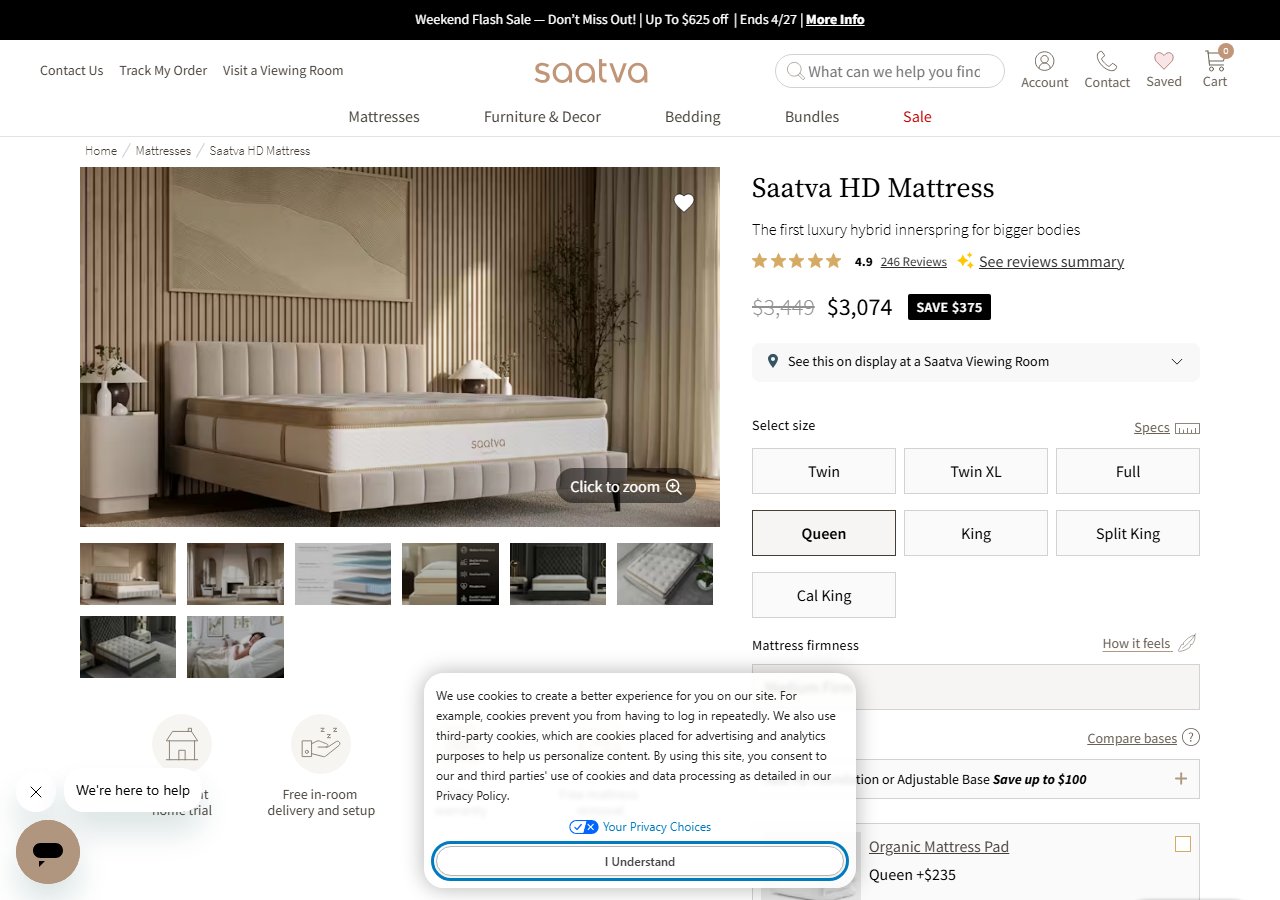
Saatva HD Mattress (Heavy-Duty)
$2,395-$3,995
See Price at Saatva →
Purple Hybrid Premier Mattress
$2,499-$4,799
See Price at Purple →Putting It Together: The Data-to-Intervention-to-Product Hierarchy
The federal data is consistent across agencies: musculoskeletal disorders are the leading driver of disability claims (SSA), among the most expensive conditions in U.S. healthcare (AHRQ HCUP), and a significant contributor to Medicare drug spending (CMS). For adults over 60, these systems converge: arthritis and disc degeneration disrupt sleep, sleep disruption lowers pain tolerance and elevates inflammatory markers, and the cycle accelerates physical and functional decline.
The appropriate response to that data is not a mattress purchase. It is a systematic approach: adjust your sleep position first, per NIH guidance. Add daily walking, per NIH NCCIH evidence. Evaluate your current mattress for age and visible deterioration, per CDC sleep hygiene recommendations. Rule out clinical red flags with your physician. Then, if the surface remains a variable, invest in construction features — pressure relief, zoned support, appropriate firmness — that address the specific biomechanical needs of your aging joints.
The Saatva Loom & Leaf, Saatva HD, and Purple Hybrid Premier each offer distinct engineering approaches to those biomechanical needs. None of them is a substitute for movement, clinical care, or good sleep hygiene. All three are meaningfully better than a sagging 12-year-old spring mattress for an adult managing arthritis and chronic back pain at 65. That is the honest framing the federal data supports — and the only framing worth taking seriously.