The Overlap Between Arthritis and Poor Sleep Is Not Accidental
CDC arthritis surveillance reports that approximately 25% of U.S. adults carry a doctor-confirmed arthritis diagnosis — and that figure climbs steeply with age. By the time Americans reach their sixties, osteoarthritis of the hips, knees, and spine is more the rule than the exception. At the same time, CDC sleep data shows approximately 35% of U.S. adults sleep fewer than 7 hours per night, the threshold the CDC associates with elevated risk for obesity, diabetes, cardiovascular disease, and — critically — worsened pain sensitivity. For adults over 60, these two datasets do not sit in separate columns. They describe the same people, the same nights, and the same grinding feedback loop.
This article is built around a simple argument: before you spend a dollar on a new mattress, you need to understand why joint pain disrupts sleep in the first place, what free interventions the federal evidence base recommends, when symptoms require a clinician, and only then — when you have worked through those layers — what mattress construction actually addresses the biomechanical problem your joints are generating every night.
Why Arthritis and Back Pain Wreck Sleep After 60: The Biomechanical Mechanism
Sleep is supposed to be the body's primary recovery window. For younger adults with healthy joints, it largely is. For older adults with arthritis, degenerative disc disease, or spinal stenosis, the sleep surface itself becomes a source of mechanical stress rather than relief.
Here is the mechanism. As cartilage thins in arthritic joints — particularly at the hips, knees, shoulders, and lumbar facets — the normal joint space narrows. Bone-on-bone contact pressure increases. During the day, movement and muscle activation help distribute load across surviving cartilage and surrounding soft tissue. At night, static load on a firm or unsupportive surface concentrates pressure directly on the most inflamed, least-cushioned surfaces of the body: lateral hips when side-sleeping, sacrum when back-sleeping, and lumbar discs in virtually every position.
That concentrated pressure triggers nociceptor activation — the body's pain signal pathways — which fragments sleep architecture. The sleeper wakes or shifts; frequent repositioning further disturbs REM and slow-wave sleep; and the body never reaches the deep-sleep phase where anti-inflammatory cytokines are released and tissue repair is prioritized. The result: the person with arthritis wakes stiffer and more inflamed than they went to bed, not because sleep failed them in principle, but because the mechanical environment of the sleep surface created a pain signal that the nervous system could not ignore.
CDC NHANES data documents that approximately 20% of U.S. adults experience chronic pain, with lower back pain as the single most common location. The economic toll is enormous. AHRQ MEPS data shows that adults with chronic back conditions incur substantially higher annual personal healthcare expenditures than those without — and AHRQ HCUP data identifies back pain as one of the most expensive conditions in U.S. healthcare by total inpatient and outpatient cost. CMS drug spending surveillance shows opioid and non-opioid pain medication spending rank among the most expensive Medicare drug categories — a downstream consequence of undertreated musculoskeletal pain that compounds for older adults already managing polypharmacy.
The body part most frequently injured across all U.S. occupations, per BLS musculoskeletal disorder tracking, is the back — and many adults over 60 carry accumulated occupational spinal load from decades of lifting, bending, and sustained physical demand before retirement. That cumulative burden does not disappear when the shift ends. It shows up at 2 a.m. as hip pain that won't let them stay asleep.
The Free Interventions Come First
The cheapest intervention is the one that costs nothing. Federal health agencies — NIH, CDC, NIOSH, and NCCIH — have published substantial evidence-based guidance on non-product approaches to chronic back and joint pain. For older adults specifically, these interventions matter enormously because the mechanism is partly behavioral and partly postural, not purely structural. A new mattress cannot fix what a poor sleep position, a sedentary daily routine, or a sleep hygiene deficit is creating.
Start with sleep position, because it is the highest-leverage free variable in your pain equation. NIH back pain guidance recommends side-sleeping with a pillow between the knees — this keeps the pelvis level and reduces rotational torque on the lumbar spine and hip joint — or back-sleeping with a pillow under the knees, which flattens the lumbar curve and offloads the sacroiliac joint. Stomach-sleeping, by contrast, forces the neck into rotation and anteriorly tilts the pelvis, compressing lumbar facet joints. If you are currently a stomach sleeper and you have arthritis or lumbar pain, your sleep position is generating a significant fraction of your morning stiffness.
Second, daily walking has more clinical evidence behind it for chronic low back pain than most passive interventions. NIH NCCIH's evidence review on low back pain identifies walking 30 minutes most days as reducing chronic low back pain as effectively as most non-drug clinical treatments. Walking lubricates synovial joints, activates deep paraspinal muscles that support the lumbar spine during sleep, and reduces systemic inflammatory markers. No mattress replicates this effect.
Third, evaluate your mattress honestly before replacing it. CDC sleep hygiene guidance frames this clearly: if a mattress has visible sag, if you wake stiffer than you went to bed on it, or if it is older than 7 to 10 years, the surface itself is contributing to the problem and replacement is justified. But if the mattress is relatively new and not visibly degraded, a new mattress is unlikely to be the root cause — and buying one will not undo poor sleep hygiene, late caffeine, or a sedentary day.
Finally, if you spend significant time lifting, bending, or performing manual tasks in your daily life — many adults over 60 continue to do so as caregivers, home managers, or part-time workers — OSHA's ergonomics guidance recommends hinging at the hips rather than the lumbar spine, keeping loads close to the body, and avoiding twisting under load. Most acute back flare-ups that disrupt sleep for days or weeks are mechanically triggered and mechanically rehearsable.
For adults who have worked through those free interventions — corrected sleep position, added daily movement, replaced an aging mattress — and still wake with hip, shoulder, or lower back pain, the construction of the sleep surface becomes genuinely relevant. This is the population for whom mattress specification matters: people whose joints are generating real pressure-point load that a better-designed surface can meaningfully reduce.
When to See a Clinician First
Before shopping for a mattress, older adults need to rule out symptoms that require medical evaluation rather than a consumer purchase. A new sleep surface is an appropriate tool for managing diffuse joint stiffness and pressure-point pain. It is not an appropriate response to neurological symptoms, new trauma, or systemic red flags.
NIH neurological disorders guidance on back pain is explicit: seek prompt evaluation for back pain that radiates below the knee (a sign of nerve root compression or spinal stenosis requiring imaging), pain that follows a fall or trauma, pain accompanied by leg weakness, bowel or bladder changes, or pain with unexplained fever or weight loss. These are not mattress problems. Spinal stenosis, which is common in adults over 60 and produces characteristic leg cramping and weakness with walking, requires a diagnosis from a clinician before any sleep surface decision is meaningful. Similarly, compression fractures — which can occur with osteoporosis in this age group from minor trauma — present as acute, worsening back pain and require imaging, not a new mattress.
The SSA Disability Insurance data identifying musculoskeletal disorders as the single largest category of new disability claims annually reflects, in part, delayed clinical evaluation. Adults who manage around worsening symptoms without a diagnosis sometimes reach disability threshold before they get imaging that would have identified a treatable structural problem. If your pain is new, rapidly worsening, or accompanied by any of the red flags above, the right next step is a clinician, not a browser tab.
Where the Sleep Surface Actually Matters: Firmness, Pressure Relief, and Zoned Support
For older adults with confirmed arthritis, degenerative disc disease, or chronic joint pain who have ruled out clinical red flags and tried the free interventions, the construction of the sleep surface is a legitimate intervention — not a luxury add-on.
The research framework here is straightforward. The sleep surface must accomplish two competing tasks simultaneously: pressure relief (reducing peak load at bony prominences — hips, shoulders, sacrum) and spinal support (preventing the spine from sagging into a C-curve that stresses lumbar discs and facet joints). A surface that is too firm achieves the second goal and fails the first; a surface that is too soft achieves the first and fails the second. For older adults, who have less subcutaneous tissue padding than younger sleepers and whose joints are more sensitive to sustained pressure, the window between too-firm and too-soft is narrower.
Memory foam, when properly formulated and layered over adequate support, is the material with the longest documented track record for pressure-point reduction. It conforms to body geometry, distributing load across a larger surface area rather than concentrating it at the hip or shoulder apex. For back-sleepers with lumbar arthritis, zoned support systems — where the center-third of the mattress is firmer than the shoulder and hip zones — allow the lumbar spine to maintain its natural lordotic curve without creating pressure at the sacrum. For side-sleepers with hip osteoarthritis, deep pressure-relieving comfort layers are the priority.
For older adults with serious, persistent back pain and significant joint involvement, the Saatva Loom & Leaf Memory Foam Mattress is the highest-priority recommendation in this article. Loom & Leaf uses a gel-infused, spinal zone-quilted memory foam construction with multiple firmness options (Relaxed Firm and Firm), which means the buyer is not guessing at a single-firmness product but selecting based on their actual sleep position and pain profile. The Relaxed Firm option is appropriate for side and combination sleepers with hip and shoulder joint pain; the Firm option suits back-sleepers managing lumbar arthritis who need lumbar curve support without sacral pressure. At $1,695–$3,295 depending on size and firmness, it is a considered investment — and for the reader who has tried sleep position correction, daily walking, and basic sleep hygiene and still wakes in pain, the engineering here directly addresses the pressure-point load mechanism described above.
For older adults who are larger-framed — heavier bodyweight accelerates the rate at which a comfort layer compresses to its base, eliminating the pressure-relief zone — standard mattress construction simply does not hold up under sustained load. The Saatva HD Mattress was engineered specifically for this use case, with a reinforced coil system and high-density comfort layers designed to maintain their contouring effect across a wider weight range. If you are over 250 lbs and have been sleeping on a mattress that feels fine in the store but collapses into a hammock shape within a year, the HD's construction addresses the actual failure mode. At $2,395–$3,995, it is the premium end of this list, but the structural engineering is meaningfully different from standard models.
For older adults whose primary complaint is hip and shoulder pressure — particularly side-sleepers who wake with lateral hip pain or shoulder impingement — the Purple Hybrid Premier Mattress offers a distinct material approach. Purple's GelFlex Grid is a buckling-column polymer grid that collapses under bony prominences (distributing pressure) while remaining supportive under lighter areas (maintaining spinal alignment). Unlike memory foam, it does not retain heat — a meaningful advantage for older adults who run warm at night or are managing medications that affect thermoregulation. At $2,499–$4,799, it is the premium pressure-relief pick for side-sleepers with documented hip or shoulder joint involvement.
Mattresses Engineered for Joint Pain and Pressure Relief After 60
These three mattresses were selected for older adults managing arthritis, chronic back pain, or hip and shoulder joint involvement — each addresses a specific variant of the pressure-point and spinal support problem documented in the federal data above.

Saatva Loom & Leaf Memory Foam Mattress
$1,695-$3,295
See Price at Saatva →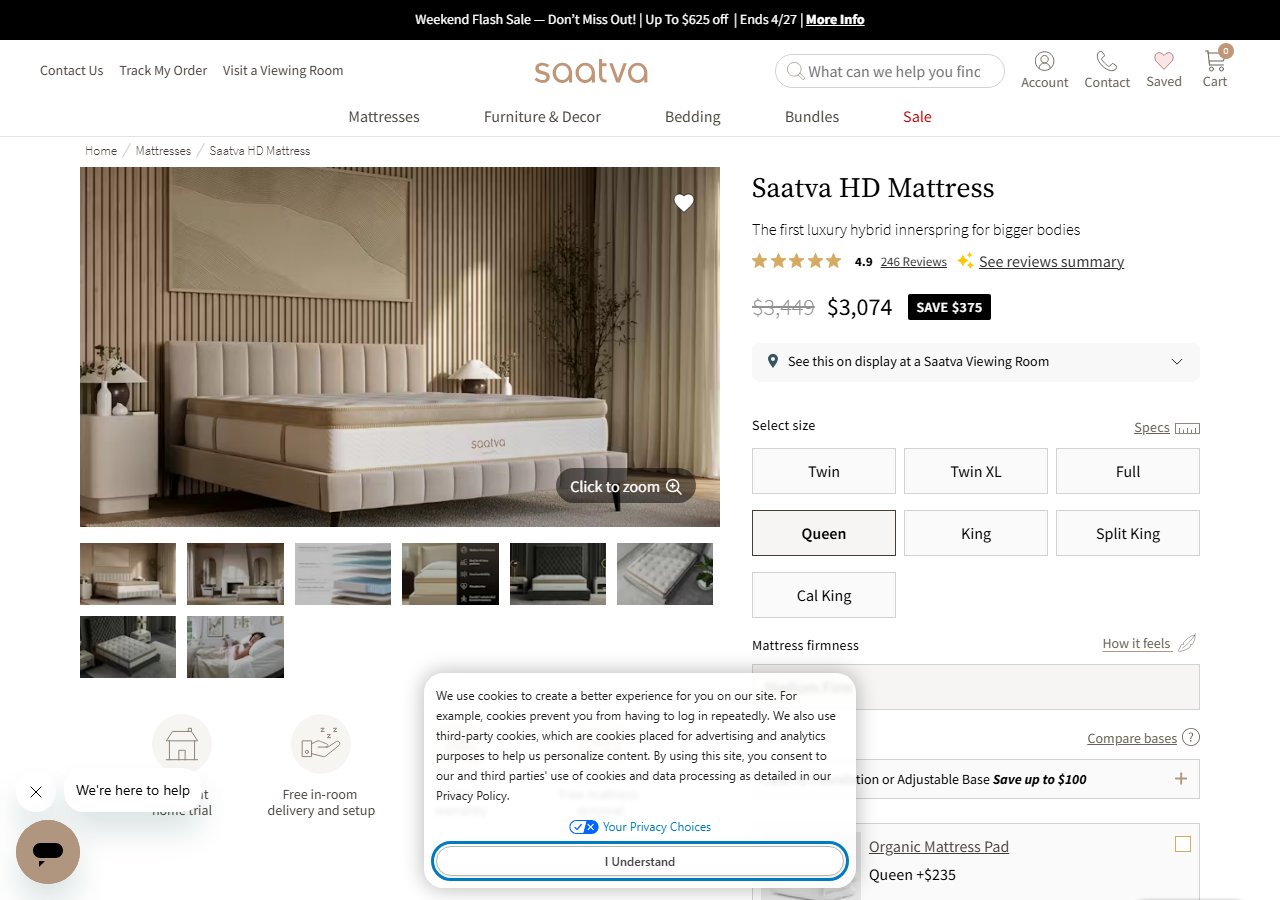
Saatva HD Mattress (Heavy-Duty)
$2,395-$3,995
See Price at Saatva →
Purple Hybrid Premier Mattress
$2,499-$4,799
See Price at Purple →The Bottom Line: Data First, Products Second
The federal data picture for adults over 60 managing joint pain and disrupted sleep is sobering: 25% arthritis prevalence, 35% sleeping under the recommended 7-hour threshold, chronic back pain as both the most common pain complaint and one of the most expensive conditions in U.S. healthcare. These numbers reflect real people in real pain — and the commercial ecosystem has learned to respond to that pain with product marketing rather than mechanism-first guidance.
This article has tried to do the opposite. The biomechanical mechanism — joint-space narrowing, pressure-point concentration, sleep fragmentation, blunted recovery — comes first, because without understanding it, you cannot make a rational purchase decision. The free interventions — sleep position, daily walking, mattress age evaluation, movement mechanics — come second, because they address the mechanism at lower cost and higher leverage than any product. Clinical red flags come third, because some symptoms require a clinician before any surface decision is appropriate. And products come last: specific, well-engineered options for readers who have moved through the earlier layers and still need a better sleep surface.
If that is you — if you have side-corrected, walked, replaced an aging mattress, and still wake stiff — the Loom & Leaf, Saatva HD, or Purple Hybrid Premier each address a specific variant of the pressure-load problem your joints are generating. Pick the one whose engineering matches your sleep position and body type. Then keep walking.