The Compounding Crisis: Arthritis, Aging, and Lost Sleep
Here is the federal data reality for Americans over 60: CDC arthritis surveillance shows approximately 25% of U.S. adults have doctor-diagnosed arthritis — a figure that climbs steeply with age and is disproportionately represented in people who spent decades in physically demanding occupations. Simultaneously, CDC sleep data documents that roughly 35% of U.S. adults sleep fewer than 7 hours per night, the threshold below which chronic disease risk measurably increases. For adults over 60, both statistics are often lived simultaneously — not as separate problems, but as a single, self-reinforcing feedback loop.
Joint pain interrupts sleep. Fragmented sleep reduces the body's capacity to regulate inflammatory cytokines — the signaling proteins that modulate pain sensitivity. Higher overnight pain sensitivity means more sleep disruption the following night. Over months and years, this loop erodes functional capacity, accelerates musculoskeletal deterioration, and drives up healthcare costs that AHRQ HCUP data already identifies as among the most expensive in the U.S. healthcare system. Back pain alone ranks as one of the costliest conditions by combined inpatient and outpatient spending.
The downstream economic toll is significant. SSA Disability Insurance reports identify musculoskeletal disorders as the single largest category of new disability claims filed annually — not heart disease, not cancer. And CMS drug spending data confirms that opioid and non-opioid pain medications are among the most expensive Medicare drug categories, reflecting how many older adults are managing chronic joint and back pain with pharmacological tools that carry their own serious risks. These are not abstract statistics for readers over 60 — they are the population this data describes.
Why Sleep Gets Harder to Protect After 60
Understanding why arthritis disrupts sleep requires a brief look at the biomechanical and physiological changes that accumulate across a working lifetime. The cartilage that cushions joint surfaces — in the hips, knees, shoulders, and spine — undergoes gradual degradation with age and cumulative mechanical load. NIOSH Lifting Equation research has documented that manual material-handling tasks across warehousing, construction, and healthcare routinely exceed safe spinal loading limits — meaning millions of adults entering their 60s have spent decades compressing intervertebral discs and loading facet joints beyond recommended thresholds.
The result in the bedroom is predictable. Arthritic hips and knees create pressure-point pain when the body rests against a firm surface without adequate contouring. The spine, particularly in people with degenerative disc changes, loses its ability to self-correct during sleep; it depends on the sleeping surface to maintain a neutral lumbar curve throughout the night. When the surface is too firm, bony prominences at the shoulder and hip create pain that wakes the sleeper. When it is too soft, the spine sinks into flexion — a position that loads the posterior elements of lumbar vertebrae and can trigger morning stiffness that takes hours to resolve.
CDC NCHS Data Brief 390 reports that approximately 20% of U.S. adults experience chronic pain, with the lower back as the most common site. For adults over 60 with arthritis, chronic back pain and joint pain often coexist, meaning the sleep surface must solve for multiple simultaneous pressure-relief challenges — not just one.
The sleep architecture changes that come with normal aging compound the problem further. Older adults spend more time in lighter sleep stages and less time in slow-wave (deep) sleep, the phase most associated with physical restoration and inflammatory regulation. A sleep surface that creates even modest discomfort in younger adults can fully shatter the fragile deep-sleep windows that older adults have access to. What reads as minor inconvenience at 35 is a serious health variable at 65.
How a Lifetime of Work Loads the Body
Many adults over 60 arrive at retirement carrying the accumulated load of physically demanding careers. The BLS Musculoskeletal Disorders by Occupation data consistently shows the back as the most commonly injured body part across all U.S. occupations resulting in days away from work. Healthcare workers, construction laborers, warehouse workers, and agricultural workers spend decades in postures and under loads that the spine was not designed to sustain for 8-to-12-hour shifts. Even white-collar workers accumulate hip flexor tightening, lumbar deconditioning, and thoracic kyphosis from decades of sustained seated posture.
AHRQ Medical Expenditure Panel Survey data shows that average annual personal healthcare expenditures for adults with chronic back conditions substantially exceed costs for those without — and the gap widens with age. Adults over 60 managing arthritis and chronic back pain are not just sleeping worse; they are spending significantly more out of pocket and through Medicare to manage the pain that poor sleep perpetuates.
The practical implication: for this reader, the sleep surface is not a luxury purchase. It is a functional health variable sitting at the intersection of joint health, pain management, sleep quality, and healthcare cost. But it is also only one variable — and not always the most important one.
Try These First: Free Interventions That Federal Research Supports
The cheapest intervention is the one that requires no purchase at all. Before evaluating any sleep surface, every adult over 60 with joint pain and disrupted sleep should audit the free variables that federal health agencies have documented as effective. A new mattress layered on top of poor sleep position, sedentary days, and unresolved clinical issues will underperform every time.
Sleep position is the single largest free variable most people overlook. NIH guidance on back pain specifically recommends side-sleeping with a pillow between the knees or back-sleeping with a pillow under the knees — both positions maintain the spine in neutral alignment and reduce loading on arthritic facet joints and hips. Stomach-sleeping, by contrast, forces the cervical spine into rotation and hyperextends the lumbar spine throughout the night, consistently worsening chronic back and neck pain. Changing sleep position costs nothing and frequently reduces morning stiffness within days.
Daily walking is the movement intervention with the strongest evidence base for chronic low back pain. NIH NCCIH's evidence review on low back pain found that walking 30 minutes most days reduces chronic low back pain as effectively as most non-drug clinical treatments. This is a remarkable finding that is still underutilized: for many older adults, the morning stiffness and nighttime back pain they attribute to their mattress would respond equally well — or better — to a consistent daily walk. Joint lubrication, inflammatory cytokine regulation, and core muscular endurance all improve with low-impact aerobic movement.
Mattress replacement timing deserves honest evaluation before any purchase decision. CDC sleep hygiene guidance and clinical consensus suggest replacing a mattress if it shows visible sag, if you consistently wake stiffer than you went to bed, or if the mattress is older than 7 to 10 years. If none of those criteria are met, the existing sleep surface may not be the primary driver of disrupted sleep — and upgrading it will not resolve the problem.
For readers who have already optimized sleep position, walk consistently, and are sleeping on a mattress that fails the above criteria — or who have been through physical therapy and still wake up in joint pain — the evidence does support evaluating the sleep surface itself. This is where engineering matters: pressure distribution, zonal support, and material response time all have measurable effects on how well an arthritic body recovers overnight.
When to See a Clinician Before Buying Anything
There is a category of joint and back pain that no sleep surface will address — because the underlying cause requires clinical evaluation, imaging, or intervention. NIH National Institute of Neurological Disorders and Stroke provides clear guidance on red flags that should prompt a clinician visit before any other decision. Adults over 60 face elevated risk for several conditions — spinal stenosis, compression fractures, and referred pain from abdominal or pelvic pathology — that can present as back or joint pain but have nothing to do with sleep surface mechanics.
Do not buy a new mattress if your back pain radiates below the knee, if it followed a fall or trauma, if it comes with leg weakness or numbness, if you have experienced any bowel or bladder changes, or if it is accompanied by fever or unexplained weight loss. These are clinical red flags that warrant imaging and referral, not a new purchase. For the typical older adult with familiar, chronic arthritis-related joint pain and morning stiffness — particularly pain that worsens with inactivity and improves somewhat with gentle movement — a sleep surface evaluation is appropriate.
Where the Right Sleep Surface Fits In
For adults over 60 with arthritis or chronic back pain who have ruled out clinical red flags and optimized their free variables, the sleep surface becomes a meaningful therapeutic tool. The engineering criteria for this reader are specific: pressure relief at the shoulder and hip (the primary pain-generating contact points for side sleepers with arthritis), zonal lumbar support that maintains spinal curvature without creating a pressure ridge, and response characteristics that allow position changes without requiring significant muscular effort — because arthritic joints make the leverage-and-roll motion of changing sleep positions genuinely painful on a mattress that grips too aggressively.
For readers dealing with serious, documented back pain and joint inflammation, the Saatva Loom & Leaf Memory Foam Mattress is the premium memory foam option engineered specifically for this use case. Its gel-infused memory foam construction delivers the slow-pressure-equalizing response that distributes load away from arthritic hips and shoulders, while its lumbar zone enhancement — a denser support layer built into the center third of the mattress — counteracts the spinal sag that soft foam surfaces often produce under the heavier midsection. At a $1,695–$3,295 price range, this is not a casual purchase, but for an older adult spending measurably more on healthcare per year due to chronic back pain (per AHRQ MEPS data), the math on preventive sleep quality investment deserves honest consideration.
Adults over 60 who are larger-framed, heavier, or who carry the accumulated musculoskeletal load of physically demanding careers — think retired warehouse workers, construction laborers, or long-career healthcare workers whose joints have absorbed decades of NIOSH-documented overload — face an additional engineering problem: standard mattresses compress fully under higher body weight, eliminating the pressure relief and lumbar support they were designed to provide. The Saatva HD Mattress addresses this with a reinforced coil system and higher-density foam construction designed to maintain support curves at higher load levels. Its weight accommodation extends to 500 lbs per side, and the surface contouring is calibrated to remain pressure-relieving rather than bottoming out.
For older adults whose primary complaint is not just back pain but widespread joint sensitivity — arthritis in the hips, shoulders, and knees simultaneously — the Purple Hybrid Premier Mattress offers a fundamentally different pressure-distribution mechanism. Purple's GelFlex Grid technology distributes pressure laterally rather than building it at contact points, which makes it particularly effective for multi-joint arthritis patients who find that traditional foam surfaces create painful pressure ridges even when the mattress is relatively new. The coil layer underneath the grid provides the motion isolation and edge support that older adults need when getting in and out of bed — a motion that is often the most painful part of the night for arthritic knees and hips.
Sleep Surfaces Engineered for Arthritic Joints and Aging Spines
These three mattresses were selected specifically for adults over 60 managing arthritis, chronic back pain, or joint sensitivity — evaluated on pressure relief, lumbar support geometry, and load-appropriate construction rather than general comfort metrics.

Saatva Loom & Leaf Memory Foam Mattress
$1,695-$3,295
See Price at Saatva →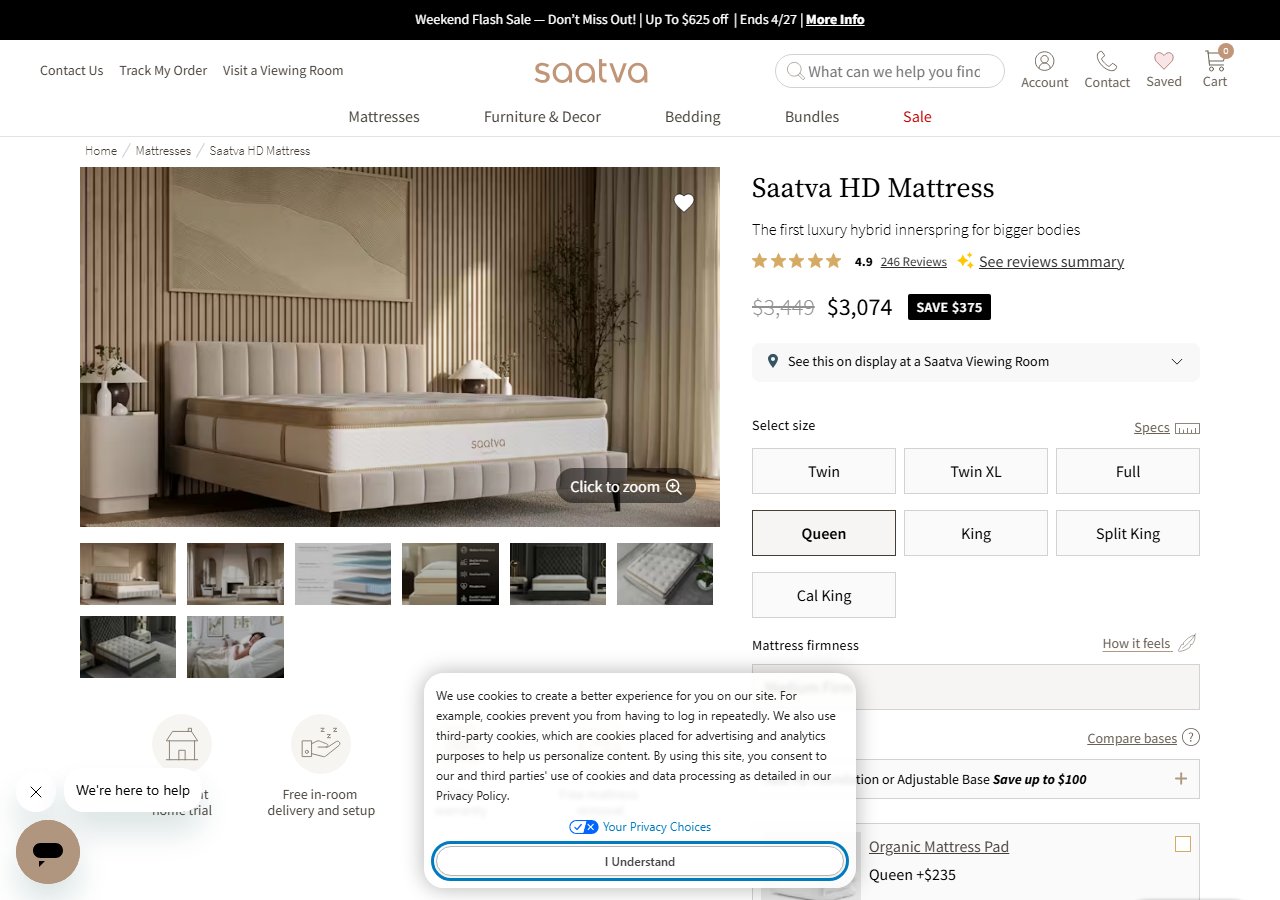
Saatva HD Mattress (Heavy-Duty)
$2,395-$3,995
See Price at Saatva →
Purple Hybrid Premier Mattress
$2,499-$4,799
See Price at Purple →The Evidence-Anchored Summary
The federal data on older adult joint pain and sleep is consistent and alarming: arthritis affects one in four U.S. adults, chronic pain affects one in five, musculoskeletal disorders are the leading cause of disability claims, and the back is the most commonly injured body part across all working occupations. For adults over 60, these statistics converge into a nightly reality — joint pain disrupts sleep, poor sleep amplifies pain, and the healthcare costs of managing the cycle are substantial.
The evidence-supported response to that reality runs in a specific order. Optimize sleep position first — it costs nothing and has direct NIH-documented support. Build consistent daily walking — the NCCIH evidence base for this rivals most clinical interventions. Evaluate whether your current mattress actually meets replacement criteria before spending thousands on a new one. See a clinician if any of the documented red flags are present. And when the surface itself is genuinely the limiting factor — as it often is for older adults sleeping on decade-old mattresses that have lost their support geometry — choose based on engineering criteria specific to your pain pattern: pressure relief for arthritic joints, lumbar zone support for back pain, and load-appropriate construction for larger frames.
The Saatva Loom & Leaf, Saatva HD, and Purple Hybrid Premier each address different versions of that same underlying problem. None of them replaces movement, clinical care, or proper sleep positioning. All of them are meaningfully better than a mattress that has collapsed into sag and is actively worsening the joint pain it should be relieving.
For a population that CMS data shows is already spending heavily on pain medication to manage what better sleep architecture might partially address, the hierarchy of interventions matters. Start free. Move up the chain only when free variables are exhausted. And when you do invest in equipment, buy based on mechanism — not marketing.