Joint Pain Doesn't Stop When You Lie Down — Federal Data Shows Why
If you are over 60 and lying awake at 2 a.m. because your hips, knees, or lower back are radiating discomfort into the mattress, you are not alone and you are not imagining it. CDC arthritis surveillance data documents that approximately 25% of U.S. adults carry a doctor-diagnosed arthritis diagnosis, and that figure climbs steeply after age 60, with prevalence concentrated in people who spent their working decades in physically demanding occupations — manufacturing, construction, healthcare, agriculture, and warehousing. Meanwhile, CDC sleep data shows that 35% of all U.S. adults sleep fewer than 7 hours per night, the threshold the CDC associates with elevated chronic disease risk. For older adults managing arthritis, joint degeneration, or chronic spinal pain, these two statistics are not independent. They are mechanistically linked.
The economic weight of this problem is immense. AHRQ HCUP data identifies back pain as one of the most expensive conditions in U.S. healthcare by total inpatient and outpatient cost. AHRQ Medical Expenditure Panel Survey (MEPS) data shows that adults with chronic back conditions carry substantially higher average annual personal healthcare expenditures than those without. And CMS Drug Spending Dashboard data confirms that pain medications — opioid and non-opioid alike — represent some of the most expensive Medicare drug spending categories, a direct reflection of how many older Americans are managing pain pharmacologically every single day. This is a public health problem at scale, not a niche concern.
Why Joint Pain Gets Worse at Night: The Biomechanical and Physiological Mechanism
Understanding why nighttime pain intensifies after 60 requires a short detour into physiology. During the day, movement keeps synovial fluid circulating through joint capsules, which lubricates cartilage surfaces and temporarily offloads inflammatory cytokines. When you lie still for hours, that circulation slows. Inflammatory mediators — including interleukins and tumor necrosis factor — accumulate in joint spaces, producing the classic morning stiffness that arthritis patients describe as "rusting up" overnight.
At the same time, spinal loading changes dramatically with age. The intervertebral discs that cushion lumbar vertebrae lose hydration and height across the decades, a process accelerated by a lifetime of work that may have involved lifting, twisting, or sustained static postures. CDC NCHS Data Brief 390 documents that approximately 20% of U.S. adults experience chronic pain, with lower back as the single most common pain location. For older adults, that statistic reflects cumulative disc compression, facet joint arthritis, and lumbar stenosis — conditions that the horizontal sleeping position does not automatically relieve, and can actually aggravate if the sleep surface fails to maintain spinal alignment.
The NIOSH Lifting Equation was developed precisely because research showed that manual material-handling tasks across warehousing, construction, and healthcare routinely exceed safe spinal loading limits — and many of today's adults over 60 spent 30-plus years in those occupations. The structural damage from decades of overloaded spinal mechanics does not disappear at retirement. It arrives in your bedroom as nighttime pain, morning stiffness, and interrupted sleep. BLS Musculoskeletal Disorder by Occupation tracking confirms that the back is the most common injured body part across all U.S. occupations with days away from work — meaning the population most likely to have arthritis and chronic spinal issues is also the population most likely to have accumulated significant occupational wear before age 60.
The sleep disruption itself accelerates the problem. Sleep is when the body performs tissue repair, including cartilage metabolism and intervertebral disc rehydration (discs absorb fluid nocturnally when unloaded in the horizontal position). Fragmented sleep from pain interrupts these processes. The result is a vicious cycle: pain disrupts sleep, disrupted sleep impairs tissue repair, impaired repair worsens pain. SSA Disability Insurance data identifies musculoskeletal disorders as the largest single category of new disability claims annually — a downstream consequence of exactly this escalation pathway going untreated over years.
The Pressure-Relief Problem Is Specific to Older Adults
Younger adults with back pain still have good subcutaneous tissue padding over bony prominences — the hips, shoulders, sacrum, and greater trochanters. Older adults typically do not. Body composition shifts with age toward less muscle mass and subcutaneous fat over pressure points, meaning the same mattress that felt neutral at 45 can feel like sleeping on a hard floor at 65. The hips sink unevenly, the lumbar spine loses support, or the shoulder creates a lateral flexion angle that produces neck and thoracic pain by morning.
For side sleepers — which most pain-management guidelines favor — this is particularly consequential. A surface that is too firm creates pressure point loading at the hip and shoulder. A surface that is too soft allows the hip to sink so deeply that the lumbar spine falls out of alignment. For back sleepers with lumbar stenosis or facet joint arthritis, a surface that fails to maintain the natural lumbar lordosis forces the spine into flexion or hyperextension, both of which compress symptomatic structures. There is no single "correct" firmness; the right answer depends on body weight, sleep position, and the specific joints involved.
Try These First — Free and Low-Cost Interventions Before Any Purchase
The cheapest intervention is the one that does not require buying anything. Before evaluating any sleep surface, federal health agencies recommend a set of behavioral and postural interventions that address the root mechanisms of nighttime joint pain. These interventions are evidence-based, cost nothing or nearly nothing, and should be your first line of action regardless of what you eventually decide about equipment.
Sleep position is the largest free variable. NIH guidance on back pain from the National Institute of Arthritis and Musculoskeletal and Skin Diseases recommends side-sleeping with a pillow between the knees, or back-sleeping with a pillow under the knees, to keep the spine in a neutral posture. Both positions offload facet joints and reduce lumbar compressive forces compared to stomach-sleeping, which torques the lumbar spine and is consistently associated with worsening chronic spinal pain. A standard bed pillow repositioned between or under the knees costs nothing if you already own one.
Daily walking is more effective than most passive interventions. NIH National Center for Complementary and Integrative Health evidence review on low-back pain finds that walking 30 minutes on most days reduces chronic low-back pain outcomes as effectively as most non-drug clinical treatments. Walking keeps synovial fluid in circulation, maintains muscle support around degenerated joints, and promotes the disc rehydration that nighttime rest is supposed to complete. A new mattress may optimize your horizontal hours; walking optimizes your vertical hours, which are far more numerous.
Evaluate your current mattress before replacing it. CDC sleep hygiene guidance and clinical consensus recommend replacing a mattress if it shows visible sagging, if you consistently wake stiffer than you went to bed, or if it is older than 7 to 10 years. An old, sagging mattress is a legitimate pain driver. But even the most precisely engineered new mattress does not compensate for poor sleep hygiene, sedentary days, or untreated inflammatory disease.
Lifting and bending mechanics matter even in retirement. If you are still gardening, doing home maintenance, or handling loads of any kind, OSHA ergonomics guidance recommends hinging at the hips rather than the lumbar spine, keeping loads close to the body, and eliminating twisting under load. Most acute back episodes that interrupt sleep are mechanical and triggered by a specific movement pattern. Correcting the movement reduces the acute insult that then disrupts nighttime recovery.
If you have applied sleep position changes, incorporated regular walking, addressed your current mattress age, and still wake with significant joint pain, the next question is whether your sleep surface is contributing to the problem — and whether clinical evaluation has ruled out conditions that no mattress can treat.
When to See a Clinician First
Not all nighttime joint pain is addressable through sleep surface optimization. NIH National Institute of Neurological Disorders and Stroke back pain guidance is explicit: certain symptom patterns require prompt clinical evaluation and imaging before any conservative self-management approach — including mattress changes — should be pursued. Older adults are at elevated risk for several of these conditions precisely because of age-related skeletal changes.
Spinal stenosis, vertebral compression fractures (which can occur with minimal trauma in adults with osteoporosis), and inflammatory arthritis affecting the axial skeleton can all present as nighttime back or joint pain that progressively worsens. Treating these with a new mattress is at best futile and at worst a delay that worsens outcomes. The cost burden of under-treated spinal conditions is already enormous — AHRQ HCUP data documents back pain as among the most expensive inpatient and outpatient conditions in U.S. healthcare, and much of that cost reflects conditions that escalated before receiving appropriate evaluation.
Where Sleep Surface Design Intersects With Arthritis and Spinal Health
Once red flags are excluded and free interventions have been applied, sleep surface selection becomes a legitimate consideration for adults over 60 managing arthritis or chronic spinal pain. The relevant engineering factors are zoned pressure relief, edge support (critical for older adults who use the bed edge to stand), motion isolation (relevant for couples where one partner's movement causes pain-triggering micro-awakenings), and off-gassing or temperature regulation (older adults are more sensitive to heat, which can exacerbate inflammatory joint pain).
Memory foam offers the strongest conforming pressure relief for hip and shoulder loading, but traditional high-density memory foams retain heat. Hybrid construction — pocketed coils beneath a comfort foam or gel layer — tends to provide better temperature neutrality and edge support while retaining meaningful pressure relief. Zoned support systems, which vary firmness by body region, address the specific biomechanical mismatch of pressure-point relief at the shoulder while maintaining lumbar support — exactly what older side sleepers and back sleepers with lumbar arthritis need.
For older adults who spent working decades in heavy physical occupations, body weight and structural joint changes may require a mattress engineered for higher weight distribution. For those managing primarily shoulder and hip pressure pain from arthritis, a premium conforming foam system is often the priority. For those whose primary issue is spinal alignment during side sleeping, a hybrid with zoned coils tends to perform better than an all-foam option.
The Direct Brand Recommendations
The Saatva Loom & Leaf Memory Foam Mattress is our primary recommendation for older adults with serious arthritis-driven pressure pain. Saatva constructs the Loom & Leaf with a layered high-density memory foam system topped with gel-infused foam for temperature regulation — addressing the heat retention problem that makes traditional memory foam unsuitable for many older adults. The Loom & Leaf is available in Relaxed Firm and Firm configurations; for most adults over 60 sleeping on their side or back with hip or shoulder arthritis, the Relaxed Firm provides the pressure conformance without the excessive sink that disrupts lumbar alignment. At $1,695–$3,295 depending on size, it occupies the premium tier — but the AHRQ MEPS data on chronic-pain healthcare expenditures makes the cost-comparison case plainly: adults with undertreated chronic back conditions spend substantially more on healthcare annually than those without.
For older adults who spent careers in warehousing, construction, or other high-MSD occupations — and who may carry higher body weight or more severe structural joint changes as a result — the Saatva HD Mattress is engineered specifically for higher weight distribution. The HD uses a dual steel coil system with reinforced lumbar support and a high-density foam comfort layer, providing the edge support and central support geometry that heavier frames require for spinal alignment. For a 70-year-old former warehouse worker whose back was documented in the BLS injury data decade after decade, and who now lies awake with lumbar or sacral pain, the HD's construction logic aligns directly with those biomechanical realities. Price runs $2,395–$3,995.
For older adults whose primary sleep disruption is pressure pain at the hips and shoulders — common in side sleepers with osteoarthritis — the Purple Hybrid Premier Mattress offers a distinct engineering approach. Purple's GelFlex Grid is a hyper-elastic polymer grid that collapses under pressure points while remaining firm under the lumbar and thoracic spine. This is not foam conformance; it is a structurally different pressure-relief mechanism that many arthritis patients find superior to memory foam because it does not retain heat and does not create the "stuck" sensation that some older adults find difficult to move through during nighttime repositioning. At $2,499–$4,799, it is the highest price point in this list — justified for adults whose primary complaint is pressure-driven joint pain that standard foam options have failed to relieve.
Mattresses Engineered for Arthritis Pressure Relief and Aging Joints
Each of the three mattresses below was selected specifically for older adults managing arthritis, chronic spinal pain, or occupational joint wear — evaluated on pressure relief at bony prominences, lumbar alignment support, edge support for egress, and temperature regulation.

Saatva Loom & Leaf Memory Foam Mattress
$1,695-$3,295
See Price at Saatva →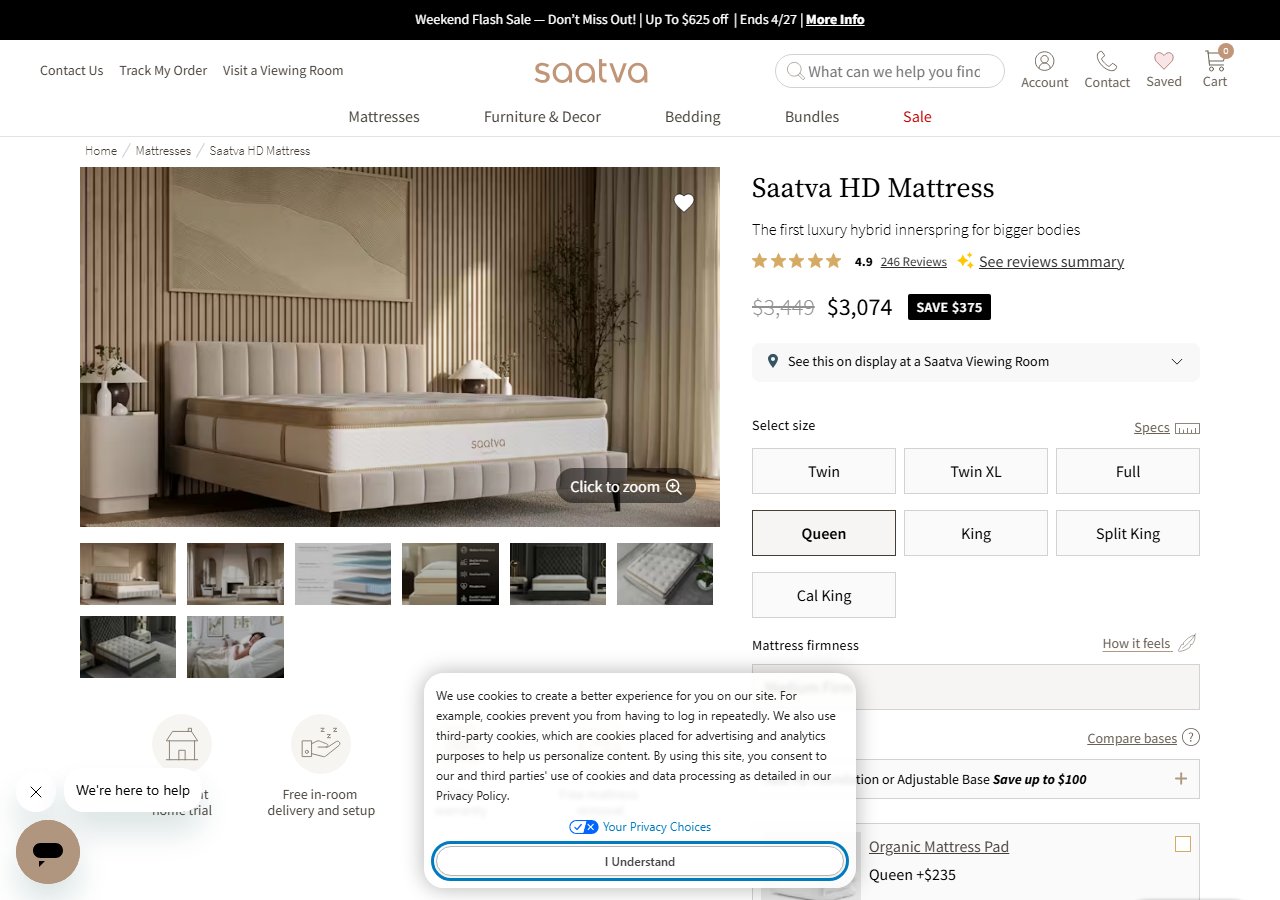
Saatva HD Mattress (Heavy-Duty)
$2,395-$3,995
See Price at Saatva →
Purple Hybrid Premier Mattress
$2,499-$4,799
See Price at Purple →Putting the Federal Data Into a Decision Framework
The evidence assembled from CDC, NIH, AHRQ, SSA, CMS, and BLS points to a consistent hierarchy for adults over 60 managing joint pain that disrupts sleep. Movement — specifically regular walking — is the highest-leverage intervention and is supported by NIH NCCIH evidence review as equivalent to most non-drug clinical treatments for chronic low-back pain. Sleep position mechanics are the second intervention, free, and directly addressable with a repositioned pillow. Mattress evaluation should follow an honest assessment of your current surface's age and condition. Clinical evaluation should occur before any of the above if red flags are present.
When a sleep surface does become part of the solution, the selection logic should be driven by your primary pain mechanism: pressure pain at bony prominences, lumbar alignment failure, heat sensitivity, or structural joint changes from decades of physically demanding work. Each of those mechanisms maps to different construction features, and each of the three mattresses reviewed here addresses a distinct point on that map.
The CDC arthritis data makes the scale of this problem undeniable: one in four American adults is living with diagnosed arthritis, and the majority are sleeping on a surface that was never evaluated against their specific joint loading pattern. The CMS drug spending data shows what happens when pain goes unaddressed: Medicare drug spending on pain medication is among the highest in the entire formulary. Investing in the behavioral, clinical, and — where appropriate — equipment-based interventions that address root sleep mechanics is not a luxury decision for older adults. It is a health-economics decision with federal data behind it.