The Federal Data Picture: Why Older Adults Are Sleeping Worse Than They Should
CDC sleep data shows approximately 35% of U.S. adults report sleeping fewer than 7 hours per night — the threshold below which chronic disease risk climbs measurably. That number would be alarming on its own. But for adults over 60, it understates the problem, because the quality of those hours — not just the quantity — deteriorates in ways that are directly tied to joint health, cartilage degradation, and the biomechanics of aging bodies on inadequate sleep surfaces.
CDC arthritis surveillance finds that approximately 25% of U.S. adults report doctor-diagnosed arthritis, and the prevalence is not evenly distributed across age groups. It skews heavily toward adults over 55. Osteoarthritis — the wear-and-tear variant most common after 60 — attacks the cartilage of the hips, knees, and lumbar spine, the exact joints that bear compressive load during sleep. When those joints are already inflamed and cartilage is thinning, every hour spent on a surface that fails to offload pressure translates directly into pain, stiffness, and microarousals that fragment sleep architecture.
This is not a niche problem for a small segment of the population. CDC NCHS Data Brief 390 documents that approximately 20% of U.S. adults live with chronic pain, with lower back pain as the single most common pain location. Among adults over 60, that figure climbs. The downstream costs are staggering: AHRQ HCUP data identifies back pain as one of the most expensive conditions in U.S. healthcare by combined inpatient and outpatient cost. AHRQ MEPS data shows that average annual personal healthcare expenditures for adults with chronic back conditions substantially exceed those without — a financial burden that compounds on fixed retirement incomes. And CMS drug spending data identifies opioid and non-opioid pain medications among the most expensive Medicare drug categories, reflecting how many older Americans are medicating pain that begins, in part, each night on the wrong sleep surface.
The federal data converges on a single conclusion: musculoskeletal pain in older adults is a public health emergency with significant sleep consequences. SSA Disability Insurance reports identify musculoskeletal disorders as the single largest category of new disability claims filed annually. That is lifetime earning and independence lost — outcomes that begin with untreated overnight joint loading.
Why This Happens: The Biomechanics of Aging Joints During Sleep
To understand why sleep surface matters so much after 60, you need to understand what happens to the musculoskeletal system as it ages — and what happens to it specifically during the 7 to 9 hours it spends on a mattress.
Cartilage does not regenerate. Articular cartilage — the smooth, shock-absorbing tissue covering joint surfaces — has no direct blood supply and extremely limited self-repair capacity. Once osteoarthritis strips it away in the hips, knees, or lumbar facet joints, the underlying bone becomes the load-bearing surface. Bone-on-bone contact during sleep, when the body is supposed to be recovering, creates inflammatory responses that manifest as morning stiffness, joint swelling, and the characteristic first-step pain that millions of older Americans know well.
Spinal discs lose hydration. Intervertebral discs are largely water. Throughout a lifetime of loading — standing, sitting, lifting — they lose hydration progressively. By the seventh decade of life, disc height is measurably reduced in most adults. This narrows the space between vertebrae, compresses facet joints, and reduces the spine's natural ability to absorb shock. The NIOSH Lifting Equation documents how manual material handling routinely exceeds safe spinal loading limits — but the cumulative spinal load from decades of occupational work does not disappear at retirement. It manifests as the structural vulnerabilities that make sleep surface firmness so consequential in the sixth, seventh, and eighth decades.
Pressure sensitivity increases with age. Subcutaneous fat — the layer of padding between skin and bone — thins with age. This is why bony prominences like the greater trochanter of the hip, the shoulder acromion, and the lateral knee become pressure points on sleep surfaces that a 35-year-old would not notice. A surface that is too firm for an older body creates sustained pressure on these points, triggering microarousals — brief conscious arousals that fragment sleep stages without the sleeper remembering them — that explain why many older adults report waking exhausted despite spending 8 hours in bed.
Inflammatory joint conditions worsen with immobility. Both osteoarthritis and rheumatoid arthritis are worsened by prolonged static positioning. The synovial fluid that lubricates joints circulates through movement. Extended periods of stillness — like sleeping — allow inflammatory byproducts to pool in joint capsules, producing the characteristic morning stiffness that peaks roughly 20 to 45 minutes after waking. A sleep surface that encourages frequent position changes without causing pain during those transitions is doing meaningful biomechanical work.
The cumulative occupational load. Many adults over 60 spent decades in physically demanding work. BLS MSD by Occupation tracking shows the back is the most commonly injured body part across all U.S. occupations with days away from work. Former construction workers, nurses, warehouse workers, and agricultural laborers carry the structural consequences of that loading into retirement. Their spines and hips are not the same as those of office workers the same age. Their sleep surface requirements reflect that history.
The Cheapest Intervention Is the One That Doesn't Require Buying Anything
Before evaluating any product, older adults with joint pain should exhaust the evidence-based, zero-cost interventions that federal health agencies have validated. A new mattress cannot undo poor sleep position, sedentary days, or mechanical lifting habits. These interventions come first — not as a disclaimer, but because the federal data supporting them is often stronger than the data supporting any specific product.
Sleep position is the most powerful free variable you have. NIH guidance on back pain is explicit: side-sleeping with a pillow between the knees keeps the pelvis level and prevents the top hip from rotating forward, which would torque the lumbar spine. Back-sleeping with a pillow under the knees reduces lumbar extension. Stomach-sleeping — still practiced by a significant minority of older adults — hyperextends the lumbar spine and rotates the cervical spine, both of which worsen chronic pain. Changing sleep position costs nothing and can produce measurable relief within days.
Daily walking is a clinical-grade intervention for chronic back pain. NIH NCCIH's evidence review on low-back pain finds that walking 30 minutes most days reduces chronic low-back pain as effectively as most non-drug clinical treatments. For older adults whose joints are stiff from sleep, a morning walk is not just good general health practice — it is a specific therapeutic intervention that circulates synovial fluid, reduces inflammatory cytokine levels, and activates the paraspinal muscles that support the lumbar spine during the next night's sleep.
Know when your mattress is actually the problem. CDC sleep hygiene guidance provides a practical checklist: if your mattress has visible sag (particularly in the hip zone), if you wake consistently stiffer than you went to bed, or if it is more than 7 to 10 years old, the surface itself is contributing to your pain. But replacing a mattress without addressing sleep position, daily movement, and weight management is unlikely to produce lasting improvement.
Learn body mechanics that protect aging joints. Even in retirement, older adults lift, bend, and carry. OSHA ergonomics guidance documents the correct mechanics: hinge at the hips rather than the lumbar spine, keep loads close to the body, avoid twisting under load. Most acute back episodes in older adults are mechanical — caused by a single poor-movement event on a spine that has accumulated decades of wear. Relearning these mechanics is free and measurably reduces injury risk.
For readers who have already addressed sleep position, daily movement, and mattress age — and who are still waking with joint pain — surface characteristics become legitimately important. The right firmness profile, pressure distribution, and temperature regulation can make a clinically meaningful difference for older adults with arthritis, reduced disc height, and thinning subcutaneous padding. The products below were selected based on those specific biomechanical requirements.
When to See a Clinician: Red Flags That Require More Than a Mattress
Not all back and joint pain in older adults is mechanical or sleep-surface related. NIH neurological disorders guidance is clear that certain symptom patterns require prompt clinical evaluation — and buying a new mattress for these presentations is not just insufficient, it delays necessary care.
For adults over 60, the threshold for seeking evaluation should be lower than for younger adults, because the differential diagnosis is broader. Spinal stenosis, compression fractures from osteoporosis, vertebral infection, and metastatic disease all present with back pain — and all are more prevalent in older populations. Pain that is severe, unrelenting, occurs at rest, or wakes you from sleep (as opposed to pain caused by sleep) warrants imaging and clinical evaluation, not a new mattress.
The combination of new-onset back pain with any neurological symptom — leg weakness, numbness, or tingling that extends below the knee — suggests nerve compression or cord compromise that requires urgent evaluation. Bowel or bladder dysfunction accompanying back pain is a surgical emergency. Fever with back pain raises the possibility of vertebral osteomyelitis. And any back pain following a fall or trauma in an older adult requires imaging to rule out compression fracture, particularly in women with osteoporosis, where fractures can occur without dramatic traumatic force.
Surface Characteristics That Matter for Arthritis and Pressure Relief After 60
With the intervention and clinical framework established, surface selection becomes a meaningful conversation. For older adults with arthritis and the biomechanical vulnerabilities described above, federal research and occupational health guidance point toward three surface characteristics that matter most: conforming pressure distribution, zoned support, and thermal regulation.
Conforming pressure distribution is the ability of a surface to contour closely to the body's shape, reducing peak pressure at bony prominences (hip, shoulder, knee) while maintaining enough support to prevent spinal misalignment. Memory foam and high-density latex accomplish this through viscoelastic or elastic deformation. A surface that does not conform pushes back against the greater trochanter or shoulder acromion with reactive force, creating the pressure-point pain and microarousals described earlier.
Zoned support addresses a specific biomechanical problem: the lumbar spine needs more support than the shoulders and hips, which need more contouring. A single-firmness surface makes this trade-off impossible — either the lumbar spine sags (too soft) or the shoulder and hip joints are over-pressured (too firm). Zoned construction solves this by using different foam densities or coil gauges under different body regions.
Thermal regulation matters because many older adults — particularly those on NSAIDs or other pain medications, or those with vascular changes associated with aging — are more sensitive to sleep temperature. Memory foam has historically retained heat; newer formulations with gel infusions, copper infusions, or open-cell structures have addressed this to varying degrees.
For older adults who spent careers in physically demanding work and carry the structural consequences of that loading, these surface requirements are not preferences — they are functional necessities.
The Saatva Loom & Leaf: Memory Foam Built for Serious Back Pain
The Saatva Loom & Leaf Memory Foam Mattress is the clearest direct match for older adults dealing with arthritis-driven pressure sensitivity combined with lumbar pain. Built from multiple layers of high-density memory foam with a gel-infused lumbar crown specifically positioned under the lumbar zone, it addresses the zoned support requirement directly. The top layer uses a temperature-regulating spinal gel panel — a direct response to the heat-retention problem that has historically made dense memory foam uncomfortable for older sleepers.
The Loom & Leaf comes in two firmness options: Relaxed Firm (a medium in most manufacturer scales) and Firm. For most older adults with hip and shoulder pressure sensitivity alongside lumbar pain, Relaxed Firm will be the correct choice — firm enough to prevent lumbar sag, conforming enough to reduce bony prominence pressure. At $1,695–$3,295 depending on size, it sits at the premium end of the memory foam market, but the construction quality — particularly the organic cotton cover, natural thistle flame barrier, and hand-tufted finish — reflects a product built for longevity, not the 3–5 year replacement cycle of budget foam.
The Saatva HD: For Larger Bodies With Joint Complications
Older adults who are larger-framed — or who gained weight during a less active retirement phase, a common pattern given that CDC data links obesity to accelerated osteoarthritis progression — face a specific surface problem that standard mattresses do not solve: they need conforming pressure relief while also needing structural support that does not compress under greater body weight. A mattress that tests as "medium firm" for a 160-pound person will sleep like a soft mattress for a 250-pound person, allowing the hips to sink through to the support core and creating the lumbar misalignment that drives morning pain.
The Saatva HD Mattress is engineered specifically for this body-weight loading scenario. It uses a dual-coil system — micro coils in the comfort layer over heavier-gauge support coils — that maintains progressive resistance under greater load. This means the mattress remains functionally supportive across a wider weight range without sacrificing surface conformity. At $2,395–$3,995, it is the highest-investment option in this list, but for larger-framed older adults whose weight is accelerating joint degeneration, the structural durability — Saatva rates it for extended use at higher weights — justifies the premium over standard mattresses that will develop hip-zone sag within 2–3 years.
The Purple Hybrid Premier: Pressure Relief Through Grid Technology
For older adults whose primary complaint is pressure-point pain rather than lumbar instability — particularly those with hip replacement hardware, significant knee osteoarthritis, or shoulder pathology that makes side-sleeping on conventional foam painful — the Purple Hybrid Premier offers a fundamentally different engineering approach. The GelFlex Grid — a hyper-elastic polymer structure — does not compress uniformly like foam. It collapses selectively under pressure points (shoulders, hips) while remaining firm under lower-pressure regions (the waist and lumbar zone), achieving zoned support through material physics rather than layered construction.
The thermal performance is also meaningfully different from foam: the open grid structure allows significant airflow, making it the best option among these three for older adults who sleep warm or who experience the vasomotor changes associated with aging or medication side effects. At $2,499–$4,799, it occupies the top of the price range, but the pressure-relief mechanism is genuinely distinct from both foam options and worth the evaluation for sleepers whose pressure sensitivity has made foam — even high-quality foam — uncomfortable.
Mattresses Engineered for Arthritis Pressure Relief and Aging Joints
These three mattresses were selected specifically for adults over 60 managing arthritis, lumbar degeneration, and pressure sensitivity — each addressing a distinct biomechanical need identified in the federal data above.

Saatva Loom & Leaf Memory Foam Mattress
$1,695-$3,295
See Price at Saatva →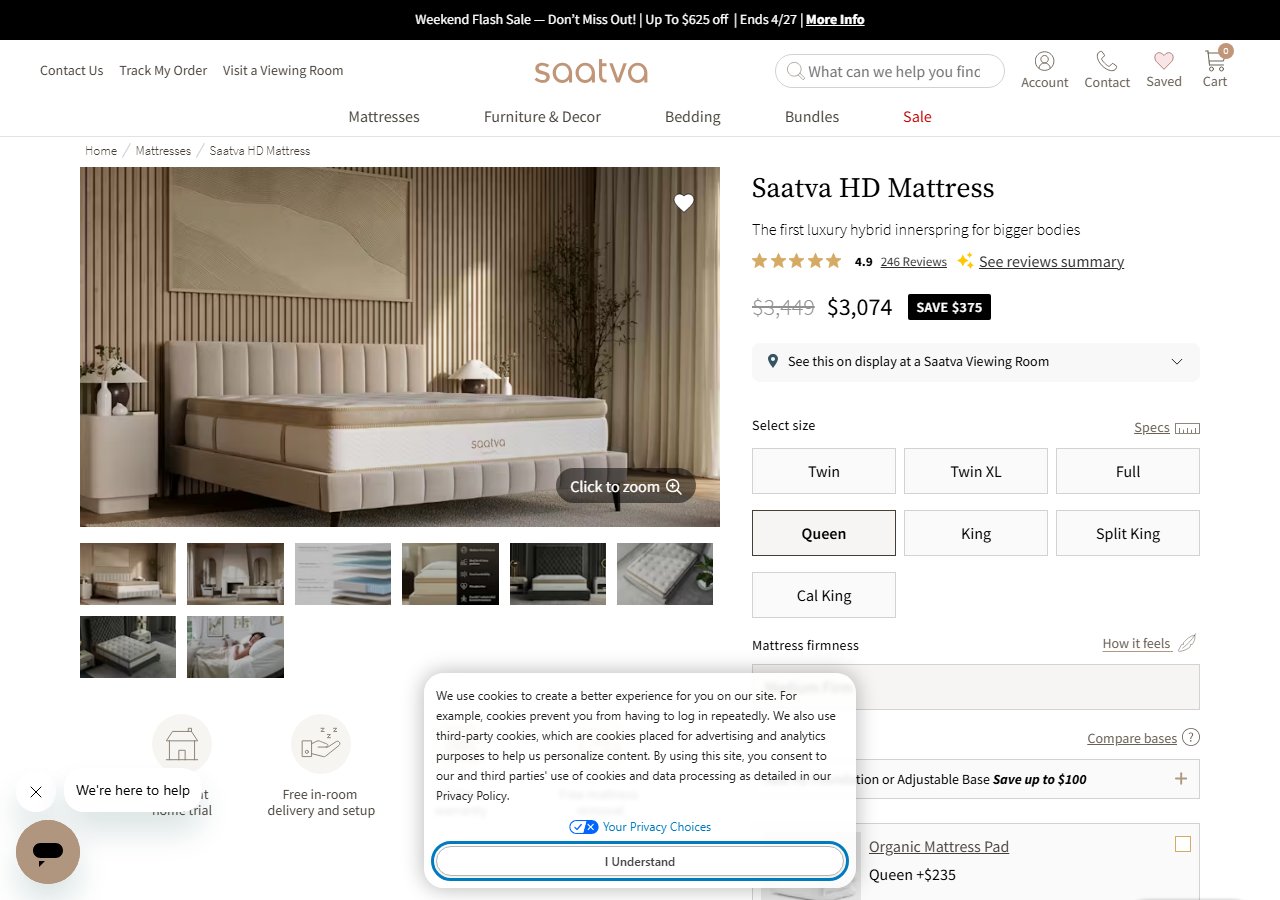
Saatva HD Mattress (Heavy-Duty)
$2,395-$3,995
See Price at Saatva →
Purple Hybrid Premier Mattress
$2,499-$4,799
See Price at Purple →Putting the Federal Data to Work: A Decision Framework for Older Adults
The federal data assembled here tells a consistent story: musculoskeletal pain in older adults is undertreated, drives massive healthcare spending, and has a meaningful sleep component that is often addressed last — after medications, procedures, and clinical interventions — despite being the most modifiable variable in many cases.
AHRQ MEPS data shows the financial burden of chronic back conditions falling disproportionately on individuals. CMS drug spending data reflects billions in annual pain medication costs for Medicare beneficiaries. SSA disability data shows musculoskeletal disorders as the leading driver of lost independence. Against that backdrop, the decision framework is clear:
Start with free interventions. Sleep position adjustment and daily walking are supported by NIH and NCCIH with evidence comparable to most pharmaceutical interventions. They cost nothing and have no side effects. Implement them first and give them 4–6 weeks.
Assess your current surface honestly. Visible sag, sleeping worse than you did five years ago on the same mattress, or a surface older than a decade are indicators that the surface itself is the problem. Replace it.
Match surface characteristics to your specific pathology. Pressure sensitivity from bony prominence thinning points toward conforming foam or grid technology (Loom & Leaf or Purple Hybrid Premier). Larger body weight requiring sustained structural support points toward the Saatva HD. Both conditions present simultaneously in many older adults — prioritize based on which symptom is more functionally limiting.
Know your red flags. Any neurological symptom, systemic symptom, or post-trauma back pain requires clinical evaluation before product research.
The $1,695–$4,799 investment range represented by these products is substantial. But positioned against the AHRQ-documented healthcare costs of undertreated back pain, and against the CDC's finding that inadequate sleep is independently associated with elevated chronic disease risk, the calculus shifts. A sleep surface that reduces overnight joint loading, improves sleep continuity, and reduces inflammatory morning stiffness is not a luxury purchase for an older adult with arthritis. It is a functional health intervention — one tool among several, but a legitimate one.