The federal numbers behind your back pain
If you weigh 250 pounds or more and your lower back hurts most mornings, you are not experiencing a personal failure of toughness. You are experiencing a collision between occupational physics and a healthcare system that has historically under-engineered solutions for larger bodies. Start with the data.
According to BLS Musculoskeletal Disorders by Occupation tracking, the back is the single most commonly injured body part across all U.S. occupations that result in days away from work. Not the shoulder. Not the knee. The back — year after year, industry after industry. And the costs cascade: BLS Employer Costs for Employee Compensation data shows that industries with high musculoskeletal disorder (MSD) incidence carry workers' compensation insurance rates 3–5 times higher than low-MSD industries. That is not a rounding error. That is an industry-wide signal that back injuries are structurally endemic to physical labor.
The NIOSH Lifting Equation — the federal standard for evaluating manual material handling — documents that tasks common to warehousing, construction, and healthcare routinely push workers past safe spinal compression thresholds. For a 250-pound worker, the biomechanical math shifts further: greater body mass means greater compressive force at the lumbar discs even during nominally "safe" lifts, because body weight itself contributes to axial load on the spine. A 130-pound nurse and a 280-pound warehouse associate performing the same patient transfer or box lift are not experiencing the same spinal event, even if OSHA logs them identically.
The population-level chronic pain picture is equally sobering. The CDC NCHS Data Brief 390 estimates that approximately 20% of U.S. adults — roughly 50 million people — live with chronic pain, and lower back pain is the most common pain location reported. Meanwhile, SSA Disability Insurance data identifies musculoskeletal disorders as the largest single category of new disability claims filed annually. The workers who file those claims are disproportionately in physical trades. They are disproportionately older. And epidemiological evidence consistently shows higher body mass index correlates with greater severity of lumbar disc degeneration and facet joint arthritis — conditions that CDC Arthritis data shows affect roughly 25% of U.S. adults, with prevalence concentrated in high-physical-demand occupations.
Why higher body weight makes the biomechanics worse — and harder to recover from
Understanding why this happens matters more than most people realize, because the mechanism determines which interventions actually work.
The lumbar spine — the lowest five vertebrae — bears compressive load in proportion to the weight above it plus any external loads being handled. During an upright standing position, the L4-L5 and L5-S1 disc levels already carry the majority of upper body mass. For a 260-pound person, that baseline compressive force at the lumbar discs is substantially higher than for someone weighing 160 pounds. Add a repetitive lifting task — say, unloading pallets or transferring a patient — and the NIOSH Lifting Equation tells us spinal compression regularly exceeds the 3,400-Newton action limit that defines elevated injury risk. For high-bodyweight individuals, that limit is breached faster, at lighter external loads, and with less warning.
The recovery problem compounds overnight. The intervertebral discs rely on a process called imbibition — the passive rehydration of disc tissue that occurs primarily during non-weight-bearing rest (i.e., sleep) — to recover from daytime compressive loads. If a sleep surface does not maintain neutral lumbar alignment for a larger body, two failure modes emerge. First, a mattress that is too soft allows the heaviest segments (hips and pelvis for a heavier person) to sink excessively, creating a lateral spinal curve or lumbar flexion throughout the night. Second, a mattress that is too firm creates pressure concentrations at bony prominences — hips, shoulders — disrupting sleep and producing morning stiffness without adequate spinal support. Either failure interrupts the disc rehydration cycle the spine depends on.
This is not a boutique concern. CDC sleep data shows approximately 35% of U.S. adults already sleep fewer than 7 hours per night — the threshold linked to elevated chronic disease risk. For adults managing chronic back pain, that deficit is often pain-driven. A sleep surface mismatch does not cause the original injury, but it reliably extends recovery time and degrades sleep quality, which itself has downstream effects on pain sensitivity (the gate-control theory of pain is well-established in the clinical literature). AHRQ HCUP data identifies back pain as one of the most expensive conditions in U.S. healthcare by total inpatient and outpatient spending — and AHRQ MEPS data shows that adults with chronic back conditions carry annual personal healthcare expenditures substantially higher than those without. The economic argument for reducing sleep-surface-driven pain aggravation is not trivial.
The opioid and non-opioid pain medication spending picture reinforces the point: CMS Drug Spending Dashboard data identifies pain medications among the most expensive Medicare drug categories — a direct downstream cost of undertreated and poorly managed chronic musculoskeletal pain. Every structural intervention that reduces pain load — whether a better movement habit or a more appropriate sleep surface — is a legitimate part of a cost-of-care reduction strategy.
Try these first — before you spend a dollar on anything
The cheapest intervention is the one that does not require buying anything. Before evaluating any product, every high-bodyweight adult with back pain should work through these evidence-backed behavioral levers. They are not placeholders. Clinical trials consistently show they move the needle on chronic low back pain as much as or more than passive interventions like heat, massage, or new equipment.
1. Daily walking — the most underrated prescription. The NIH NCCIH evidence review on low back pain concludes that walking 30 minutes most days reduces chronic low back pain as effectively as most non-drug clinical treatments. For high-bodyweight individuals, walking provides controlled axial loading that stimulates disc nutrition without the shear forces of heavy lifting. Start at 15 minutes if 30 is too much. Walking also improves sleep quality independently of pain, which creates a positive feedback loop.
2. Fix your sleep position tonight — it costs nothing. NIH NIAMS back pain guidance is explicit: side-sleeping with a pillow between the knees keeps the lumbar spine in neutral rotation; back-sleeping with a pillow under the knees reduces lumbar extension forces. Stomach-sleeping torques the lumbar vertebrae and worsens chronic pain — for high-bodyweight individuals, it also creates anterior pelvic tilt across an entire sleep cycle. If you change nothing else tonight, stop sleeping on your stomach.
3. Relearn how to lift before you lift again. OSHA's ergonomics guidance prescribes hip-hinging (not lumbar flexion) as the correct movement pattern for any ground-level load. Keep the load as close to your body's center of mass as possible. Avoid twisting under load — the combination of axial compression and torsion is specifically what the NIOSH Lifting Equation flags as highest-risk. Most acute back episodes are mechanical and preventable with deliberate technique rehearsal.
4. Audit your mattress honestly. CDC sleep hygiene guidance and clinical consensus both suggest replacing a mattress if it has visible sag, if you wake stiffer than when you went to bed, or if it is older than 7–10 years. This is not a sales point — it is a clinical signal. A mattress that has exceeded its support lifespan provides negative value for spinal health. Even the most expensive replacement mattress will not undo poor movement habits or sedentary days; but a structurally failed mattress that is causing morning stiffness is worth replacing on its own merits.
If you have already worked through all four of those levers — walked consistently for 6–8 weeks, corrected your sleep position, refined your lifting mechanics, and confirmed your current mattress is structurally failed — then equipment becomes a legitimate next step. The research on sleep surface firmness and spinal alignment for higher body mass is real. It is not a marketing construct. The key is choosing the right type of construction, not just the right brand.
When to see a clinician — and when a new mattress is the wrong answer
This section matters. There is a subset of back pain presentations where buying a new sleep surface is actively the wrong move, because it delays the care that is actually indicated. The NIH NINDS back pain guidance is the benchmark here.
See a clinician promptly — not after buying a mattress, not after trying stretches for another week — if your back pain includes any of the following:
- Pain that radiates below the knee, particularly with numbness or tingling in the foot or calf. This is a classic radiculopathy pattern (nerve root compression) that requires imaging and clinical evaluation, not a new sleep surface.
- Back pain following trauma — a fall, a motor vehicle accident, a heavy drop. Fracture must be excluded before attributing pain to sleep surface quality.
- Leg weakness or loss of coordination. This can indicate spinal cord or cauda equina involvement, which is a medical emergency.
- Bowel or bladder changes accompanying back pain. Cauda equina syndrome is rare but time-sensitive; emergency evaluation is mandatory.
- Back pain with fever, unexplained weight loss, or a history of cancer. These flag systemic causes — infection, malignancy — that imaging is required to exclude.
For high-bodyweight adults specifically, radiculopathy is worth additional vigilance: greater lumbar compressive load accelerates disc degeneration, and the combination of occupational loading (documented extensively by NIOSH) with high body mass increases disc herniation risk at L4-L5 and L5-S1 in particular. Do not attempt to sleep your way through nerve symptoms.
Where a reinforced sleep surface actually helps
For the reader who has a mechanically sound spine, has confirmed their current mattress is structurally inadequate, and is looking for a sleep surface specifically engineered to support higher body mass — the product landscape matters. Standard mattresses are typically load-tested and designed around a 180-pound average-body-weight assumption. A 280-pound sleeper applying greater force per square inch to a foam or coil system will compress that system differently — faster and deeper — than the manufacturer's design envelope anticipated.
Three construction factors are most relevant for high-bodyweight adults:
Coil gauge and count (for hybrid and innerspring): Heavier-gauge coils (lower number = thicker wire) resist compression more effectively. For a 250+ pound sleeper, a mattress using 13–14 gauge tempered steel coils provides substantially more durable support than a 16–18 gauge system designed for average body mass.
Foam density and ILD (Indentation Load Deflection): High-density memory foam (5+ lb/cubic foot) retains its support profile under sustained higher loads without bottoming out — what the industry calls "sleeping through the mattress." Low-density foams (2–3 lb/cubic foot) degrade faster under higher body mass, which is exactly the sag pattern that CDC sleep hygiene data flags as a replacement trigger.
Reinforced perimeter and zoned support: Edge reinforcement is disproportionately important for higher-weight sleepers who may get in and out of bed multiple times per night — important for occupational workers managing pain — and for couples where one partner is significantly heavier than the other.
With that construction framework in mind, here are the three products we evaluated for this specific reader profile.
For readers whose primary concern is deep pressure relief from memory foam — particularly those who sleep on their side and experience hip and shoulder pressure points alongside lumbar pain — the Saatva Loom & Leaf Memory Foam Mattress is the premium memory foam pick for serious back pain. Loom & Leaf uses a 5-pound-density memory foam comfort layer — the density threshold that matters for high-bodyweight sleepers — over a support system that maintains lumbar alignment without the "hammock" sinking pattern lower-density competitors produce. Saatva offers it in Relaxed Firm and Firm configurations; for adults over 250 pounds, the Firm is the more defensible choice biomechanically.
For the reader who self-identifies as a warehouse worker, construction professional, or anyone whose occupation routinely pushes them past NIOSH safe-lifting thresholds, the Saatva HD Mattress is the most directly engineered solution on this list. Saatva designed the HD specifically for sleepers up to 500 pounds, using a dual-coil system with individually wrapped support coils beneath an additional tempered steel base layer — a construction architecture that standard mattresses simply do not deploy. The weight rating is not marketing language; it is a structural specification. For workers whose lumbar spines absorb compressive loads all day, the Saatva HD provides the overnight unloading environment the spine requires, without the premature sag that defeats recovery.
For readers whose back pain is accompanied by significant pressure-point sensitivity — common in higher-bodyweight side sleepers — the Purple Hybrid Premier Mattress offers a differentiated construction approach. Purple's GelFlex Grid does not behave like traditional foam: it collapses under pressure points (shoulders, hips) while maintaining firm support in low-pressure regions (lumbar, legs), producing a dynamic pressure map that foam cannot replicate. Combined with the Hybrid Premier's coil base, it is the strongest performer on pressure relief in this list, at a price point that reflects that engineering.
Sleep Surfaces Engineered for High-Bodyweight Spinal Support
These three mattresses were curated specifically for adults 250 pounds and above who are managing occupational lower back pain and need a sleep surface built for their actual load profile — not the industry's 180-pound average assumption.

Saatva Loom & Leaf Memory Foam Mattress
$1,695-$3,295
See Price at Saatva →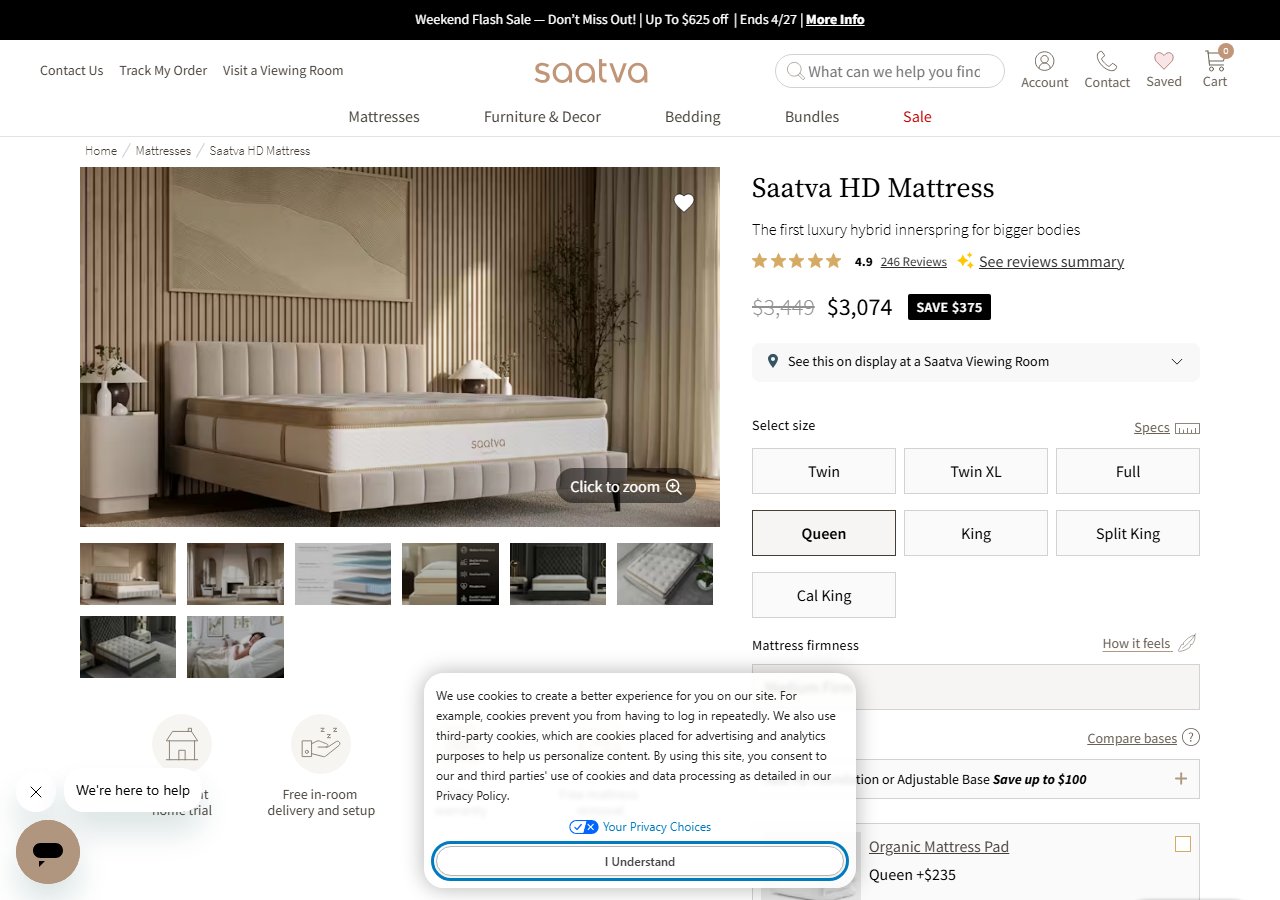
Saatva HD Mattress (Heavy-Duty)
$2,395-$3,995
See Price at Saatva →
Purple Hybrid Premier Mattress
$2,499-$4,799
See Price at Purple →The data-to-recovery hierarchy
Federal data from BLS, NIOSH, CDC, AHRQ, and SSA collectively tells a consistent story: high-bodyweight adults in physical occupations face a compounding injury burden that is not adequately addressed by standard clinical or consumer pathways. The back is the most frequently injured body part in the American workforce. Musculoskeletal disorders are the leading cause of new SSA disability claims. Back pain generates healthcare costs that AHRQ data puts among the most expensive in the U.S. system.
The intervention hierarchy that the evidence actually supports is: movement first (walking, lifting mechanics), sleep behavior second (position, sleep hygiene), clinical evaluation for red flags third, and reinforced sleep surface as an adjunct fourth — not a replacement for the first three. A structurally appropriate mattress for a 260-pound worker with occupational lumbar loading is a legitimate recovery tool. It is not, by itself, a treatment.
Start with the free levers. See a clinician if you have any of the red flags listed above. And if you have done both and your mattress is sinking — replace it with something built for your body's actual load profile, not the average one the manufacturer had in mind.