The Federal Data Snapshot Adults Over 60 Cannot Afford to Ignore
Here is where the numbers start to sting. The CDC reports that approximately 35% of U.S. adults sleep fewer than the seven hours per night associated with lower chronic disease risk. That figure, alarming in isolation, becomes acute when layered against arthritis prevalence: roughly 25% of U.S. adults carry a doctor-diagnosed arthritis diagnosis, with rates climbing sharply after age 55. And the Social Security Administration's Disability Insurance reports consistently identify musculoskeletal disorders as the single largest category of new disability claims filed each year—not cardiovascular disease, not cancer, but the mechanical breakdown of joints, discs, and connective tissue.
For an adult over 60 who spent decades in a physically demanding occupation—construction, healthcare, warehousing, agriculture—these three data streams collide nightly on their sleep surface. The mattress that worked at 40 is not the mattress that serves at 65. Body composition shifts, spinal discs lose hydration and height, cartilage thins, and soft tissue becomes less tolerant of pressure concentration. The result is a feedback loop: poor sleep worsens pain sensitivity, heightened pain disrupts sleep architecture, and both accelerate the functional decline that federal disability data is tracking.
This is not a wellness trend. This is a quantifiable public health pattern with a measurable economic cost. AHRQ's HCUP data places back pain among the most expensive conditions in U.S. healthcare by combined inpatient and outpatient cost. AHRQ's Medical Expenditure Panel Survey finds that adults with chronic back conditions spend substantially more on personal healthcare annually than those without. And CMS drug spending dashboards show opioid and non-opioid pain medications among the most expensive Medicare drug categories—a reflection of how many older Americans are managing pain pharmacologically that might, in part, be addressable through better sleep mechanics.
The investment case for the right sleep surface is not sentimental. It is actuarial.
Why Sleep Degrades for Adults Over 60: The Biomechanical and Physiological Mechanism
To understand why mattress choice matters more at 60 than at 30, you need to understand what happens to the musculoskeletal system across a working lifetime—and what happens in the hours between 11 p.m. and 6 a.m. as a consequence.
Spinal disc dehydration and height loss. Intervertebral discs are roughly 80% water at birth. By the sixth decade of life, they have lost significant hydration, reducing their shock-absorbing capacity and narrowing the foraminal spaces through which nerve roots exit the spine. This is not pathology—it is normal aging—but it means that a mattress surface that cradles the lumbar spine improperly will place sustained mechanical load on already-compromised disc structures for seven or eight hours every night.
Cartilage thinning and arthritis pressure sensitivity. CDC arthritis data shows that arthritis prevalence accelerates with age, particularly in the hips, knees, and lumbar facet joints. Arthritic cartilage is thinner, less lubricated, and dramatically more sensitive to sustained pressure. A mattress that is too firm creates point-loading at the hip greater trochanter and shoulder acromion—the bony prominences that make contact with the sleep surface in a side-sleeping position. A mattress that is too soft allows the heavier pelvis to sink disproportionately, collapsing lumbar alignment and compressing facet joints. The clinical sweet spot is a surface with enough compliance to buffer those pressure points and enough support to resist the pelvic drop.
Reduced proprioceptive feedback and repositioning difficulty. Older adults reposition themselves during sleep less frequently than younger adults, partly due to reduced proprioceptive sensitivity and partly due to the pain cost of movement. This means pressure dwell time at any given contact point is longer, and the mattress material's recovery characteristics—its ability to redistribute pressure as the sleeper subtly shifts—become more important, not less.
The chronic pain amplification loop. CDC NCHS Data Brief 390 documents that approximately 20% of U.S. adults experience chronic pain, with the lower back as the most common pain location. Chronic pain degrades sleep quality through hyperarousal of the central nervous system—making the transition into deep, restorative sleep stages harder and shorter. Shortened deep sleep, in turn, reduces the body's own analgesic response, increasing pain sensitivity the following day. This is a documented bidirectional cycle, not a hypothesis, and it is why sleep surface optimization for pain patients is categorically different from general mattress shopping.
Occupation leaves a structural legacy. Many adults over 60 spent decades in occupations that systematically loaded their spines beyond safe limits. NIOSH's Lifting Equation documents that manual material-handling tasks in warehousing, construction, and healthcare routinely exceed recommended spinal loading limits. BLS Musculoskeletal Disorder data identifies the back as the most commonly injured body part across all occupations tracked for days away from work. Adults who spent careers in these sectors are not experiencing average age-related spinal change—they are experiencing accelerated structural wear on top of normal aging, which is why the mattress recommendations appropriate for a sedentary 60-year-old may be inadequate for a retired construction worker or former warehouse supervisor.
Try These First — The Cheapest Intervention Is the One That Requires No Purchase
Before spending anywhere from $1,695 to $4,799 on a new mattress, every adult over 60 should methodically work through a set of free or near-free interventions. The evidence base for some of these is stronger than the evidence base for specific mattress constructions. The NIH NCCIH's comprehensive review of low-back pain interventions finds that walking 30 minutes most days reduces chronic low back pain as effectively as most non-drug clinical treatments. A mattress is an adjunct. Movement is the lever.
Sleep position is the single most modifiable free variable available to a back-pain sufferer tonight, before any purchase. NIH's National Institute of Arthritis and Musculoskeletal and Skin Diseases specifically recommends side-sleeping with a pillow between the knees, or back-sleeping with a pillow under the knees, as the positions most likely to keep the spine in a neutral alignment overnight. Stomach-sleeping torques the lumbar spine and forces the cervical spine into sustained rotation—two mechanical insults that accumulate over eight hours. If you are currently stomach-sleeping on a worn mattress, the single most impactful change you can make tonight costs nothing.
For readers who have already made sleep position adjustments, replaced worn pillows, improved sleep hygiene, incorporated daily walking, and are still waking with measurable stiffness and disrupted sleep—the mattress itself is likely a contributing variable. The CDC's sleep hygiene guidance is clear that a mattress showing visible sag, age beyond seven to ten years, or consistently producing worse morning stiffness than the evening before is a legitimate clinical variable, not a luxury concern. At that point, targeted equipment investment is warranted.
When to See a Clinician Before You Shop for a Mattress
Not every back pain pattern that is disrupting sleep is a mattress problem. Some presentations require imaging, neurological evaluation, or urgent intervention that no sleep surface can provide. NIH's National Institute of Neurological Disorders and Stroke identifies several red flag presentations that demand clinical evaluation before any other intervention is considered. Back pain that radiates below the knee, pain following acute trauma, leg weakness or numbness, changes in bowel or bladder function, or back pain accompanied by unexplained fever should all be evaluated by a physician promptly. These are not mattress problems. These are neurological or systemic problems that present with a back pain component.
For older adults specifically, new-onset severe back pain without a clear mechanical trigger warrants ruling out vertebral compression fracture—a complication of osteoporosis that becomes significantly more prevalent after age 65 and that is worsened, not helped, by lying on an inadequate surface. If your pain pattern changed suddenly, intensified significantly, or is accompanied by any of the red flags above, stop mattress shopping and see a clinician. A mattress upgrade is an appropriate investment for mechanical, degenerative, arthritis-related sleep disruption. It is not a substitute for diagnosis.
Where Products Help: Matching Mattress Construction to Arthritis and Joint-Load Biomechanics
For the reader who has worked through the interventions above, confirmed the mattress is a legitimate variable, and ruled out clinical red flags, equipment selection becomes a serious evidence-informed exercise. The three mattresses below were selected based on their construction characteristics relative to the specific biomechanical demands described in this article: pressure relief at bony prominences, lumbar support that resists pelvic drop, and material resilience adequate for an older adult who may repositioned less frequently during the night.
The Premium Memory Foam Pick: Saatva Loom & Leaf
For adults over 60 managing arthritis in the hips, shoulders, or lumbar spine, the Saatva Loom & Leaf Memory Foam Mattress represents the most clinically purposeful construction in this category. Loom & Leaf is built on a multi-layer memory foam system—an 8-pound density cooling gel memory foam comfort layer above a 4-inch high-density base foam—that creates graduated pressure relief: the softer upper zones compress to buffer bony prominences, while the denser base resists the pelvic sinkage that collapses lumbar alignment. It is available in Relaxed Firm and Firm configurations, which matters because adults over 60 with arthritis who side-sleep typically need the Relaxed Firm, while back-sleepers with lumbar degeneration often do better on the Firm.
At $1,695–$3,295 depending on size and configuration, this is a serious investment, but contextualized against AHRQ MEPS data showing that chronic back condition patients spend substantially more on healthcare annually, a mattress that meaningfully reduces pain-disrupted sleep nights has a calculable return. Saatva also offers white-glove delivery and old mattress removal—relevant for adults who should not be lifting or maneuvering a heavy old mattress themselves.
The Heavy-Duty Pick for High-BMI Sleepers and Former Manual Labor Workers: Saatva HD
Not all adults over 60 share the same body composition or structural history. Retired warehouse workers, former construction tradespeople, and higher-BMI older adults are sleeping on a fundamentally different load distribution profile than a lighter, more sedentary 65-year-old. Standard mattresses, even premium ones, are engineered for average weight distributions and will compress prematurely and unevenly under body weights above approximately 230–250 pounds. The Saatva HD Mattress is specifically engineered for this population.
The Saatva HD uses a 3-inch Euro pillow top over individually wrapped coils rated for higher sustained loads, with a reinforced perimeter edge support system and a high-density foam foundation that resists the accelerated compression that undermines lumbar support in standard mattresses at higher body weights. For adults whose careers were tracked by NIOSH's Lifting Equation as routinely exceeding safe spinal loading—and whose spines reflect that history—a mattress that holds its support geometry under real-world loads is not a luxury specification. It is a functional requirement. Priced at $2,395–$3,995, the Saatva HD is positioned as a long-horizon investment: a mattress that will not develop the load-induced sag that Standard-construction mattresses develop within three to four years under heavier sleepers.
The Pressure-Relief Specialist Pick: Purple Hybrid Premier
For adults whose primary complaint is pressure-point pain—waking with aching hips, numb shoulders, or sore knees from side-sleeping—the Purple Hybrid Premier Mattress takes a materially different engineering approach than either Saatva option. Purple's proprietary GelFlex Grid replaces traditional foam comfort layers with a grid structure that collapses at pressure points while remaining firm in unsupported areas between the body and the sleep surface.
The practical clinical implication for arthritic older adults is significant: the GelFlex Grid does not simply compress under load the way memory foam does. It selectively yields at the precise anatomical zones—hip greater trochanter, shoulder acromion, knee—while providing a stable, non-collapsing platform everywhere else. This means the lumbar spine receives support rather than sinkage even as the hip and shoulder receive cushioning rather than point pressure. The Purple Hybrid Premier layers this grid over a pocketed-coil base, which adds motion isolation and edge support relevant to older adults who use the bed edge to sit and stand. At $2,499–$4,799 depending on size and grid thickness, it is the highest-ceiling option in this list and makes the most sense for adults whose primary symptom is pressure-driven pain rather than pure lumbar alignment disruption.
Top Mattresses for Adults Over 60 With Arthritis and Back Pain
Each mattress below was selected for its specific construction characteristics relative to the pressure-relief, lumbar support, and load-distribution demands of adults over 60 managing arthritis, degenerative disc changes, or career-accumulated spinal wear.

Saatva Loom & Leaf Memory Foam Mattress
$1,695-$3,295
See Price at Saatva →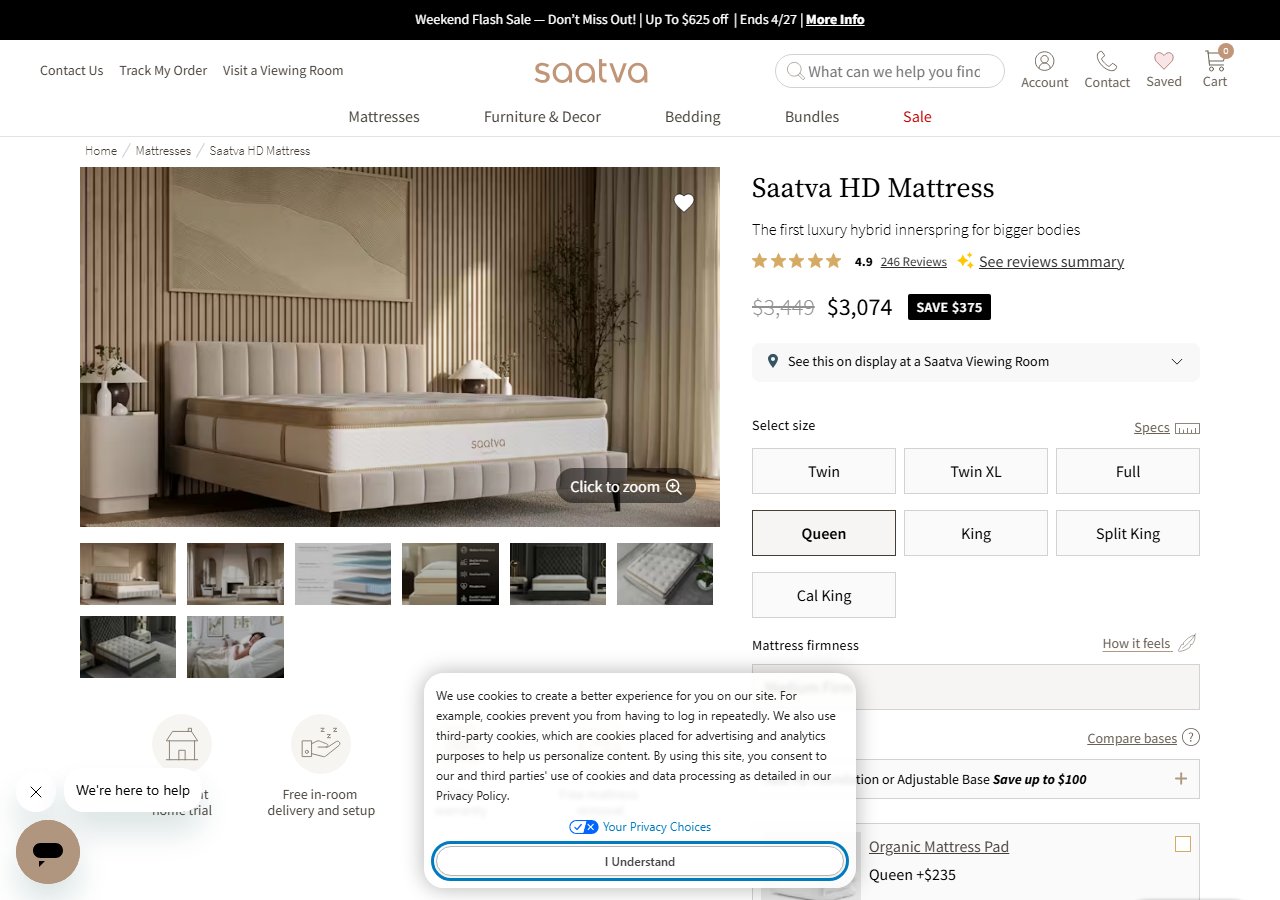
Saatva HD Mattress (Heavy-Duty)
$2,395-$3,995
See Price at Saatva →
Purple Hybrid Premier Mattress
$2,499-$4,799
See Price at Purple →Making the Decision: A Data-Anchored Framework for Adults Over 60
The federal data presented in this article describes a compounding crisis that is not going to resolve through passive aging. SSA Disability Insurance reports show musculoskeletal disorders driving more new disability claims than any other category. CMS drug spending data places pain medication costs among the highest in Medicare drug categories. The chronic pain-sleep disruption feedback loop documented in CDC NCHS Data Brief 390 does not self-correct without intervention.
The hierarchy is not complicated. Start with the free interventions: sleep position correction, daily walking, sleep hygiene, mechanical lifting awareness. If those interventions have been implemented and the sleep surface is still a contributing variable—visible sag, age beyond seven to ten years, consistent morning stiffness—then equipment investment is warranted and the three mattresses above represent the most construction-appropriate options for adults over 60 managing arthritis and degenerative joint conditions.
For adults with arthritis-driven pressure point pain as the primary complaint, the Purple Hybrid Premier's grid architecture is purpose-matched. For adults with lumbar alignment as the central issue and a history of career-driven spinal load, the Saatva Loom & Leaf's graduated foam layers address that mechanism directly. For higher-BMI adults or former manual laborers whose standard mattress is failing under load-related compression, the Saatva HD was built for exactly that structural profile.
None of these mattresses replaces clinical care, daily movement, or appropriate sleep positioning. All three, in the right biomechanical context, represent a meaningful evidence-aligned investment in the restorative sleep that aging joints require.