Night Shifts Break Your Sleep Architecture — Here's the Federal Data Proving It
You finished a 12-hour night shift at 7 a.m. The sun is fully up. Your kids are awake. Neighbors are mowing. And your body — wired by 200,000 years of evolution to be alert in daylight — is fighting every effort to sleep. This is not a discipline problem. This is a circadian biology problem, and federal occupational health data documents exactly how badly it damages the workers who experience it every week.
CDC Sleep and Sleep Disorders Data shows approximately 35% of U.S. adults already report sleeping less than 7 hours per night — the threshold below which chronic disease risk measurably rises. For night-shift nurses and healthcare workers, that figure almost certainly understates the problem, because daytime sleep in a light-contaminated, noise-contaminated environment is physiologically inferior to nighttime sleep even when total hours look comparable on paper. Sleep fragmentation — waking repeatedly due to light cues, ambient sound, or circadian misalignment — reduces slow-wave and REM sleep, the stages responsible for tissue repair and immune regulation.
BLS Musculoskeletal Disorder data identifies the back as the single most common body part injured across all U.S. occupations resulting in days away from work. Healthcare occupations — particularly nursing, nursing aides, and orderlies — consistently rank among the highest-risk categories for back and shoulder MSDs because patient handling is among the most physically demanding manual-labor tasks performed in any industry. When you add chronic sleep deprivation to that physical load, you compound injury risk: fatigued workers have degraded proprioception, slower reaction times, and reduced core stabilization capacity. The spine is being loaded at work and then denied the restorative sleep it needs to recover.
Why Night-Shift Healthcare Work Is a Perfect Storm for Back and Sleep Injury
The biomechanical mechanism here is not complicated, but it is cumulative and often invisible until it becomes debilitating. Healthcare workers performing patient transfers, repositioning bedridden patients, and operating heavy equipment are routinely exposed to spinal loading that exceeds federal safety thresholds. The NIOSH Lifting Equation documents that manual material-handling tasks in healthcare routinely exceed the recommended weight limits for safe spinal loading. A lateral patient transfer — dragging or repositioning a patient in bed — generates lumbar compressive and shear forces that engineering data consistently places above the NIOSH Action Limit.
Now layer in sleep deprivation. The BLS Census of Fatal Occupational Injuries documents sleep deprivation and fatigue as contributing factors to occupational fatalities across industries. While the CFOI is most commonly cited in transportation contexts — and FMCSA driver-safety data documents elevated crash risk among fatigued commercial vehicle operators — the underlying physiology applies equally to a nurse on her third consecutive night shift: degraded judgment, slower reaction time, reduced pain sensitivity (which masks early-warning injury signals), and impaired motor coordination during precisely the physical tasks that carry the highest spinal load.
AHRQ HCUP data confirms that back pain is one of the most expensive conditions in the U.S. healthcare system by combined inpatient and outpatient cost. This is not merely a personal health problem — it is a system-level occupational health crisis. And SSA Disability Insurance data shows musculoskeletal disorders are the single largest category of new disability claims annually in the United States. A night-shift nurse experiencing compounding spinal load without adequate sleep recovery is on a federally documented trajectory toward long-term disability, not just temporary soreness.
The geographic distribution of this problem is not uniform. HRSA Health Professional Shortage Area data shows that healthcare worker shortage areas — where mandatory overtime, longer shifts, and reduced staffing ratios are most common — overlap with elevated MSD rates among shift-work-dominant healthcare employment. Rural nurses, in particular, often have fewer options to refuse a fourth consecutive night shift or to access occupational health resources during recovery.
CDC NCHS Data Brief 390 reports that approximately 20% of U.S. adults experience chronic pain, with the lower back as the most common location. In healthcare worker populations, that figure is substantially higher. The accumulation of inadequate daytime sleep and repeated spinal overloading at work creates a reinforcing loop: poor sleep increases pain sensitivity and inflammation, which makes it harder to sleep, which further impairs physical recovery — and the cycle accelerates over years and decades on the job.
The Cheapest Interventions Don't Require Buying Anything
Before this article discusses any equipment, it is worth being direct: the most powerful sleep quality improvements available to night-shift healthcare workers are behavioral and environmental, they cost nothing, and they are supported by federal health guidance. Products — including adjustable bed bases — are adjuncts to a well-constructed sleep environment and consistent sleep habits, not replacements for them.
CDC sleep hygiene guidance recommends a bedroom temperature between 65 and 68 degrees Fahrenheit, complete darkness (blackout-level, not just dim), and eliminating screens in the hour before sleep. For a day-sleeping nurse, this means blackout curtains rated to block 99%+ of light, a door sign or phone notification silencer during sleep hours, and a deliberate wind-down routine that starts before you climb into bed — not after. These environmental interventions are free and have stronger population-level evidence behind them than most sleep devices.
NIH guidance on back pain specifically identifies sleep posture as a primary modifiable factor in lumbar pain management. Side-sleeping with a pillow between the knees keeps the pelvis neutral and reduces lumbar load through the night. Stomach-sleeping — a common habit among exhausted shift workers who simply collapse into whatever position feels immediately comfortable — is the worst documented position for both back and neck pain, and costs you nothing to change except the habit itself.
For back pain specifically, NIH NCCIH Low-Back Pain guidance lists daily walking as a first-line non-drug intervention supported by meta-analyses. Thirty minutes of moderate walking most days outperforms most passive interventions in the published evidence. For a night-shift worker, this might mean a 30-minute walk in the early evening before your shift — a schedule that also serves as a circadian anchor to support wakefulness at work and fatigue at the end of the shift.
Finally, if you snore loudly, have been told you gasp in your sleep, or experience profound daytime sleepiness even after adequate hours in bed, NHLBI sleep apnea guidance recommends screening with a formal sleep study before purchasing any sleep equipment. Adjustable bed bases can reduce positional snoring and mild GERD symptoms — but they do not treat moderate-to-severe obstructive sleep apnea, which is a medical condition requiring CPAP or equivalent therapy. Buying equipment before ruling out a treatable medical cause is an expensive way to not solve the problem.
If you have worked through the environmental and behavioral changes above — blackout curtains are up, sleep posture is corrected, you are walking daily, and you have been cleared of sleep apnea — and you are still waking in pain or struggling to maintain sleep, equipment begins to make real sense. Specifically, a motorized adjustable base addresses a genuine biomechanical problem: the flat sleeping surface that most mattresses impose is not necessarily the optimal spinal loading position for a healthcare worker whose back has been under compressive load for 12 hours. Elevating the head slightly (to reduce acid reflux, which is disproportionately common among shift workers whose meal timing is disrupted) or raising the knee section (to reduce lumbar lordosis and decompress the lumbar spine) are interventions that a flat mattress simply cannot provide.
When to See a Clinician First
Adjustable beds are comfort and recovery equipment. They are not medical treatment. Before considering any purchase, night-shift healthcare workers should be aware of the specific clinical red flags that indicate a provider visit should come first — and come urgently in some cases.
NIH National Institute of Neurological Disorders and Stroke guidance is explicit: most low back pain resolves within 4 to 6 weeks without imaging. But certain presentations require prompt clinical evaluation. Pain that radiates down one or both legs (suggesting nerve root compression or disc herniation), back pain accompanied by bowel or bladder dysfunction (a potential cauda equina emergency), pain that follows significant physical trauma, or pain accompanied by fever all require medical evaluation before any self-management approach is appropriate. Night-shift workers, who may be accustomed to pushing through discomfort, are at elevated risk of dismissing these symptoms as ordinary work soreness.
Additionally, for shift workers experiencing severe sleep disruption, cognitive impairment during waking hours, or depressive symptoms, the clinical picture may involve circadian rhythm disorder, not simply poor sleep hygiene. The CDC sleep data threshold of 7 hours is a population average; individual sleep debt compounds over weeks and months on a night-shift schedule in ways that behavioral interventions alone may not fully reverse. An occupational medicine provider or sleep medicine specialist can evaluate whether pharmacological circadian support, light therapy protocols, or formal sleep disorder treatment is appropriate before equipment purchases are considered.
Where an Adjustable Base Actually Helps — and Which Configurations Work
For the nurse or shift worker who has addressed the environmental and clinical foundations and is sleeping on a flat surface that leaves them waking with lumbar stiffness, hip pain, or acid reflux disrupting their daytime sleep, a motorized adjustable base offers a set of mechanical interventions that are well-matched to these specific problems.
The core value of an adjustable base for this reader is positional flexibility: the ability to raise the head section to between 15 and 30 degrees, which reduces gastroesophageal reflux pressure during sleep; to raise the foot section, which reduces lumbar lordosis and redistributes spinal loading away from the compressed structures at the end of a long shift; and to find a zero-gravity position (head and knees both elevated) that many orthopedic practitioners recommend for lumbar disc decompression during rest. None of these positions are achievable on a standard flat platform.
The FDA 510(k) database covers many adjustable bed mechanism patents and motorized base designs, providing federal-level engineering review of motor durability and pinch-point safety standards. For healthcare workers buying a motorized base, it is worth verifying that the specific mechanism has been through an engineering review process — motors on bases in the $500-800 price range frequently have not, while bases from established manufacturers have design documentation that supports longer-term reliability.
For the healthcare worker who wants the most complete positional control available in a packaged base-plus-mattress configuration, the Sven & Son Bliss Adjustable Bed Base-Frame + 14 inch Hybrid Spring Mattress combines a full-function motorized base with a medium-soft hybrid mattress that provides both the pressure relief a tired body needs and the spinal support a loaded lumbar spine requires. The hybrid construction — pocketed coils with foam comfort layers — maintains consistent support at the lumbar zone without the full-body sink that can cause spinal misalignment during extended daytime sleep.
For workers who already have a compatible mattress and need a base upgrade specifically for positional control, the Sven & Son Harmony Adjustable Bed Base provides independent head and foot adjustment with a wireless remote, making it easy to program your preferred zero-gravity or anti-reflux angle before your shift ends and you need to climb into bed without decision fatigue. The Harmony's motor and frame system is built for daily use — relevant for a night-shift worker who is adjusting their sleep position every single day, not occasionally.
For shift workers and nurses managing a tighter budget but still needing the core functional benefits — head elevation for reflux control and foot elevation for lumbar decompression — the Sven & Son Classic Adjustable Bed Base provides the essential adjustability at the lowest price point in this lineup. It lacks some of the programmable memory positions of the Harmony and the bundled mattress of the Bliss, but the fundamental positional mechanics are present: head up, feet up, zero-gravity preset. For a nurse who has never used an adjustable base and wants to verify that positional sleep adjustment works for her specific pain pattern before committing to a higher investment, the Classic is a logical starting point.
Adjustable Bases Built for Night-Shift Healthcare Worker Recovery
These three configurations were selected specifically for healthcare workers and shift nurses managing daytime sleep quality, lumbar decompression after patient-handling shifts, and acid reflux from irregular meal timing.
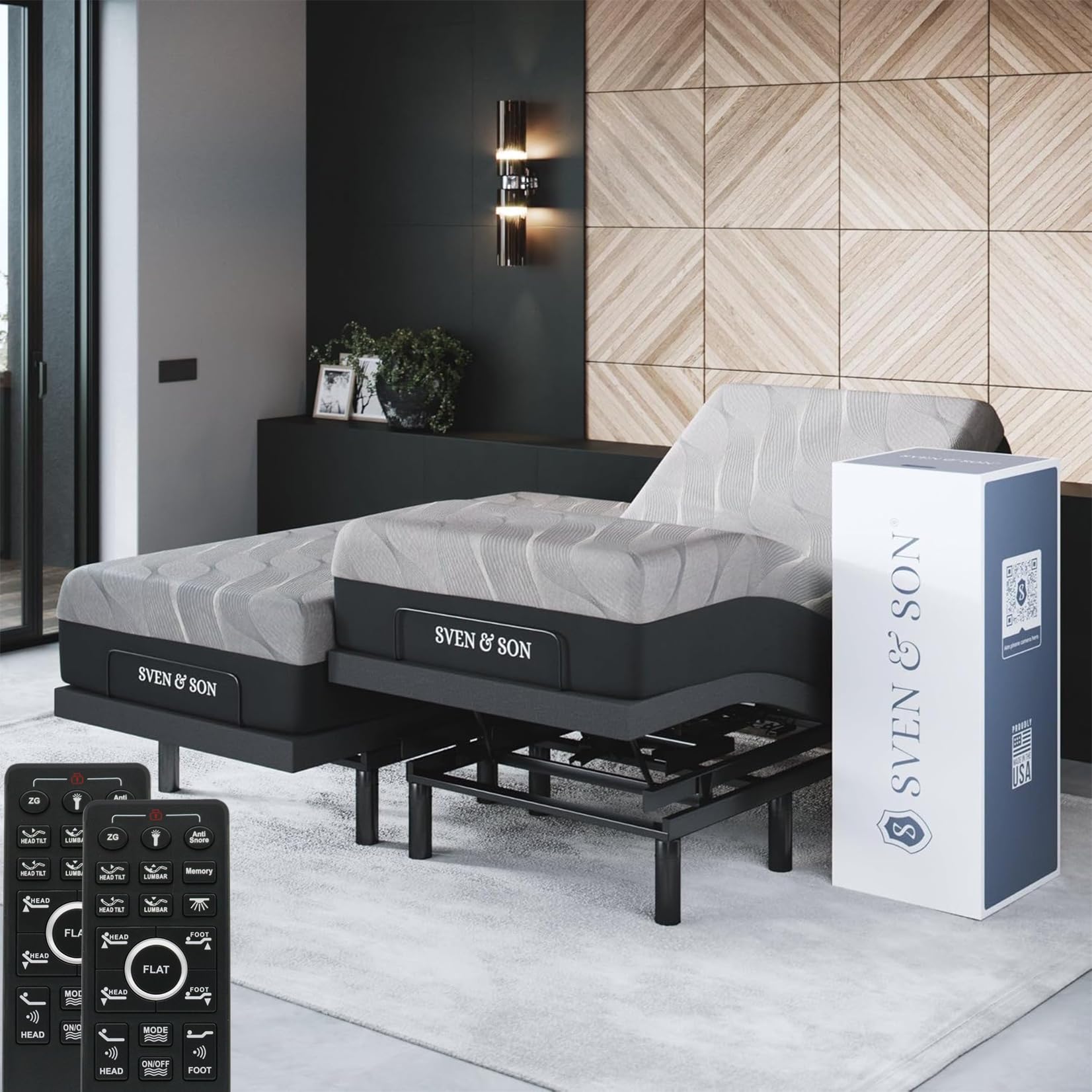
Sven & Son Bliss Adjustable Bed Base-Frame + 14 inch Hybrid Spring Matt (Medi...
$2,749.95
Check Price on Amazon →
Sven & Son Harmony Adjustable Bed Base, Head and Foot Lift, Massage, Under-Be...
$2,194.95
Check Price on Amazon →
Sven & Son Classic Adjustable Bed Base, Head and Foot Lift, Massage, Under-Be...
$1,994.95
Check Price on Amazon →How to Actually Use an Adjustable Base as a Recovery Tool
Owning an adjustable base does not automatically improve sleep quality. Like any tool, the value comes from deliberate use. For night-shift healthcare workers, the following protocol — based on the federal ergonomic and sleep guidance cited throughout this article — is a practical starting framework:
Before sleep: Lower all screens 60 minutes before your intended sleep time. Set the bedroom to 65-68°F. Deploy blackout measures. Use your base remote to preset your angle before you get into bed — zero-gravity (head 30-45°, knees 15-30°) for lumbar decompression, or a slight head elevation of 10-15° if acid reflux from irregular meal timing is a factor during your shift.
During sleep: Side-sleeping remains the recommended default for back pain management. An adjustable base does not override the value of a body pillow or knee pillow for lateral spinal alignment. The base elevation provides macro-level spinal positioning; the pillow provides micro-level pelvic alignment. Use both.
After your shift: Do not attempt to force immediate sleep. The 30-minute walk recommended by NIH NCCIH for back pain is also a circadian transition tool — it signals the end of a waking period and supports the gradual melatonin rise that precedes natural sleep onset, even during daylight hours. Walk first, then darken the room, then use the base.
Long-term tracking: If you are using an adjustable base partly to manage back pain, keep a simple log. Note your pain level (1-10) upon waking, your total sleep duration, and your base position. Within 2-3 weeks you will have enough data to determine whether positional adjustment is producing a measurable benefit — and whether the investment is justified relative to other interventions you could pursue.
The Federal Data Hierarchy: What Actually Moves the Needle
This article has covered a lot of ground because the evidence base for night-shift healthcare worker sleep and back health is genuinely complex. Let the federal data set the priority order:
The highest-leverage interventions for daytime sleep quality — documented by CDC — are environmental: darkness, temperature, and noise control. They are free. The highest-leverage interventions for back pain — documented by NIH and NIOSH — are behavioral: sleep posture correction, daily walking, and load management during patient handling tasks. Also largely free.
Equipment — including an adjustable base — sits in a second tier. It provides genuine biomechanical value when the environmental and behavioral foundations are in place, and it addresses specific problems (gastric reflux during sleep, lumbar decompression after heavy lifting, inability to maintain side-sleeping position due to hip pressure) that behavioral interventions alone cannot fully solve.
Back pain is already the most common work injury in the U.S. by BLS data, and AHRQ confirms it is among the most costly conditions in the healthcare system. SSA disability data shows where unmanaged musculoskeletal disorders end up. Night-shift healthcare workers are at the intersection of the highest physical spinal load and the poorest sleep recovery conditions in the U.S. workforce. Federal data does not suggest this resolves on its own — it suggests it requires systematic, evidence-based intervention at every level: environmental, behavioral, clinical, and yes, equipment when everything else is in place.