The federal data on sleep after 50 is blunt — and expensive
Here is the number that should stop you mid-scroll: AHRQ's Healthcare Cost and Utilization Project identifies back pain as one of the most expensive conditions in all of U.S. healthcare when you tally both inpatient and outpatient costs. Not cancer. Not cardiac disease. Back pain — the condition that quietly metastasizes across the second half of life, shaped in large part by how, where, and how long you sleep. If you are over 50 and waking up stiff, rolling out of bed with lumbar ache, or logging nights of fragmented sleep, you are not dealing with a minor inconvenience. You are sitting at the leading edge of a healthcare cost curve that the federal data says trends sharply upward from here.
The CDC reports that approximately 35% of U.S. adults sleep fewer than 7 hours per night — the threshold at which chronic disease risk measurably rises. Among adults past 50, the mechanisms driving short sleep multiply: hormonal shifts reduce slow-wave sleep architecture, musculoskeletal pain fragments sleep continuity, acid reflux worsens in the supine position, and the cardiovascular and metabolic conditions that accumulate across decades each carry their own sleep-disrupting pharmacological side effects. The interplay is not subtle. It is compounding.
And the downstream cost is federal-record-level real. The SSA Disability Insurance Statistical Reports confirm that musculoskeletal disorders — the category that encompasses the chronic back pain that keeps aging adults awake at 3 a.m. — represent the single largest category of new disability claims filed annually in the United States. The CDC NCHS Data Brief 390 documents that approximately 20% of U.S. adults live with chronic pain, and among that group, lower back pain is the most common specific location. These are not actuarial abstractions. They are the trajectory that begins with a decade of poor sleep.
Why sleep quality degrades after 50 — the biomechanical and physiological mechanism
Understanding why this happens matters, because the mechanism determines which interventions have genuine leverage and which are noise.
The lumbar spine, across a lifetime of occupational loading, accumulates a specific damage profile. The NIOSH Lifting Equation documents that manual material-handling tasks in warehousing, construction, and healthcare routinely exceed safe spinal loading limits — and the cumulative effect on intervertebral discs is well established. Even among knowledge workers and executives who avoided heavy labor, decades of seated desk posture produce anterior pelvic tilt, hip flexor shortening, and compressed lumbar discs. BLS Musculoskeletal Disorders data identifies the back as the single most common injured body part across all U.S. occupations with days away from work — evidence that disc and soft-tissue loading is near-universal across the working population.
At night, that damaged or compressed lumbar spine needs offloading. A flat mattress surface keeps the spine in a single, static position for six to eight hours. Pressure points at the sacrum and greater trochanter restrict circulation and trigger micro-arousals — brief awakenings the sleeper may not consciously register but that fragment deep-sleep architecture. In the side-sleeping position (which most adults over 50 migrate toward as the least painful option), the pelvis and shoulder carry asymmetrical loads throughout the night. Acid reflux, which worsens with age and with lying flat, further disrupts sleep continuity and is associated with chronic cough and nighttime awakening. Positional snoring — the kind driven by the tongue and soft palate falling posterior when supine — peaks in severity in the fully flat position.
The financial implication of this mechanism is straightforward. Every fragmented night is a compounding invoice: increased next-day cortisol, elevated systemic inflammation markers, impaired glucose metabolism, and reduced cognitive performance. Across years, these translate into the healthcare utilization numbers the AHRQ is tracking. The question is not whether to address this — the federal data makes the cost of inaction explicit. The question is how to address it effectively, starting with the cheapest interventions first.
Try these first — the interventions that cost nothing
The most important principle in this analysis: the cheapest intervention is the one that does not require buying anything. Federal clinical guidance from NIH, CDC, and AHRQ converges on a hierarchy of interventions for sleep disruption and chronic back pain. Non-product strategies consistently outperform or match equipment-based approaches in meta-analyses, and they carry zero financial risk. Before evaluating any piece of sleep equipment, work through this list completely.
Start with sleep environment optimization. CDC sleep hygiene guidance recommends a bedroom temperature between 65 and 68 degrees Fahrenheit, blackout darkness, and no screens in the hour before bed. These are free modifications that outperform most equipment upgrades in controlled studies of sleep quality. A $400 smart pillow or $3,000 adjustable base will not compensate for a room that is 73 degrees and lit by a television.
Next, address sleep position directly. NIH guidance from the National Institute of Arthritis and Musculoskeletal and Skin Diseases identifies sleep posture as a primary modifiable factor in back pain. Side-sleeping with a firm pillow between the knees keeps the pelvis in neutral alignment and reduces lumbar load measurably. Stomach-sleeping is the single worst position for both back and neck pain — the cervical spine is rotated to maximum range for the entire night. A $12 pillow placed correctly addresses the same biomechanical problem that a zero-gravity position on an adjustable base addresses mechanically.
For chronic back pain specifically, daily walking is a first-line, evidence-graded non-drug intervention. NIH National Center for Complementary and Integrative Health guidance on low back pain cites walking as matching or outperforming passive interventions in meta-analyses. Thirty minutes of moderate walking most days improves lumbar disc nutrition (which is dependent on movement-driven fluid exchange), reduces systemic inflammation, and improves sleep quality through thermoregulatory and circadian mechanisms. No equipment required.
Finally — and this one is non-negotiable before purchasing any sleep equipment — screen for sleep apnea. NHLBI guidance is explicit: adjustable beds may help with positional snoring and mild GERD, but they do not treat moderate-to-severe obstructive sleep apnea. If you snore loudly, if a bed partner has witnessed gasping or breathing pauses, or if you experience daytime sleepiness despite adequate time in bed, a formal sleep study should precede any equipment purchase. Treating obstructive sleep apnea with CPAP or an oral appliance — not an adjustable base — is the intervention with the federal evidence base.
For readers who have genuinely worked through the above — who have optimized their sleep environment, corrected their sleep position, added daily movement, ruled out sleep apnea, and still wake with lumbar pain or fragmented sleep — the research and federal engineering data support evaluating a motorized adjustable base as a meaningful adjunct. The mechanism is not mystical: elevating the head of the bed reduces the angle at which the soft palate falls posterior, directly reducing positional snoring. The zero-gravity position — torso elevated 25 to 35 degrees, legs slightly elevated — distributes body weight across a larger surface area and measurably reduces lumbar disc pressure compared to flat supine lying. For GERD, head elevation above 6 to 8 inches has clinical support for reducing nocturnal reflux events.
When to see a clinician — and why waiting is the costlier choice
Before any equipment purchase, a brief clinical detour is warranted. The FDA Adverse Event Reporting System (FAERS) documents the safety profile of pharmaceutical sleep interventions — and the data is a useful reminder that prescription sleep aids carry real adverse event rates, particularly in adults over 60 where drug metabolism changes significantly. The reflex toward pharmaceutical solutions for sleep disruption is common and often underscores the absence of a structural diagnosis. Seeing a clinician before purchasing equipment — or a prescription — is the correct sequence.
NIH National Institute of Neurological Disorders and Stroke back pain guidance is clear that most low back pain resolves within 4 to 6 weeks without imaging. However, certain presentations demand immediate clinical evaluation. See a clinician promptly — not after trying another pillow — if any of the red flags below apply to you.
Red flags that require clinical evaluation before any equipment decision
The following presentations require a clinician before any sleep equipment purchase:
- Pain that radiates below the knee or into the foot, especially with numbness or tingling. This may indicate nerve root compression (radiculopathy) that requires imaging and clinical management, not positional adjustment. NIH NINDS back pain guidance lists leg radiation as a priority referral criterion.
- New bowel or bladder dysfunction accompanying back pain is a cauda equina red flag requiring emergency evaluation. No equipment intervention is appropriate until this is ruled out.
- Back pain following trauma — a fall, a vehicle accident, a compression fracture event — requires imaging before any loaded activity or positional experiment.
- Back pain accompanied by unexplained weight loss or fever may indicate infectious or malignant etiology. CDC NCHS Data Brief 390 documents that among adults with chronic pain, secondary diagnoses are common and often under-investigated.
- Witnessed breathing pauses or gasping during sleep: NHLBI sleep apnea guidance requires formal sleep study before any positional sleep intervention. An adjustable base cannot treat moderate-to-severe obstructive sleep apnea.
Where products fit — after the free work is done
For the reader who has cleared the above — optimized the environment, addressed sleep position, added movement, seen a clinician, ruled out apnea — an adjustable base occupies a specific and defensible role in the recovery toolkit. The federal engineering review process adds a meaningful layer of confidence here: FDA 510(k) Class II clearance data covers many adjustable bed mechanism patents and motorized base designs, providing federal-level engineering review of motor durability and pinch-point safety. This is not a trivial credential — it means the motor and articulation mechanism has been reviewed against established safety benchmarks. When evaluating any adjustable base, verifying 510(k) clearance for the motorized components is a baseline due-diligence step.
The three Sven & Son models evaluated here cover a logical decision range for wellness-oriented consumers who are serious about spinal recovery and sleep quality — and who want to buy once rather than iterate through cheaper products that fail in three years.
The entry point in this range is the Sven & Son Classic Adjustable Bed Base, priced at $1,994.95. The Classic delivers the core biomechanical intervention — head and foot articulation into zero-gravity positioning — with a clean, durable platform. For readers whose primary driver is lumbar offloading and positional GERD management, the Classic addresses the mechanism without additional features that add cost but not clinical function. This is the appropriate starting point if you are evaluating adjustable bases for the first time and want to validate whether positional adjustment genuinely improves your sleep quality before investing further.
The mid-tier Sven & Son Harmony Adjustable Bed Base, at $2,194.95, adds features relevant to the over-50 recovery use case: enhanced under-bed lighting for nighttime navigation (a fall-risk consideration for adults with balance or nocturia issues), a wireless remote, and refined motor engineering. For couples sleeping in split-king configurations — increasingly common among adults who have different pain profiles or different temperature preferences — the Harmony's dual-zone independent control is the critical differentiator. The ability for one partner to elevate to zero-gravity without disturbing the other addresses one of the most common practical complaints about adjustable bases in households with mismatched sleep needs.
At the top of this range sits the Sven & Son Bliss Adjustable Bed Base-Frame + 14 inch Hybrid Spring Mattress at $2,749.95 — a combined base and mattress bundle that eliminates the compatibility variable entirely. One of the most common errors consumers make when purchasing adjustable bases is pairing them with a mattress not engineered to flex under articulation. Coil mattresses with non-tempered springs fatigue rapidly under repeated bending; memory foam without sufficient base-layer flexibility can crack at the articulation point. The Bliss bundle pairs a 14-inch hybrid spring mattress specifically designed to work with the base's articulation range, which means the consumer receives a single-source system rather than a two-component compatibility experiment. For wellness consumers who want a complete, validated sleep system rather than a DIY assembly, this is the most coherent purchase.
Adjustable Bases for Sleep Recovery and Lumbar Offloading After 50
These three Sven & Son models were selected for wellness consumers over 50 who need verified motorized articulation for zero-gravity lumbar positioning, GERD management, and independent dual-zone control — not brand novelty.
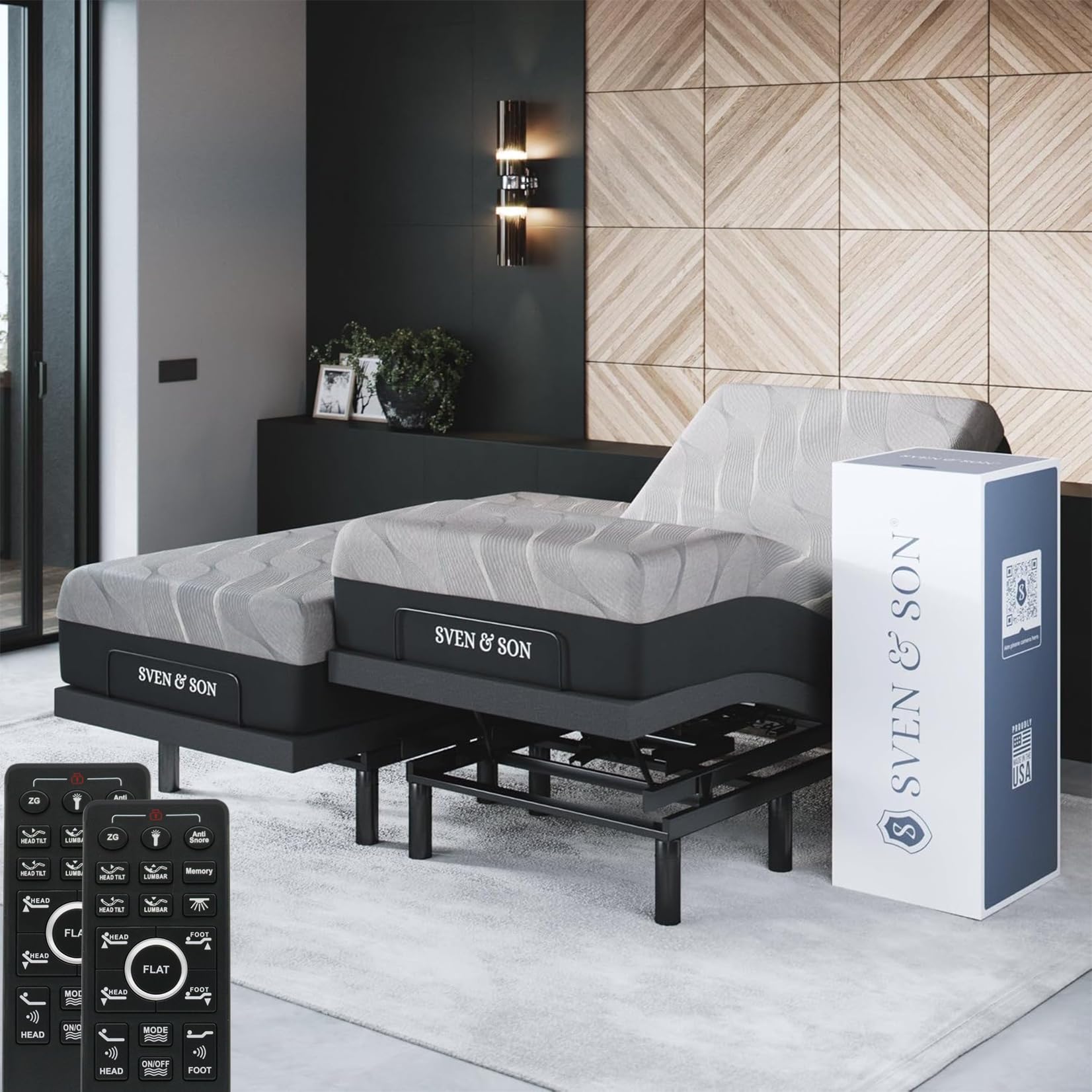
Sven & Son Bliss Adjustable Bed Base-Frame + 14 inch Hybrid Spring Matt (Medi...
$2,749.95
Check Price on Amazon →
Sven & Son Harmony Adjustable Bed Base, Head and Foot Lift, Massage, Under-Be...
$2,194.95
Check Price on Amazon →
Sven & Son Classic Adjustable Bed Base, Head and Foot Lift, Massage, Under-Be...
$1,994.95
Check Price on Amazon →The economics of acting on this data
The AHRQ HCUP data does not care whether you find this framing uncomfortable: back pain is already among the most expensive conditions in U.S. healthcare. The adults who are generating those costs are predominantly in the 50-and-older cohort, are experiencing fragmented sleep driven by the same musculoskeletal and positional mechanisms described above, and are in many cases managing those symptoms with pharmaceutical interventions that carry their own adverse event profiles — documented in the FDA FAERS database — rather than with structural sleep optimization.
The cost hierarchy here is not complicated. Free interventions first: sleep environment, sleep position, daily walking, clinical screening. Then, if indicated, an evidence-anchored equipment investment made once, correctly. The BLS Census of Fatal Occupational Injuries data on fatigue-related outcomes in transportation workers — where sleep deprivation is a documented contributing factor to the highest absolute fatality counts of any occupational sector — is a useful anchor for how seriously federal researchers take sleep quality as a health and safety variable. The economics of sleep quality are not speculative. They are in the federal record.
The reader who works through the interventions outlined above, screens clinically where appropriate, and then selects the right adjustable base for their specific biomechanical and lifestyle profile is making a decision that the federal data supports. The reader who buys on impulse without doing the free work first is likely to be disappointed — and is likely to be back in a clinician's office generating more of the AHRQ cost data within the decade. The sequence matters as much as the product.