Your Lower Back Is Taking the Brunt of Every Shift — Federal Data Confirms It
If you clock into a warehouse and clock out with a tight, aching lower back, you are not imagining the damage. BLS Musculoskeletal Disorders by Occupation tracking identifies the back as the single most common body part injured across all U.S. occupations with days away from work — and warehousing, courier, and freight-handling sectors consistently post MSD incidence rates that rank among the highest in the national economy. The injury is not random, and it is not inevitable. It is the predictable output of a specific biomechanical mechanism that repeats itself hundreds of times per shift — and understanding that mechanism is the first step toward interrupting it.
The financial stakes sharpen the picture further. BLS Employer Costs for Employee Compensation data shows that industries with high MSD incidence carry workers' compensation insurance rates 3–5 times higher than low-MSD industries. AHRQ HCUP data identifies back pain as one of the most expensive conditions in U.S. healthcare by total inpatient and outpatient cost. And SSA Disability Insurance reports identify musculoskeletal disorders as the single largest category of new disability claims filed annually. These are not edge-case outcomes. They are the statistically likely trajectory for warehouse workers who do not actively manage the cumulative load their occupation places on the lumbar spine.
Why Warehouse Work Systematically Breaks Down the Lumbar Spine
The mechanism is not complicated, but it is relentless. Warehouse work concentrates mechanical stress at the lumbar spine through three overlapping pathways: repetitive compressive loading, sustained awkward posture, and asymmetric twisting under load. Each pathway is documented in federal ergonomics research as an independent risk factor for musculoskeletal injury; the combination of all three, repeated across an 8- or 10-hour shift, is what produces the chronic lumbar degradation that shows up in BLS injury data year after year.
The NIOSH Lifting Equation is the federal government's primary tool for quantifying spinal loading in manual material-handling environments. The equation calculates a Recommended Weight Limit for a specific lifting task; when a worker's actual load exceeds that limit — which NIOSH documents routinely happens in warehousing, construction, and healthcare — the excess load is absorbed by the intervertebral discs, facet joints, and paraspinal musculature of the lumbar spine. Over hundreds of repetitions per shift and hundreds of shifts per year, that excess load produces disc compression, facet joint irritation, and the progressive degenerative changes that ultimately manifest as chronic lower back pain.
Compounding the compressive load is the postural reality of most warehouse environments. Order selectors, loaders, and unloaders spend extended periods in forward-flexed postures — bent at the waist, reaching into low shelf positions or floor-level pallet locations — that place the lumbar spine in a mechanically disadvantaged position. Research incorporated into OSHA's ergonomics framework consistently shows that sustained lumbar flexion increases disc pressure and reduces the spine's ability to absorb additional compressive forces. Workers who return to an upright position after sustained flexion often experience the acute pain episodes that BLS counts as lost-time injuries.
The third pathway — asymmetric twisting under load — is the most acutely dangerous. Twisting the lumbar spine while simultaneously bearing a load multiplies compressive and shear forces in ways that can produce acute disc herniation in a single event. OSHA's ergonomics guidance specifically identifies combined lifting-and-twisting as a priority hazard in warehouse settings. Yet the operational tempo of high-volume fulfillment centers makes load-and-twist a common motion pattern, particularly during peak periods when workers are moving faster than their ergonomic training recommends.
CDC NCHS Data Brief 390 puts this occupational reality in population context: approximately 20% of U.S. adults experience chronic pain, and lower back is the most common single pain location reported. Among warehouse workers, who face the three-pathway loading mechanism described above across a full working career, the probability of landing in that chronic pain population is substantially elevated relative to sedentary workers.
The Role of Off-Duty Recovery — and Why Sleep Is the Under-Managed Variable
A warehouse worker's body does not stop accumulating the effects of spinal loading when the shift ends. The intervertebral discs that absorbed compressive load throughout the day rehydrate during horizontal rest — disc tissue is avascular and receives nutrients primarily through the fluid exchange that occurs during unloaded rest. That means the hours a worker spends lying down are not passive; they are the primary biological window during which the lumbar spine recovers from the day's mechanical stress.
CDC sleep and sleep disorders data shows that approximately 35% of U.S. adults report sleeping fewer than 7 hours per night — the threshold below which the CDC associates elevated chronic disease risk. For warehouse workers managing shift schedules, split shifts, or overnight rotations, the sleep deprivation rate is likely higher than the general-population figure. Sleep-deprived tissue recovers more slowly. A lumbar spine that does not complete its overnight rehydration cycle is more vulnerable to the next day's compressive loading — a cycle that accelerates degenerative change.
The sleep surface is one of the few variables in this cycle that a worker controls completely. The employer controls the shelf height, the pallet weight, and the shift schedule. The worker controls the surface they sleep on. A surface that places the lumbar spine in sustained flexion or extension during the 6–8 hours of horizontal rest undoes part of the recovery benefit those hours are supposed to provide. A surface calibrated to keep the spine neutral — neither sagging into flexion nor pushed into extension — maximizes the recovery value of each sleep hour.
AHRQ MEPS data shows that average annual personal healthcare expenditures for adults with chronic back conditions substantially exceed costs for adults without such conditions. CMS drug spending data identifies opioid and non-opioid pain medication spending among the most expensive Medicare drug categories — a downstream reflection of the chronic-pain burden that begins, in many cases, with occupational lumbar loading. The cost case for optimizing off-duty recovery is not subtle.
Try These Before You Buy Anything
The cheapest intervention is the one that requires no purchase. Before evaluating any mattress, a warehouse worker with chronic lower back pain should exhaust the free variables available to them. The evidence base for non-product interventions in chronic low back pain is stronger than the evidence base for any specific sleep surface — and several of these interventions are more likely to move the needle than swapping a mattress.
Sleep position is the highest-leverage free variable. NIH guidance from the National Institute of Arthritis and Musculoskeletal and Skin Diseases recommends side-sleeping with a pillow between the knees, or back-sleeping with a pillow under the knees, as the positions most likely to maintain lumbar neutrality. Stomach-sleeping creates cervical rotation and lumbar extension simultaneously — a combination that amplifies rather than relieves the spinal stress accumulated during a warehouse shift. A worker who currently stomach-sleeps on a medium-firm mattress may experience more benefit from changing sleep position than from replacing the mattress.
Movement during off-duty hours is the most evidence-supported intervention for chronic low back pain. NIH NCCIH's evidence review of low-back pain interventions finds that walking 30 minutes most days reduces chronic low back pain as effectively as most non-drug clinical treatments. The counterintuitive finding for many workers is that rest does not speed recovery — graded movement does. A 30-minute walk before sleeping may improve sleep quality and reduce morning stiffness more reliably than any particular mattress firmness level.
Lifting mechanics at work are trainable and worth revisiting. OSHA's ergonomics guidance emphasizes hinging at the hips rather than the lumbar spine, keeping loads close to the body, and avoiding combined lifting-and-twisting. Most acute back episodes in warehouse settings are mechanical and rehearsable — meaning a worker who re-ingrains correct hip-hinge mechanics can reduce the compressive load that accumulates over a shift, which directly reduces the recovery burden placed on the sleep surface.
Some workers reading this have already tried these interventions. They sleep on their side, they walk, they use proper lifting technique, and their lower back still wakes them up at 3 a.m. For those workers, the sleep surface itself may genuinely be contributing to the problem — either because it has visible sag, because it is older than the CDC Sleep Hygiene guidance's recommended 7-to-10-year replacement window, or because it never provided adequate lumbar support to begin with. That is the reader this equipment section is written for.
When the Back Pain Requires a Clinician, Not a Mattress
Before discussing specific sleep surfaces, it is worth being direct about the limits of any product recommendation. A mattress can optimize the hours your spine spends in a neutral, unloaded position. It cannot diagnose disc herniation, decompress a nerve root, or treat an underlying inflammatory condition. NIH guidance from the National Institute of Neurological Disorders and Stroke identifies specific red flags that warrant prompt clinical evaluation — not a new mattress — as the appropriate response.
CDC Arthritis data shows that approximately 25% of U.S. adults report doctor-diagnosed arthritis, with prevalence concentrated in occupations involving sustained physical demand. Warehouse workers are disproportionately represented in that 25%. Inflammatory arthritis and osteoarthritis both produce symptoms that can overlap with mechanical low back pain but require clinician-directed treatment. If you have not been evaluated for an underlying diagnosis driving your back pain, the most important thing you can do before buying anything is to schedule that evaluation.
Red Flags: See a Clinician Promptly If You Have Any of These
The clinical red flags section below identifies the symptoms that require medical evaluation. For everyone else — workers whose pain is diffuse, position-dependent, worse in the morning and better with movement, and not accompanied by neurological symptoms — optimizing the sleep surface is a legitimate and evidence-consistent next step.
Where the Right Sleep Surface Actually Helps
For a warehouse worker whose lumbar pain is mechanical in origin — meaning it is load-related, position-sensitive, and responsive to movement — the sleep surface functions as an 8-hour lumbar support intervention delivered every night. The engineering question is whether the surface can maintain lumbar neutrality across the full range of positions a warehouse worker sleeps in, under the full weight distribution that worker presents, without either collapsing into sag or remaining so rigid that pressure points develop at the hips and shoulders.
The first and most important mattress consideration for this reader is load capacity. Warehouse workers, as an occupational category, skew toward higher body weights than sedentary populations — partly because the work selects for physical size and strength, and partly because the occupational injury cycle (hurt back → reduced activity → weight gain → more back stress) is clinically well-documented. A conventional innerspring or low-density foam mattress may perform well in showroom testing under a 150-pound load but produce the lumbar sag that undermines spinal neutrality under the 220- or 250-pound loads common in this occupational group. This is the engineering problem that separates general-market mattresses from options actually suited to this reader.
For workers dealing with serious lumbar pain and higher body weight, the Saatva HD Mattress is the most directly engineered response to this specific problem in the current market. Saatva built the HD explicitly for body weights up to 500 pounds, using a dual-coil system — a base layer of individually wrapped support coils topped by a secondary layer of comfort coils — that maintains its support profile under loads that cause conventional mattresses to sag prematurely. The lumbar zone support is reinforced specifically in the center third of the mattress, the area that bears the most load from a back or side sleeper's heaviest body segment. For a worker who has had multiple mattresses fail them over a 3-to-5-year period, this engineering is meaningful rather than cosmetic.
For workers whose primary complaint is pressure-point pain — the shoulder and hip discomfort that develops when a mattress is firm enough to support the lumbar spine but too rigid to accommodate the body's contour — the Saatva Loom & Leaf Memory Foam Mattress addresses the tradeoff through high-density memory foam construction. Memory foam conforms to the body's shape, distributing pressure across a larger surface area and reducing the peak pressures that develop at the greater trochanter (hip) and shoulder in side-sleeping positions. The Loom & Leaf uses multiple foam layers of varying density — a softer comfort layer for conforming, a firmer transition layer for preventing the excessive sinkage that lumps the spine out of neutral alignment. This is the appropriate pick for the warehouse worker who is primarily a side sleeper and whose pain is concentrated at the hips or radiates from hip-level pressure into the lower back.
For workers who prioritize pressure relief but want a more responsive surface than traditional memory foam — one that does not produce the "stuck" feeling that some workers find disorienting during the multiple position changes that pain-disrupted sleep involves — the Purple Hybrid Premier Mattress offers a materially different construction approach. Purple's proprietary GelFlex Grid replaces conventional foam comfort layers with a grid structure that collapses under pressure points (hips, shoulders) while remaining rigid under distributed loads (the lumbar spine in a neutral position). The hybrid coil base provides the edge support and motion isolation that innerspring construction delivers well. The net effect is a surface that provides pressure relief without the conforming delay of memory foam — a meaningful difference for workers who shift positions frequently during sleep.
Mattresses Built for Warehouse Worker Lumbar Recovery
These three mattresses were selected specifically for the load profiles, body weight ranges, and sleep position needs of workers who spend 8–10 hours per shift in manual material-handling environments — not for general consumers.

Saatva Loom & Leaf Memory Foam Mattress
$1,695-$3,295
See Price at Saatva →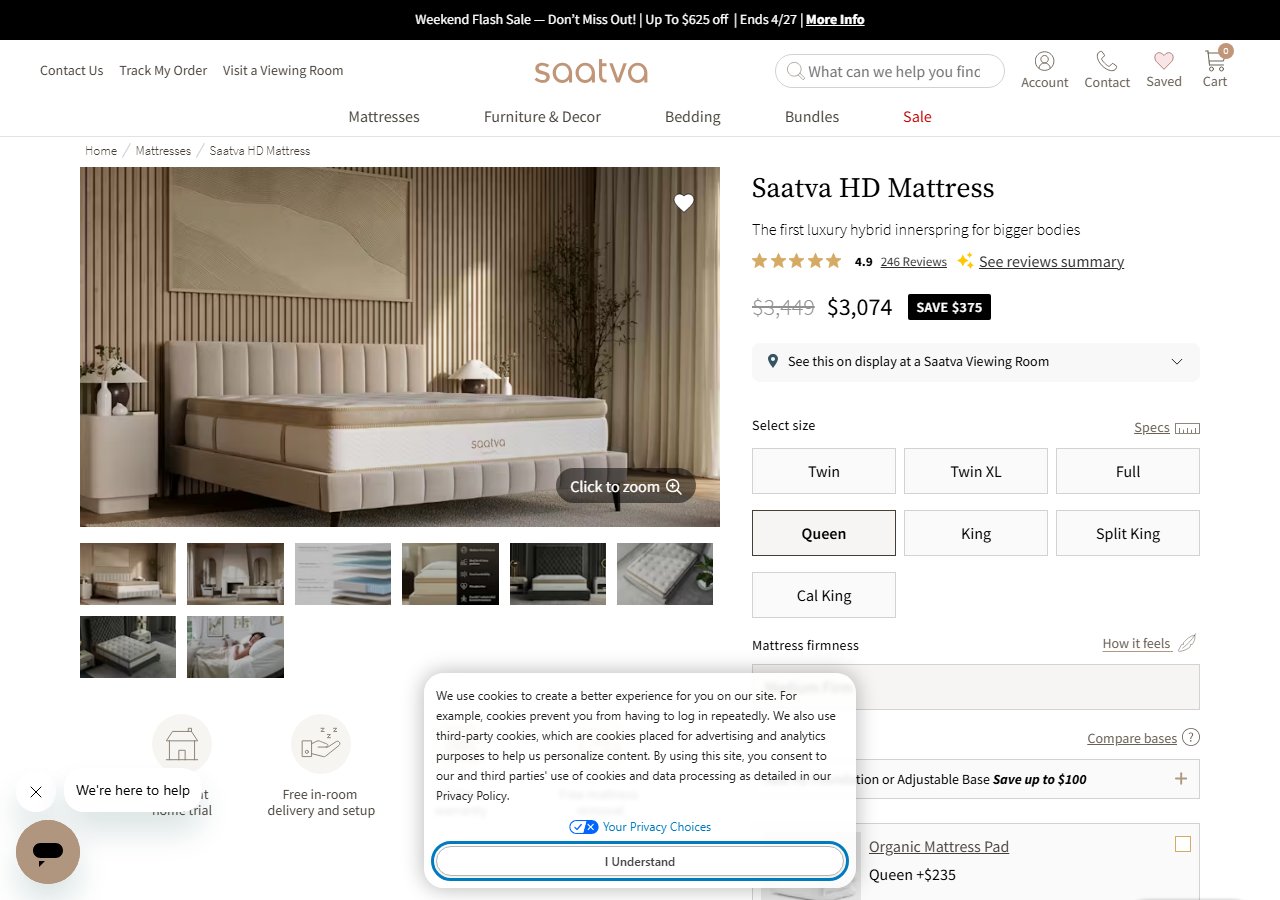
Saatva HD Mattress (Heavy-Duty)
$2,395-$3,995
See Price at Saatva →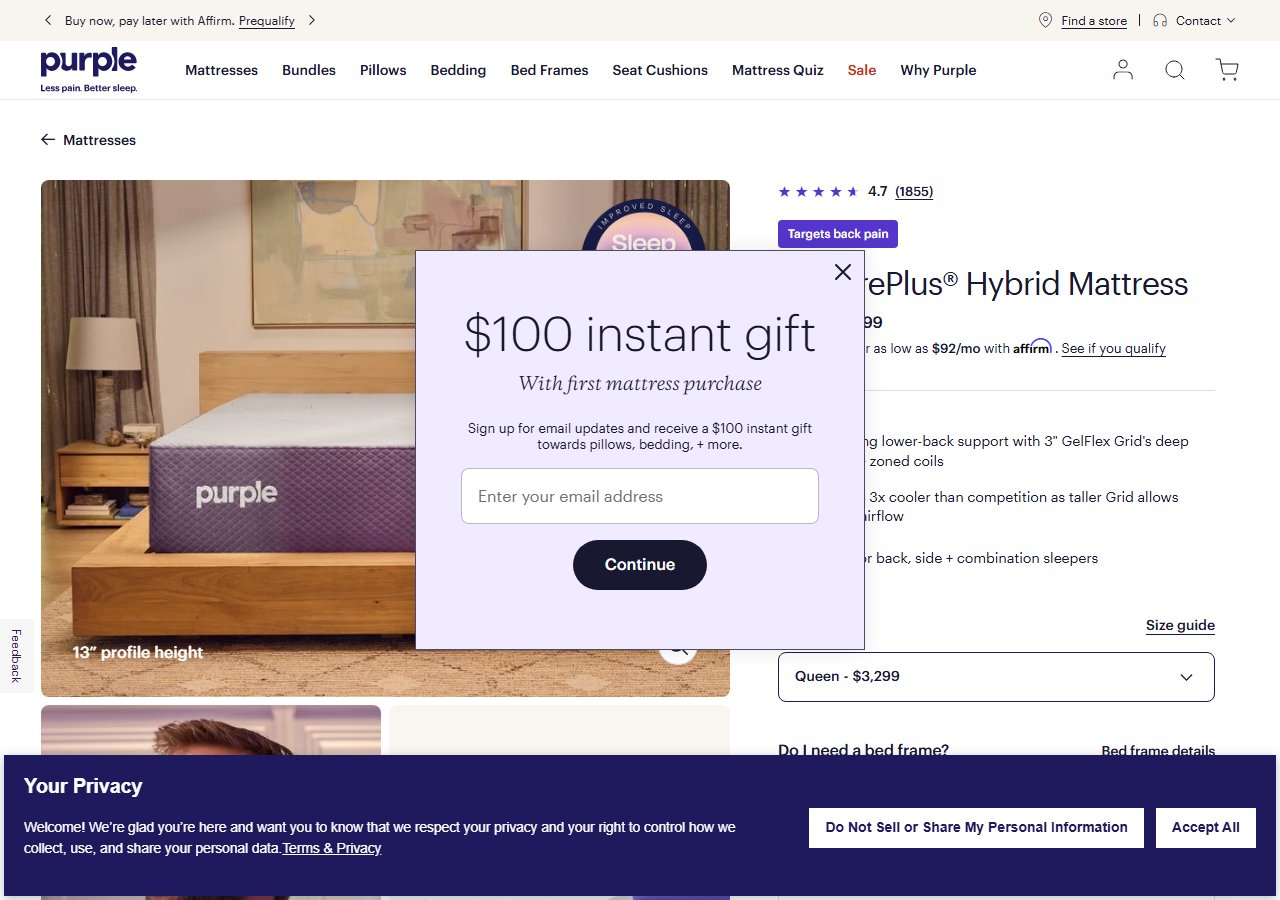
Purple Hybrid Premier Mattress
$2,499-$4,799
See Price at Purple →Putting the Data Hierarchy Together
The federal data reviewed in this article describes a clear and sequential problem. Warehousing is one of the highest-MSD sectors in the U.S. economy. The back is the most injured body part in that sector and across all occupations. The injury mechanism is documented: repetitive compressive loading, sustained lumbar flexion, and asymmetric twisting under load. The recovery window is the off-duty hours — particularly sleep. The sleep surface is one of the few variables in the recovery cycle that the worker controls. And the healthcare cost of not managing chronic lumbar pain — captured in AHRQ MEPS expenditure data, AHRQ HCUP hospital cost data, and CMS drug spending figures — dwarfs the cost of any mattress on this list.
The decision hierarchy for a warehouse worker with chronic lower back pain should follow the same sequence this article used: exhaust the free variables first (sleep position, movement, lifting mechanics), confirm that the existing mattress is not past its functional life, rule out red-flag symptoms that require clinical evaluation, and then — if those steps are complete — select a sleep surface matched to your specific load profile and sleep position. A worker who weighs 240 pounds and sleeps primarily on their back needs a different surface than a 180-pound side sleeper, even if both have chronic lumbar pain. The products above were selected with that specificity in mind.
The BLS will continue to count warehouse back injuries as long as the work remains physically demanding. What changes is whether each individual worker manages the recovery cycle intelligently enough to keep those injuries from becoming the chronic, disabling, expensive conditions that SSA disability data and AHRQ cost data describe. That management happens mostly in the hours between shifts — and it starts with the surface you sleep on.