The Back Injury Crisis Hidden Inside American Warehouses
There is a federal data point that rarely makes it into workplace safety conversations but should be on every warehouse manager's wall and every picker's phone: according to BLS Musculoskeletal Disorders by Occupation tracking, the back is the most commonly injured body part across all U.S. occupations that result in days away from work. Not the hands. Not the knees. The back — the same structure that warehouse workers load, compress, flex, and torque for eight to twelve hours a shift, often across rotating schedules that destroy consistent sleep.
If you are a warehouse worker reading this, you likely already knew that in your body before you read it in a federal database. The ache that starts in the lumbar region around hour six, the stiffness when you climb out of bed the next morning, the way certain bends at the pick station send a jolt up the left side — these are not personal failings or bad luck. They are predictable biomechanical consequences of a work environment that federal occupational health data has documented for decades.
This article is structured deliberately. We cover the mechanism of warehouse back strain first, because understanding why it happens changes how you address it. Then we cover non-product interventions — the cheapest and often most effective levers — before discussing clinical red flags that a sleep surface cannot fix. Only then do we get to mattresses, because a mattress is a useful recovery tool, not a treatment, and it works best when it is part of a strategy rather than a substitute for one.
Why Warehouse Work Destroys the Lumbar Spine: The Federal Evidence
The NIOSH Lifting Equation, the federal government's most authoritative tool for evaluating manual material-handling risk, provides a rigorous framework for calculating the point at which a lift becomes dangerous to the spine. Its core finding, replicated across decades of occupational research: manual material-handling tasks across warehousing, construction, and healthcare routinely exceed safe spinal loading limits. Not occasionally. Routinely.
Here is what that means mechanically. The lumbar spine — specifically the intervertebral discs between L4, L5, and S1 — acts as a shock absorber and load transfer system. Under controlled conditions, with proper mechanics and adequate recovery time, these discs handle compressive force through hydraulic pressure from their fluid nucleus. The problem in warehouse work is threefold:
1. Load magnitude. Warehouse tasks involving repetitive lifting of boxes, pallets, and inventory units frequently push lumbar compressive forces beyond the 3,400-newton action limit the NIOSH Lifting Equation identifies as the threshold where tissue damage risk rises sharply. A 50-pound box lifted with even slight forward trunk lean can generate over 700 pounds of compressive force at the L5-S1 disc.
2. Repetition and fatigue. A single heavy lift is rarely the injury event. It is the cumulative exposure across hundreds of lifts in a shift, over weeks and months, that degrades disc integrity, fatigues the erector spinae and multifidus muscles, and progressively narrows the protective range before tissue failure. BLS days-away-from-work data consistently shows this cumulative pattern in overexertion injuries.
3. Inadequate recovery windows. This is where sleep surface matters. Intervertebral discs are avascular — they rehydrate and recover through a passive, pressure-dependent process called imbibition, which occurs primarily during rest and recumbent positioning. When workers sleep on surfaces that keep the spine in sustained lateral flexion or extension — a sagging mattress, a surface too soft to support the lumbar lordosis, or a firmness profile mismatched to body weight — that recovery process is compromised. Eight hours of poor sleep position is not neutral; it is additional cumulative spinal stress layered on top of what the shift already produced.
The downstream consequences of unchecked lumbar damage are severe. SSA Disability Insurance data identifies musculoskeletal disorders as the largest single category of new disability claims annually in the United States. AHRQ HCUP data places back pain among the most expensive conditions in U.S. healthcare by total inpatient and outpatient cost. And CMS Drug Spending Dashboard data identifies opioid and non-opioid pain medication among the most costly Medicare drug categories — a figure that reflects the treatment burden of chronic pain that was, in many cases, preventable.
BLS Employer Costs for Employee Compensation data adds a workforce-level framing: industries with high musculoskeletal disorder incidence carry workers' compensation insurance rates 3 to 5 times higher than low-MSD industries. That premium reflects real risk — and real workers who are no longer able to do the job they trained for.
The CDC NCHS Data Brief 390 provides the population context: approximately 20% of U.S. adults experience chronic pain, with lower back as the most common pain location. For warehouse workers, whose occupational exposure to the primary risk factor for lumbar injury is measured not in occasional incidents but in daily hours, that already-elevated baseline population figure understates the sectoral risk.
The Sleep Variable: Why 35% of Workers Are Starting Already Behind
Before we even get to mattress firmness or support zones, there is a more basic problem. CDC Sleep and Sleep Disorders data shows that approximately 35% of U.S. adults report sleeping fewer than 7 hours per night — the threshold the CDC associates with elevated risk for obesity, diabetes, heart disease, and mental health disorders. For shift workers specifically, research on circadian disruption (documented extensively in NIOSH shift-work literature) shows that irregular schedules — alternating days and nights, early-morning starts, mandatory overtime — compound sleep deprivation by forcing sleep during circadian phases the body does not find natural.
This matters for lumbar recovery because the rehydration cycle described above is time-dependent. The discs need sustained, quality recumbent time. A worker getting five interrupted hours on a mattress that sags in the middle is getting neither the quantity nor the quality of rest the spine needs to recover. Sleep surface is not the only variable — but it is one of the few variables a worker can control at home when they cannot control their shift schedule, their pick quota, or their facility's ergonomic infrastructure.
Try These First: Free and Low-Cost Interventions Before Any Purchase
The most evidence-supported back pain interventions do not require spending any money. The cheapest intervention is always the one that requires no purchase at all. Federal health agencies have published direct, actionable guidance on what works — and what works first is usually movement, mechanics, and position, not equipment.
Start with daily walking. The NIH National Center for Complementary and Integrative Health's evidence review on low-back pain finds that walking 30 minutes on most days reduces chronic low-back pain as effectively as most non-drug clinical treatments. For warehouse workers who spend their shifts walking but in posturally loaded, task-constrained patterns, unloaded walking — no pack, no weight, no quota — functions differently on the lumbar musculature. It stimulates blood flow to paraspinal muscles, reduces inflammatory load, and maintains the disc health that compressive work degrades. If you are choosing between a new mattress and a commitment to daily walks, the walk wins by a wide margin in the evidence base.
Next, address lifting and bending mechanics on the job. OSHA's ergonomics guidance is explicit: hinge at the hips, not the lumbar spine; keep loads close to the body's center of mass; avoid twisting under load. Most acute back episodes in warehouse settings are mechanical and — critically — rehearsable. The lumbar flexion-rotation injury pattern that accounts for a large share of disc herniations is not random; it follows predictable movement errors that can be corrected with specific cuing and practice. This is not a mattress problem.
Third, fix your sleep position before you replace your mattress. NIH back pain guidance from the National Institute of Arthritis and Musculoskeletal and Skin Diseases is direct: side-sleeping with a pillow between the knees maintains spinal alignment and reduces hip-drop stress on the lumbar spine. Back-sleeping with a pillow under the knees reduces lumbar extension load. Stomach-sleeping torques the lumbar spine and exacerbates chronic pain. A free position change — with a repurposed pillow — can materially change the quality of spinal rest without any purchase.
Finally, know when the mattress itself is the problem. CDC Sleep Hygiene guidance and orthopedic consensus both point to the same signal set: replace a mattress if it shows visible sagging (greater than 1 to 1.5 inches of body impressions), if you consistently wake stiffer than you went to bed, or if it is older than 7 to 10 years. Even the most expensive mattress available does not compensate for poor sleep hygiene, sedentary off-shift hours, or mechanical lifting errors. But a mattress that is past its functional life is actively adding to cumulative spinal stress — and that is a legitimate equipment problem.
If you have already made the position changes, are walking consistently, and are still waking up in lumbar pain — and your mattress is either visibly degraded or past its service life — then the question of which sleep surface to replace it with becomes legitimate and worth examining carefully. The rest of this article addresses that question directly.
When to See a Clinician: Red Flags a Mattress Cannot Address
Not every back pain presentation is a recovery and sleep-surface problem. NIH National Institute of Neurological Disorders and Stroke guidance on back pain establishes clear clinical thresholds: back pain that radiates below the knee, follows a traumatic event, presents with leg weakness, involves bowel or bladder changes, or is accompanied by fever requires prompt clinical evaluation — not a mattress purchase. These symptoms suggest nerve compromise, spinal canal pathology, infection, or fracture, none of which are addressable by a change in sleep surface.
For warehouse workers specifically, two additional patterns deserve clinical attention. First, pain that is consistently worse at rest or at night — rather than better — is a red flag for inflammatory or oncologic spine pathology, which presents very differently from mechanical overuse injury. Second, CDC Arthritis data documents that approximately 25% of U.S. adults report doctor-diagnosed arthritis, with prevalence concentrated in physically demanding occupations. Workers in their 40s and 50s who have spent years in warehouse roles should discuss joint status with a clinician, because arthritis management involves disease-modifying approaches that a mattress cannot replicate. The AHRQ Medical Expenditure Panel Survey shows that adults with chronic back conditions incur substantially higher annual personal healthcare expenditures than those without — a cost trajectory that earlier clinical intervention can disrupt. If your back pain is daily, worsening, and limiting your function off the job, a physician or physical therapist is the right first call.
Where Sleep Surfaces Fit: The Equipment Case for Warehouse Workers
With the mechanism understood, the free interventions deployed, and the clinical red flags ruled out, the question of which sleep surface best serves a warehouse worker's lumbar recovery becomes a legitimate materials science and biomechanics question. The answer is not one-size-fits-all, and it is not simply "firmer is better" — a common misconception that the orthopedic literature has revised substantially over the past two decades.
What the evidence supports: a medium-firm to firm support profile that maintains lumbar lordosis in the supine and lateral positions, adequate pressure relief at the hips and shoulders to prevent compensatory postural distortions, and — critically for heavier workers — a support core rated for the actual body weight of the user. Many standard mattresses are engineered for a 130-180 pound average, which means a 240-pound warehouse worker will compress into the soft comfort layer much faster, generating exactly the hammock sag position that loads the lumbar spine throughout the night.
For workers experiencing serious lumbar pain and wanting premium memory foam support, the Saatva Loom & Leaf is the first option worth examining. Its multi-layer memory foam construction — with a 5-pound-density memory foam layer at the core and a gel-infused surface layer for temperature management — provides the contouring pressure relief that reduces hip and shoulder point loading, while the high-density support base maintains the firmness floor needed to prevent the hammock effect. Saatva offers it in both Relaxed Firm and Firm profiles, and for most warehouse workers with active lumbar pain, the Relaxed Firm is the better clinical match: firm enough to support, compliant enough to conform. At $1,695 to $3,295 depending on size, it is a serious investment — and it is built with the density and material quality to hold its support profile for 10-plus years, which amortizes the cost well below the annual healthcare expenditure premium that AHRQ MEPS documents for adults with chronic back conditions.
For workers at higher body weights — the 250-plus-pound range that is well-represented in physically demanding warehouse roles — the Saatva HD is specifically engineered for exactly this load profile. The HD's lumbar zone support system uses a targeted coil architecture under the center third of the mattress to resist the progressive compression that standard innersprings exhibit under sustained heavy load. Its support core is rated for users up to 500 pounds, and the dual coil layer provides both motion isolation and a support floor that standard mattresses cannot maintain. For a 270-pound worker who has been sleeping on a standard queen mattress and waking stiff every morning, the HD's zoned support system addresses a structural mismatch that no amount of position adjustment can fully compensate. Priced at $2,395 to $3,995, it is positioned as a purpose-built solution, not a premium generalist.
For workers whose primary complaint is pressure-point pain at the hips and shoulders — often the result of years of joint loading that has sensitized soft tissue — the Purple Hybrid Premier offers a materially different support mechanism. Purple's GelFlex Grid is a non-foam polymer structure that collapses under point loads (relieving pressure at the hip and shoulder prominences) while remaining rigid under distributed loads (supporting the lumbar and pelvic region). The result is a pressure map that looks fundamentally different from both foam and innerspring surfaces — and for workers with concurrent hip or shoulder joint sensitivity alongside lumbar pain, that differentiation is clinically meaningful. At $2,499 to $4,799, it is the premium pressure-relief option in this set.
Mattresses Built for Warehouse Workers' Lumbar Recovery
These three sleep surfaces were selected specifically for the load profiles, body weight ranges, and pressure-point patterns that BLS and NIOSH data associate with warehouse and material-handling occupations — not for general consumer use.

Saatva Loom & Leaf Memory Foam Mattress
$1,695-$3,295
See Price at Saatva →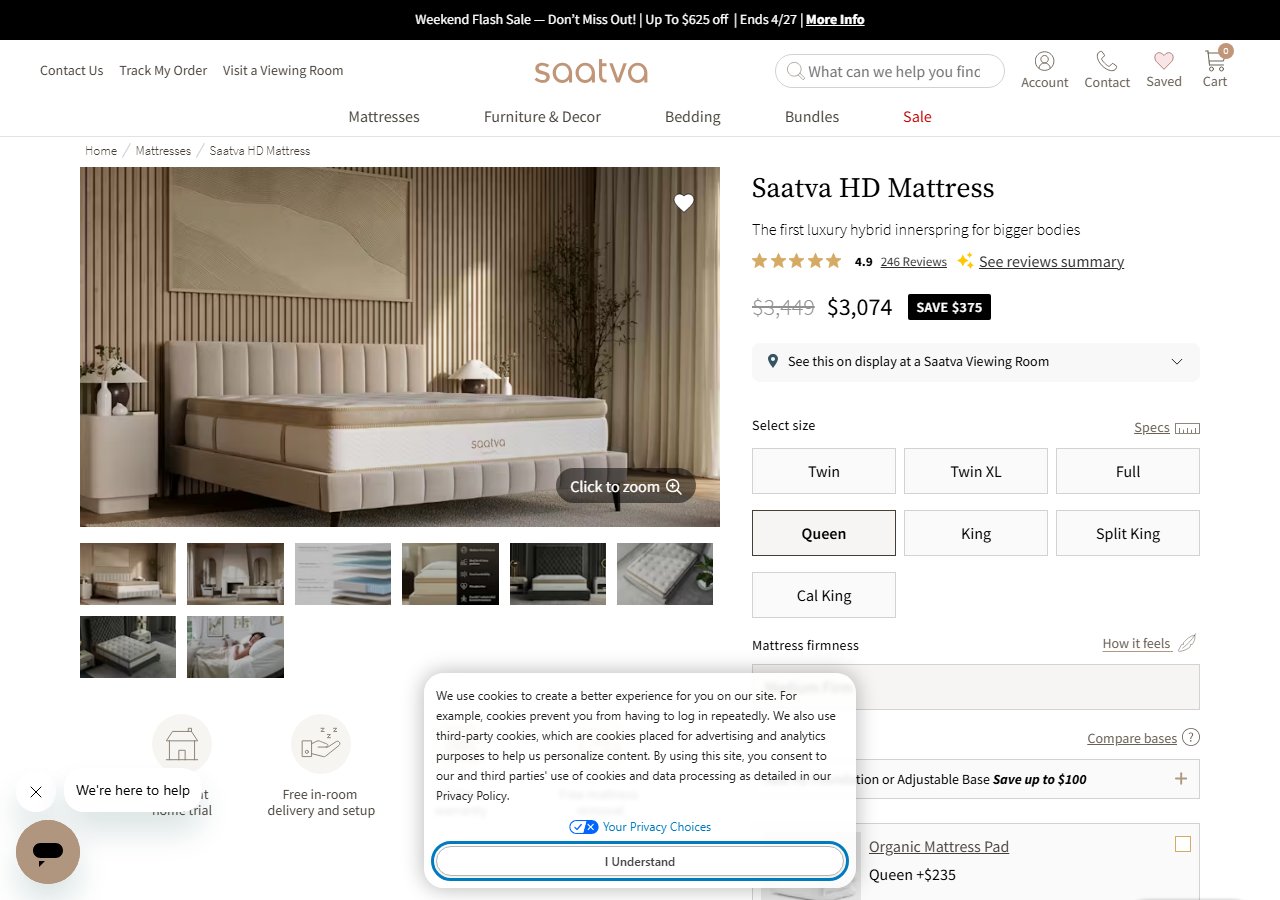
Saatva HD Mattress (Heavy-Duty)
$2,395-$3,995
See Price at Saatva →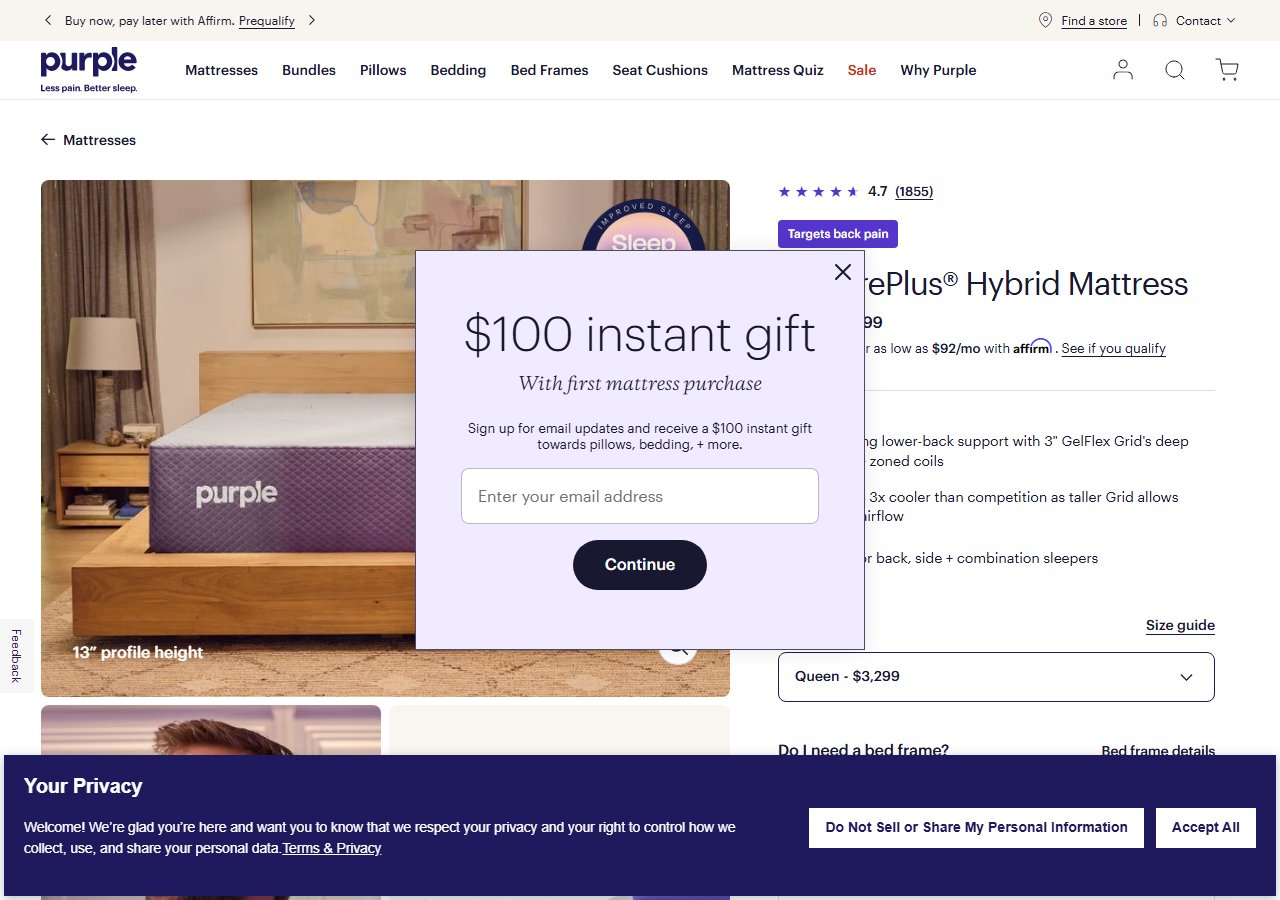
Purple Hybrid Premier Mattress
$2,499-$4,799
See Price at Purple →Matching the Surface to the Worker: A Framework
The three options above are not interchangeable. The framework for choosing among them follows directly from the federal data and biomechanical logic established earlier in this article:
- If your primary complaint is lumbar stiffness and you are in the 130-240 pound range: The Saatva Loom & Leaf Relaxed Firm addresses lumbar support and pressure relief in a balanced profile built to last.
- If you are over 250 pounds and waking stiff regardless of sleep position: The Saatva HD's heavy-duty zoned support system addresses the structural mismatch between standard mattress engineering and higher body weights.
- If hip or shoulder pressure pain is the dominant symptom alongside back pain: The Purple Hybrid Premier's GelFlex Grid provides the most differentiated pressure relief in this set.
None of these options replaces the interventions that come before them in the hierarchy. The NIOSH Lifting Equation's documentation of routine spinal overloading in warehousing is an occupational systems problem — it requires ergonomic controls at the facility level, movement habits at the individual level, and clinical monitoring for workers with escalating symptoms. Sleep surface quality is one recovery variable among several. But for workers who have addressed what they can control during their shifts and are still losing recovery hours to a degraded or mismatched sleep surface, upgrading that surface is one of the highest-leverage off-shift investments available.
The Bottom Line: Federal Data, Free Interventions, Then Equipment
The BLS has documented for years that warehouse and material-handling work produces some of the highest back injury rates in the American economy. NIOSH has quantified why — routine exceedance of safe spinal loading limits in manual material-handling tasks. The downstream costs appear in SSA disability claim data, in AHRQ healthcare expenditure tracking, in CMS drug spending on pain medications. These are not abstract policy numbers. They describe the physical trajectory of workers who did not get the recovery support — biomechanical, clinical, and environmental — that their jobs demanded.
The hierarchy matters: fix your movement mechanics, address your sleep position, walk daily, and see a clinician if your symptoms cross the red-flag thresholds NIH has identified. If you have done those things and your mattress is still the weak link in your recovery chain, the options in this article are engineered with the load profiles and support architectures that warehouse workers' bodies actually require — not the average sedentary consumer who the mainstream mattress market was built to serve.