The Federal Data on Warehouse Back Injuries Is Not Subtle
If you work in a warehouse — fulfillment center, distribution hub, cold storage, freight dock — you already know the feeling: a dull, persistent ache that starts in the lumbar spine sometime around hour six of a ten-hour shift and follows you home. What you may not know is that federal occupational safety data has been measuring and documenting that pain for decades, and the numbers are stark.
The Bureau of Labor Statistics identifies the back as the most common body part injured across all U.S. occupations with days away from work, and warehousing and storage consistently appears near the top of industry-level MSD incidence tables. The NIOSH Lifting Equation documents that manual material-handling tasks in warehousing routinely exceed safe spinal loading limits — not occasionally, not in edge cases, but as a structural feature of how most warehouse work is physically organized. Pallets get stacked at floor level. Conveyor heights are set for throughput, not ergonomics. Pick rates are set by software, not by spinal biomechanics.
The downstream consequence is predictable. CDC NCHS Data Brief 390 reports that approximately 20% of U.S. adults live with chronic pain, and lower back is the most common pain location. For warehouse workers, that population average understates the occupational reality. And SSA Disability Insurance data identifies musculoskeletal disorders as the single largest category of new disability claims annually — meaning the workers who cannot recover from these injuries are flowing into disability insurance at scale.
The financial burden confirms the clinical one. AHRQ MEPS data shows that adults with chronic back conditions carry substantially higher annual personal healthcare costs than those without, and AHRQ HCUP data identifies back pain as one of the most expensive conditions in U.S. healthcare by total inpatient and outpatient cost. BLS Employer Workers' Compensation data shows that high-MSD industries carry workers' comp insurance rates 3–5x higher than low-MSD counterparts. This is not a personal wellness problem. It is a structural occupational hazard with a measurable cost trajectory.
The question this article addresses is narrow and specific: given what federal data tells us about warehouse lumbar load and recovery deficits, what does sleep surface quality actually contribute to the recovery equation, and which products are worth the investment?
Why Warehouse Work Destroys Lumbar Discs Faster Than Almost Any Other Occupation
To understand why mattress firmness matters specifically for warehouse workers — as opposed to, say, desk workers with incidental back discomfort — you need to understand the biomechanical mechanism.
The lumbar spine is a stack of five vertebrae separated by intervertebral discs, which are gel-filled shock absorbers that hydrate and decompress during non-load-bearing rest. Under compressive load — lifting, carrying, bending — those discs are squeezed. Axial compression from a 50-pound lift, performed with even decent technique, generates roughly 770 pounds of compressive force on the L4-L5 disc, according to NIOSH biomechanical modeling. Poor technique, twisting under load, or lifting from floor level dramatically increases that figure.
Warehouse workers perform dozens to hundreds of these lifts per shift, often with progressively deteriorating technique as fatigue accumulates. The NIOSH Lifting Equation was developed specifically because occupational researchers recognized that the cumulative spinal load in manual material handling environments consistently exceeded what human tissue could sustain without injury over a career. The equation defines a "recommended weight limit" that accounts for task frequency, lift origin and destination, trunk rotation, and other variables — and in real warehouse conditions, actual lifts routinely exceed those limits.
Disc degeneration, facet joint arthritis, and lumbar muscle fatigue accumulate over years of this loading. CDC arthritis data reports that approximately 25% of U.S. adults have doctor-diagnosed arthritis, with prevalence concentrated in physically demanding occupations — warehouse workers are not just members of that 25%, they are disproportionately represented in it.
Here is where sleep enters the equation as a recovery variable, not merely a comfort preference: during sleep, the spine is unloaded. Intervertebral discs rehydrate. Paraspinal muscles — the deep stabilizers of the lumbar spine — recover from the sustained low-level contraction they maintain during standing and walking. When that recovery window is compromised by an inadequate sleep surface, the worker enters the next shift already behind on recovery. Over weeks and months, that deficit compounds.
CDC sleep data shows that approximately 35% of U.S. adults already sleep fewer than 7 hours per night, a threshold the CDC associates with elevated chronic disease risk. Shift workers — and warehouse workers disproportionately work rotating, early-morning, or overnight shifts — have even worse sleep architecture than day workers, because circadian disruption fragments REM and deep sleep stages. A mattress that fails to support neutral spinal alignment on top of circadian disruption creates a recovery deficit that cannot be offset by any amount of ibuprofen.
Try These First: Free and Low-Cost Interventions That Federal Research Supports
Before this article gets to product recommendations, it is worth stating plainly: the cheapest intervention is the one that does not require buying anything. Federal research agencies have invested significant resources documenting which non-product interventions move the needle on chronic low back pain, and for warehouse workers, several of those interventions are immediately actionable.
Lifting and bending mechanics are the most upstream intervention. OSHA's ergonomics guidance is explicit: hinge at the hips, not the lumbar spine. Keep loads close to the body. Never twist under load — rotate your feet, not your torso. Most acute warehouse back episodes are mechanical in origin, meaning they result from a specific biomechanical error that is learnable and rehearsable. A single session with an occupational physical therapist demonstrating proper hip-hinge mechanics can have more durable impact than any mattress.
Daily walking is, according to NIH NCCIH's evidence review of low back pain interventions, as effective as most non-drug clinical treatments for reducing chronic low back pain. Thirty minutes of walking most days keeps the paraspinal muscles active, maintains disc hydration through movement-driven fluid exchange, and reduces the inflammatory stiffness that accumulates during sedentary off-shift hours. The irony for warehouse workers — who spend their shifts walking — is that post-shift walking often drops to near zero. Purposeful walking, distinct from occupational walking, has different biomechanical and psychological effects.
Sleep position is a free and immediately adjustable variable. NIH guidance on back pain recommends side-sleeping with a pillow between the knees, or back-sleeping with a pillow under the knees, to maintain spinal neutrality during sleep. Stomach sleeping forces the lumbar spine into hyperextension and rotates the cervical spine — both positions that worsen chronic pain and accelerate disc compression rather than reversing it. For a warehouse worker, changing sleep position from stomach to side is free, available tonight, and has evidence behind it.
Mattress age and condition matter before brand and firmness level do. CDC sleep hygiene guidance and clinical consensus suggest replacing a mattress if it shows visible sag, if you wake stiffer than when you went to bed, or if it is older than 7 to 10 years. A heavily worn mattress creates a hammock-like depression that places the lumbar spine in sustained flexion for 7–8 hours per night — precisely the position that loads already-fatigued lumbar structures further.
For workers who have already addressed sleep position, are walking consistently, have received training on lift mechanics, and are sleeping on a mattress less than seven years old with no visible sag — and are still waking with lumbar stiffness, or sleeping poorly enough that it affects performance and recovery — a mattress upgrade becomes a clinically defensible expenditure. The products below are selected specifically for the load patterns and body composition profiles that characterize warehouse work.
When a Mattress Is Not the Answer: Clinical Red Flags
The federal research literature is clear that most acute low back pain resolves within six to eight weeks with conservative management. But some back pain signals pathology that requires imaging, specialist referral, or emergency care — and no mattress addresses those signals.
NIH neurological disorders guidance on back pain identifies several presentations that require prompt clinical evaluation rather than self-management: back pain that radiates below the knee (a potential indicator of disc herniation with nerve root compression or spinal stenosis), pain following trauma, pain accompanied by leg weakness or numbness, pain with bowel or bladder changes (a potential indicator of cauda equina syndrome, which is a surgical emergency), or pain accompanied by fever or unexplained weight loss. These are not "serious sounding" symptoms to use in a disclaimer — they are specific clinical criteria for conditions that imaging and specialist evaluation can identify and treat.
Warehouse workers face particular risk here because occupational culture frequently discourages reporting injuries or seeking care. CMS drug spending data identifies opioid and non-opioid pain medications among the most expensive Medicare drug categories — which reflects, among other things, what happens when musculoskeletal injuries go unmanaged clinically for years and eventually require pharmacological management. The workers who end up as new SSA disability claimants did not get there overnight. They worked through pain that warranted earlier clinical attention.
If any of the red flags above apply to you, see a clinician before spending money on a new mattress. The mattress recommendations below are appropriate for workers managing mechanical low back fatigue and recovery-quality deficits — not for workers with undiagnosed neurological symptoms or structural pathology.
Where Products Help: Mattress Firmness, Load Profile, and the Warehouse Worker
With mechanism established, interventions prioritized, and clinical red flags surfaced, the product conversation can be grounded in something more useful than brand marketing: what does federal biomechanical research tell us about what a warehouse worker's spine actually needs from a sleep surface?
The answer involves three variables. First, firmness level: for the majority of back-pain sufferers, research supports medium-firm to firm surfaces — enough resistance to prevent lumbar sag into the mattress, but enough give to allow the shoulder and hip (which protrude further than the lumbar spine in side-sleeping) to sink to a neutral position. A surface that is too firm creates a pressure point at the hip and shoulder while the lumbar spine hangs unsupported. A surface that is too soft allows the lumbar spine to sink into flexion.
Second, weight capacity and support structure: warehouse workers are often larger-bodied men and women. The Bureau of Labor Statistics occupational profile for warehousing skews male, physically active but also physically fatigued, and frequently in the 180–280 pound range. Standard consumer mattresses are engineered for an average-weight sleeper. A worker at 240 pounds compresses a standard innerspring or foam mattress significantly more than the test conditions those mattresses are designed around, which changes the effective firmness level and spinal alignment outcome.
Third, pressure relief at the hip and shoulder: workers who carry occupational muscle soreness into sleep need a surface that dissipates pressure at the major bony prominences without compromising lumbar support. This is the core engineering tension in mattress design for this population.
The Saatva Loom & Leaf Memory Foam Mattress addresses the first and third variables with a layered memory foam construction that offers two firmness options — Relaxed Firm and Firm — designed specifically around spinal alignment rather than generic comfort. The Firm option uses a 5-pound-density memory foam that resists the sinkage that causes lumbar flexion during sleep, while the quilted organic cotton Euro-top manages surface pressure at the hip and shoulder. For a warehouse worker managing lower lumbar fatigue who needs contouring without sag, this is the premium foam pick in this lineup. Loom & Leaf is priced from $1,695, which is a meaningful expenditure — but relative to the AHRQ MEPS data on chronic back condition healthcare costs, a single urgent care visit and a course of physical therapy can easily exceed that figure.
For workers who are larger-bodied — say, over 220 pounds — or who have found that standard mattresses sag and lose support within the first year or two, the Saatva HD Mattress is engineered specifically for that load profile. The HD is a heavy-duty innerspring design with a higher coil gauge, reinforced perimeter support, and a weight capacity rated to 500 pounds per side. It is not a mattress for the average consumer — it is a mattress built around the structural reality that a large worker exerts significantly more force on a sleep surface than the industry's standard test assumptions account for. The edge support is also notably robust, which matters for workers who sit on the edge of the bed to put on work boots and need that zone to resist compression. Priced from $2,395, it is an investment, but for the worker who has gone through two or three standard mattresses in five years due to sagging, the durability calculus changes.
For workers whose primary complaint is pressure-related soreness — hip pain from side sleeping, shoulder pain from accumulated occupational stress — the Purple Hybrid Premier Mattress offers a meaningfully different engineering approach. Purple's GelFlex Grid is a polymer grid structure that behaves differently from both foam and coil systems: it collapses under bony prominences (relieving pressure) while remaining firm beneath the lumbar spine (maintaining alignment). For a worker with hip bursitis or rotator cuff irritation from occupational activity, this pressure-differential response can translate to measurably less sleep disruption from pain. The Purple Hybrid Premier also runs cooler than dense memory foam, which matters for workers who run warm after physically demanding shifts. Priced from $2,499.
Mattresses Built for Warehouse Worker Lumbar Recovery
These three mattresses were selected for their alignment with the specific load profiles, body composition ranges, and pressure-relief needs documented in federal occupational research on warehouse and manual material-handling workers.

Saatva Loom & Leaf Memory Foam Mattress
$1,695-$3,295
See Price at Saatva →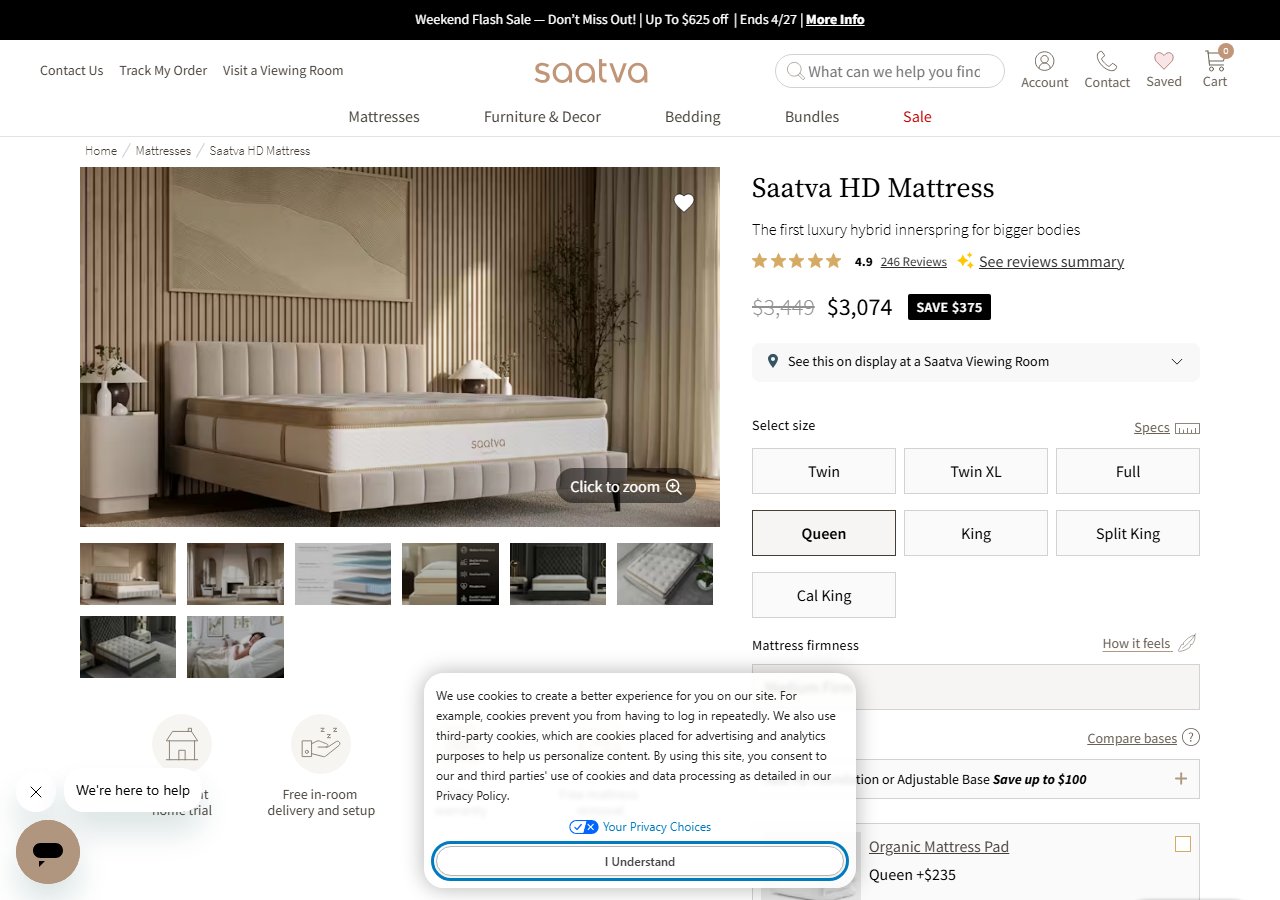
Saatva HD Mattress (Heavy-Duty)
$2,395-$3,995
See Price at Saatva →
Purple Hybrid Premier Mattress
$2,499-$4,799
See Price at Purple →Making the Investment Decision: A Data-Grounded Framework
A new mattress in the $1,700–$4,000 range is not an impulse purchase. For a warehouse worker earning median wages — the BLS Occupational Employment and Wage Statistics program puts the median for warehouse and storage workers in the $35,000–$45,000 annual range — this is a meaningful expenditure that warrants a structured decision framework.
Here is how to think about it using the federal data as anchors:
First, exhaust the free interventions. Sleep position adjustment, consistent walking, and lifting mechanics review cost nothing. If you have not deliberately tried side-sleeping with a pillow between the knees for 30 consecutive nights, do that before spending $2,000 on a new mattress.
Second, assess your current mattress honestly. Lie flat on your back on the mattress and slide your hand under the small of your back. If there is a significant gap — meaning the mattress is not supporting the lumbar curve — your mattress is either too firm or has developed structural failure (sagging). If you wake stiffer than when you went to bed, that is a signal. If the mattress is over eight years old, it has almost certainly lost meaningful structural support regardless of how it looks.
Third, match product to load profile. If you are under 200 pounds and your primary complaint is lumbar stiffness, the Loom & Leaf Firm is a well-matched choice. If you are over 220 pounds or have historically broken down mattresses within a few years, the Saatva HD is the more durable platform. If hip or shoulder pressure pain is your dominant symptom, the Purple Hybrid Premier's grid technology addresses that mechanism directly.
Fourth, remember the cost trajectory of unmanaged back pain. The AHRQ HCUP data on back pain as a top-tier healthcare cost and the SSA disability data on MSDs as the leading disability claim category document where inadequately managed warehouse back injuries can lead. A mattress is not a substitute for clinical care, but for workers managing mechanical fatigue rather than structural pathology, optimizing the 7–8 hours of recovery time available each night is one of the highest-leverage interventions available outside of a clinical setting.
The federal data on warehouse musculoskeletal injury is consistent, longitudinal, and not ambiguous. The back is the most injured body part. The spinal loading in manual material handling routinely exceeds safe limits. Chronic pain affects one in five Americans, with lower back as the leading site. Sleep deficits compound injury risk. The downstream costs — personal, occupational, and systemic — are among the highest in the U.S. healthcare system.
A mattress investment, made with clear eyes about what it can and cannot do, is a defensible tool in that context. Move first, manage your lifting mechanics, optimize your sleep position, and see a clinician if you have red flag symptoms. Then, if a better sleep surface is still indicated, buy it with the knowledge that you have done the work that no product can substitute for.