The federal case against the 12-hour seated shift
Here's a number worth sitting with — though not for too long: the CDC's Chronic Disease Indicators database reports that approximately 1 in 4 U.S. adults has chronic low-back pain, and sedentary occupations are explicitly listed among the documented contributors. That figure represents tens of millions of people, many of them showing up to their desks, dispatch consoles, nurse's station charting seats, or call-center terminals for 12-hour stretches, day after day, in chairs that were never engineered for that duration.
This article is for the people working those shifts. The emergency dispatchers clocking 12-hour rotations. The healthcare administrators and nurses doing seated charting between physical tasks. The remote workers whose "office" is a spare bedroom chair. The customer experience agents glued to a headset for half a day. The federal data on what sustained sitting does to the lumbar spine is not subtle — and neither are the solutions, once you understand the mechanism.
Why sustained sitting breaks down the lumbar spine: the biomechanical mechanism
Human spines were not designed for static seated posture. The intervertebral discs that cushion your lumbar vertebrae are avascular — they receive oxygen and nutrients through diffusion driven by movement and compressive load changes. When you sit still for extended periods, that diffusion slows. Intradiscal pressure increases in flexed seated postures compared to standing upright, and the posterior annular fibers of lumbar discs experience sustained tensile stress. Over a single 12-hour shift, the cumulative load is significant. Over months and years of shift work, the mechanism becomes a clinical reality.
NIOSH's ergonomics guidance identifies awkward seated posture as one of the top three exposure factors for office-related musculoskeletal disorders — alongside repetitive motion and contact stress. The key word is "awkward." A perfectly maintained neutral lumbar curve in a correctly fitted chair reduces posterior disc load substantially compared to forward-flexed slouching. But neutral posture requires active muscular effort that fatigues over time, which is why the first two hours of a shift feel manageable and the last two hours feel like a slow-motion injury in progress.
OSHA's Ergonomics page makes the regulatory case unambiguous: prolonged static seated posture is an ergonomic risk factor that explicitly requires workplace mitigation. This is not opinion — it is federal occupational health guidance. Employers who ignore it are not just leaving worker health on the table; they are leaving a cost exposure on the table. BLS data on employer costs for workers' compensation shows that back and neck claims rank among the highest-cost injury categories, a financial reality that makes ergonomic investment look less like a perk and more like a liability hedge.
The weight variable matters too. CDC NHANES data reports that approximately 39% of U.S. adults have obesity — a figure that shapes the ergonomics conversation in a direct, biomechanical way. Excess body weight increases compressive lumbar load in the seated position, raises center-of-gravity in ways that shift the pelvis posteriorly, and demands meaningfully more from a chair's lumbar support architecture. A chair rated for the average 170-pound office worker performing an 8-hour day is not the same engineering problem as seating for a 240-pound dispatcher working 12-hour rotations. Federal data on obesity prevalence is the reason chair lumbar support quality matters more than most buyers realize.
The healthcare worker specific case
BLS Healthcare Industry data provides a particularly instructive case study. Nurses and direct-care staff face elevated lower-back injury rates partly attributable to seated charting time between physically demanding tasks. This is the worst-case ergonomic pattern: high-intensity physical loading (patient transfers, lifts, repositioning) interspersed with extended static seated posture at charting stations. The muscles are fatigued from load, and then asked to maintain postural tone for an hour of documentation. Lumbar extensor fatigue compounds the disc load problem. The chair at the charting station is not incidental — it is the final insult in a chain of exposures that the BLS data captures at the occupational-injury level.
Office and administrative support workers face a related but distinct risk profile. BLS Survey of Occupational Injuries and Illnesses data shows these workers report higher-than-average rates of repetitive strain and seated-posture musculoskeletal claims. The mechanism is different from the healthcare worker's — less dramatic loading events, more relentless low-grade postural stress compounded over a full shift.
The cheapest intervention is the one that doesn't require buying anything
Before we discuss chairs — and we will discuss specific chairs, in detail — the federal evidence is clear that behavioral and environmental interventions precede equipment in the hierarchy of ergonomic effectiveness. This is not a philosophical position. It is what NIOSH micro-break research demonstrates: 30-second breaks every 30 minutes reduce reported musculoskeletal symptoms in computer users regardless of chair quality. The chair cannot compensate for static posture the way movement can. A $1,500 ergonomic chair that you sit in without moving for three uninterrupted hours will produce worse outcomes than a $300 chair used with consistent micro-break discipline.
Similarly, OSHA's Computer Workstations eTool specifies that monitor position, keyboard height, and workstation geometry all interact with seated posture in ways that a chair cannot override. If your monitor is 15 degrees below eye level and you're craning your neck forward for 12 hours, the lumbar support on any chair is solving the wrong problem. The setup sequence matters, and it costs nothing to get right.
Hip flexor tightness is the postural residue of a 12-hour shift, and no chair eliminates it — but two minutes of targeted stretching, grounded in CDC adult physical activity guidelines, can. Thoracic mobility work undoes the rounding pattern that sustained sitting imposes on the upper back, which in turn reduces the compensatory lumbar extension that strains the facet joints.
For readers who have already adopted micro-break habits, corrected their workstation geometry, and integrated daily mobility work — and still find that 12-hour shifts are generating cumulative back discomfort — seating quality becomes a genuinely meaningful variable. The evidence for high-adjustability ergonomic chairs comes from the OSHA specification framework: seat height, lumbar support position, armrest height, and seat-pan depth are the four primary chair variables for achieving neutral posture, and budget chairs routinely compromise two or three of those four. When all four are correctly calibrated for your body, the muscular effort required to maintain neutral posture across a 12-hour shift decreases — and that is where equipment investment pays a measurable return.
When to see a clinician: red flags that no chair addresses
This is the section that affiliate-driven ergonomics content skips. We are not skipping it.
NIH back pain guidance from the National Institute of Arthritis and Musculoskeletal and Skin Diseases lists chair fit and lumbar support as modifiable risk factors for chronic low-back pain in office workers. That is evidence for the value of seating quality — but the same source is unambiguous that certain back pain presentations require medical evaluation, not ergonomic shopping. A new chair does not treat radicular symptoms. A $1,500 ergonomic chair does not reverse disc herniation. It does not address spinal stenosis, sacroiliac joint dysfunction, or lumbar facet arthropathy. It does not treat pain that has a neurological component.
NIH's National Institute of Neurological Disorders and Stroke back pain guidance is direct: persistent pain with radiation into the leg, numbness or tingling, muscular weakness, bowel or bladder changes, or back pain that wakes you from sleep are red flags requiring clinical evaluation. These are not "try a better chair" symptoms. If any of these describe your experience, the ergonomics conversation is secondary to a medical one.
Clinical red flags for 12-hour shift workers with back pain:
- Pain that radiates below the knee, particularly with numbness or tingling — possible lumbar nerve root involvement (NIH NINDS)
- Bilateral leg weakness or heaviness, especially after extended sitting — possible central canal compromise (NIH NINDS)
- Back pain that wakes you from sleep or is present at rest — may indicate non-mechanical pathology (NIH NIAMS)
- Any bowel or bladder dysfunction concurrent with back pain — potential cauda equina involvement; seek emergency evaluation (NIH NINDS)
- Pain unresponsive after 6 weeks of conservative management — warrants clinical imaging and specialist referral (NIH NIAMS)
Where seating quality becomes a legitimate variable
For the reader whose back pain is mechanical — the posture-related, end-of-shift fatigue and stiffness that resolves with movement and rest, without neurological symptoms — chair quality is a real lever. The OSHA framework gives us the evaluation criteria: a chair must allow precise adjustment of seat height, lumbar support position and depth, seat-pan depth, and armrest height and width. Any chair that compromises adjustability in more than one of those dimensions is not an ergonomic chair in the federal-guidance sense of the term. It is a seat with ergonomic marketing.
Three chairs warrant discussion here, positioned against the OSHA adjustment framework and the specific demands of a 12-hour shift.
The Steelcase Leap V2 is the most mechanically sophisticated chair in this comparison for long-shift use. Its LiveBack technology — the mechanism that allows the seatback to actually change shape with your spine's movement — is engineered specifically for the problem of postural fatigue over extended periods. Where a standard lumbar support is a fixed curve that fits well at hour two and poorly at hour ten (when your posture has shifted), the Leap's back flexes with you. The Lower Back Firmness control lets you dial in exactly how much support the lumbar zone provides, and the Natural Glide System allows forward movement that keeps your hips and torso aligned as you lean toward the screen — a critical feature for the charting nurse or the dispatcher who's constantly referencing a console. At $1,189, it is a meaningful investment, but the mechanical case for it holds up against the OSHA specification framework more completely than most chairs at any price.
The Herman Miller Aeron (Size B) is the reference point against which most high-end ergonomic chairs are benchmarked, and for good reason. The PostureFit SL lumbar system supports both the sacrum and the lumbar simultaneously — the two-zone approach that most single-pad lumbar systems ignore. The 8Z Pellicle mesh varies in tension across the seat and back zones, which matters for 12-hour shift use because it distributes pressure more evenly than foam-over-frame construction. At $1,499.99, it is priced above the Leap, and the case for the Aeron over the Leap often comes down to mesh preference and body geometry. The Aeron sizes (A, B, C) are anthropometrically specified — a level of fit specificity that matters when the CDC data tells us that 39% of U.S. adults are obese and the range of body geometries in the workforce is wide.
For readers who need a capable ergonomic chair at a significantly lower price point, the ELABEST X100 Ergonomic Mesh Chair with Footrest at $319.99 offers the core adjustability framework that OSHA specifies — height adjustment, lumbar support, armrests — with the addition of an integrated footrest that improves circulation for shorter users or those who work at fixed-height desks. It does not match the mechanical sophistication of the Leap or the Aeron, and for a true 12-hour daily-use scenario, the durability and support precision of the higher-end options will be felt over months of use. But for workers who cannot access employer ergonomic programs and need meaningful improvement over a standard office chair at a manageable price, the X100 delivers the OSHA-specified adjustability variables at a fraction of the premium chair cost.
Ergonomic Chairs Engineered for 12-Hour Shift Demands
These three chairs were selected because they meet the OSHA-specified adjustability criteria — seat height, lumbar support, seat-pan depth, and armrest position — that federal guidance identifies as essential for neutral posture in sustained seated-work environments.
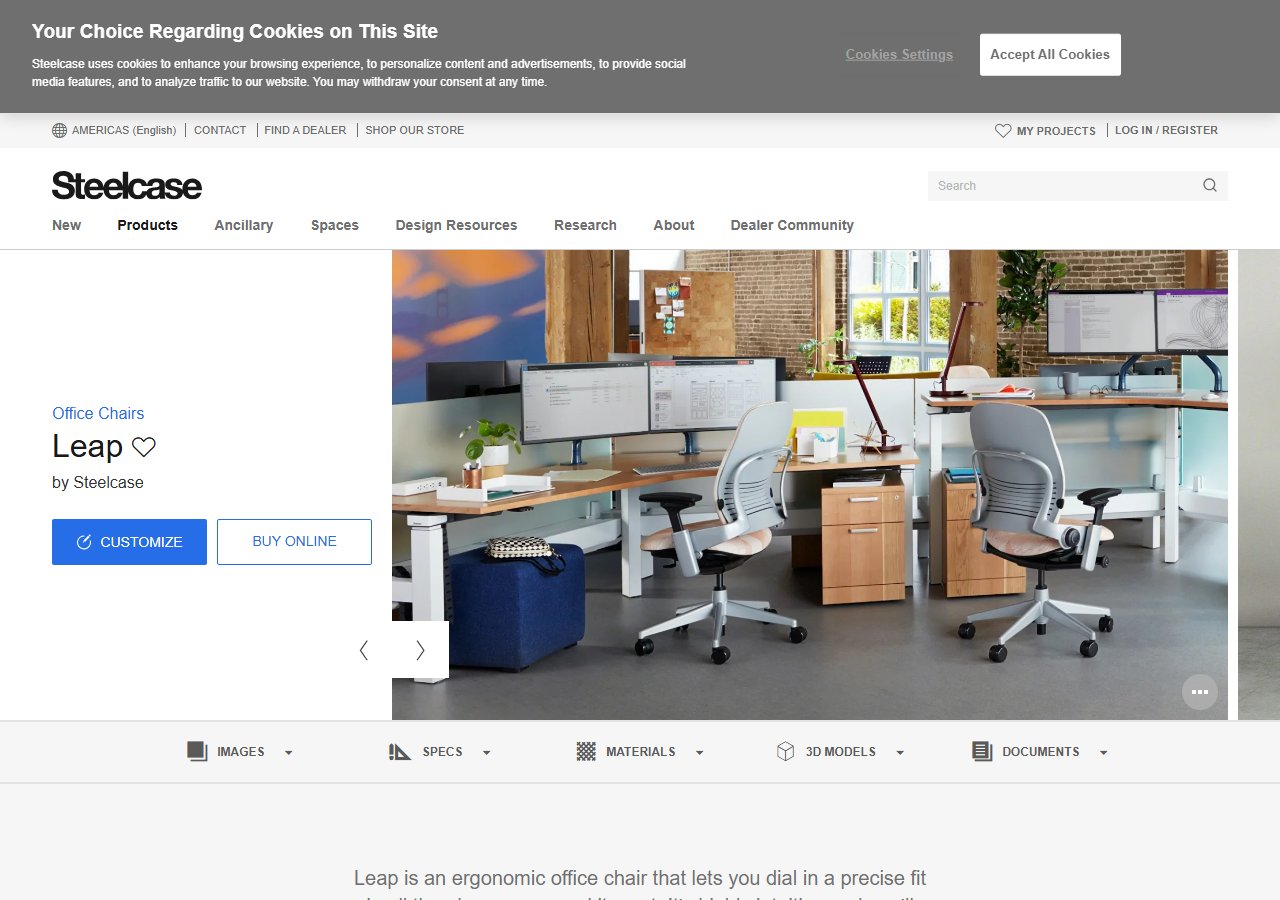
Steelcase Leap V2 Office Chair
$1,189
See Price at Steelcase →
Herman Miller Aeron Ergonomic Chair - Size B, Graphite Size B Graphite
$1,499.99
Check Price on Amazon →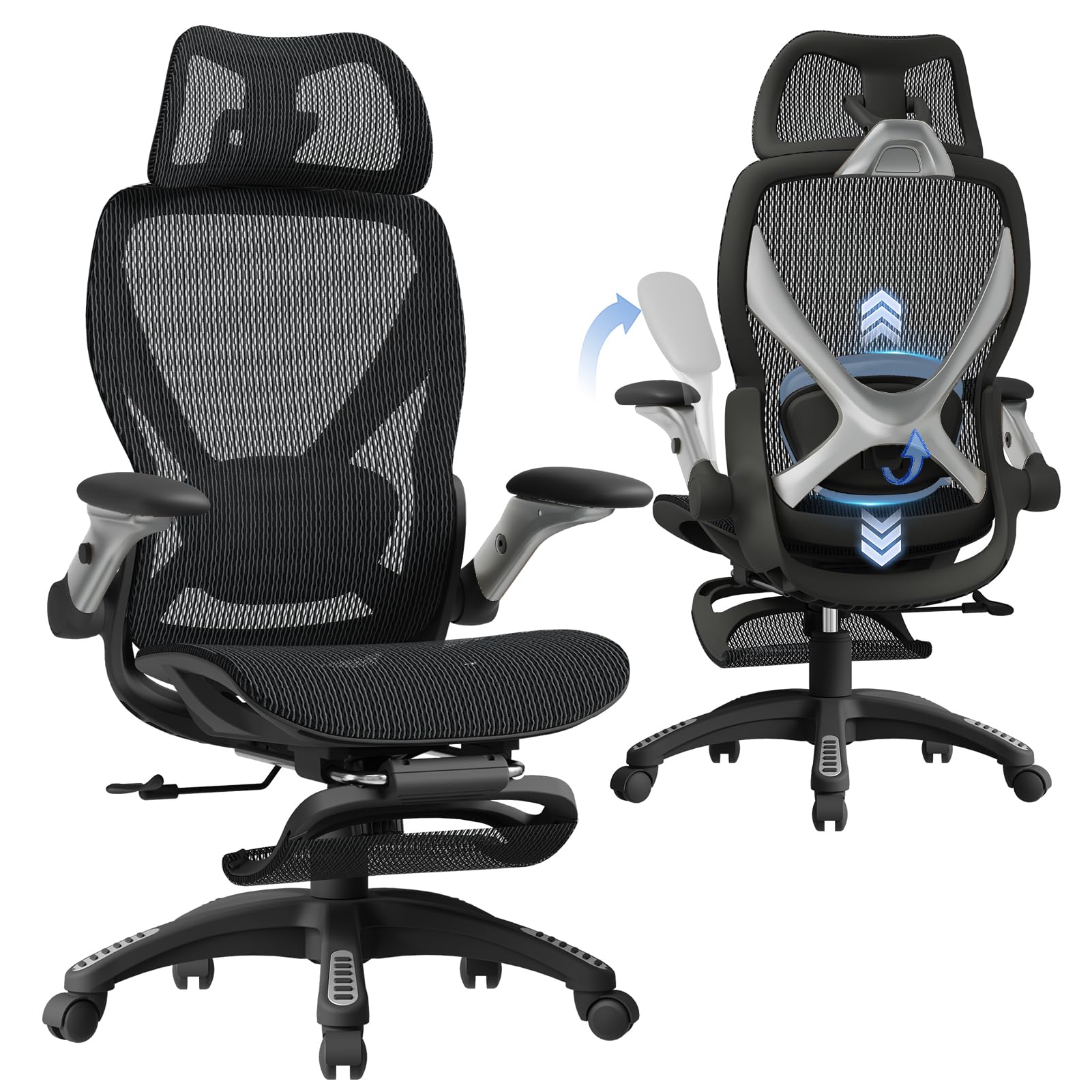
ELABEST X100 Ergonomic Mesh Office Chair with Footrest, Big and Tall Hone Des...
$319.99
Check Price on Amazon →The data-to-intervention hierarchy, restated
The federal evidence on sustained sitting and musculoskeletal injury is substantial, internally consistent, and points to a clear hierarchy of intervention. CDC data establishes the prevalence of chronic low-back pain in sedentary-occupation workers. NIOSH research shows that behavioral interventions — micro-breaks, postural resets — outperform equipment upgrades in isolation. OSHA's specification framework tells us exactly what a chair must do to achieve neutral posture. NIH guidance tells us when a chair is irrelevant and clinical care is the priority.
Working that hierarchy in order — behavior and environment first, clinical screening to rule out red flags, then equipment — is the approach that the federal evidence supports. The Steelcase Leap V2 is the chair this data points to for most 12-hour shift workers who have worked the hierarchy correctly: it solves the posture-fatigue problem over extended durations in ways that cheaper chairs cannot. The Herman Miller Aeron is the precision-fit alternative with a documented legacy. The ELABEST X100 is the budget-accessible entry into genuine adjustability.
What none of them can do is substitute for movement, workstation setup, and — when the red flags appear — medical care. The chair is one tool in the intervention set. Federal data tells us it belongs at step three, not step one.