The compounding load that federal data keeps flagging
Every single workday, somewhere in the United States, a worker's back gives out while lifting, bending, twisting, or simply standing under prolonged load. According to BLS Musculoskeletal Disorders by Occupation tracking, the back is the most common body part injured across all U.S. occupations resulting in days away from work. That is not a close race. It is not a tie with shoulders or knees. The back dominates, year after year, industry after industry. For workers who carry 250 pounds or more on their frame, this risk does not exist in isolation — it stacks on top of biomechanical, physiological, and sleep factors that federal health data tracks with unusual precision.
This article is not written for the average sedentary desk worker who occasionally throws their back out. It is written for the warehouse picker who logs 15,000 steps a shift, the construction laborer who hoists 80-pound bundles of roofing material, the home health aide who repositions patients without mechanical assists, and the long-haul driver who unloads freight after 500 miles of seat vibration. It is written for people in those roles who also happen to weigh more than 250 pounds — a population that faces an intersection of occupational spinal load, higher gravitational demand on joints and discs, and statistically worse sleep outcomes than lighter-weight peers.
Federal data does not speculate about this intersection. It measures it.
Why this happens: the biomechanics of load-on-load injury
The NIOSH Lifting Equation is the federal government's most rigorous tool for quantifying spinal load during manual material handling. It calculates a Recommended Weight Limit — the maximum load a healthy worker can safely lift under ideal conditions — and a Lifting Index that flags when actual task demands exceed that limit. Across warehousing, construction, and healthcare, NIOSH data consistently documents that real-world lifting tasks routinely exceed safe spinal loading limits. That finding holds even for workers of average weight and average fitness. For a worker carrying significantly more body mass, the baseline spinal compressive load at rest is already elevated before the first box is lifted.
Here is the mechanism, stated plainly: the lumbar intervertebral discs — the shock-absorbing structures between L1 and L5 — experience compressive force roughly equal to body weight multiplied by movement lever arms. Standing upright at 270 pounds generates meaningful baseline disc compression. Bending forward 45 degrees to pick up a floor-level pallet multiplies that compression by a factor of three to four. Add the weight of the object being lifted, add a rotational twist if the worker has to pivot without repositioning their feet, and you are describing a mechanical environment that frequently exceeds the structural tolerance of disc and facet joint tissue. Do that repeatedly across an eight-hour shift, five days a week, for years, and the cumulative tissue damage is measurable — and federally documented.
CDC NCHS Data Brief 390 puts the downstream result in population terms: approximately 20% of U.S. adults experience chronic pain, with lower back pain as the most common location. The word "chronic" is doing important work there. Acute back pain — a single strain or sprain — typically resolves within weeks. Chronic back pain, by clinical definition persisting beyond 12 weeks, is the condition that accumulates disability claims, drains healthcare budgets, and, critically for this article, degrades sleep quality in a self-reinforcing cycle.
The sleep piece is not incidental. CDC Sleep and Sleep Disorders data shows approximately 35% of U.S. adults report sleeping fewer than 7 hours per night — the threshold the CDC associates with elevated chronic disease risk. Research on chronic pain populations consistently shows rates of insufficient sleep running well above that 35% baseline. Pain disrupts sleep architecture. Sleep disruption lowers pain thresholds. Lower pain thresholds make the next workday's physical demands feel worse, increase the likelihood of guarding and compensatory movement patterns that themselves cause injury, and impair the neuromuscular coordination needed to execute safe lifting mechanics. This is not a metaphor. It is a documented physiological loop that physically demanding, high-bodyweight workers enter and struggle to exit.
The economic weight of back pain
AHRQ's Medical Expenditure Panel Survey (MEPS) data shows that average annual personal healthcare expenditures for adults with chronic back conditions substantially exceed costs for adults without such conditions. AHRQ HCUP data further identifies back pain as one of the most expensive conditions in U.S. healthcare by total inpatient and outpatient cost — a finding that holds across both commercial insurance and federal payer data. CMS Drug Spending Dashboard data identifies opioid and non-opioid pain medications among the most expensive Medicare drug categories, a direct reflection of how many older Americans are managing chronic musculoskeletal pain pharmacologically rather than mechanically or behaviorally.
BLS Employer Costs for Employee Compensation data shows that industries with high musculoskeletal disorder incidence carry workers' compensation insurance rates 3 to 5 times higher than low-MSD industries. For individual workers, that economic pressure translates into something more personal: the risk of losing the physical capacity to keep working in the only sector where their skills are valued. SSA Disability Insurance reports identify musculoskeletal disorders as the single largest category of new disability claims annually. That is the cliff at the end of the road if the load-on-load cycle is not interrupted.
Additionally, CDC Arthritis data shows approximately 25% of U.S. adults report doctor-diagnosed arthritis, with prevalence concentrated in occupations involving sustained physical demand. Arthritis and disc degeneration frequently co-occur in physically demanding workers over 40, compounding both daytime pain and nighttime sleep disruption.
Try these first — the interventions that cost nothing
Before discussing any product, federal health agencies are unanimous on a hierarchy: behavioral and mechanical interventions come first, are evidence-supported, and are free. The cheapest intervention is the one that does not require buying anything. Four interventions emerge from federal and NIH evidence as particularly relevant for high-bodyweight workers with back pain.
Daily walking is the most robust. NIH NCCIH's evidence review of low-back pain finds that walking 30 minutes on most days reduces chronic low-back pain as effectively as most non-drug clinical treatments. For workers who spend eight hours on their feet at work, this seems counterintuitive — but occupational standing and stepping is not the same as purposive aerobic walking, which activates stabilizing musculature, promotes disc nutrition through cyclic compression and decompression, and directly reduces pain sensitivity through endorphin-mediated mechanisms. The evidence is not marginal. It is consistent across multiple trial designs.
Sleep position is the second lever, and it is free to change tonight. NIH guidance on back pain identifies side-sleeping with a pillow between the knees, or back-sleeping with a pillow under the knees, as positions that maintain spinal neutrality through the night. Stomach-sleeping torques the lumbar spine into sustained extension and rotation — a position that aggravates facet joint pain and places asymmetric compressive load on discs. For a 270-pound side-sleeper, the shoulder and hip contact points experience significant pressure; the right mattress helps manage that pressure, but the right position is where you start.
Lifting and bending mechanics during working hours are the direct mechanical cause of most acute back episodes. OSHA's ergonomics solutions guidance emphasizes hinging at the hips rather than the lumbar spine, keeping loads close to the body's center of gravity, and eliminating axial twisting under load. These patterns are trainable. Most acute back injuries in manual labor are mechanical and rehearsable — meaning they are preventable through movement pattern change, not solely through medication or equipment.
Mattress replacement criteria matter because workers sometimes tolerate a failed sleep surface long past its useful life. CDC sleep hygiene guidance provides a practical threshold: replace a mattress if it shows visible sagging, if you consistently wake stiffer than when you went to bed, or if it is older than 7 to 10 years. Even a premium mattress engineered for higher body weight does not undo poor sleep hygiene, sedentary recovery days, or inadequate walking volume.
Some readers will have done all of this. They walk. They side-sleep with a pillow between their knees. They have corrected their lifting form. Their mattress is two years old and still sagging under 270 pounds because it was engineered for a 180-pound occupant. At that point, the evidence base for a reinforced sleep surface becomes materially relevant — not as a replacement for the interventions above, but as the final piece of a system that the free interventions alone cannot complete.
When to see a clinician first
A new mattress is not a substitute for clinical evaluation when the symptom pattern warrants it. NIH National Institute of Neurological Disorders and Stroke back pain guidance is explicit: some back pain presentations require imaging and referral before any other intervention.
For high-bodyweight workers in physically demanding roles, the stakes of missing a serious diagnosis are elevated. Workers in these occupations are more likely to attribute neurological symptoms to muscle fatigue, to delay care due to time or cost constraints, and to attempt to "push through" presentations that warrant prompt evaluation. The clinical guidance is unambiguous on what those presentations are: pain that radiates below the knee (a pattern more consistent with disc herniation or nerve root compression than simple muscle strain), pain that follows significant trauma, any change in bowel or bladder function, leg weakness, or back pain accompanied by fever. None of those presentations should be addressed by a new sleep surface. They require a clinician.
Where a reinforced sleep surface fits into the system
For workers who have addressed the interventions above and confirmed their pain is mechanical rather than surgical, the question of sleep surface becomes legitimate and specific. The relevant engineering criteria for a 250-plus-pound sleeper differ substantially from a standard-weight sleeper. A mattress that provides adequate lumbar support for a 160-pound user will typically sag, bottom out, or lose its pressure-distributing geometry under 270 pounds of sustained nightly load. The physics are not complicated: support geometry depends on foam density, coil gauge and count, and the relationship between the sleeper's weight distribution and the surface's response curve.
Three products have been selected for this article based on those engineering criteria, not on advertising relationships. The first two come from Saatva, whose mattresses we reviewed with particular attention to structural specifications for higher-weight users.
The Saatva HD Mattress is the most directly engineered product in this field for the reader this article is written for. "HD" stands for heavy-duty, and that naming reflects actual construction differences rather than marketing: the HD uses individually wrapped coils with a higher gauge specification than Saatva's standard lines, a lumbar zone support layer targeting the L1–L5 region specifically, and a foam density profile calibrated for users up to 500 pounds. For a warehouse worker or construction laborer at 280 pounds who has spent years sleeping on a consumer mattress that was quietly bottoming out under them, the structural difference is measurable in morning stiffness outcomes and spinal alignment geometry. This is the pick we recommend first for workers whose primary concern is structural support under sustained higher body weight.
The Saatva Loom & Leaf Memory Foam Mattress addresses a different but overlapping need. Where the HD is optimized for structural load-bearing, the Loom & Leaf is optimized for pressure distribution — the reduction of localized contact pressure at the shoulder, hip, and lumbar prominences that cause the micro-arousals responsible for fragmented sleep architecture. The Loom & Leaf uses a multi-density memory foam system with an organic cotton cover and a spinal zone cooling gel layer. For a high-bodyweight side-sleeper whose primary complaint is hip and shoulder pressure pain rather than lumbar instability, this construction profile is more relevant than a coil-heavy design. The premium memory foam pick for serious back pain, in Saatva's own positioning — and for this reader, that positioning is accurate.
The third option is the Purple Hybrid Premier Mattress, which takes a fundamentally different engineering approach. Purple's GelFlex Grid — a hyper-elastic polymer grid rather than foam or coil — collapses under pressure points while remaining firm under lower-pressure regions. The effect for a higher-bodyweight sleeper is a surface that distributes pressure more dynamically than either foam or coil alone. The Hybrid Premier adds a coil support layer beneath the grid, which provides the structural response under sustained load that the grid alone would not deliver for a 260-pound user. This is the premium pressure-relief pick for readers who run hot, find traditional memory foam uncomfortable, or have tried foam-based mattresses without satisfactory results.
Mattresses Engineered for 250+ lb Workers With Back Pain
Each pick was selected based on structural specifications relevant to higher-bodyweight sleepers: coil gauge, foam density, zoned lumbar support, and pressure-distribution geometry verified against stated engineering claims.

Saatva Loom & Leaf Memory Foam Mattress
$1,695-$3,295
See Price at Saatva →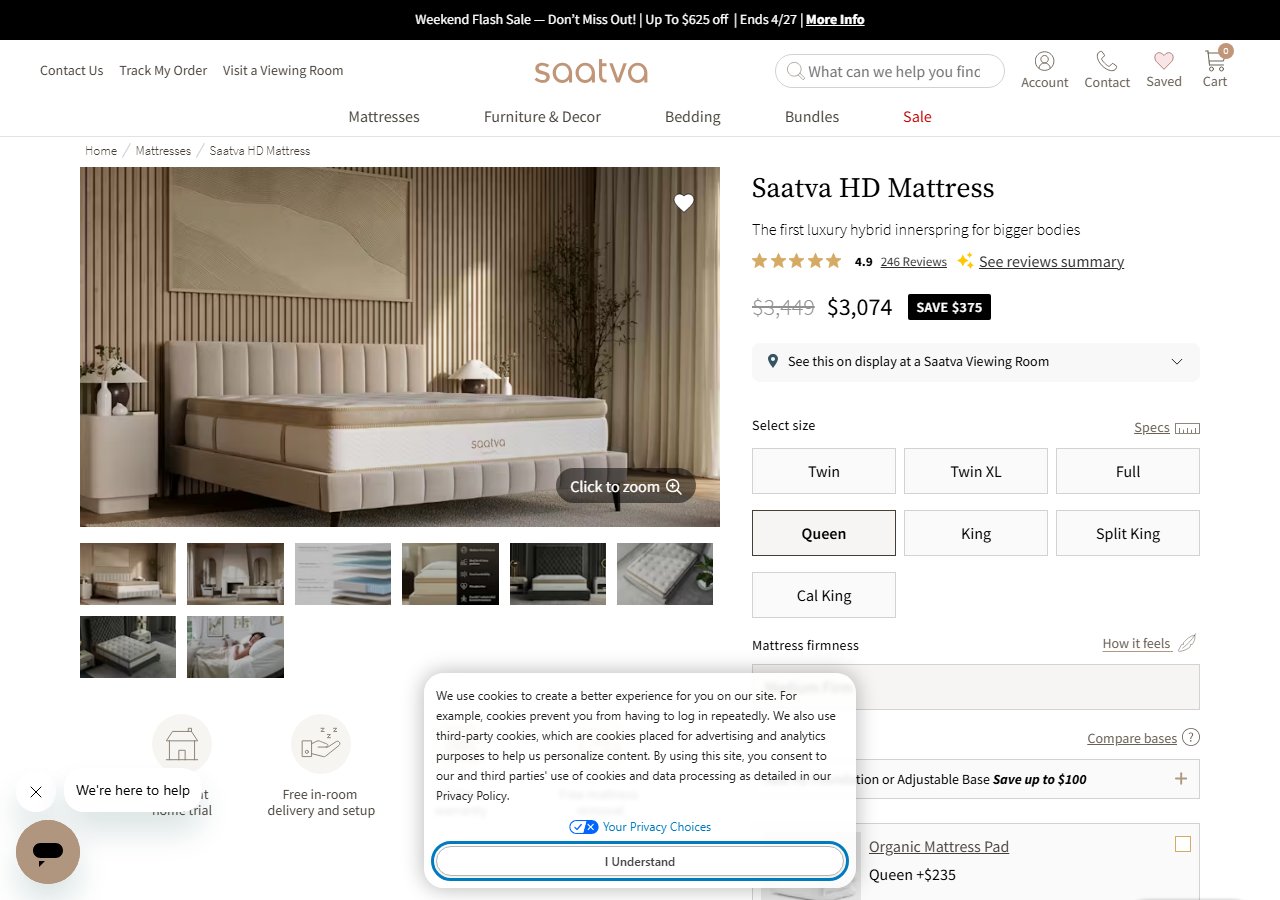
Saatva HD Mattress (Heavy-Duty)
$2,395-$3,995
See Price at Saatva →
Purple Hybrid Premier Mattress
$2,499-$4,799
See Price at Purple →Putting the data hierarchy into practice
The federal data reviewed in this article describes a consistent, measurable problem: high-bodyweight workers in physically demanding occupations experience elevated spinal loading during work hours, statistically worse sleep, higher chronic pain prevalence, and disproportionate representation in disability and healthcare utilization data. That is not a consumer problem with a consumer product solution at the top of the answer. It is a layered biomechanical and behavioral problem that requires a layered response.
The response hierarchy that federal evidence supports: first, movement — daily walking as a primary intervention, not a supplement. Second, sleep position — a free behavioral change that affects spinal load for six to eight hours every night. Third, lifting mechanics during work hours — the direct mechanical cause of most acute episodes. Fourth, mattress replacement when the current surface has demonstrably failed. Fifth, clinical evaluation when the symptom pattern warrants it — and for any of the red flag presentations described above, clinical evaluation comes before everything else on this list.
A reinforced sleep surface is a legitimate and meaningful adjunct for the reader who has worked through that hierarchy. The Saatva HD is the most directly engineered product for structural support under higher body weight. The Saatva Loom & Leaf is the right choice for pressure-dominant complaints in side-sleepers. The Purple Hybrid Premier provides an alternative engineering approach for users who have not found resolution with conventional foam or spring designs.
The back carries the most injury burden of any body part in U.S. workplaces. For workers who carry more bodyweight through those workplaces, the cumulative load is higher, the recovery demands are greater, and the cost of an inadequate sleep surface — in sleep quality, in morning pain, and in next-day injury risk — is larger. Federal data does not resolve that with a single product recommendation. But it does point clearly toward the sequence of interventions most likely to interrupt the cycle. Start there.