The Federal Data Portrait: Back Injuries Don't Clock Out When You Do
According to BLS Musculoskeletal Disorders by Occupation tracking, the back is the single most commonly injured body part across all U.S. occupations that result in days away from work. That is not a finding limited to construction sites or loading docks — it spans healthcare, transportation, retail, and office settings. But for workers in high-exertion occupations who also carry 250 or more pounds on their frame, the injury pathway is compounded at every level: the workday load, the commute, and critically, the hours spent on a sleep surface that was never engineered to handle their weight.
The economic consequences are not abstract. BLS Employer Costs for Employee Compensation data shows that industries with high musculoskeletal disorder (MSD) incidence carry workers' compensation insurance rates 3 to 5 times higher than low-MSD industries. AHRQ HCUP data identifies back pain as one of the most expensive conditions in the entire U.S. healthcare system by total inpatient and outpatient cost. And SSA Disability Insurance reports identify musculoskeletal disorders as the single largest category of new disability claims filed each year. These are not cautionary statistics about rare outcomes. They describe what happens to millions of American workers at the intersection of physical demand and inadequate recovery.
CDC NCHS Data Brief 390 reports that approximately 20% of U.S. adults experience chronic pain, with lower back pain being the most prevalent pain location in that population. For adults who are also above 250 pounds, the biomechanical load on spinal structures during every waking and sleeping hour is meaningfully greater — and the consequences of a poor sleep surface accumulate with every night.
Why This Happens: The Biomechanics of Bodyweight and Spinal Loading
Understanding why higher bodyweight amplifies back-injury risk requires a brief tour through the mechanics. The lumbar spine — the five vertebrae at the base of your back — is the primary load-bearing region of the spinal column. During upright standing, those five segments support essentially your full torso weight plus any external load you are carrying. During forward bending — picking up a box, loading a shelf, making a bed — the compressive force on the L4-L5 and L5-S1 discs can multiply to 6 to 10 times body weight, according to the biomechanical principles underlying the NIOSH Lifting Equation.
For a 175-pound worker, a 40-pound box lift generates approximately 770 pounds of compressive force at L4-L5. For a 275-pound worker performing the same task, that figure climbs past 1,100 pounds — well above what NIOSH's recommended weight limits model as sustainable over a full workday. The NIOSH Lifting Equation was designed precisely to document that manual material-handling tasks across warehousing, construction, and healthcare routinely exceed safe spinal loading limits, and the equation's outputs are more severe as baseline body mass increases.
Now extend that logic to sleep. The average person spends 7 to 9 hours per night lying on a surface that is either supporting or failing to support their spine. For a 150-pound sleeper, most consumer mattresses perform adequately: the foam or spring system has enough resistance to keep the hips from sinking past the shoulders, maintaining spinal neutrality. For a 270-pound sleeper, the same mattress frequently bottoms out — the hips sink disproportionately, the lumbar spine bows into flexion, and the paraspinal muscles that were already taxed by the workday spend the night firing to compensate rather than recovering. By morning, you are stiffer and more sensitized than when you lay down.
This is the mechanism that connects BLS lift-injury data to sleep surface research. The back does not have a clean boundary between occupational stress and recovery-phase stress. If recovery is impaired — by a surface that cannot support the weight it is asked to bear — the accumulated load on spinal discs, facet joints, and supporting musculature simply never fully dissipates.
CDC Arthritis Data adds another layer: approximately 25% of U.S. adults report doctor-diagnosed arthritis, with prevalence concentrated in occupations involving sustained physical demand — the same demographic we are describing. Arthritis in the facet joints of the lumbar spine is both a cause and a consequence of chronic poor loading mechanics, and it makes adequate sleep-surface support not a comfort preference but a functional requirement.
CMS Drug Spending Dashboard data identifies opioid and non-opioid pain medication spending among the most expensive Medicare drug categories — a downstream reflection of what happens when chronic back pain goes unmanaged. The AHRQ Medical Expenditure Panel Survey reinforces this, showing that average annual personal healthcare expenditures for adults with chronic back conditions substantially exceed those for adults without. A better-engineered sleep surface is not a luxury purchase in this context — it is a component of injury management with a calculable downstream cost offset.
And there is a sleep-quantity dimension here too. CDC Sleep and Sleep Disorders data shows approximately 35% of U.S. adults report sleeping less than the 7-hour threshold associated with elevated chronic disease risk. Pain is one of the leading causes of sleep disruption — and poor sleep, in turn, lowers pain thresholds, creating a reinforcing cycle. For heavier adults managing occupational back stress, a sleep surface that fails structurally is not just uncomfortable; it is a direct input into that pain-sleep feedback loop.
Try These First: Free and Low-Cost Interventions That Federal Data Supports
The cheapest intervention is the one that requires no purchase at all. Before you evaluate any sleep surface, work through the behavioral and mechanical variables that federal health guidance specifically endorses for chronic low back pain management. These are not filler recommendations — each has a documented evidence base.
Sleep position is the single highest-leverage free variable. NIH National Institute of Arthritis and Musculoskeletal and Skin Diseases back pain guidance is explicit: side-sleeping with a pillow between the knees, or back-sleeping with a pillow under the knees, keeps the lumbar spine in a neutral position that minimizes disc pressure and muscular strain. Stomach sleeping — the default position for a significant fraction of heavier adults who find it more comfortable initially — torques the lumbar spine into extension and rotation and consistently worsens chronic lower back pain outcomes. If you are a stomach sleeper, position retraining is free and often produces faster relief than any product change.
Daily walking has one of the strongest evidence bases of any non-pharmacological intervention. NIH NCCIH's evidence review on low back pain documents that 30 minutes of walking most days reduces chronic low back pain as effectively as most non-drug clinical treatments. For heavier adults, low-impact cardiovascular movement also assists with the body composition changes that reduce baseline spinal loading — a compounding benefit over time. The new mattress is the tool that supports your recovery; the walk is the intervention that drives it.
Lifting and movement mechanics apply both on and off the job. OSHA's ergonomics guidance makes the core principle clear: hinge at the hips rather than rounding the lumbar spine, keep loads close to the body's center of mass, and never twist under load. Most acute back episodes in heavier adults are mechanically triggered — a poor bending pattern during a single lift, repeated over months, is how a disc herniates. These mechanics are rehearsable. Physical therapists teach them in 2 to 3 sessions; OSHA's free resources communicate the fundamentals at no cost.
Mattress condition assessment before purchase is also free. CDC sleep hygiene guidance provides a useful framework: replace a mattress if it shows visible sag, if you consistently wake stiffer than when you went to bed, or if it is older than 7 to 10 years. But even a degraded mattress does not justify skipping the sleep-position and movement interventions above — those variables interact. The most structurally supportive mattress on the market will underperform if you are stomach-sleeping on it.
For readers who have already addressed sleep position, walk daily, and are working with a physical therapist on mechanics — but who are sleeping on a mattress that cannot support their weight — the evidence does support a targeted equipment investment. The question is what structural properties actually matter for heavier bodies, and which products are engineered to deliver them rather than simply marketed toward them.
When to See a Clinician: Red Flags That No Sleep Surface Can Address
This is the most important section in the article for a subset of readers. Federal clinical guidance is unambiguous that certain presentations of back pain require imaging and physician evaluation before any conservative intervention — including purchasing a new sleep surface.
NIH National Institute of Neurological Disorders and Stroke back pain guidance identifies the following as red flags requiring prompt clinical evaluation: pain that radiates below the knee (possible nerve root compression or disc herniation), pain following trauma, back pain accompanied by leg weakness or numbness, and pain associated with bowel or bladder dysfunction. These are not scenarios where better lumbar support during sleep will produce improvement. They are scenarios where delay in imaging can result in permanent neurological deficit.
Additional flags specific to heavier adults include pain that is worse lying flat than standing (possible vascular or visceral referral rather than musculoskeletal origin), unintentional weight loss accompanying back pain, and back pain in adults over 50 following a fall or minor trauma (possible vertebral compression fracture, for which CDC arthritis and bone health data documents elevated risk). If any of these apply, the path forward begins with your primary care physician or an orthopedic specialist, not with a mattress evaluation.
For the majority of readers — those with chronic mechanical low back pain that is positionally variable, worse after prolonged sitting or lifting, and without neurological signs — the evidence strongly supports both the behavioral interventions above and the structural sleep surface considerations that follow.
Where Sleep Surface Engineering Actually Matters for Heavier Adults
For adults at 250 pounds or above, the standard mattress market has a core structural problem: most consumer mattresses are designed and tested with a reference sleeper in the 150 to 180-pound range. When that mattress meets a 270-pound body, several things fail simultaneously. Foam comfort layers compress beyond their designed operating range, losing the progressive resistance that creates body contouring. Innerspring coil systems deflect past their linear range, causing the hips to dive below the shoulders and eliminating spinal neutrality. Edge support collapses, restricting usable sleep surface. And heat dissipation — important for heavier bodies that generate more body heat — suffers as compressed foam layers become denser.
The engineering response to this is measurable and specific. Heavier sleepers benefit from: higher coil counts with smaller-gauge (higher-tension) steel; multi-zone coil systems that provide differential resistance under hips versus shoulders; high-density foam bases (1.8 PCF or above for support cores) that resist bottoming out; and reinforced perimeter coil systems that maintain edge support under sustained load.
Three mattresses in this category stand out for their documented structural engineering approach rather than their marketing positioning.
The Saatva HD Mattress is the most explicitly engineered-for-heavier-bodies option in this review. Saatva built this mattress specifically for users up to 500 pounds per side, using a dual-tempered steel coil system with a lumbar zone micro-coil insert that provides targeted support at the L1-L5 region — precisely the zone that NIOSH's lifting equation identifies as the primary failure point for overloaded spines. For a warehouse worker or construction professional at 270 pounds who is managing occupational spinal loading daily, this kind of zoned lumbar reinforcement during the recovery phase is not a luxury specification. It is a direct mechanical response to the documented injury pattern.
For heavier adults whose primary complaint is pressure buildup at the hips and shoulders — a common presentation in side-sleepers and in adults with arthritis in the hip joints — the Saatva Loom & Leaf Memory Foam Mattress offers a different engineering profile. Its multi-layered memory foam system uses a 5 PCF density top layer over an organic cotton and natural thistle flame barrier, with an 8-inch support foam base. The higher-density foam maintains its pressure-relieving properties under heavier loads where lower-density foams lose progressive contouring — critical for the kind of consistent hip and shoulder pressure relief that NIH back pain guidance associates with improved sleep position maintenance.
The Purple Hybrid Premier Mattress takes a distinct engineering approach via its GelFlex Grid — a polymer grid structure that does not behave like foam or coil but instead provides a pressure-neutral surface through elastic deformation. The Grid's column-buckling mechanics mean it adapts to applied load nonlinearly, providing more support where the body presses harder (hips, lumbar region) and more give where it presses less (waist, upper back). For heavier adults dealing with the kind of chronic pressure sensitization that develops alongside arthritis or post-injury nerve hypersensitivity, this pressure-neutral property has meaningful theoretical support. The hybrid version adds a pocketed coil base that provides the edge support and overall firmness baseline that heavier sleepers require.
Mattresses Engineered for Heavier Adults Managing Back Pain
Each mattress below was selected specifically for structural properties — coil gauge, foam density, zoned lumbar support, and edge reinforcement — that federal biomechanical standards and clinical back pain research support for adults at 250 pounds and above.

Saatva Loom & Leaf Memory Foam Mattress
$1,695-$3,295
See Price at Saatva →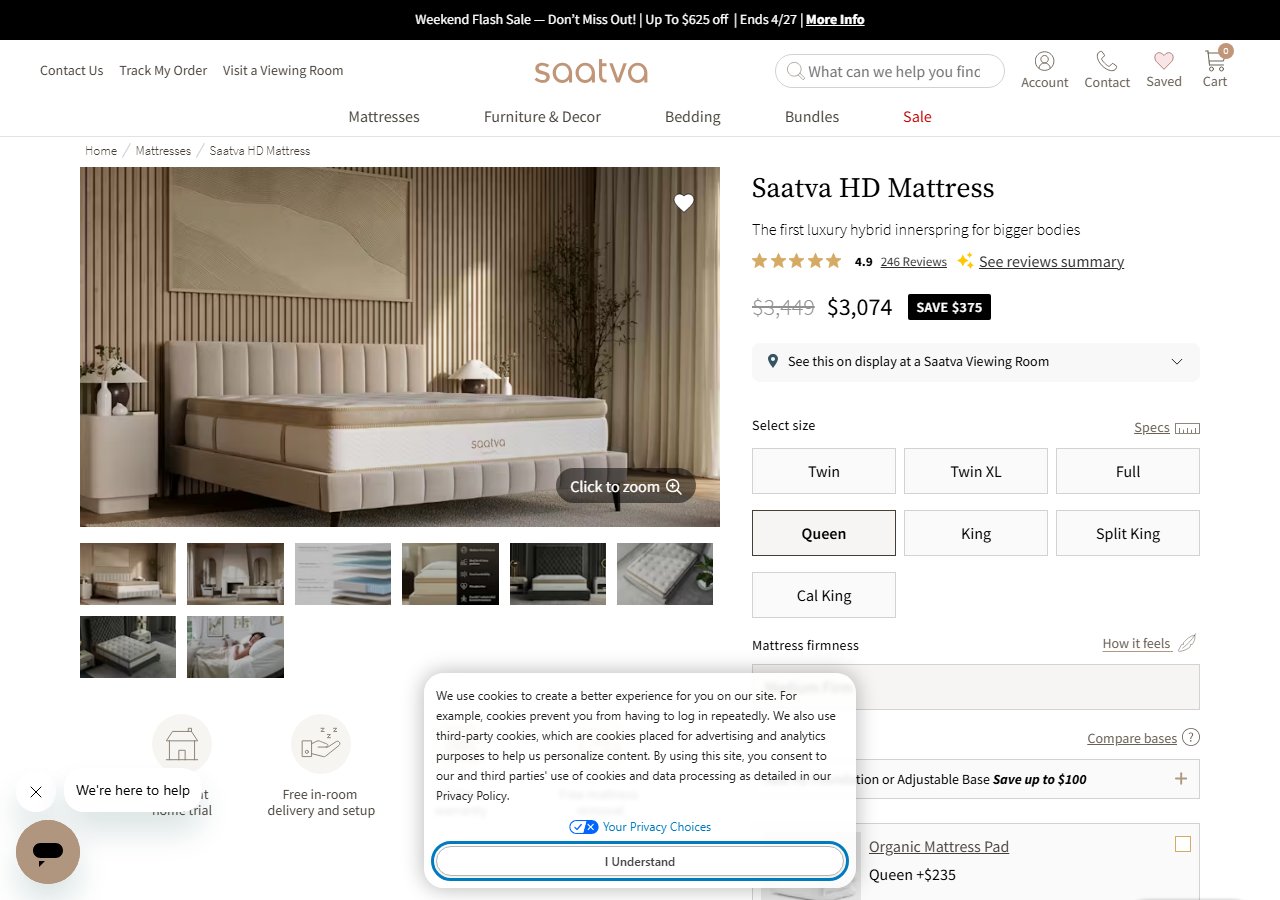
Saatva HD Mattress (Heavy-Duty)
$2,395-$3,995
See Price at Saatva →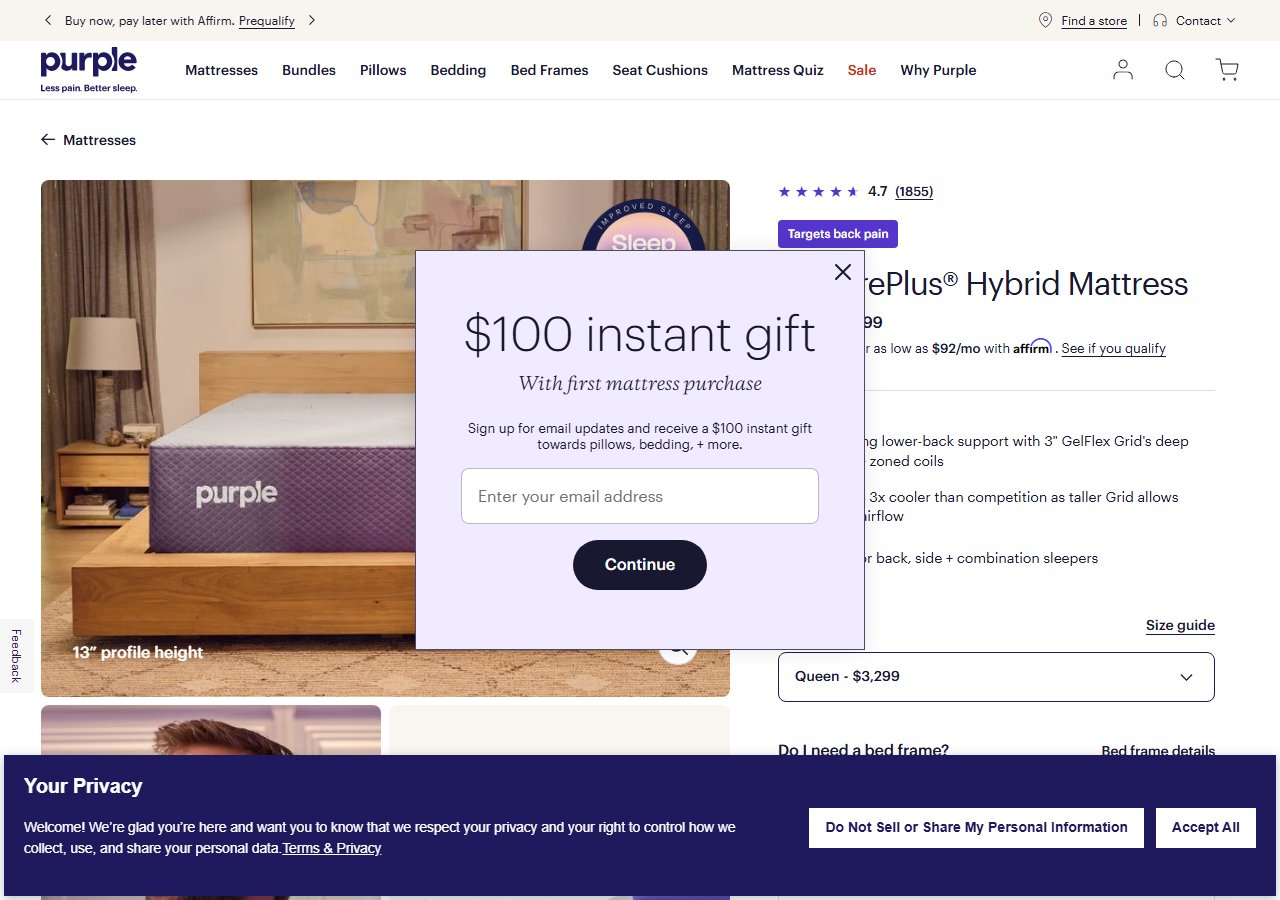
Purple Hybrid Premier Mattress
$2,499-$4,799
See Price at Purple →What the Data Hierarchy Tells You About Where to Start
The federal data in this article describes a compounding problem: occupational spinal loading that exceeds NIOSH safe limits, chronic pain affecting one in five American adults, and a sleep-disorder prevalence that amplifies pain sensitivity. For heavier adults in physical-demand occupations, each of these variables compounds the others.
The evidence-based response is hierarchical. Sleep position retraining and daily walking are the interventions with the broadest evidence base and lowest cost — start there. Clinical red flags require evaluation before any other decision. And for adults who have addressed those variables and are still sleeping on a mattress that sags, bottoms out, or fails to maintain spinal neutrality under their weight, a structurally engineered sleep surface is a legitimate and evidence-adjacent tool in back-pain management.
The Saatva HD is the right starting point for most heavier adults in physical-demand occupations — it is the only mattress in this review explicitly rated for the weight range, with lumbar-zone engineering that maps directly to the injury mechanism BLS and NIOSH data document. The Loom & Leaf is the better fit for pressure-sensitive sleepers who prioritize contouring over bounce. The Purple Hybrid Premier is the standout for sleepers who run hot and want a surface that eliminates rather than redistributes pressure points.
None of these replace the walk, the physical therapy, or the clinician visit. They are the final layer of a recovery architecture that the federal data says heavier adults in physical-demand jobs critically need — and that the standard mattress market has historically underserved.