The Federal Data Behind Construction Worker Back Pain
If you work in heavy trades — framing, concrete, electrical, HVAC, masonry — you already know your back is the canary in the coalmine. But the scale of the problem is bigger than most workers realize until it sidelines them. According to BLS Musculoskeletal Disorders by Occupation, the back is the single most commonly injured body part across all U.S. occupations with days away from work. Construction isn't just represented in that data — it's one of the primary drivers of it. The industry combines sustained awkward postures, heavy repetitive lifting, ground-level work, and vibration exposure from power tools and heavy equipment in a way that few other occupations match.
The financial consequence is not abstract. BLS Employer Costs for Employee Compensation data shows that industries with high MSD incidence carry workers' compensation insurance rates 3 to 5 times higher than low-MSD industries. That premium is ultimately paid in reduced wages, reduced benefits, and — for independent tradespeople — out-of-pocket insurance costs that rival a mortgage payment. Meanwhile, AHRQ HCUP data identifies back pain as one of the most expensive conditions in U.S. healthcare by total inpatient and outpatient spending. And SSA Disability Insurance data identifies musculoskeletal disorders as the largest single category of new disability claims filed annually — meaning for a significant number of construction workers, the injury arc ends careers, not just shifts.
None of this is inevitable. But avoiding that arc requires understanding exactly why construction work loads the spine the way it does — and what happens to that loaded spine during the eight hours you spend horizontal.
Why This Happens: The Biomechanics of Construction-Specific Spinal Loading
Construction MSDs don't emerge from a single dramatic moment (though acute injuries do happen). The dominant pathway is cumulative load — the gradual degradation of intervertebral discs, facet joints, and paraspinal musculature across years of exposure that exceed what the spine was engineered to handle repeatedly.
The NIOSH Lifting Equation is the federal government's primary tool for quantifying safe manual material handling limits. It accounts for load weight, horizontal distance from the body, vertical position of the lift, asymmetry (twisting), frequency, and grip quality. When NIOSH evaluates construction tasks — hoisting wall sections, lifting rebar bundles, moving concrete board, repositioning scaffold planks — the Recommended Weight Limits generated by the equation are routinely exceeded. In practical terms: the loads construction workers handle every day are loads the human lumbar spine was not designed to tolerate at that frequency, across a 20- or 30-year career.
Beyond lifting, construction workers face two additional biomechanical insults that office workers and even many healthcare workers don't: whole-body vibration from operating heavy equipment, compactors, and jackhammers, and sustained non-neutral postures from working at grade level, in crawlspaces, overhead, and on ladders. Whole-body vibration is a recognized independent risk factor for lumbar disc degeneration — the discs absorb vibrational energy in ways they're not engineered to handle. Non-neutral postures held for extended durations (think a plumber working in a crawlspace for two hours) compress specific regions of the disc asymmetrically, accelerating degeneration in a localized pattern.
The result, across a construction career, is a spine that arrives at the end of the workday carrying more structural stress than it can fully resolve in a single night of recovery — assuming the sleep environment supports recovery at all. That assumption is where many construction workers lose ground they don't realize they're losing.
Sleep as the Overlooked Recovery Window
Construction workers are not a population typically counseled by occupational medicine on sleep surface selection. But the federal sleep data makes a compelling case for paying attention. CDC Sleep and Sleep Disorders data shows approximately 35% of U.S. adults report sleeping fewer than 7 hours per night — the threshold below which chronic disease risk, inflammatory markers, and pain sensitivity all measurably increase. Among shift workers and tradespeople who wake before dawn, that number is likely higher.
The mechanism matters here. During deep sleep, the intervertebral discs rehydrate. Discs are avascular — they have no direct blood supply — and receive nutrition through osmotic exchange, which depends partly on positional offloading during rest. A sleep surface that does not adequately support spinal neutral alignment keeps paraspinal muscles in low-level contraction throughout the night, prevents that osmotic exchange, and sends the worker back onto the jobsite already behind on recovery. Over weeks and months, this compounds.
CDC NCHS Data Brief 390 documents that approximately 20% of U.S. adults experience chronic pain, with the lower back as the most common single location. In a population as physically stressed as construction workers, chronic low back pain is less a statistical abstraction and more a near-certain career companion — unless the recovery window is deliberately managed.
For construction workers specifically, there's an additional factor that most sleep articles don't account for: body mass and force distribution. Many experienced tradespeople, particularly in heavy labor categories like ironwork, masonry, and concrete, carry significant upper-body muscle mass in addition to elevated body weight. A mattress engineered for an average 160-pound office worker will not distribute load the same way for a 220-pound ironworker. The pressure map is different. The deflection depth is different. The coil or foam response is different. And a mattress that bottoms out — or that fails to match the contour of broader shoulders and heavier hips — keeps the spine in a non-neutral position for the entire night, negating the recovery benefit of sleep entirely.
Try These First: The Free and Low-Cost Interventions Federal Data Supports
Before we discuss sleep surfaces, the data demands a clear statement: the cheapest intervention is the one that does not require buying anything. Federal evidence consistently shows that behavioral and mechanical changes produce as much or more benefit than product purchases for most people with non-specific chronic low back pain. The interventions below are supported by NIH, OSHA, and CDC data — and every one of them costs nothing or close to it.
The most evidence-supported single intervention for chronic low back pain is daily walking. A review by the NIH National Center for Complementary and Integrative Health found that walking 30 minutes most days reduces chronic low back pain as effectively as most non-drug clinical treatments. For construction workers who are physically active during the workday, this may seem redundant — but jobsite physical activity is asymmetric and load-bearing; walking for recovery is rhythmic and decompressive. The distinction matters clinically.
Lifting and bending mechanics are the second major lever. OSHA's Ergonomics Solutions guidance documents the core principles: hinge at the hips rather than rounding the lumbar spine, keep loads close to the body's center of mass, avoid twisting under load. The majority of acute construction back episodes are mechanical and, critically, rehearsable — meaning consistent practice of proper mechanics during even the highest-load tasks reduces acute injury risk substantially.
Sleep position is the third lever — and it costs nothing to change tonight. NIH guidance from the National Institute of Arthritis and Musculoskeletal and Skin Diseases recommends side-sleeping with a pillow between the knees, or back-sleeping with a pillow under the knees, to maintain spinal neutrality throughout the night. Stomach sleeping — common among heavier-set individuals who find it comfortable — torques the lumbar spine into extension and rotation simultaneously, worsening chronic pain patterns over time. This is the single highest-leverage zero-cost change available to most construction workers with back pain.
Finally: assess your current mattress honestly before buying a new one. CDC Sleep Hygiene guidance and occupational health practice both point to visible sag, waking stiffer than you went to bed, and mattress age beyond 7 to 10 years as the key replacement signals. A worker who sleeps on a 12-year-old mattress with a visible body impression in the center does not have a back pain problem that a new movement protocol will fully solve — the surface itself is the variable.
For the construction workers who have already addressed body mechanics, walk daily, sleep in a spine-neutral position, and still wake with significant stiffness or pain — particularly those whose mattress is visibly past its useful life or whose body mass exceeds what consumer-grade mattresses are typically engineered for — a sleep surface upgrade becomes a genuinely warranted intervention, not a luxury purchase.
When to See a Clinician: Red Flags Specific to Construction Workers
A new mattress is not a medical device. Federal guidance is explicit about the category of symptoms that require clinical evaluation before any self-directed intervention — product-based or otherwise. NIH's National Institute of Neurological Disorders and Stroke identifies the following as red flags requiring prompt clinician evaluation:
- Back pain that radiates below the knee, particularly with numbness or tingling, suggesting possible nerve root involvement or disc herniation
- Back pain following trauma — a fall from scaffold, a caught load, a vehicle accident — where structural injury must be ruled out before conservative management
- Pain accompanied by leg weakness, difficulty walking, or loss of fine motor control in the lower extremities
- Any back pain accompanied by bowel or bladder changes, which can indicate cauda equina syndrome — a medical emergency requiring same-day evaluation
- Back pain accompanied by fever or unexplained weight loss, which may indicate infectious or oncologic etiology
For construction workers specifically, the trauma pathway is particularly relevant. Falls from elevation are among the leading causes of construction fatalities and serious injuries. Back pain that begins or significantly worsens after any fall — regardless of height — warrants imaging before any conservative treatment. Do not defer this to a mattress change.
The chronic pain burden in this population is also significant enough to warrant noting the drug treatment landscape. CMS Drug Spending Dashboard data identifies opioid and non-opioid pain medication spending among the most expensive Medicare drug categories — a reflection of how many chronic pain patients end up in long-term pharmaceutical management when the underlying mechanical drivers are never adequately addressed. If you are already managing chronic back pain with prescription medication, any change in your sleep surface or intervention approach should be coordinated with the prescribing clinician.
Where Sleep Surfaces Fit: What the Construction Worker's Body Actually Needs
With mechanism understood, free interventions applied, and clinical red flags cleared — the sleep surface question becomes a legitimate engineering problem. What does a high-load body type, with elevated muscle mass, possible disc degeneration, and occupational inflammation, actually need from a mattress?
The answer has three components: adequate support through the transition zone (the area from the lumbar spine through the hips, where the body is heaviest and where spinal alignment is most vulnerable to sag), pressure relief at the shoulders and hips (where bone-prominence contact with a firm surface creates localized pressure that disrupts sleep and blood flow), and durability under elevated static load (consumer-grade mattresses are typically tested at average body weights; a 220-plus-pound worker sleeping eight hours per night compresses foam and coil systems at a rate that standard mattresses are not engineered to handle over a decade).
The Saatva Loom & Leaf Memory Foam Mattress is the starting point for construction workers dealing with serious back pain who sleep on their side or back and need contouring support without full-foam sinkage. Loom & Leaf uses a high-density memory foam construction with a cooling gel layer — relevant because construction workers run warm after physical exertion — and a lumbar zone enhancement that provides additional support precisely where spinal loading is most concentrated. At its Relaxed Firm comfort level, it provides the progressive resistance that keeps heavier body sections from sinking past spinal neutral. For a worker dealing with documented disc issues or facet joint irritation, the contouring behavior of quality memory foam reduces the pressure-point wakeups that fragment sleep and prevent the restorative deep sleep stages that matter for tissue repair.
For workers who run 220 pounds or above — or who share a bed with a partner of similar size — the Saatva HD Mattress is the purpose-built engineering answer. The HD is explicitly designed for higher body weights, with a coil-on-coil construction using individually wrapped coils over a heavy-gauge base layer, a weight capacity well above what standard consumer mattresses carry, and edge support reinforcement that matters for workers who sit on the edge of the bed to put on work boots every morning. Standard mattresses tested at average body weights deflect differently under elevated loads — the HD addresses this with construction specifications that standard lines don't require. For an ironworker or concrete finisher who has watched two or three standard mattresses fail within five years, the engineering rationale for the HD is not aspirational — it's practical.
For construction workers whose primary complaint is pressure-point pain — specifically in the shoulders and hips after side-sleeping — the Purple Hybrid Premier Mattress offers a meaningfully different mechanical approach. Purple's GelFlex Grid is not foam — it's a polymer grid structure that collapses under pressure points (distributing concentrated load) while remaining firm under distributed load (maintaining lumbar support). The Hybrid Premier pairs this grid with pocketed coils, giving it the responsiveness and edge support that pure foam mattresses sacrifice. For a worker whose upper-body mass creates significant shoulder pressure in side-sleeping positions, the pressure-map performance of the Purple grid is substantively different from foam alternatives, and the hybrid construction provides the pushback that keeps the lumbar spine from sagging. The Purple Hybrid Premier runs warmer climates slightly better than dense memory foam options, which matters for workers who run physiologically hot.
Sleep Surfaces Engineered for High-Load Construction Bodies
These three mattresses were selected specifically for construction professionals dealing with cumulative spinal loading, elevated body mass, and the recovery demands of heavy-trade work — not for the average sedentary adult.

Saatva Loom & Leaf Memory Foam Mattress
$1,695-$3,295
See Price at Saatva →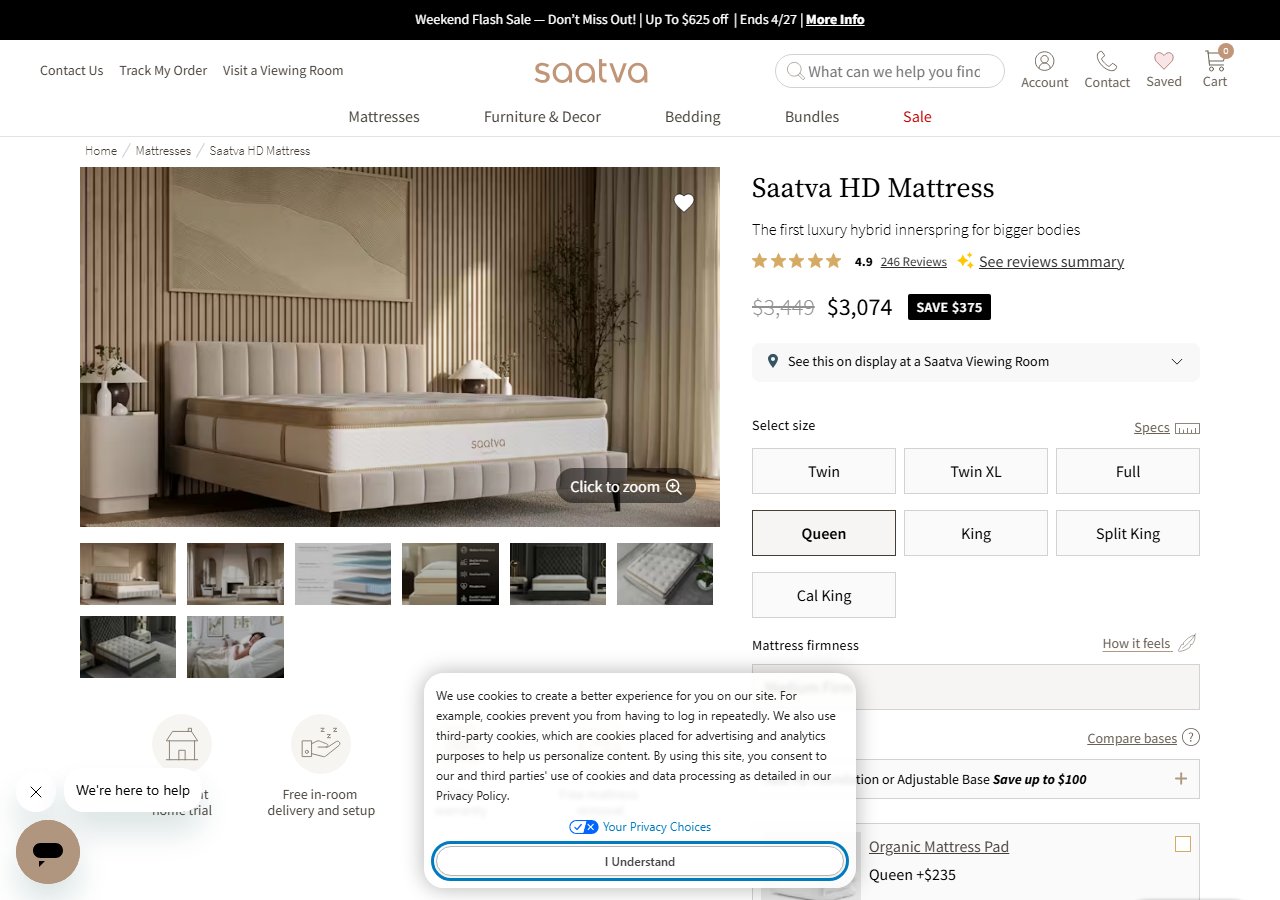
Saatva HD Mattress (Heavy-Duty)
$2,395-$3,995
See Price at Saatva →
Purple Hybrid Premier Mattress
$2,499-$4,799
See Price at Purple →Putting the Data Together: A Construction Worker's Recovery Framework
The federal data, assembled, tells a clear story. Construction work imposes spinal loading that NIOSH documents as routinely exceeding safe limits. That loading accumulates across a career in a population where approximately 25% will develop doctor-diagnosed arthritis and 20% already experience chronic pain. The back is the most common injury site. SSA data shows MSDs are the leading driver of disability claims. AHRQ MEPS data shows the healthcare cost differential for adults with chronic back conditions is substantial. The financial case for proactive management — not just reactive treatment — is built into the data.
The recovery framework for a construction professional is hierarchical, not singular. First, mechanics: OSHA lifting principles, applied daily, reduce the accumulation rate. Second, movement: daily walking, supported by NIH evidence, reduces chronic pain as effectively as most non-drug treatments. Third, sleep position: neutral spine positioning at night costs nothing and compounds over time. Fourth, surface assessment: if the mattress is visibly degraded, older than a decade, or failing under your actual body weight, replacement is a legitimate clinical variable. Fifth — and only after the above — a purpose-selected sleep surface that matches your body mass, sleep position, and primary pain complaint.
None of these steps replaces clinical care. The red flags above are real, and construction workers have elevated lifetime risk of traumatic spine injury in addition to cumulative degenerative risk. But the data also shows that the highest-cost outcome — disability — is not inevitable. The workers most likely to avoid it are the ones who treat recovery as part of the job description, not an afterthought to it.