Construction Professionals Have a Back Problem the Industry Rarely Talks About
The morning stiffness most construction workers write off as "just part of the job" has a federal paper trail. According to BLS Musculoskeletal Disorders by Occupation tracking, the back is the single most common body part injured across all U.S. occupations resulting in days away from work. Construction is not an outlier in that dataset — it is one of the engines driving the national average up. Carpenters, ironworkers, concrete finishers, electricians, and HVAC tradespeople spend their days in combinations of sustained awkward posture, high-force manual exertion, whole-body vibration from heavy equipment, and repetitive asymmetric loading that few other American occupational categories can match. Those cumulative exposures do not resolve the moment the workboots come off.
The body's primary window for spinal disc rehydration, soft-tissue repair, and inflammatory reset is sleep. An eight-hour shift of compressive spinal loading followed by eight hours of genuinely restorative sleep is physiologically manageable over a career. An eight-hour shift of compressive loading followed by six fragmented hours on a sagging mattress in a poor sleep position is a different equation entirely — and the federal data on both sides of that equation is grim.
CDC sleep surveillance data shows that approximately 35% of U.S. adults already report sleeping fewer than 7 hours per night, the threshold the CDC associates with elevated chronic disease risk including musculoskeletal degeneration. For construction workers managing active back pain or post-injury recovery, sleep disruption compounds an already stressed system. And the downstream cost is not abstract: AHRQ HCUP data identifies back pain as one of the most expensive conditions in U.S. healthcare by total inpatient and outpatient spending, while AHRQ MEPS data shows that adults with chronic back conditions carry substantially higher annual personal healthcare costs than those without. The injury does not stay on the job site. It moves into the clinic, the bedroom, and eventually the Social Security Administration's disability queue — SSA Disability Insurance data consistently identifies musculoskeletal disorders as the single largest category of new disability claims filed each year.
This article is not a product roundup dressed up as journalism. It starts where the federal data starts: with mechanism, then with free interventions, then with clinical red flags, and only then with what the research actually says about sleep surfaces for high-load body types.
Why Construction Work Is Specifically Hard on the Lumbar Spine
Not all back pain is created equal, and the back pain pattern of a construction professional is mechanistically distinct from that of an office worker with poor posture or a runner with iliotibial band dysfunction. Understanding the difference matters because it shapes every downstream decision, including what kind of sleep surface actually helps.
Cumulative compressive load is the core problem. The NIOSH Lifting Equation was developed specifically to quantify the spinal compression force generated during manual material-handling tasks, and its consistent finding is that construction, warehousing, and heavy-trade tasks routinely push workers past the safe spinal load limit — defined by NIOSH as approximately 3,400 newtons of compressive force on the L4-L5 disc. A concrete finisher hauling 80-pound bags, a framer repeatedly lifting and rotating lumber overhead, or a plumber working in a confined crawlspace for four hours does not approach that limit occasionally. They exceed it systematically, shift after shift, year after year.
The lumbar intervertebral discs — the shock-absorbing pads between vertebrae — are avascular structures that rely almost entirely on the compression-decompression cycle of daily activity and overnight recumbency to exchange nutrients and waste products. During sleep, the discs absorb fluid and partially rehydrate. But this rehydration process is position-dependent and surface-dependent. A mattress that allows the lumbar spine to sag into flexion — whether because it is too soft for the person's body weight, because it has developed pressure depressions, or because it is simply worn out — shortchanges the rehydration cycle and adds low-grade mechanical stress to a structure that has already taken heavy abuse during working hours.
Whole-body vibration is a second mechanism that is underappreciated in lay discussions of construction back pain. Operators of heavy equipment — excavators, forklifts, jackhammers, compaction equipment — are exposed to sustained low-frequency vibration that has been shown in occupational medicine literature to accelerate lumbar disc degeneration. This isn't background noise; it is a specific biomechanical stressor that accelerates the disc degeneration pathway independently of lifting load.
Body composition and frame size add a third variable unique to construction populations. Workers in physically demanding trades often carry significantly more lean muscle mass than the general population — and frequently more total body weight as well. Standard mattress construction is engineered for an average adult body weight in the range of 130 to 180 pounds. A 230-pound ironworker or a 260-pound heavy equipment operator creates a dramatically different pressure distribution at the mattress surface, and a mattress that provides adequate lumbar support for a 160-pound person may allow complete hammocking for a heavier user. This is not a speculation — it is straightforward physics — and it is why body weight is among the first variables that should inform any sleep surface evaluation for this population.
CDC NCHS Data Brief 390 reports that approximately 20% of U.S. adults experience chronic pain, with the lower back as the most common pain location. For a workforce in which cumulative lumbar loading is occupationally unavoidable, that 20% figure almost certainly underestimates the true prevalence among active tradespeople. And CDC Arthritis data shows that roughly 25% of U.S. adults report doctor-diagnosed arthritis, with prevalence concentrated in occupations involving sustained physical demand — a description that fits heavy construction precisely.
The insurance industry has priced this reality. BLS Employer Costs for Employee Compensation data shows that industries with high MSD incidence carry workers' compensation insurance rates 3 to 5 times higher than low-MSD industries. That premium is the actuarial expression of what repeated spinal loading costs — not just in human suffering, but in dollars.
Try These First: Free and Low-Cost Interventions Before You Spend a Dollar on a New Mattress
The cheapest intervention is the one that does not require buying anything. Federal occupational health agencies and NIH research arms have produced a substantial body of evidence on what actually moves the needle for chronic back pain — and the most effective levers are behavioral and biomechanical, not commercial. Before any construction worker spends $1,500 to $4,000 on a new sleep surface, these interventions deserve a genuine trial.
Sleep position is the single highest-leverage, zero-cost variable in overnight spinal mechanics. NIH National Institute of Arthritis and Musculoskeletal and Skin Diseases guidance on back pain is clear: side-sleeping with a pillow between the knees, or back-sleeping with a pillow under the knees, keeps the spine in a neutral alignment that reduces overnight disc compression and soft-tissue strain. Stomach-sleeping, by contrast, forces the lumbar spine into hyperextension and rotates the cervical spine — a combination that worsens chronic lumbar pain and creates new cervical tension. Many construction workers who believe they need a new mattress actually need to change their sleep position first and hold that position for four to six weeks before drawing any conclusions.
Lifting and movement mechanics on the job site remain the most evidence-dense intervention for construction-related back pain prevention. OSHA's Ergonomics Solutions guidance documents the hip-hinge pattern that protects the lumbar spine during heavy lifts: load close to the body, hinge at the hips rather than rounding the lumbar spine, avoid twisting under load. Most acute lumbar episodes in construction are mechanical and — critically — are rehearsable. Workers who internalize the hip-hinge pattern and apply it consistently during the highest-load phases of their shift accumulate meaningfully less spinal compression over a career than those who do not.
Daily walking is the intervention that consistently surprises people. NIH National Center for Complementary and Integrative Health's evidence review on low-back pain finds that 30 minutes of walking on most days reduces chronic low-back pain as effectively as most non-drug clinical treatments. For construction workers who are already physically active at work, this may sound counterintuitive — but the distinction is between dynamic aerobic loading, which promotes disc nutrition and anti-inflammatory cytokine activity, and static or high-compressive loading, which does the opposite. A deliberate post-shift or morning walk is a different physiological signal than eight hours of heavy trade work.
Mattress replacement is itself an intervention when the surface is the problem — but the criteria matter. CDC Sleep Hygiene guidance supports replacing a mattress when there is visible sag, when the sleeper wakes consistently stiffer than they went to bed, or when the mattress is older than 7 to 10 years. These are evidence-anchored thresholds, not marketing claims. But a new mattress does not undo poor sleep hygiene, inadequate sleep duration, sedentary recovery habits, or poor on-site mechanics. It is one piece of a system.
For some construction workers, these interventions will be enough. A consistent sleep position change combined with a dedicated hip-hinge practice on the job site and 30 minutes of daily walking has genuinely resolved or significantly reduced chronic back pain for many people, without a dollar spent on equipment. But others — particularly those in the heavier body-weight range, those sleeping on mattresses older than a decade, or those with documented spinal pathology — will find that the surface they sleep on is a genuine limiting factor. For that group, the evidence for sleep surface selection is worth examining carefully.
When to See a Clinician Before You Do Anything Else
This article is data journalism, not medical advice. There is a category of back pain symptoms that should bypass every intervention and product recommendation on this page and go directly to a licensed clinician. NIH National Institute of Neurological Disorders and Stroke guidance on back pain is explicit about the red flags that require prompt medical evaluation, and every construction worker should know them.
A new mattress is not the answer to a herniated disc with active nerve compression. It is not the answer to a vertebral fracture, a spinal infection, or cauda equina syndrome. These are medical diagnoses that require imaging, neurological examination, and in some cases urgent surgical intervention. Buying a more supportive sleep surface while an undiagnosed L4-L5 herniation is compressing the sciatic nerve is, at best, a distraction from care that cannot wait. See the clinical red flags section below and treat any of those symptoms as a reason to call a provider today, not next week.
The CMS Drug Spending Dashboard identifies opioid and non-opioid pain medication spending among the most expensive Medicare drug categories — a reflection of how often chronic back pain, when not appropriately managed, escalates into pharmaceutical dependency. Early clinical evaluation, when red flags are present, is cheaper and better than the alternative.
What the Evidence Actually Says About Sleep Surfaces for High-Load Body Types
For construction professionals who have worked through the interventions above, addressed their sleep position, and confirmed that their mattress is genuinely the limiting factor, the question becomes: what should a sleep surface do for a body that carries this kind of occupational load?
The biomechanical answer is threefold. First, the surface needs to support lumbar lordosis — the natural inward curve of the lower spine — rather than allow it to flatten or reverse under body weight. A mattress that is too soft for the sleeper's weight permits the pelvis and torso to sink unevenly, producing exactly the kind of overnight spinal flexion that undercuts disc rehydration. Second, it needs to distribute pressure away from bony prominences — particularly the shoulder girdle and hips in side-sleepers — without sacrificing the foundational support layer. Third, for workers above 220 pounds, the mattress needs to be engineered for higher weight loads — which means a denser foam core, a higher coil count and gauge in hybrid constructions, and edge support that holds at body weight rather than collapsing.
The Saatva Loom & Leaf Memory Foam Mattress is worth examining first for construction professionals dealing with serious chronic back pain. It uses a 5-inch base layer of high-density support foam topped by Saatva's proprietary memory foam formulation, with a gel-infused surface layer designed to manage the elevated skin temperature that accompanies heavier body types. The firmness profile (available in Relaxed Firm and Firm) is calibrated to keep the lumbar spine in extension rather than allowing it to sag — which is exactly what the rehydration argument demands. For workers in the 160-to-220-pound range with documented lower back pain and heat sensitivity, this is a serious option.
For workers above 220 pounds — a category that includes a substantial share of ironworkers, concrete laborers, and heavy equipment operators — the Saatva HD Mattress is purpose-engineered for this population in a way that most premium mattresses are not. The HD uses a dual-coil construction — an individually wrapped microcoil support layer beneath a tempered steel base coil system — rated to 500 pounds per side. That is not a marketing claim; it is a structural specification that matters when a 250-pound worker with 15 years of cumulative lumbar loading lies down on a surface that needs to maintain its geometry through 8 hours of bodyweight compression. The HD also incorporates a 3-inch Euro pillow top with a high-resiliency foam core, which provides the pressure distribution that bony prominences require without sacrificing the foundational support that the lumbar spine needs. This is the most directly targeted product for the heaviest-demand construction population.
For workers whose primary complaint is pressure-point pain — shoulder and hip soreness in side-sleepers, often secondary to the postural asymmetries that accumulate over years of trade work — the Purple Hybrid Premier Mattress brings a genuinely distinct engineering approach. Purple's GelFlex Grid is not foam; it is a hyper-elastic polymer grid that collapses under bony prominences (relieving pressure) while remaining firm under broader body surfaces (providing support). In practical terms, it provides a pressure-relief profile that memory foam struggles to match at higher body weights without going so soft that lumbar support is compromised. The Premier version — with a 4-inch grid depth versus the standard 2-inch — amplifies both effects. For the construction worker whose back pain is concentrated in the thoracic or shoulder region, or who sleeps on their side and wakes with hip pain, this is a meaningfully different solution than either Saatva option.
All three of these products are at the premium end of the market, and the price differential from a budget mattress is real. But the AHRQ cost data is also real: adults with chronic back conditions spend substantially more on healthcare annually than those without. A sleep surface that genuinely supports overnight tissue recovery is not a luxury expenditure — it is a maintenance cost for a body that is being used at a level most Americans' bodies are not.
Sleep Surfaces Built for the Demands of Heavy-Trade Bodies
These three mattresses were selected specifically for construction professionals — people carrying high occupational spinal loads, often at heavier body weights, who need a sleep surface engineered for recovery rather than simply comfort.

Saatva Loom & Leaf Memory Foam Mattress
$1,695-$3,295
See Price at Saatva →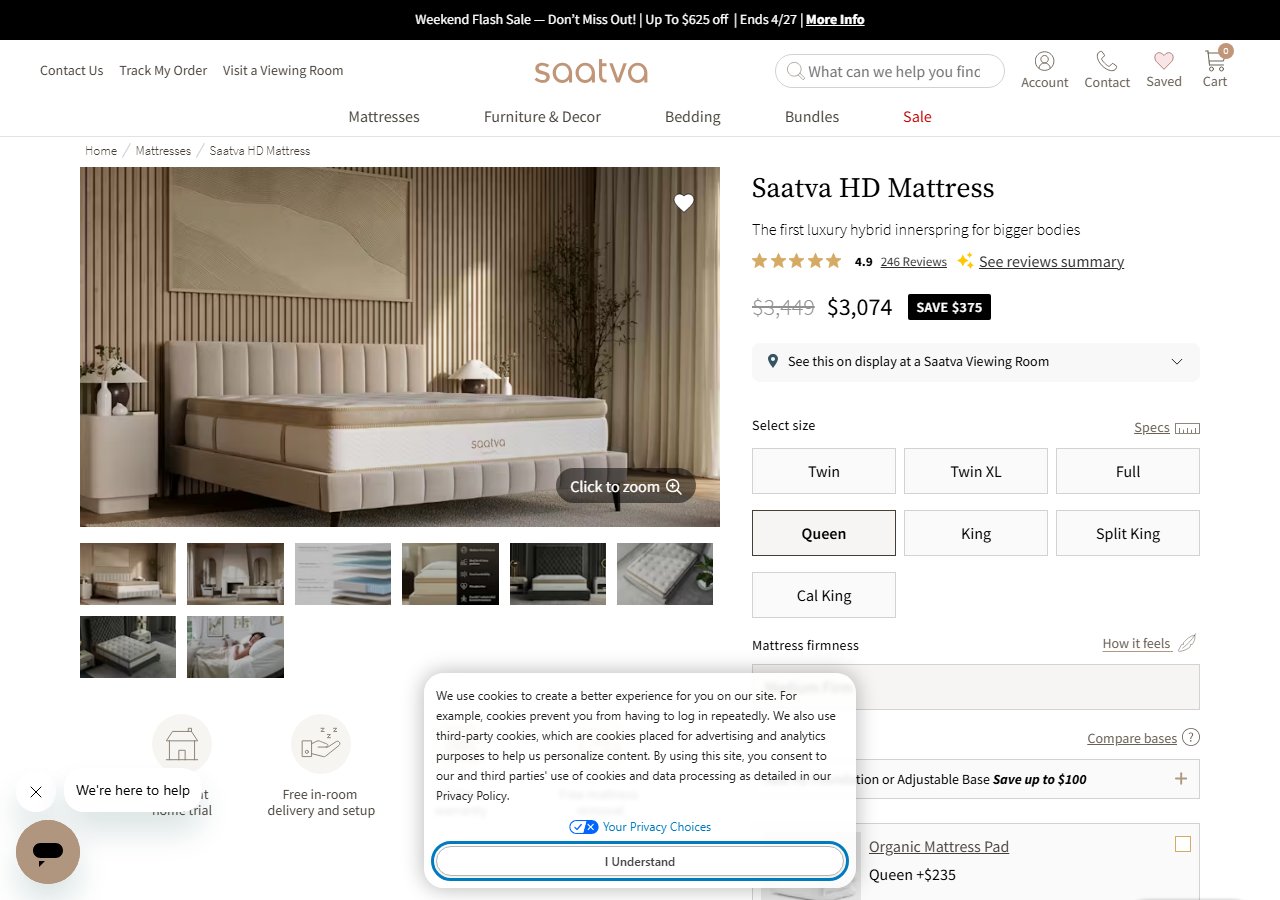
Saatva HD Mattress (Heavy-Duty)
$2,395-$3,995
See Price at Saatva →
Purple Hybrid Premier Mattress
$2,499-$4,799
See Price at Purple →The Bottom Line: Federal Data Points to a Hierarchy, Not a Product
The BLS, NIOSH, CDC, AHRQ, and SSA data assembled in this article all point in the same direction: construction-related musculoskeletal disorders are common, expensive, career-altering, and preventable — and the overnight recovery environment is one variable workers can control. But the hierarchy matters. Sleep position is free. On-site lifting mechanics are free. A daily walk is free. Clinical evaluation, when red flags are present, is covered by most employer health plans.
A sleep surface engineered for high-load body types — whether the Saatva Loom & Leaf for medium-weight workers with serious lumbar pain, the Saatva HD for heavier workers who need structural support that standard mattresses cannot provide, or the Purple Hybrid Premier for workers whose primary complaint is pressure-point pain — is a legitimate tool in the recovery toolkit. But it is one tool among several, and it works best when the other tools are already in use.
The goal is not to buy something. The goal is to stop waking up stiff, to protect a lumbar spine that still has years of work left in it, and to stay out of the SSA disability queue that musculoskeletal disorders fill faster than any other condition. Federal data shows the stakes clearly. The interventions, in the right order, give construction professionals the best available evidence-based path forward.