The Morning Stiffness Problem Isn't Random
If you work in heavy construction — framing, roofing, concrete, ironwork, plumbing rough-in — you already know the feeling: you wake up and spend the first twenty minutes of your day un-seizing. Your lower back aches before the coffee is done. Your hips feel locked. By mid-morning, after you've been on your feet and moving, things loosen up. By the end of the shift, the cycle is set to repeat.
This is not just aging. It is a biomechanical consequence that federal occupational health data has been tracking for decades. According to BLS Musculoskeletal Disorders by Occupation tracking, the back is the most common body part injured across all U.S. occupations with days away from work — and construction consistently ranks among the highest-risk industries by MSD rate. The morning stiffness you feel is your body surfacing from a recovery cycle that your sleep surface may be actively working against.
This article is not a mattress advertisement. It is a data-journalism breakdown of why construction workers carry a disproportionate musculoskeletal burden, what free interventions actually move the needle first, when the problem requires a clinician rather than a product, and — only after all of that — what specific mattress characteristics federal biomechanical research suggests matter for high-load body types.
Why This Happens: The Biomechanics of a Construction Shift
To understand why construction workers wake stiff, you have to understand what a typical shift does to the spine.
Modern spinal biomechanics research identifies cumulative compressive and shear loading as the primary mechanism behind occupational low-back disorders. Every time a framer lifts a bundle of lumber, a roofer carries shingles up a ladder, or an ironworker twists under load, the intervertebral discs, facet joints, and paraspinal musculature absorb force. The NIOSH Lifting Equation — the federal standard for evaluating manual material-handling risk — documents that tasks across construction, warehousing, and healthcare routinely exceed safe spinal loading limits. That is a federal engineering finding, not an opinion: construction work physically loads the spine beyond what NIOSH considers the safe threshold for sustained daily performance.
Three specific mechanisms drive the morning stiffness cycle in construction workers:
1. Disc fluid dynamics. Intervertebral discs are largely avascular, meaning they receive hydration and nutrients through a process called imbibition — fluid exchange driven by loading and unloading cycles. After eight to ten hours of sustained compressive loading on a job site, discs are partially dehydrated. During sleep, discs are supposed to re-hydrate. But if the sleep surface holds the spine in a suboptimal position — either over-flexed in a sagging mattress or hyperextended on a surface that is too firm for the individual's hip-to-waist ratio — that nighttime rehydration is impaired. You wake stiffer than you went to bed, which is the cardinal sign that the mattress is actively impeding recovery.
2. Paraspinal muscle fatigue accumulation. The erector spinae, multifidus, and quadratus lumborum groups work continuously in construction tasks to stabilize the lumbar spine under load. After a full shift, these muscles are glycogen-depleted and in low-grade inflammatory state. If the sleep surface fails to offload these structures — by lacking adequate zoned support or pressure relief at the pelvis and shoulders — the muscles remain in partial contraction overnight. The result is the locked, seized feeling construction workers know well.
3. Chronic inflammation and arthritis onset. CDC Arthritis Data shows approximately 25% of U.S. adults report doctor-diagnosed arthritis, with prevalence concentrated in occupations involving sustained physical demand. Construction workers who have been in the trades for ten or more years frequently present with facet joint arthritis and disc degeneration that is measurably accelerated compared to sedentary workers. These structural changes mean the body is less tolerant of poor sleep positioning — the error budget gets smaller as the years add up.
CDC NCHS Data Brief 390 documents that approximately 20% of U.S. adults experience chronic pain, with lower back as the most common pain location. In construction, that figure is not evenly distributed across the population — it skews sharply toward workers in physically demanding trades who have spent years accumulating the load.
The Economic Weight of Not Addressing This
The cost of untreated construction back pain is not abstract. AHRQ MEPS data shows that annual personal healthcare expenditures for adults with chronic back conditions substantially exceed costs for adults without them. AHRQ HCUP data further identifies back pain as one of the most expensive conditions in U.S. healthcare by total inpatient and outpatient cost. And SSA Disability Insurance data identifies musculoskeletal disorders as the largest single category of new disability claims annually — meaning back injuries do not just cost workers medical bills, they end careers.
BLS Employer Costs for Employee Compensation data shows that industries with high MSD incidence carry workers' compensation insurance rates 3–5 times higher than low-MSD industries. That is the economic signal that construction back pain is not being solved at scale. The morning stiffness that feels like an inconvenience is the early-stage presentation of a trajectory that ends in disability claims for a significant fraction of workers who ignore it long enough.
Try These First: Free and Low-Cost Interventions That Move the Needle
The cheapest intervention is the one that does not require buying anything. Before we discuss any product, you need to know what the federal evidence base says about non-product interventions — because several of them are as effective as, or more effective than, any mattress on the market.
Here is what the evidence actually supports for construction workers with occupational back pain:
Sleep position is the biggest free variable. NIH back pain guidance recommends side-sleeping with a pillow between the knees, or back-sleeping with a pillow under the knees, to maintain spinal neutral. Stomach-sleeping torques the lumbar spine and actively worsens chronic pain. For a construction worker with disc degeneration or facet arthritis, changing sleep position costs nothing and can produce measurable morning symptom reduction within days.
Lifting and bending mechanics are rehearsable. OSHA's ergonomics guidance is explicit: hinge at the hips, not the lumbar spine; keep loads close to the body; avoid twisting under load. Most acute back episodes in construction are mechanical events triggered by accumulated poor mechanics over years. These patterns are not instinctive — they require deliberate rehearsal, ideally reinforced by a site supervisor or occupational health program.
Daily walking outperforms most passive treatments. This is the one that surprises most workers: NIH NCCIH's evidence review on low-back pain documents that walking 30 minutes most days reduces chronic low-back pain as effectively as most non-drug clinical treatments. A new mattress alone does not come close to this effect size. If you are choosing between spending $2,000 on a mattress and committing to a daily 30-minute walk, the walk wins on the evidence — though ideally you do both.
Know when the mattress itself is the problem. CDC Sleep Hygiene guidance supports replacing a mattress when it has visible sag, when you consistently wake stiffer than you went to bed, or when it is older than 7–10 years. A mattress past these thresholds is no longer doing its structural job. This is the threshold at which product intervention has a legitimate evidence basis.
For readers who have already addressed sleep position, are walking regularly, and have replaced a genuinely degraded mattress — or for workers whose body mass and daily load profile genuinely overwhelms a standard consumer mattress — the equipment tier of this problem deserves serious analysis. That is what the next sections cover.
When to See a Clinician Before Changing Anything Else
Morning stiffness from occupational loading is different from neurological back pain. NIH National Institute of Neurological Disorders and Stroke back pain guidance is explicit about the red flags that require imaging or specialist referral before any self-management strategy — including mattress changes — is appropriate.
For construction workers specifically, the pattern of work-related injury makes certain red flags more likely. A worker who has been in the trades for 15+ years and suddenly develops new radiating leg pain, or a worker who notices progressive leg weakness after a fall, is not experiencing ordinary occupational fatigue — they may have a herniated disc or spinal stenosis that requires medical evaluation. Similarly, back pain that is constant rather than positional, that is worse at night rather than better, or that accompanies fever or unexplained weight loss, is not mechanical back pain and should not be treated as such.
A new sleep surface will not fix nerve compression. It will not address a compression fracture from a fall. And CMS Drug Spending data shows that opioid and non-opioid pain medication spending remains among the most expensive Medicare drug categories — a signal that too many workers are managing pain pharmacologically when the underlying structural problem has not been properly diagnosed. Get evaluated before you spend $3,000 on a mattress if any of the red flags below apply.
Where Products Help: Sleep Surface Characteristics That Matter for High-Load Body Types
Construction workers present a specific mattress-engineering challenge that most consumer mattress reviews fail to address: high body mass, high daily spinal load, asymmetric musculature, and a genuine clinical need for lumbar support and pressure relief simultaneously.
Standard mattresses are engineered for average adult body weight (roughly 130–180 lbs). A journeyman ironworker at 230 lbs or a concrete finisher at 250 lbs who sleeps on a standard medium-firm innerspring is almost certainly bottoming out the comfort layers and sleeping on the support core — which is too firm for proper pressure relief at the hip and shoulder, and provides no zoned lumbar support.
Here is what federal biomechanical data and materials engineering research suggest actually matters:
Zoned support, not uniform firmness. The goal is firmer support under the lumbar spine (to maintain the natural lordotic curve) with softer pressure relief at the hips and shoulders. Uniform-firmness mattresses fail this test for most construction workers because the heavier sections of the body (hips, shoulders) sink disproportionately, placing the spine in a flexed position overnight.
Weight-rated support cores. Standard innerspring and foam cores are not engineering-rated for users above 200 lbs in sustained-contact applications (8 hours of sleep). A worker at 220–280 lbs needs a support core with a higher indentation load deflection (ILD) rating and, in foam-core designs, higher density foam that resists permanent deformation.
Pressure relief for paraspinal tissue. After a shift of sustained muscular contraction, the paraspinal muscles need genuine offloading — not just weight support but lateral pressure reduction at the contact points. This is where foam formulation and gel grid technology matter.
With those engineering criteria established, here are the three products that best fit the construction worker profile:
For workers with significant chronic back pain and a preference for conforming support, the Saatva Loom & Leaf Memory Foam Mattress is the premium memory foam pick. Loom & Leaf uses a dual-layer memory foam system with a temperature-regulating gel layer over a high-density support foam core — the kind of construction that actually maintains its structural integrity under heavier users over time, rather than developing body impressions within 18 months the way lower-density foam beds do. At $1,695–$3,295 depending on size, it is a serious investment, but AHRQ data on the healthcare cost of chronic back conditions suggests the economics favor the better sleep surface over the long term.
For heavier construction workers — those over 200 lbs, or carrying the load profiles of concrete, steel, or heavy framing work — the Saatva HD Mattress is engineered specifically for this population. Saatva HD is the only mattress in this article explicitly engineered for users in the 300+ lb weight range, with a dual coil system (micro-coils over a zoned base coil layer), high-density foam support, and edge reinforcement that prevents the roll-off problem standard mattresses develop. For an ironworker or concrete finisher who has tried standard mattresses and found they sag within a year, this is the specification that actually matches the load. Priced at $2,395–$3,995, it reflects the engineering cost of building a mattress that works as an orthopedic support tool for big-and-tall users — not just a consumer product.
For workers whose primary complaint is pressure sensitivity — hip pain, shoulder pain, or diagnosed arthritis at high-contact joints — the Purple Hybrid Premier Mattress offers a different engineering approach. Purple's GelFlex Grid is a polymer matrix that simultaneously provides column-buckling pressure relief at contact points and structural support between them. Unlike memory foam, it doesn't trap heat — a meaningful factor for workers who run hot after physically demanding shifts. At $2,499–$4,799, it's the premium pressure-relief pick, and it addresses the arthritis prevalence finding from CDC data in a way that foam-only beds don't.
Mattresses Built for High-Load Construction Body Types
These three mattresses were selected based on weight-rated support engineering, zoned lumbar design, and pressure-relief characteristics matched to the biomechanical demands documented in BLS and NIOSH construction occupational data.

Saatva Loom & Leaf Memory Foam Mattress
$1,695-$3,295
See Price at Saatva →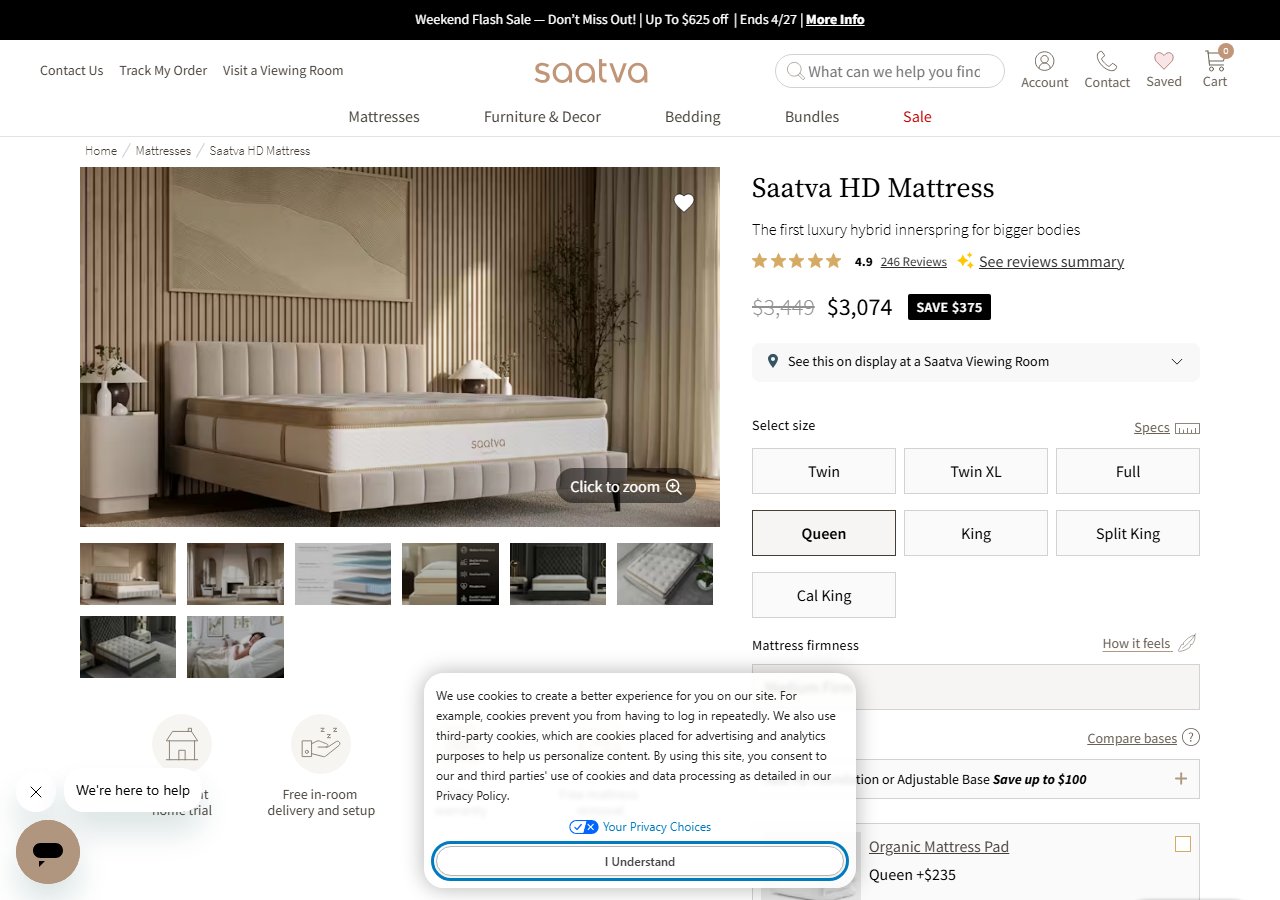
Saatva HD Mattress (Heavy-Duty)
$2,395-$3,995
See Price at Saatva →
Purple Hybrid Premier Mattress
$2,499-$4,799
See Price at Purple →Putting the Data Hierarchy Together
The federal data on construction back pain tells a clear story: this is a population under serious, documented, cumulative spinal load — and the consequences of not managing it are not just discomfort but disability, career termination, and substantial healthcare cost. BLS MSD data is not ambiguous about which occupations bear the highest back injury burden. SSA Disability Insurance reports are not ambiguous about where musculoskeletal disorders end up in the disability system.
The intervention hierarchy that data supports is: movement and sleep position first (free, high-effect), clinical evaluation for red flags before anything else if warning signs are present, then a properly engineered sleep surface as a legitimate recovery tool — not a cure.
CDC sleep data shows 35% of U.S. adults are already sleeping fewer than 7 hours per night. Construction workers who are also sleeping on a degraded or undersupported mattress are compounding a sleep debt with a structural recovery failure. The morning stiffness that has become normalized in the trades is not inevitable. It is a measurable, addressable problem — and the evidence base for addressing it exists in federal occupational health data that most workers never see.
Start with the free interventions. See a clinician if the red flags apply. And if the mattress is genuinely the constraint — if it is old, visibly sagging, or simply not built for your weight class — the engineering characteristics described above give you a real framework for choosing one that works.
The goal is not to sell you something. The goal is to make sure a 20-year ironworker can still get out of bed without seizing up, and that the morning recovery cycle is doing what it is supposed to do: prepare the body for another day of demanding work.