The Body Keeps the Score — and Construction Work Stacks the Debt Fast
You didn't pull your back this morning. You pulled it over the last 15 years — every truss you lifted, every concrete bag you hauled, every hour you spent kneeling on subfloor or bent over a miter saw. What you feel when you swing your legs off the mattress at 5 a.m. is the compounded interest on a long career of spinal loading that no single workday would produce alone.
BLS Musculoskeletal Disorder tracking identifies the back as the most common body part injured across all U.S. occupations with days away from work. Construction doesn't just appear in that data — it sits near the top of it. Framers, ironworkers, pipefitters, electricians, and concrete laborers all share a common physiological exposure: repetitive axial loading of the lumbar spine under conditions that combine weight, asymmetry, vibration, and fatigue. The NIOSH Lifting Equation was developed precisely because manual material-handling tasks in warehousing, construction, and healthcare routinely exceed safe spinal compression limits — limits the human lumbar discs were not designed to sustain shift after shift, year after year.
The downstream cost of this injury pattern is staggering. AHRQ HCUP data identifies back pain as one of the most expensive conditions in U.S. healthcare by combined inpatient and outpatient spending. AHRQ's Medical Expenditure Panel Survey finds that adults with chronic back conditions spend substantially more on personal healthcare annually than adults without them. And CMS drug spending data places opioid and non-opioid pain medication among the costliest Medicare drug categories — a downstream signal of how often chronic spinal pain ends in long-term pharmaceutical management rather than resolution. Most sobering: SSA Disability Insurance data identifies musculoskeletal disorders as the single largest category of new disability claims filed each year in the United States. For construction workers, that is not an abstraction. It is a known career endpoint that peers have reached.
Why Construction Work Breaks the Back — The Biomechanical Mechanism
To understand why sleep surface matters for this specific population, you first have to understand what construction work actually does to the spine over time.
The lumbar spine — the five vertebrae and intervertebral discs between the ribcage and pelvis — is the primary load-bearing structure of the torso. In clinical biomechanics, compressive forces at L4-L5 and L5-S1 (the bottom two disc levels) are the focus of most occupational injury research because these segments bear the highest moment arm when loads are held away from the body. NIOSH's Revised Lifting Equation defines an "Action Limit" of 51 pounds under ideal conditions — both hands centered, load at waist height, minimal asymmetry, no twisting. In real construction conditions, those modifiers rarely align. A 94-pound bag of concrete mix hoisted from ground level and shifted laterally to a mixer can generate compressive disc loads three to four times that limit.
Beyond acute lifting events, construction imposes three additional spinal stressors that are often underweighted:
Vibration exposure. Jackhammer, compactor, and heavy equipment operation transmit whole-body vibration through the lumbar spine. Epidemiological research has associated sustained whole-body vibration with accelerated disc degeneration at L4-L5 and L5-S1 — the same segments most vulnerable to lifting injury.
Sustained non-neutral postures. Kneeling to set tile, squatting to frame low walls, bending forward to lay decking — these postures place the lumbar spine in sustained flexion under load. Sustained flexion compresses the anterior disc and tensions the posterior annular fibers, a pattern that over years accelerates disc bulge formation.
Cumulative fatigue. Paraspinal and core musculature that stabilizes the spine fatigues across a full shift. Fatigue reduces the muscular protection that prevents shear forces from concentrating at the disc. A worker who makes their last lift at hour nine has meaningfully less spinal stability than the same worker at hour one — even if the load is identical.
The CDC NCHS Data Brief 390 finds that approximately 20% of U.S. adults experience chronic pain, with the lower back as the most common pain location. In physically demanding trades, that prevalence skews higher. And roughly 25% of U.S. adults report doctor-diagnosed arthritis, with prevalence concentrated in exactly the occupations — construction, manufacturing, agriculture — that combine sustained physical demand with aging workforces.
Now here is the connection to sleep: the spine does most of its disc rehydration during recumbency. Intervertebral discs are largely avascular — they depend on the pressure cycle of loading and unloading to pump nutrients in and waste products out. During sleep, with the spine unloaded, discs reabsorb fluid and restore height. This is why humans are measurably taller in the morning than in the evening. A sleep surface that fails to maintain spinal alignment during this rehydration window doesn't merely cause discomfort — it actively interferes with the primary recovery mechanism available to disc tissue that has spent eight to ten hours under compressive load.
For construction workers — who are often heavier than average due to muscle mass, who sleep in positions driven by pain rather than preference, and whose spines have already sustained years of asymmetric loading — the mattress is not a luxury variable. It is a recovery tool. But it is also only one tool, and not the first one to reach for.
Try These First — Before You Spend a Dollar on a New Mattress
The cheapest intervention is the one that does not require buying anything. Federal occupational health guidance is consistent on this: most chronic low back pain in working adults responds to behavioral and mechanical changes that cost nothing. Before evaluating any product, construction workers managing morning stiffness and back pain should work through the following non-product interventions systematically.
Daily walking is more powerful than most workers realize. NIH NCCIH's evidence review on low back pain finds that walking 30 minutes most days reduces chronic low back pain as effectively as most non-drug clinical treatments. This is not intuitive for workers who already spend eight hours on their feet — but occupational standing and walking are biomechanically different from continuous aerobic walking. A structured 30-minute walk before or after shift, sustained over weeks, reconditions the paraspinal musculature and reduces the sensitization that drives chronic pain cycles.
Sleep position is the biggest free variable in your night. NIH guidance on back pain is direct: side-sleeping with a pillow between the knees, or back-sleeping with a pillow under the knees, maintains lumbar neutral. Stomach-sleeping torques the lumbar spine, increases anterior disc loading, and worsens chronic pain over time. For construction workers accustomed to sleeping however pain allows, this positional correction is often the single highest-yield free intervention available.
Mechanics at work are rehearsable and correctable. OSHA's ergonomics guidance is explicit: hinge at the hips, not the lumbar spine; keep loads close to the body; avoid twisting under load. Most acute back episodes are mechanical and preventable with rehearsed technique. Workers who have not had a formal ergonomics review — which many job sites now provide — should request one. A single session with an occupational health specialist on lifting mechanics can change the trajectory of a back pain condition that years of passive treatment have not resolved.
Know when your mattress is actually the problem. CDC Sleep Hygiene guidance supports replacing a mattress that shows visible sag, produces morning stiffness worse than at bedtime, or is older than 7 to 10 years. These are legitimate product-replacement triggers. But even the most engineered mattress does not undo poor sleep hygiene or a sedentary day. A mattress is a necessary condition for good spinal recovery, not a sufficient one.
For workers who have already made these adjustments — who walk daily, sleep correctly positioned, use proper lifting mechanics at the jobsite, and still wake up stiff — the evidence supports looking at the sleep surface itself. CDC data shows that approximately 35% of U.S. adults sleep fewer than the recommended 7 hours per night. For construction workers already operating at a recovery deficit from occupational loading, adding poor sleep surface support to short sleep duration creates a compounding problem that behavioral change alone cannot fully resolve. At that point, mattress engineering becomes a legitimate clinical adjunct.
When to See a Clinician — Red Flags That a Mattress Cannot Fix
Morning stiffness and generalized low back achiness after a long career in the trades is common and, in most cases, manageable without urgent medical attention. But certain presentations require evaluation before any home intervention — product or behavioral — is appropriate.
NIH guidance from the National Institute of Neurological Disorders and Stroke identifies the following as red flags requiring prompt clinical evaluation: back pain that radiates consistently below the knee (suggesting nerve root compression or disc herniation at a level that may need imaging); pain that developed after trauma (fall, vehicle accident, or dropped load); pain accompanied by leg weakness, foot drop, or loss of sensation; and any back pain accompanied by bowel or bladder changes. These presentations are not mattress problems. They are medical problems.
Additionally, construction workers over 50 who develop new-onset back pain after years without significant symptoms should be evaluated for compression fracture — particularly if they have had significant cumulative vibration exposure or known osteopenia. BLS employer cost data shows that industries with high MSD incidence carry workers' compensation rates 3–5x higher than low-MSD industries, which reflects in part the cost of delayed treatment when workers manage serious conditions with passive measures too long.
Where Products Fit — Mattress Engineering for High-Load Body Types
Construction workers shopping for a mattress face a problem that most mattress marketing does not address: they are often heavier than average (due to muscle mass, not necessarily body fat), they carry asymmetric spinal loading patterns from their dominant-side trade work, and they need a mattress that provides both adequate pressure relief for soft-tissue recovery and sufficient support to prevent lumbar sag throughout the night. Consumer mattresses are typically engineered for average body weights and symmetrical load distribution. They fail construction workers in specific ways.
The core failure mode is lumbar sag. A mattress that is too soft for a worker's weight allows the hips and torso to sink unevenly, creating a hammock posture that places the lumbar spine in sustained flexion — exactly the same loading pattern that damaged it during the workday. A mattress that is too firm fails to accommodate shoulder width in side-sleeping positions, forcing the spine into lateral flexion. The engineering challenge is a zoned support profile that is firm enough at the lumbar to prevent sag, soft enough at the shoulder to allow proper shoulder clearance, and consistent enough across its lifespan to deliver that profile on night 2,000 as well as night one.
For workers managing serious chronic back pain, the Saatva Loom & Leaf Memory Foam Mattress is the premium memory foam option in this category. Saatva engineers the Loom & Leaf with a proprietary gel-infused memory foam system and a lumbar zone quilting pattern that provides targeted support at the lower back — not uniform softness across the whole surface. For workers whose primary complaint is lumbar aching and morning stiffness after side or back sleeping, the zoned construction addresses the specific failure mode. The Loom & Leaf is available in Relaxed Firm and Firm variants; construction workers managing lumbar instability tend to do better in the Firm, while those with significant hip and shoulder soft-tissue soreness may prefer Relaxed Firm.
For heavier construction workers — concrete laborers, ironworkers, equipment operators who run 220 pounds and above — standard mattress coil gauges and foam densities are simply not rated for the load. The Saatva HD Mattress is purpose-engineered for this population, with a dual-coil support system using individually wrapped 14.5-gauge tempered steel coils (heavier gauge than standard consumer mattresses) over a high-density foam base, and a rated support capacity exceeding what most mattresses provide. For the worker who has owned multiple "firm" consumer mattresses and found them sagging within two to three years, the HD's construction addresses the durability problem directly. It is listed at a higher price point ($2,395–$3,995) but should outlast two to three standard mattresses at its support level — a relevant calculation for a worker spending thousands on recurrent replacements.
For construction workers whose primary complaint is not just lumbar pain but systemic soft-tissue soreness — hip bursitis, knee pain from sustained kneeling, shoulder soreness from overhead work — pressure relief at the surface level matters as much as lumbar support. The Purple Hybrid Premier Mattress uses Purple's GelFlex Grid, a hyperelastic polymer grid that distributes weight across a larger surface area than foam alone, reducing peak pressure at the hip and shoulder contact points that create pain during extended side-sleeping. The Hybrid Premier pairs this grid with pocketed coils for the deep support that trades workers need. For workers whose soreness is systemic rather than specifically lumbar, it offers a materially different pressure-relief mechanism than foam-based alternatives.
Mattresses Engineered for Construction-Worker Body Types and Recovery Demands
Each product below was selected specifically for the load profiles, weight ranges, and multi-site soreness patterns common in heavy-trade construction work — not for average consumer use cases.

Saatva Loom & Leaf Memory Foam Mattress
$1,695-$3,295
See Price at Saatva →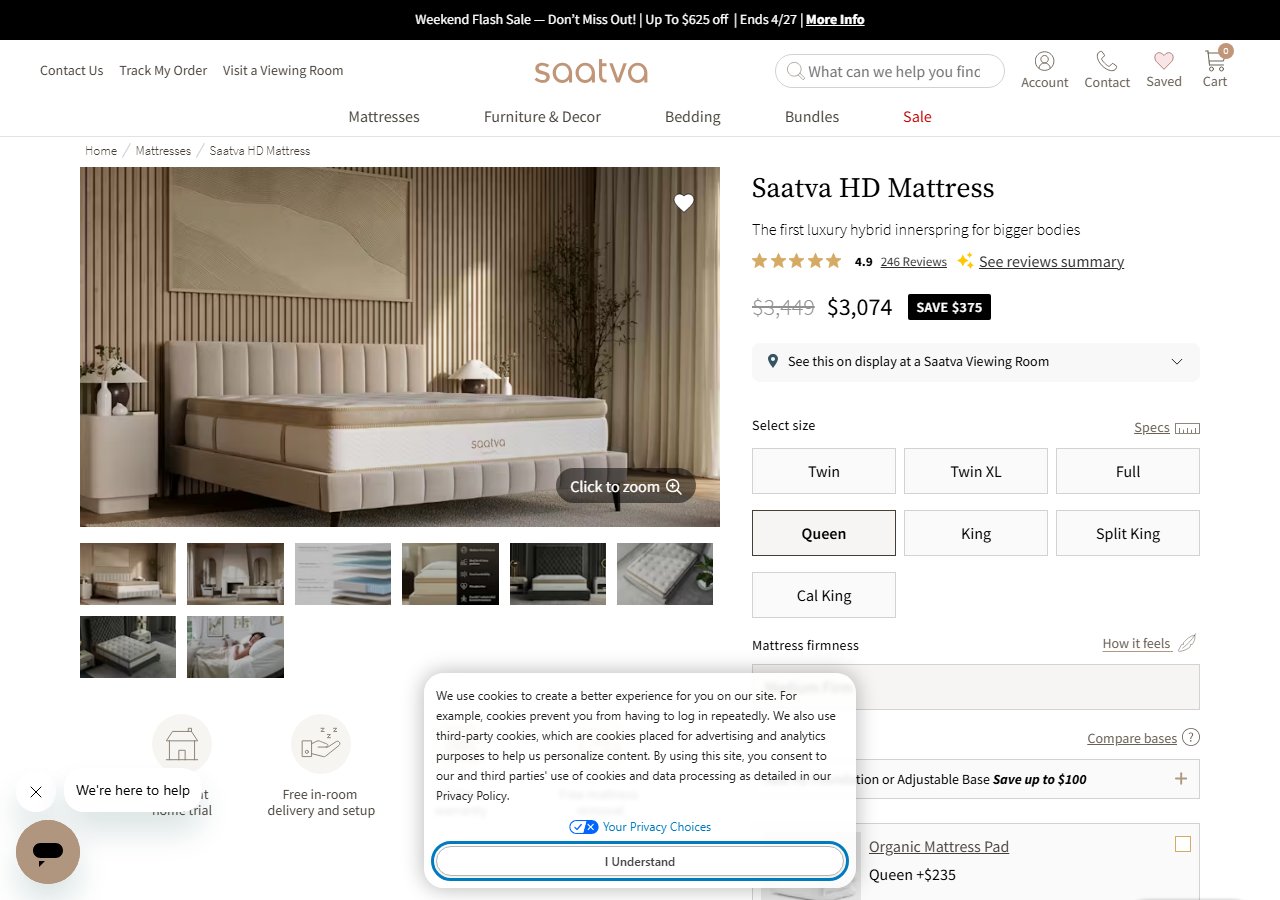
Saatva HD Mattress (Heavy-Duty)
$2,395-$3,995
See Price at Saatva →
Purple Hybrid Premier Mattress
$2,499-$4,799
See Price at Purple →Sizing the Real Cost — Why This Is Not Just About Comfort
The financial case for appropriate sleep surface investment is not subtle when you look at the federal data in aggregate. AHRQ HCUP places back pain among the most expensive conditions in U.S. healthcare by total spending. AHRQ MEPS data documents that adults with chronic back conditions spend substantially more on personal healthcare than those without. CMS drug spending data reflects a pain management system that has historically defaulted toward pharmaceutical management of a condition that has significant structural and biomechanical drivers.
For a construction worker spending $300 to $600 annually on pain medication, $200 to $500 on physical therapy co-pays, and losing workdays to MSD-related absence, a mattress at $2,000 to $3,000 that reduces morning stiffness, improves sleep continuity, and extends productive career years is not a luxury expenditure. It is a capital allocation decision. SSA Disability Insurance data — which tracks musculoskeletal disorders as the largest single category of new disability claims — gives the clearest picture of where unmanaged occupational back pain can end. For workers in physically demanding trades, proactive recovery is a career-length strategy, not a weekend comfort preference.
BLS employer cost data shows industries with high MSD incidence pay workers' compensation premiums 3–5x higher than low-MSD industries. Individual workers absorb the health side of that same cost equation. The interventions available — walking, sleep position correction, lifting mechanics, and when appropriate, an engineered sleep surface — are inexpensive relative to the alternative.
The Hierarchy That Actually Works
Federal occupational health data points to a clear priority order for construction workers managing back pain and morning stiffness. Movement first: NIH NCCIH evidence shows walking outperforms most passive interventions. Mechanics second: OSHA ergonomics guidance addresses the source of the injury, not just the symptom. Sleep position third: NIH guidance is specific and free to implement. Clinical evaluation fourth, before any product purchase, for red-flag presentations. And finally, for workers who have worked through those steps and still have an inadequate sleep surface — one that sags, is outdated, or is simply not rated for their body weight and load profile — an engineered mattress is a legitimate and evidence-consistent recovery tool.
The Saatva HD addresses load rating and durability. The Saatva Loom & Leaf addresses lumbar zone support and pressure distribution for chronic pain sufferers. The Purple Hybrid Premier addresses systemic soft-tissue pressure relief for workers with multi-site soreness. Each addresses a specific failure mode of standard consumer mattresses when used by high-load body types.
None of them replaces the behavioral work. All of them matter more after that work is done.