The Federal Data Behind Every Stiff Morning on a Job Site
If you spend your workdays framing walls, running conduit, pouring concrete, or swinging a sledge, your back is absorbing punishment that the federal government has spent decades quantifying. BLS Musculoskeletal Disorders by Occupation tracking is unambiguous: the back is the most common body part injured across all U.S. occupations with days away from work. Construction trades consistently rank among the highest-incidence sectors in that dataset. This is not a niche finding buried in a supplemental table — it is the headline number, year after year.
The downstream consequences are severe. AHRQ HCUP data identifies back pain as one of the most expensive conditions in U.S. healthcare by total inpatient and outpatient cost. AHRQ MEPS survey data shows that adults with chronic back conditions carry substantially higher annual personal healthcare expenditures than those without. And SSA Disability Insurance reports identify musculoskeletal disorders as the single largest category of new disability claims filed each year — meaning the MSD epidemic in construction is not just a pain problem, it is a livelihood problem.
Yet the conversation about construction worker back pain almost always skips straight to treatment: painkillers, injections, surgery, or — more recently — mattress advertising. This article does not skip the mechanism. Understanding why construction work destroys the lumbar spine, and why poor sleep surfaces extend that destruction through the night, is the foundation for making any intervention work.
Why Construction Work Is Uniquely Destructive to the Lumbar Spine
The NIOSH Lifting Equation — the federal standard for quantifying manual-handling risk — documents that material-handling tasks across construction, warehousing, and healthcare routinely exceed safe spinal loading limits. In construction, this plays out across multiple simultaneous exposure pathways that compound each other.
Compressive loading is the most straightforward. When a framing carpenter lifts a bundle of shingles, a mason lifts a concrete block, or an ironworker maneuvers rebar, the intervertebral discs of the lumbar spine absorb compressive forces that can exceed 3,400 Newtons — the threshold NIOSH identifies as the action limit for disc injury risk. Construction workers routinely breach this limit dozens of times per shift, not once.
Shear loading is less visible but equally damaging. When a worker bends at the waist — rather than hinging at the hip — the lumbar vertebrae slide forward relative to each other under load. The facet joints and posterior ligaments absorb that shear stress. Over years, this degrades disc integrity, narrows foramen (the passages through which nerve roots exit the spine), and creates the conditions for herniation and chronic radiculopathy.
Sustained awkward posture is a third pathway. Electrical workers running wire through attic spaces, plumbers lying on their sides under sinks, drywall hangers working overhead — these postures hold the spine in end-range positions for extended periods, loading passive tissues that are not designed for sustained tension. The cumulative fatigue damage is invisible until it is not.
Vibration exposure deserves separate mention. Heavy equipment operators, jackhammer users, and workers on compaction equipment experience whole-body vibration (WBV) that travels directly through the seated pelvis into the lumbar spine. European occupational health literature has linked chronic WBV exposure to accelerated disc degeneration; U.S. NIOSH research has corroborated this association. A construction worker with significant equipment-operator history arrives at middle age with a spine that has been mechanically aged beyond its chronological years.
The cumulative result: by the time a construction professional reaches their 40s or 50s, the lumbar discs have lost significant hydration and height, the facet joints may show early arthritic changes, and the paraspinal musculature has developed chronic tension patterns as a protective response. CDC NCHS Data Brief 390 confirms that approximately 20% of U.S. adults experience chronic pain, with lower back as the most common location — and occupational exposure is one of the strongest predictors of who ends up in that 20%.
CDC Arthritis Data adds another layer: approximately 25% of U.S. adults report doctor-diagnosed arthritis, with prevalence concentrated in occupations involving sustained physical demand. Construction is not an outlier in that dataset — it is a driver of it.
The Night Shift: How a Poor Sleep Surface Extends the Injury
Here is the mechanism that mattress advertisers mention only vaguely, if at all: sleep is the primary recovery window for the intervertebral discs. Discs are avascular — they do not have their own blood supply. They receive nutrition through a process called imbibition: when spinal loading is removed (i.e., when you lie down), fluid and nutrients are drawn back into the disc matrix. This process requires two things: adequate time horizontal, and a surface that allows the spine to decompress into a neutral position rather than forcing it into compensatory curves.
A mattress that is too soft allows the heavy pelvis and shoulders of a large-framed construction worker to sink into the surface, creating a hammock curve that holds the lumbar spine in sustained flexion all night. A mattress that is too firm creates pressure-point loading at the iliac crests and greater trochanters, forcing the worker to shift position repeatedly — disrupting the deep sleep stages where physical repair processes, including growth hormone secretion, are most active.
CDC sleep data shows approximately 35% of U.S. adults report sleeping fewer than 7 hours per night, the threshold below which chronic disease risk rises sharply. For construction workers — who are already carrying elevated inflammatory load from occupational exposure — consistently poor sleep quality accelerates MSD progression rather than halting it.
The body-weight dimension matters here more than most mattress coverage acknowledges. The average male construction worker in the United States is not a 160-pound test-dummy. Framers, ironworkers, and operating engineers frequently carry 200 to 260 pounds of body weight — sometimes more — including muscle mass built over decades of physical labor. A mattress engineered for median-weight sedentary consumers will compress to the bottom of its support layer under that load, eliminating the very pressure relief it is marketed to deliver. This is why the BLS workers' compensation cost data context matters: industries with high MSD incidence carry workers' comp rates 3-5x higher than low-MSD industries, and sleep-surface inadequacy is one modifiable risk factor that has gone largely unaddressed in occupational health interventions.
Try These First — Free Interventions That Have Federal Evidence Behind Them
Before any product enters this conversation, the honest starting point is that the cheapest effective intervention is the one that does not require buying anything. Federal evidence supports several no-cost interventions that, applied consistently, can reduce chronic low back pain burden as much as or more than any single product change.
Daily walking is the intervention with the strongest evidence base. NIH NCCIH's evidence review on low back pain concludes that walking 30 minutes on most days reduces chronic low back pain as effectively as most non-drug clinical treatments. For construction workers, this may feel counterintuitive — you walk all day. But jobsite walking is reactive, load-bearing, and postural-stress-inducing. Deliberate walking on flat terrain, without tools or load, with normal gait, is a distinct stimulus that promotes disc nutrition, paraspinal muscle endurance, and inflammatory downregulation.
Lifting and bending mechanics remain the most direct modifiable exposure. OSHA's ergonomics guidance is clear: hinge at the hips, not at the lumbar spine; keep loads close to the body; avoid twisting under load. Most acute back episodes in construction are mechanical — meaning they follow a specific loading event that exceeded tissue tolerance. Rehearsing proper mechanics in low-stakes contexts (gym, driveway) builds the motor patterns that protect the spine when a load appears unexpectedly on site.
Sleep position is the single largest free variable for nighttime spinal loading. NIH guidance on back pain from NIAMS identifies side-sleeping with a pillow between the knees, or back-sleeping with a pillow under the knees, as the positions that best maintain lumbar neutrality. Stomach-sleeping creates sustained lumbar hyperextension and cervical rotation — both of which load already-fatigued posterior structures. For a construction worker with existing facet joint inflammation, a full night of prone sleeping can undo whatever recovery progress occurred in the first few hours of rest.
Mattress replacement criteria: CDC sleep hygiene guidance frames the mattress-replacement decision practically — replace if there is visible sag, if you wake consistently stiffer than you went to bed, or if the mattress is older than 7 to 10 years. No mattress, regardless of price, compensates for inadequate sleep duration, poor sleep hygiene, or zero movement during the day.
For construction workers who have already addressed movement, mechanics, and sleep position — and who are sleeping on a structurally compromised or undersupported surface — a purposefully engineered sleep surface becomes a legitimate tool. The key word is purposefully: not all mattresses marketed for back pain are engineered for the load profiles that heavy-trade workers actually impose.
When to See a Clinician Before Buying Anything
A new mattress is appropriate for a mechanical back pain problem on an aging or inadequate sleep surface. It is not appropriate as the first response to several clinical presentations that require imaging, referral, or prompt medical evaluation. NIH National Institute of Neurological Disorders and Stroke back pain guidance identifies the following as red flags that warrant clinical evaluation before any self-directed intervention:
Back pain that radiates below the knee — particularly with associated numbness, tingling, or weakness — suggests nerve root compression that may require imaging to characterize. Back pain following acute trauma (a fall from height, a struck-by incident, a vehicle collision) requires radiographic evaluation to rule out fracture. Back pain accompanied by bowel or bladder changes is a medical emergency: cauda equina syndrome is rare but devastating and is defined by exactly this presentation. Back pain accompanied by unexplained fever or weight loss suggests infectious or oncologic etiology, neither of which a mattress addresses.
Construction workers are at elevated risk for trauma-related spinal injury by the nature of their work — falls from scaffolding, struck-by incidents, equipment accidents. The instinct to attribute new back pain to occupational wear-and-tear is understandable, but it can delay diagnosis of structurally serious injuries. When in doubt, see a clinician. A primary care provider can rule out the serious differentials in a single visit and refer appropriately. That visit is a better investment than any mattress if the underlying problem is structural, infectious, or neurological.
Where Sleep Surface Engineering Actually Helps — and Which Products Are Built for It
For construction workers without red-flag presentations, whose back pain is mechanical in origin and whose current sleep surface is visibly sagging, chronologically aged, or demonstrably too soft or too firm, a targeted product choice becomes relevant. The criteria for this population are specific:
- Support layer depth and density sufficient to prevent bottoming-out under 200-plus-pound body weights
- Pressure relief at the hips and shoulders without sacrificing lumbar support — a distinction that eliminates most consumer-grade memory foam
- Edge support adequate for a person who uses the bed edge as a daily entry and exit point
- Thermal management for workers who run hot from physical exertion
- Durability — a sleep surface for a construction worker will carry more cumulative load per year than the same mattress under a sedentary office user
The Saatva Loom & Leaf addresses the memory foam category specifically for back-pain sufferers who want the pressure-contouring properties of memory foam without the heat retention and lack of lumbar support that characterize most consumer memory foam mattresses. Saatva uses a multi-layer construction with an organic cotton cover, a gel-infused memory foam comfort layer, and a spinal zone quilting system designed to deliver firmer support beneath the lumbar region specifically. For a construction worker with disc-related chronic low back pain who sleeps on their side and needs hip-to-lumbar pressure distribution, this is the premium foam option to evaluate.
For workers at the higher end of the weight spectrum — or those whose occupational loading has been particularly severe — the Saatva HD Mattress is the structurally purpose-built option. Saatva designed the HD explicitly for users up to 500 pounds, with a support system that includes a high-density foam foundation layer, individually wrapped coils in a larger gauge than their standard models, and a second tempered steel coil layer for additional stability. This is not a rebranded standard mattress with a different cover — it is a distinct engineering specification. For ironworkers, operating engineers, or any construction professional who has watched a previous mattress develop premature body impressions within a year or two of use, the HD addresses the root cause: inadequate support layer density for the applied load.
For workers whose primary complaint is pressure-point pain at the hips and shoulders — particularly those who experience the hip-dig sensation characteristic of a mattress that is too firm — the Purple Hybrid Premier offers a materially different approach. Purple's GelFlex Grid is a hyper-elastic polymer grid that collapses under point-source pressure (like a hip bone or shoulder) while maintaining columnar support across the broader surface. Unlike memory foam, it does not create a slow-sink envelope — it provides immediate, responsive pressure relief while the underlying pocketed coil system maintains spinal alignment. For construction workers who run hot and find traditional memory foam intolerable in summer, the open-grid structure provides meaningful airflow that foam cannot match.
Mattresses Built for High-Load Construction Professionals
These three mattresses were selected specifically for construction workers: high-density support layers that do not bottom out under heavy body weights, pressure relief for compressed joints, and durability adequate for the cumulative load a physical laborer imposes over years of use.

Saatva Loom & Leaf Memory Foam Mattress
$1,695-$3,295
See Price at Saatva →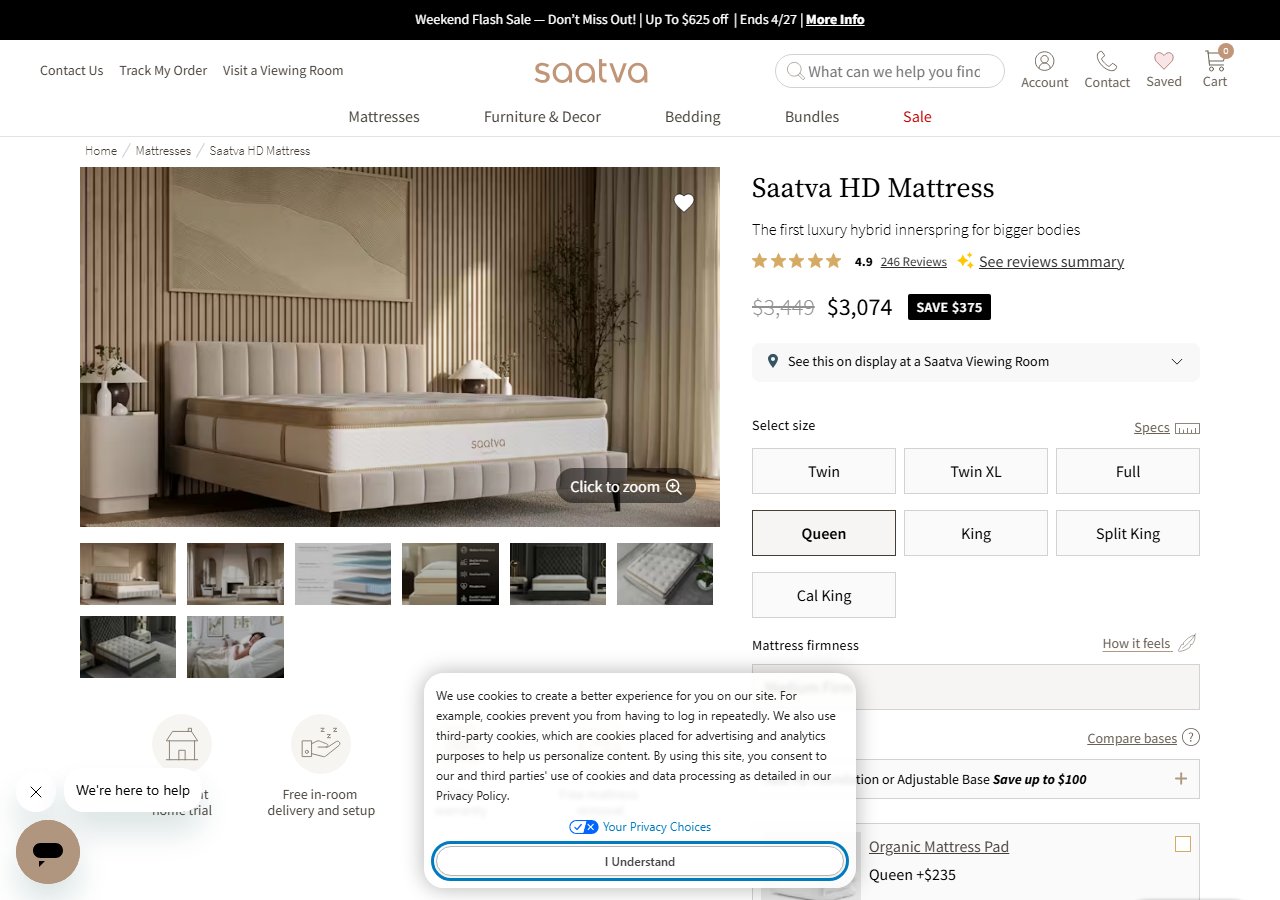
Saatva HD Mattress (Heavy-Duty)
$2,395-$3,995
See Price at Saatva →
Purple Hybrid Premier Mattress
$2,499-$4,799
See Price at Purple →Building a Recovery System, Not Just Buying a Mattress
The federal data on construction MSDs paints a clear picture: this workforce is absorbing spinal loading at volumes that exceed safe limits by design, across careers that span decades. The CMS drug spending dashboard shows opioid and non-opioid pain medication spending among the most expensive Medicare drug categories — a downstream indicator of how inadequately the U.S. health system manages chronic pain at the source. A construction worker who invests in a structurally appropriate sleep surface, combines it with deliberate daily movement, applies proper lifting mechanics on site, and monitors for red flags requiring clinical attention is building a recovery system — not just buying a product.
The mattress is one lever in that system. It is probably not the highest-leverage lever (that is movement and mechanics). But for a worker sleeping on a 12-year-old mattress with a visible body impression, it may be the most immediately modifiable variable. The products above — the Saatva Loom & Leaf for foam-preferring back-pain sufferers, the Saatva HD for high-load and higher-weight users, and the Purple Hybrid Premier for pressure-relief and thermal comfort priorities — represent the strongest engineering cases for this specific population. None of them are magic. All of them are significantly better than a compromised sleep surface for a body that has been under load since 5:30 in the morning.
Get the movement right first. Get the mechanics right second. Replace the mattress third, if the mattress is the problem. See a clinician if any of the red flags in this article apply to you.