The Federal Data Is Unambiguous: Construction Breaks Backs
According to BLS Musculoskeletal Disorders by Occupation tracking, the back is the single most common body part injured across every U.S. occupation that results in days away from work. That statistic does not come from a chiropractor's waiting room brochure. It comes from the Bureau of Labor Statistics, which aggregates employer-reported injury and illness data across millions of U.S. worksites every year. And within that universe, construction — carpentry, ironwork, masonry, concrete finishing, roofing — consistently ranks among the highest-incidence sectors for musculoskeletal disorder (MSD) events.
If you work a heavy trade and you wake up stiff most mornings, you are not imagining it. You are living inside a federal injury pattern that has been documented for decades and that costs the American healthcare system billions of dollars annually. AHRQ HCUP data identifies back pain as one of the most expensive conditions in U.S. healthcare by total inpatient and outpatient spending. The AHRQ Medical Expenditure Panel Survey shows that adults with chronic back conditions spend substantially more on personal healthcare each year than adults without such conditions. These are not rounding errors. This is a structural occupational health crisis wearing the face of a sore morning.
And yet, the conversation almost always jumps straight to products. Buy a new mattress. Try a foam roller. Get a lumbar support. This article is going to do something different: it is going to explain the mechanism first, walk through the free interventions second, flag the clinical red flags third, and only then discuss what sleep surfaces actually do — and do not — accomplish for a body carrying the load profile of a construction professional.
Why This Happens: The Biomechanics of Heavy-Trade Spinal Loading
Construction work is not a single motion. It is a sustained, variable, high-force assault on the spine across an eight-to-twelve-hour window. Framers carry lumber and operate nail guns in awkward postures. Masons load the lumbar spine with repetitive bending and twisting while handling materials that can weigh 30 to 50 pounds per unit. Ironworkers reach, torque, and stabilize under load on unstable surfaces. Concrete finishers spend hours in sustained forward flexion at the lumbar spine — one of the most mechanically punishing positions the intervertebral discs experience.
The NIOSH Lifting Equation establishes that manual material-handling tasks across warehousing, construction, and healthcare routinely exceed safe spinal loading limits. The Recommended Weight Limit (RWL) defined by NIOSH accounts for task frequency, object distance from the body, vertical displacement, and trunk rotation — and in real construction environments, workers routinely exceed the Lifting Index threshold that signals elevated injury risk. This is not a matter of workers being careless. It is a matter of task demands that structurally exceed what the spine can absorb without cumulative damage over time.
Here is the sleep connection: the intervertebral disc is largely avascular. It receives nutrition through a diffusion process driven by mechanical loading and unloading cycles — the compression of the workday and the decompression of sleep. When a worker sleeps on a surface that does not support neutral spinal alignment, the lumbar spine remains in either excessive flexion (sagging mattress) or excessive extension (mattress too firm for the body's weight distribution), and the disc does not decompress efficiently. Morning stiffness is the sensory output of a disc that spent eight hours in a mechanically disadvantaged position rather than recovering.
This is compounded by body composition. Construction professionals — especially those in concrete, steel, and framing — frequently carry higher lean body mass than the average U.S. adult. The average mattress is engineered for a body weight range centered on roughly 130 to 180 pounds. A framer or ironworker at 210 to 250 pounds compresses most consumer-grade mattresses past their designed comfort zone, creating pressure gradients at the hips and shoulders that tilt the pelvis and increase lumbar shear stress even in a nominally restful position.
The chronic-pain data reflects this population burden directly. CDC NCHS Data Brief 390 reports that approximately 20% of U.S. adults experience chronic pain, with lower back pain as the most common location. Occupational exposure is one of the strongest predictors of chronic low back pain in the epidemiological literature. The SSA Disability Insurance data identifies musculoskeletal disorders as the largest single category of new disability claims annually — meaning that for a meaningful subset of construction workers, untreated or poorly managed back pain eventually ends careers and creates long-term disability dependency.
BLS Employer Costs for Employee Compensation data shows that industries with high MSD incidence carry workers' compensation insurance rates three to five times higher than low-MSD industries. That premium is ultimately priced into everything — labor costs, contractor bids, take-home pay. The economic argument for managing MSD risk proactively is not soft. It is written into every paycheck.
The Cheapest Intervention Is the One That Does Not Require Buying Anything
Before any sleep surface enters this conversation, it is worth being precise about what non-product interventions can actually accomplish — because for many construction workers, the limiting factor on back recovery is not the mattress. It is movement volume, lifting mechanics, and sleep position. All three are free.
Lifting and bending mechanics are where most acute episodes begin. OSHA's ergonomics guidance is explicit: hinge at the hips, not the lumbar spine; keep loads close to the body; avoid twisting under load. Most acute back episodes in construction are mechanical events — a single lift in a bad position, a twist with a loaded tool, a reach from an unstable stance. These are rehearsable. Workers who internalize hip-hinge mechanics — the same pattern a powerlifter uses on a deadlift — dramatically reduce the moment arm on the lumbar spine during lifts, shifting load to the posterior chain where it belongs.
Daily walking is the most underrated evidence-based intervention for chronic low back pain. NIH NCCIH's evidence review on low-back pain finds that walking 30 minutes on most days reduces chronic low back pain as effectively as most non-drug clinical treatments. This is a meaningful benchmark. Walking drives disc nutrition, maintains lumbar mobility, and activates the deep stabilizing musculature of the trunk. Construction workers who are on their feet all day may assume they are already getting enough movement — but sustained static postures (crouching, reaching, bent-over finishing work) are not the same as dynamic ambulatory movement, and the spine responds to the difference.
Sleep position is perhaps the highest-leverage free variable in a construction worker's recovery toolkit. NIH guidance on back pain from the National Institute of Arthritis and Musculoskeletal and Skin Diseases recommends side-sleeping with a pillow between the knees, or back-sleeping with a pillow under the knees, to maintain neutral spinal alignment. Stomach-sleeping — which a substantial fraction of adults default to — torques the lumbar spine and increases compressive load on the posterior elements of the disc. Changing sleep position costs nothing and can reduce morning stiffness within days for workers whose pain is primarily positional.
When to evaluate the mattress itself: CDC sleep hygiene guidance provides a practical framework: replace the mattress if it has visible sag, if you wake consistently stiffer than you went to bed, or if the mattress is older than seven to ten years. Even the most engineered sleep surface does not undo poor sleep hygiene, insufficient sleep duration, or sedentary recovery days. CDC data shows approximately 35% of U.S. adults report sleeping fewer than seven hours per night — the threshold associated with elevated chronic disease risk. Duration matters as much as surface.
For construction workers who have already corrected their sleep position, added a daily walk, and replaced a visibly degraded mattress — and who are still waking stiff — the sleep surface becomes a legitimate variable worth engineering. The issue is usually one of two things: the mattress is too soft to support a heavy-load body type, allowing the hips to sink past neutral; or it is too firm, creating point-loading at the hips and shoulders on a side-sleeper, which shifts the pelvis and increases lumbar rotation. Getting this right requires matching mattress construction to body weight, sleep position, and the specific regions of highest load — and that is where product specifications actually matter.
When to See a Clinician First
A new mattress is not a medical intervention, and no sleep surface is a substitute for clinical evaluation when back pain has specific characteristics that warrant imaging or specialist referral.
NIH National Institute of Neurological Disorders and Stroke guidance on back pain is clear about the red flags: seek prompt clinical evaluation for back pain that radiates below the knee, follows acute trauma (a fall from height, a vehicle accident, a structural collapse), comes with progressive leg weakness, involves bowel or bladder dysfunction, or is accompanied by fever. These symptom patterns suggest nerve compression, spinal cord involvement, fracture, infection, or malignancy — conditions that a sleep surface does not treat and that delay in evaluating can worsen. The CDC arthritis data showing that approximately 25% of U.S. adults carry a doctor-diagnosed arthritis diagnosis — with prevalence concentrated in physically demanding occupations — is a reminder that construction workers often carry comorbid joint pathology alongside their back pain, and that the interaction of those conditions warrants medical input, not just product optimization.
For construction workers whose back pain is diffuse, positional, morning-dominant, and without neurological symptoms, conservative management — position modification, walking, mattress evaluation — is reasonable as a starting point. But if symptoms are worsening over weeks rather than improving, or if there is any feature from the red-flag list above, the clinical evaluation comes first. The CMS drug spending data identifying opioid and non-opioid pain medication spending among the most expensive Medicare drug categories reflects what happens when chronic back pain is undertreated early: it becomes a pharmacological burden that compounds over years. Early clinical evaluation is the intervention that prevents that trajectory.
Where Sleep Surface Engineering Actually Matters for Heavy-Trade Bodies
For the construction professional who has already done the work — corrected sleep position, added walking, ruled out clinical red flags, confirmed the mattress is past its service life — the question becomes: what does a well-specified sleep surface actually do, and which constructions handle heavy-load body types best?
The physics are not complicated. A heavier body compresses a mattress more deeply at the hips and shoulders. On a mattress that is too soft, the hips sink below the shoulder line on a side-sleeper, inducing lateral flexion of the lumbar spine. On a mattress that is too firm, the hips and shoulders cannot sink into the comfort layer at all, and the lumbar spine hangs unsupported in the gap between them. The target is a surface that allows the hips and shoulders to decompress into the mattress while the lumbar spine remains in a neutral, supported curve.
For construction workers, particularly those at or above 200 pounds, this typically means looking at mattresses with higher-density support cores, reinforced perimeter coil systems, and comfort layers engineered to manage the transition between point-loading zones. Standard consumer mattresses compress to approximately 50% of their designed ILD (Indentation Load Deflection) at the body weights common in heavy trades — which means a mattress rated as "medium-firm" for a 150-pound sleeper performs as effectively medium-soft for a 230-pound sleeper.
The Saatva Loom & Leaf Memory Foam Mattress is the premium memory foam pick in this category for construction workers whose primary complaint is pressure accumulation at the hips and shoulders. Loom & Leaf uses a multi-layer high-density foam architecture with an organic cotton cover and a stabilizing support layer designed to prevent excessive sink at the lumbar transition zone. Memory foam's viscoelastic properties allow it to conform to the contours of a body under load — distributing pressure across a larger surface area than a spring system alone — which reduces the point-loading that causes a side-sleeping construction worker to torque the pelvis overnight. The firm variant is particularly relevant for workers at higher body weights where standard foam densities compress past their support threshold.
For construction workers who are at the higher end of the weight range — 240 to 300-plus pounds — or who carry the distributed upper-body mass common in ironwork and concrete forming, the Saatva HD Mattress is the most structurally appropriate option in this category. Saatva HD is explicitly engineered for heavy-duty body types, with a support core built around a high-gauge coil system and comfort layers rated for higher compression loads than standard consumer products. The result is a mattress that maintains its designed support geometry — that neutral lumbar curve — under the body weights that exceed what most mattresses were spec'd for. This is not a marketing claim; it is a function of coil gauge, layer density, and perimeter reinforcement specifications that matter when a 260-pound framer lies down and the hip zone needs to compress precisely to the right depth without bottoming out.
For construction workers whose primary complaint is pressure sensitivity — workers managing early arthritis, tendinopathy, or soft-tissue soreness across the shoulders and hips after repetitive overhead work — the Purple Hybrid Premier Mattress offers a different pressure-management approach. Purple's GelFlex Grid is a hyper-elastic polymer matrix that behaves differently from foam: it collapses under direct pressure points while remaining supportive in areas of distributed load, which means it can relieve shoulder and hip pressure on a side-sleeper without losing lumbar support. The hybrid construction adds a pocketed coil layer for responsiveness and edge support — relevant for construction workers who tend to sleep near the edge of the mattress or who sit at the edge to put on boots. The temperature neutrality of the grid layer also matters for workers who run hot after physically demanding shifts.
Mattresses Built for the Body Weight and Spinal Load of Heavy-Trade Construction Work
These three options were curated specifically for construction professionals: workers at higher body weights, with chronic lumbar load patterns, and a need for sleep surfaces that maintain neutral spinal geometry under real compression forces.

Saatva Loom & Leaf Memory Foam Mattress
$1,695-$3,295
See Price at Saatva →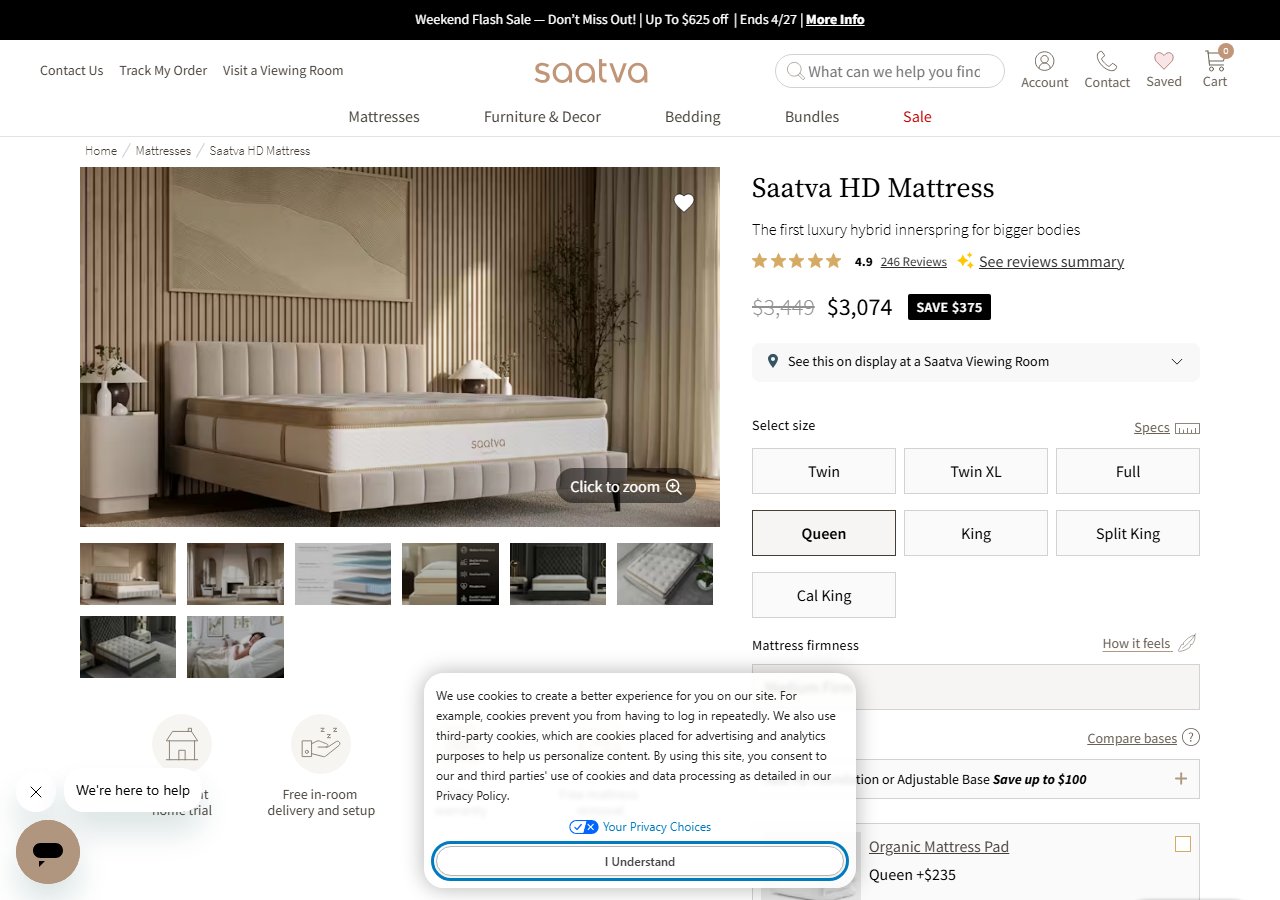
Saatva HD Mattress (Heavy-Duty)
$2,395-$3,995
See Price at Saatva →
Purple Hybrid Premier Mattress
$2,499-$4,799
See Price at Purple →Matching the Product to the Worker
These three options are not interchangeable, and construction workers are not a monolithic population. Here is how to apply the specs to the actual worker:
If your primary symptom is morning lumbar stiffness and you sleep on your side or back at 180 to 220 pounds: The Saatva Loom & Leaf in the firm configuration addresses the most common pattern — a worker whose mattress is either too old to hold its support geometry or too soft for their body weight, producing overnight lumbar flexion that manifests as stiffness in the L4-S1 region by 5 a.m.
If you are above 220 pounds and you feel like you are bottoming out on your current mattress: The Saatva HD is the engineering answer. Standard mattresses are not designed for the compression loads that large-framed construction workers produce, and no comfort-layer adjustment compensates for a support core that has exceeded its structural limit.
If your soreness is less about the lumbar spine and more about accumulated pressure in the hips, shoulders, or joints: The Purple Hybrid Premier's grid architecture distributes load differently than foam, and for workers with arthritis, tendon pain, or soft-tissue sensitivity, the pressure-mapping characteristics of the GelFlex Grid provide a distinct clinical advantage over conventional foam or innerspring construction.
The Data-to-Decision Summary
The federal data on construction and musculoskeletal disorders points to a clear occupational reality: heavy-trade work loads the spine in ways that exceed safe limits daily, that accumulate into chronic pain and disability at measurable population rates, and that generate healthcare costs the AHRQ MEPS data documents as substantially higher than those of workers without chronic back conditions. The SSA disability data shows where unmanaged MSD progression ends: in disability claims that end careers.
Sleep surface choice is one modifiable variable in that trajectory — not the most important one, but a real one for workers who have already optimized the free interventions. The hierarchy is non-negotiable: correct lifting mechanics first, add walking, fix sleep position, evaluate mattress age and condition, then consider an engineered replacement if the surface itself is the limiting factor. A construction worker who sleeps eight hours on a supportive surface, walks 30 minutes before or after a shift, and uses proper hip-hinge mechanics on the job has done more for their long-term spinal health than any product can substitute for.
But when the mattress genuinely is the problem — when it is sagging, when it cannot support the body weight sleeping on it, when it is older than a decade — replacing it with a surface engineered for heavy-load body types is a legitimate occupational health decision, not a luxury purchase. The federal data supports the investment. The biomechanics explain why it matters. The products in this category exist to solve a specific problem. Know the mechanism, exhaust the free options, see a clinician for red flags, and then choose the surface that matches your actual body weight and pain pattern.