The Federal Data on Why Construction Backs Break Down
If you finish a ten-hour shift framing walls, pouring concrete, or running conduit and you wake up the next morning unable to straighten your spine without a deliberate five-minute ritual, you are not imagining things and you are not alone. According to BLS Musculoskeletal Disorders by Occupation tracking, the back is the single most commonly injured body part across all U.S. occupations that result in days away from work. Construction trades are not an outlier in that data — they are among the industries driving it.
The numbers compound quickly when you look across multiple federal agencies. The NIOSH Lifting Equation — the federal government's primary engineering tool for evaluating manual material-handling risk — documents that tasks in construction, warehousing, and heavy industry routinely exceed the recommended weight limits that protect against cumulative spinal injury. A carpenter carrying OSB sheets up a staircase, a mason lifting and placing concrete block, an ironworker bending rebar: each task generates spinal compressive and shear forces that the lumbar spine was not designed to sustain repeatedly over a 20- or 30-year career.
The downstream costs are not abstract. AHRQ HCUP data shows back pain is one of the most expensive conditions in U.S. healthcare by total inpatient and outpatient spending. BLS Employer Costs for Employee Compensation data shows that industries with high MSD incidence — construction chief among them — carry workers' compensation insurance rates 3 to 5 times higher than low-MSD industries. And at the individual level, SSA Disability Insurance Reports identify musculoskeletal disorders as the single largest category of new disability claims filed each year. This is not a minor occupational inconvenience. For construction workers, cumulative back damage is a career-ending, income-destroying risk that deserves to be taken seriously at every level — including what happens during the eight hours you are supposed to be recovering.
The Biomechanics: Why the Job Breaks Your Back and Why Sleep Fails to Fix It
Understanding why construction workers wake up stiff requires understanding two distinct physiological processes: the loading that happens during the shift, and the incomplete tissue recovery that happens during sleep.
Daytime loading. Every time a framer swings a hammer overhead, a plumber torques a pipe wrench in a crawl space, or a laborer shovels aggregate, the lumbar intervertebral discs absorb compressive load. Healthy discs are viscoelastic — they deform under load and rehydrate during rest. The problem is that in high-demand construction trades, the load cycles never fully stop. Early in a career, recovery is fast. After a decade of exceeding the spinal load limits documented by the NIOSH Lifting Equation, disc hydration capacity declines, annular tears accumulate, and the facet joints — small paired joints that guide spinal motion — begin to develop the arthritic changes consistent with what CDC Arthritis data describes as elevated arthritis prevalence in occupations involving sustained physical demand. Approximately 25% of U.S. adults already report doctor-diagnosed arthritis, and the occupational concentration in trades is substantially higher than that population average.
Nighttime failure to recover. Tissue recovery during sleep depends on two things: adequate sleep duration and adequate spinal alignment during that sleep. On the duration question, the data is not encouraging. CDC Sleep and Sleep Disorders data shows approximately 35% of U.S. adults report sleeping fewer than 7 hours per night — the threshold the CDC associates with elevated chronic disease risk, including musculoskeletal disease progression. Construction workers are not immune to this; shift variability, physical discomfort, and the kind of residual pain that wakes you at 2 a.m. when you roll over all contribute.
On the alignment question, this is where the sleep surface enters the equation — but only after we understand why it matters mechanically. A mattress that sags excessively allows the lumbar spine to drop into flexion or lateral bend throughout the night. In a worker whose lumbar discs are already compressed and whose facet joints are already inflamed, sustained off-neutral loading during what should be decompression time means the worker wakes with less range of motion than they went to sleep with. That morning stiffness is not mysterious — it is physics. CDC NCHS Data Brief 390 reports that approximately 20% of U.S. adults experience chronic pain, with lower back the most commonly reported location. For construction workers, chronic lower back pain is both an on-the-job hazard and an off-the-job recovery failure.
The cost of failing to address this compounds over time. AHRQ Medical Expenditure Panel Survey data shows that adults with chronic back conditions incur substantially higher annual personal healthcare costs than adults without such conditions — costs that fall directly on workers, their families, and their insurers. CMS Drug Spending Dashboard data identifies opioid and non-opioid pain medications among the most expensive Medicare drug categories, a downstream reflection of how many Americans reach middle age with unmanaged chronic back pain — a population that disproportionately includes former construction workers.
What You Can Do Before Buying Anything
The cheapest intervention is the one that does not require buying anything. Before evaluating any product, construction professionals with chronic back pain should have exhausted the following free or low-cost changes. The evidence base for each of these is stronger than the evidence base for any mattress brand's proprietary foam formula.
Lifting and movement mechanics at work. OSHA's Ergonomics Solutions guidance is explicit: hinge at the hips rather than the lumbar spine, keep loads close to the body, and avoid rotational forces under load. Most acute back episodes in construction are mechanical injuries — they result from a single moment of poor mechanics under load, not from chronic disease alone. Rehearsing proper hip-hinge mechanics during training periods and during low-stakes tasks builds the motor pattern that protects you during high-stakes lifts.
Sleep position before sleep surface. NIH National Institute of Arthritis and Musculoskeletal and Skin Diseases back pain guidance recommends side-sleeping with a pillow between the knees, or back-sleeping with a pillow under the knees, as the positions that best maintain lumbar neutral alignment during sleep. Stomach-sleeping torques the lumbar spine into extension and lateral rotation — a position that is actively harmful for anyone with disc disease or facet arthritis. This costs nothing to change, though it requires conscious effort for habitual stomach-sleepers.
Daily walking as a therapeutic intervention. NIH National Center for Complementary and Integrative Health's evidence review of low-back pain treatments concludes that walking 30 minutes most days reduces chronic low back pain as effectively as most non-drug clinical treatments. For construction workers who believe their body is "used up" by the time they leave the job site, the counterintuitive reality is that light aerobic movement accelerates disc rehydration and reduces the inflammatory load that contributes to morning stiffness.
When to replace your current mattress. CDC Sleep Hygiene guidance is a reasonable framework: if your mattress shows visible sag, if you consistently wake stiffer than you went to bed, or if the mattress is older than 7 to 10 years, the surface itself may be actively contributing to your symptoms. A mattress that was adequate for a 28-year-old without occupational back loading may be grossly inadequate for a 42-year-old ironworker with two herniated discs.
For readers who have already addressed sleep position, implemented OSHA-aligned movement mechanics, and are walking regularly — and are still waking with significant stiffness — the sleep surface becomes a legitimate variable to investigate. Construction professionals present a specific biomechanical profile that differs from the general population: higher average body weight and lean muscle mass, accumulated disc and facet pathology, and often asymmetric loading from dominant-side tool use. Generic mattress guidance written for the average sedentary adult does not apply cleanly.
When the Problem Requires a Clinician, Not a Mattress
There is a category of back pain for which no mattress is the right intervention, and construction workers need to know where that line is. The NIH National Institute of Neurological Disorders and Stroke back pain guidance identifies several red flags that require prompt medical evaluation rather than self-treatment. If your back pain follows a traumatic incident on the job site — a fall from height, a vehicle accident, a load drop — imaging is warranted before you do anything else.
Pain that radiates below the knee, particularly with accompanying numbness, tingling, or weakness in the foot or leg, suggests nerve root involvement and requires clinical assessment. Bowel or bladder changes associated with back pain are a medical emergency. Fever with back pain suggests infectious etiology. Night pain that is severe, that wakes you repeatedly, or that is getting progressively worse over weeks is not a mattress problem — it is a symptom pattern that clinicians are trained to screen for serious underlying pathology. Do not spend $2,000 on a new sleep surface as a substitute for a diagnostic conversation with your physician or an occupational medicine specialist.
Construction workers are also at elevated risk for occupational exposure to vibration — from jackhammers, compactors, heavy equipment — that accelerates disc degeneration through a distinct mechanism from manual lifting. If your back pain began or worsened after years of equipment operation, that specific history is relevant clinical information your provider needs.
Where Sleep Surface Engineering Actually Matters for High-Load Bodies
For the construction professional who has cleared the clinical bar, who is not presenting red flags, and whose stiffness pattern is consistent with inadequate spinal support during sleep, the mattress choice involves real engineering decisions. High-load body types — workers over 200 pounds, those with significant musculature from physical labor, or those carrying excess weight that correlates with job-related activity reduction from injury — apply forces to a mattress that a product designed for average-weight sedentary users will not handle well.
The core failure modes of standard mattresses for this population are: (1) premature core compression, where foam or innerspring coils bottom out under higher body mass and allow the lumbar region to sag; (2) inadequate edge support, which reduces the usable sleep surface and causes lateral rollout during position changes; and (3) heat retention in dense foam constructions, which disrupts the thermoregulation that supports deep sleep stages where tissue repair is concentrated.
For construction workers with serious documented back pain and a higher body mass profile, the Saatva HD Mattress ($2,395–$3,995) is the most purpose-engineered option in this article. Saatva designed the HD explicitly for users up to 500 pounds, using a dual-layer tempered steel coil system with enhanced lumbar zone support — the kind of engineering that a standard mattress skips because the standard population doesn't need it. The lumbar-reinforced zoning is particularly relevant for workers whose most damaged spinal segment is L4-L5 or L5-S1, the levels most commonly loaded in construction lifting patterns.
For construction workers whose primary complaint is pressure pain — shoulder and hip points that ache through the night from a surface that is too firm relative to their tissue damage — the Saatva Loom & Leaf Memory Foam Mattress ($1,695–$3,295) offers a premium memory foam construction with organic cotton cover and multi-layer foam architecture that distributes pressure across a wider contact area. Memory foam's conforming properties are particularly useful for workers with asymmetric loading injuries, where one side of the spine is more damaged than the other and requires differential pressure relief. The Loom & Leaf is available in Relaxed Firm and Firm variants; construction workers with documented lumbar instability generally do better on the Firm variant.
The Purple Hybrid Premier Mattress ($2,499–$4,799) brings a different engineering approach through Purple's proprietary GelFlex Grid, a polymer grid structure that deforms under pressure points but maintains support at lower-pressure contact zones. For construction workers who run hot — a common complaint from workers whose cardiovascular fitness drives higher baseline body temperature — the grid's open-air architecture provides meaningfully better heat dissipation than closed-cell foam. The hybrid coil base provides the edge support and rebound that foam-only constructions sometimes lack for heavier users.
All three products in this review are substantial financial investments. They are worth evaluating seriously if — and only if — you have cleared the free interventions described above, you have confirmed with a clinician that your back pain is mechanical rather than red-flag symptomatic, and your current sleep surface is either visibly degraded or objectively mismatched to your body weight and sleep position.
Mattresses Built for High-Load Construction Body Types
These three mattresses were selected for construction professionals specifically — workers with documented back pain, higher body mass from physical labor, and spinal loading histories that standard consumer mattresses are not engineered to handle.

Saatva Loom & Leaf Memory Foam Mattress
$1,695-$3,295
See Price at Saatva →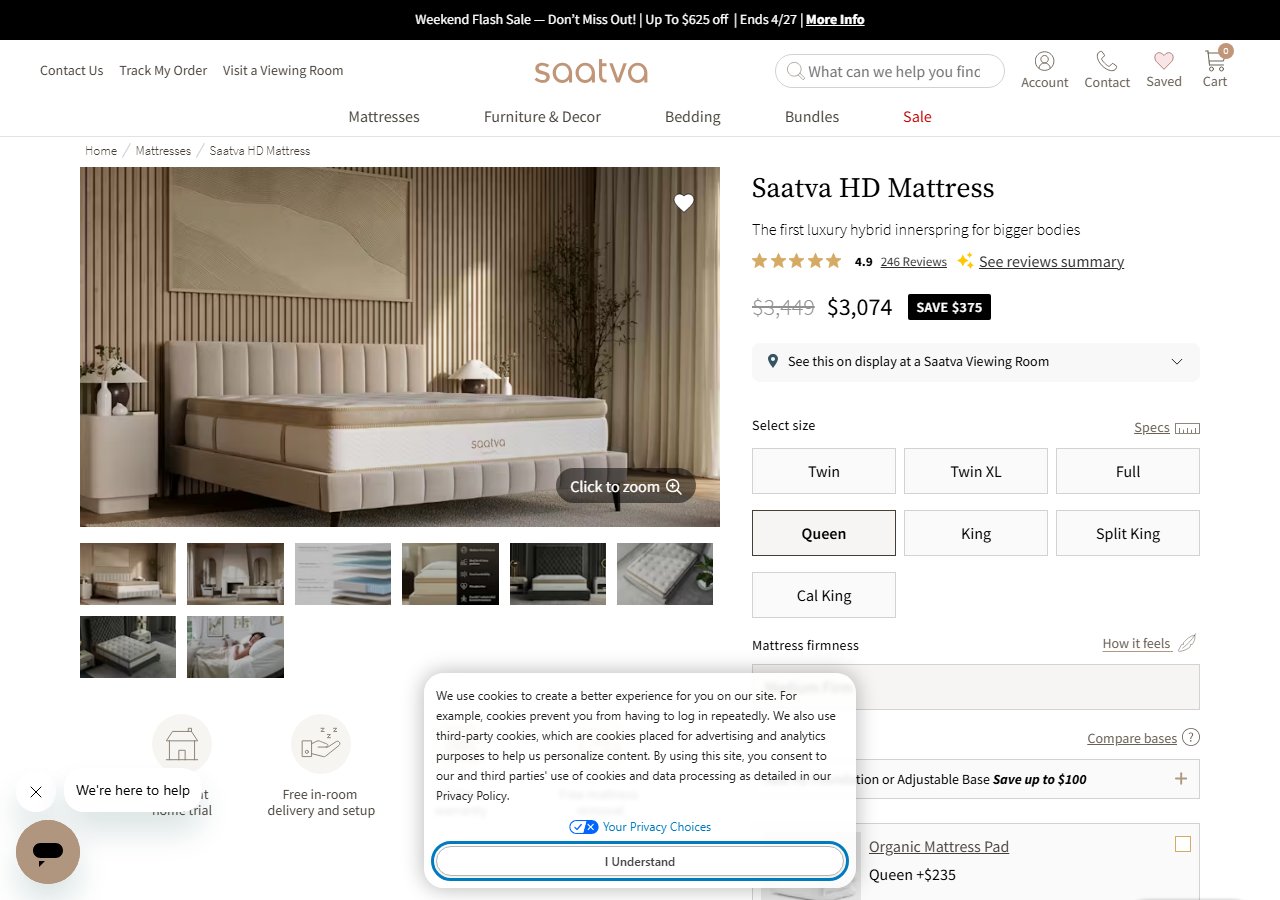
Saatva HD Mattress (Heavy-Duty)
$2,395-$3,995
See Price at Saatva →
Purple Hybrid Premier Mattress
$2,499-$4,799
See Price at Purple →The Long-Term Stakes for Construction Professionals
The data assembled across these federal sources tells a coherent and serious story. Construction work extracts a specific physical toll on the spine. The NIOSH Lifting Equation quantifies the daily overage in spinal loading. The BLS MSD tracking shows where the injuries land. The SSA Disability Insurance data shows where the worst cases end up. The CDC chronic pain prevalence data and AHRQ cost data show what chronic back disease costs the system — and the individual.
A construction worker who takes their spinal health seriously — who practices OSHA-aligned mechanics on the job, who sleeps in a spine-neutral position, who walks daily, and who sleeps on a surface engineered for their body type and load history — is doing everything the federal evidence base supports. That is not a guarantee of a pain-free career. It is, however, a materially better probability than ignoring every one of those variables and hoping the back holds out.
The morning stiffness that feels like an inevitable part of the trade is, in many cases, a recoverable condition — not an identity. Start with the free interventions. See a clinician if the red flags apply. And if a new sleep surface is warranted, choose one that was actually engineered for the body you have, not the average body the industry defaults to designing for.