The Data Behind the Pain You Feel After Every Shift
If you are a nurse, a respiratory therapist, a nursing assistant, or an emergency room technician, the odds are good that your back hurts right now. That is not an anecdote — it is federal occupational health data rendered in lived experience. BLS Musculoskeletal Disorders by Occupation tracking identifies the back as the most commonly injured body part across all U.S. occupations with days away from work. Healthcare and social assistance is one of the most injury-dense sectors in that dataset, surpassing construction and manufacturing in total MSD event counts in recent reporting years.
The downstream consequences are severe and well-documented. SSA Disability Insurance data identifies musculoskeletal disorders as the largest single category of new disability claims annually — meaning back injuries don't just sideline workers temporarily, they end careers. AHRQ HCUP data shows back pain is one of the most expensive conditions in U.S. healthcare by total inpatient and outpatient cost, a painful irony for the very workers delivering that care. And AHRQ Medical Expenditure Panel Survey data confirms that average annual personal healthcare expenditures for adults with chronic back conditions substantially exceed those without — meaning your injury is costing you money twice: once in lost shifts, once in your own medical bills.
This article is not a mattress advertisement. It is an analysis of federal occupational health data applied to a specific population — healthcare shift workers — who face a uniquely compounding set of spinal stressors that most sleep and ergonomics guidance ignores entirely. We will explain the mechanism. We will cover what you can do for free. We will tell you when to see a clinician. And then — after all of that — we will identify sleep surfaces that are actually engineered for bodies under your level of load.
Why Healthcare Shift Work Breaks Your Back: The Biomechanical Mechanism
Understanding why shift work specifically damages the lumbar spine requires separating three distinct stressor categories that overlap almost perfectly in healthcare work: mechanical loading, sleep deprivation, and circadian disruption.
Mechanical Loading: You Are a Manual Materials Handler
Most healthcare workers do not think of themselves as manual laborers in the same category as warehouse workers, but the physics disagree. Patient repositioning, transfer lifts, and emergency stabilization events involve exactly the kind of asymmetric, high-force, trunk-flexed loading that the NIOSH Lifting Equation was designed to flag. NIOSH's research documents that manual material-handling tasks in healthcare routinely exceed safe spinal loading limits — the Recommended Weight Limit in many patient-handling scenarios is essentially zero, because human bodies are irregular, unpredictable loads that cannot be optimally positioned the way a warehouse pallet can.
The specific failure mode is intervertebral disc compression under shear load. When a nurse bends forward at the lumbar spine (rather than hinging at the hips) to reposition a patient, the posterior annular fibers of the lumbar discs bear compressive and tensile loads simultaneously. Repeated over a 12-hour shift, across years of practice, this produces predictable disc degeneration, facet joint inflammation, and eventually the radiculopathy that shows up in BLS injury logs. BLS Employer Costs data documents that industries with high MSD incidence carry workers' compensation rates 3–5x higher than low-MSD industries — a premium that hospitals ultimately absorb and that reflects just how mechanically dangerous the work environment is.
Sleep Deprivation: The Recovery System You Keep Skipping
Here is the compounding factor that makes healthcare worker back injury so difficult to interrupt: the recovery window — sleep — is structurally compromised by the work schedule itself.
CDC sleep data shows approximately 35% of U.S. adults report sleeping fewer than 7 hours per night, the threshold associated with elevated chronic disease risk. For rotating shift workers, that figure is almost certainly higher. Night-shift nurses may sleep 5–6 hours during daytime hours in environments with ambient light and noise. Twelve-hour shift nurses working three consecutive shifts often accumulate substantial sleep debt before a recovery day arrives. The problem is not simply fatigue — it is that tissue repair, inflammatory modulation, and neuromuscular recovery are sleep-dependent biological processes. Discs that took compressive loading during a shift rehydrate partially during overnight rest. Skip or compress that window and recovery is incomplete.
CDC NCHS Data Brief 390 documents that approximately 20% of U.S. adults experience chronic pain, with lower back as the most common location — but the chronic-pain burden in shift-working populations is disproportionately higher. Circadian misalignment suppresses anti-inflammatory cytokine production and elevates cortisol in patterns that amplify pain sensitivity, meaning a disc that would produce mild discomfort in a day-shift worker with normal sleep produces sharp, radiating pain in a night-shift worker running a sleep deficit.
Arthritis Acceleration in High-Demand Occupations
CDC Arthritis Data shows approximately 25% of U.S. adults report doctor-diagnosed arthritis, with prevalence concentrated in occupations involving sustained physical demand. Healthcare workers who spent their twenties and thirties absorbing repetitive spinal loads are statistically more likely to enter their forties and fifties with facet joint arthropathy — a condition where the quality of the sleep surface becomes clinically relevant because joint inflammation peaks at rest, and firm surfaces that press directly on inflamed tissue exacerbate morning stiffness.
The medication cost of this trajectory is significant. CMS Drug Spending Dashboard data identifies opioid and non-opioid pain medication spending among the most expensive Medicare drug categories — reflecting what happens when a working-age MSD becomes a chronic condition managed pharmacologically rather than addressed through load reduction and recovery optimization in earlier years.
Try These First — The Cheapest Interventions Have the Strongest Evidence
The cheapest intervention is the one that does not require buying anything. Federal occupational health research is unambiguous that behavioral and positional changes produce clinically meaningful reductions in chronic low back pain — and that many workers attempt to skip these steps and buy their way to recovery, which rarely works in isolation. Before a single dollar is spent on a sleep surface, a healthcare worker with chronic back pain should audit whether the following are consistently in place.
Lifting and bending mechanics remain the highest-leverage free variable in healthcare MSD prevention. OSHA's lifting guidance is specific: hinge at the hips, not the lumbar spine; keep loads close to the body's center of gravity; avoid twisting under load; use mechanical lift equipment whenever available. The majority of acute back episodes are mechanical and — critically — rehearsable. A healthcare worker who has internalized the hip-hinge pattern reduces acute disc loading on every patient transfer, compounding over thousands of transfers across a career.
Sleep position is the largest free variable in off-duty recovery. NIH guidance from the National Institute of Arthritis and Musculoskeletal and Skin Diseases identifies side-sleeping with a pillow between the knees, or back-sleeping with a pillow under the knees, as the positions that maintain spinal neutrality through the night. Stomach-sleeping — common in fatigued workers who simply collapse into whatever position is available — torques the lumbar spine and mechanically loads the same structures that just spent 12 hours under work-related stress. Changing sleep position costs nothing and produces measurable reductions in morning pain severity.
Daily walking is the most evidence-supported active recovery tool available to you. NIH NCCIH's evidence review on low back pain concludes that walking 30 minutes most days reduces chronic low back pain as effectively as most non-drug clinical treatments. The mechanism is multifactorial: walking promotes disc nutrition through cyclic loading and unloading, activates the posterior chain musculature that stabilizes the lumbar spine, and reduces the pro-inflammatory cytokine burden associated with sedentary recovery days. This is the one intervention that a mattress absolutely cannot replicate.
If your mattress is visibly sagging, older than 7–10 years, or you wake stiffer than you went to bed, it is a legitimate contributor to your pain — but even then, CDC sleep hygiene guidance is clear that mattress quality is one variable within a larger sleep hygiene system. No mattress repairs poor sleep scheduling, caffeine timing, or light exposure before sleep. Address the full system.
For readers who have already made the behavioral changes, corrected their lifting mechanics, improved sleep position discipline, and are still waking with meaningful spinal stiffness and pain — the sleep surface is a legitimate next variable. The interventions above are non-negotiable foundations. Products are adjuncts. With that clearly established, here is how to think about sleep surface selection specifically for a body that has been doing what healthcare work demands.
When to See a Clinician Before Doing Anything Else
NIH's National Institute of Neurological Disorders and Stroke back pain guidance identifies a specific set of clinical presentations that require a physician evaluation before any self-management strategy — mattress, movement, or otherwise. Healthcare workers, who are trained to recognize these flags in their patients, are notoriously poor at applying clinical triage to themselves. If any of the following are present, stop reading buying guides and make an appointment:
- Back pain that radiates below the knee, particularly with associated numbness or tingling, suggests nerve root compression requiring imaging evaluation — not a new sleep surface.
- Pain that follows direct trauma, including a patient-handling incident or fall, may involve fracture and should be evaluated radiographically before attributing symptoms to mattress inadequacy.
- Back pain accompanied by leg weakness, difficulty controlling bowel or bladder function, or saddle-area numbness is a medical emergency (potential cauda equina syndrome) requiring same-day emergency evaluation.
- Pain with systemic symptoms including unexplained weight loss, fever, or night sweats warrants evaluation to rule out infectious or oncologic etiology — neither of which is addressable with a mattress change.
- Back pain that is progressively worsening over weeks without any mechanical trigger, or that is worse at rest than with movement, follows a pattern inconsistent with mechanical low back pain and should be evaluated by a clinician.
The federal data on this population makes clear that the stakes of delayed diagnosis are high. SSA Disability Insurance data shows MSDs are already the leading cause of new disability claims — early clinical intervention is the evidence-supported path to avoiding that outcome.
Where Sleep Surface Selection Actually Matters for Healthcare Workers
For the healthcare worker who has ruled out red-flag pathology, has corrected behavioral variables, and is still experiencing mechanical back pain that disrupts sleep — the surface is now a legitimate intervention point. The evidence base for mattress firmness and spinal alignment is not as robust as the evidence for walking or sleep position, but it is not absent: pressure mapping studies and spinal curvature research support the principle that a sleep surface should allow the lumbar spine to maintain a neutral or near-neutral curve throughout the night, rather than sagging into flexion (too soft) or being pushed into extension (too firm).
For healthcare workers specifically, three additional factors matter beyond generic back-pain guidance:
1. Pressure relief at bony prominences. A nurse or CNA who has been on their feet for 12 hours has peripheral tissue that is already mildly inflamed and pressure-sensitive. A surface that distributes weight broadly rather than concentrating pressure at the hip and shoulder complex reduces the secondary inflammation that contributes to morning stiffness.
2. Motion isolation for shift workers sharing a bed. Rotating shift schedules mean a healthcare worker may be coming to bed at 7 a.m. while a partner is leaving for work, or vice versa. Materials with strong motion isolation allow independent movement without cross-transfer waking — critical for the consolidated sleep that shift workers already struggle to achieve.
3. Edge support for getting in and out of bed. After a 12-hour shift, getting out of bed is itself a biomechanical event. A mattress that collapses at the edge requires the low-back extensor muscles to work harder during transitions — the same muscles that just spent 12 hours under load. Robust perimeter support reduces this transition stress.
With those criteria established, here are the three sleep surfaces that most directly address the healthcare shift worker's recovery profile.
The Saatva Loom & Leaf Memory Foam Mattress is the most clinically relevant pick for the majority of healthcare workers dealing with chronic back pain. It uses a multi-layer memory foam construction — including a 5-lb density foam comfort layer — that provides the contouring and pressure redistribution that matters for bodies carrying accumulated tissue inflammation after long shifts. Critically, it is available in two firmness options (Relaxed Firm and Firm), which allows a worker to select based on their body weight and sleep position rather than accepting a one-size compromise. The organic cotton cover and cooling gel layer address the thermoregulation issue that plagues shift workers sleeping during warm daytime hours. At $1,695–$3,295 depending on size, this is a serious investment — but AHRQ MEPS data makes clear that the annual personal healthcare expenditure gap between adults with chronic back conditions and those without dwarfs that figure over a multi-year horizon.
For healthcare workers who are larger-framed, heavier, or who carry the kind of dense musculature that standard mattresses simply do not accommodate, the Saatva HD Mattress is the engineered answer. Built for individuals up to 500 lbs, the HD uses a lumbar zone active wire support system that targets the area of the spine under the greatest load during sleep — the exact zone that takes mechanical abuse during patient-transfer events. The triple-tempered steel coil system prevents the progressive sag that standard-weight-rated mattresses develop quickly under higher loads, meaning the spinal alignment properties that make a mattress therapeutic do not degrade within the first year or two. For a nurse or CNA who has been told by their standard mattress that their body is the problem, the HD reframes that entirely. Priced at $2,395–$3,995, it carries a premium — but for this specific population, it is the correct engineering specification.
For healthcare workers whose primary complaint is pressure-related pain — hip pain, shoulder pain on the side they sleep on, or the diffuse morning soreness that comes from inflammatory conditions like arthritis — the Purple Hybrid Premier Mattress addresses a different biomechanical problem. Purple's proprietary GelFlex Grid technology distributes weight across a larger surface area than any foam or coil system, reducing peak pressure at bony prominences by a mechanism that is genuinely distinct from memory foam's visco-elastic response. The coil base underneath maintains lumbar support while the grid handles pressure relief at the surface — a combination that resolves the longstanding tension between support and pressure relief that defines most mattress design trade-offs. For the healthcare worker with CDC-documented inflammatory arthritis who also needs spinal support, this is the most nuanced option in the category. The price range of $2,499–$4,799 reflects the proprietary manufacturing involved.
Sleep Surfaces Built for Healthcare Shift-Worker Recovery
These three mattresses were selected specifically for bodies under the cumulative mechanical and sleep-debt load that healthcare shift work produces — prioritizing pressure relief, lumbar zone support, and motion isolation over generic firmness ratings.

Saatva Loom & Leaf Memory Foam Mattress
$1,695-$3,295
See Price at Saatva →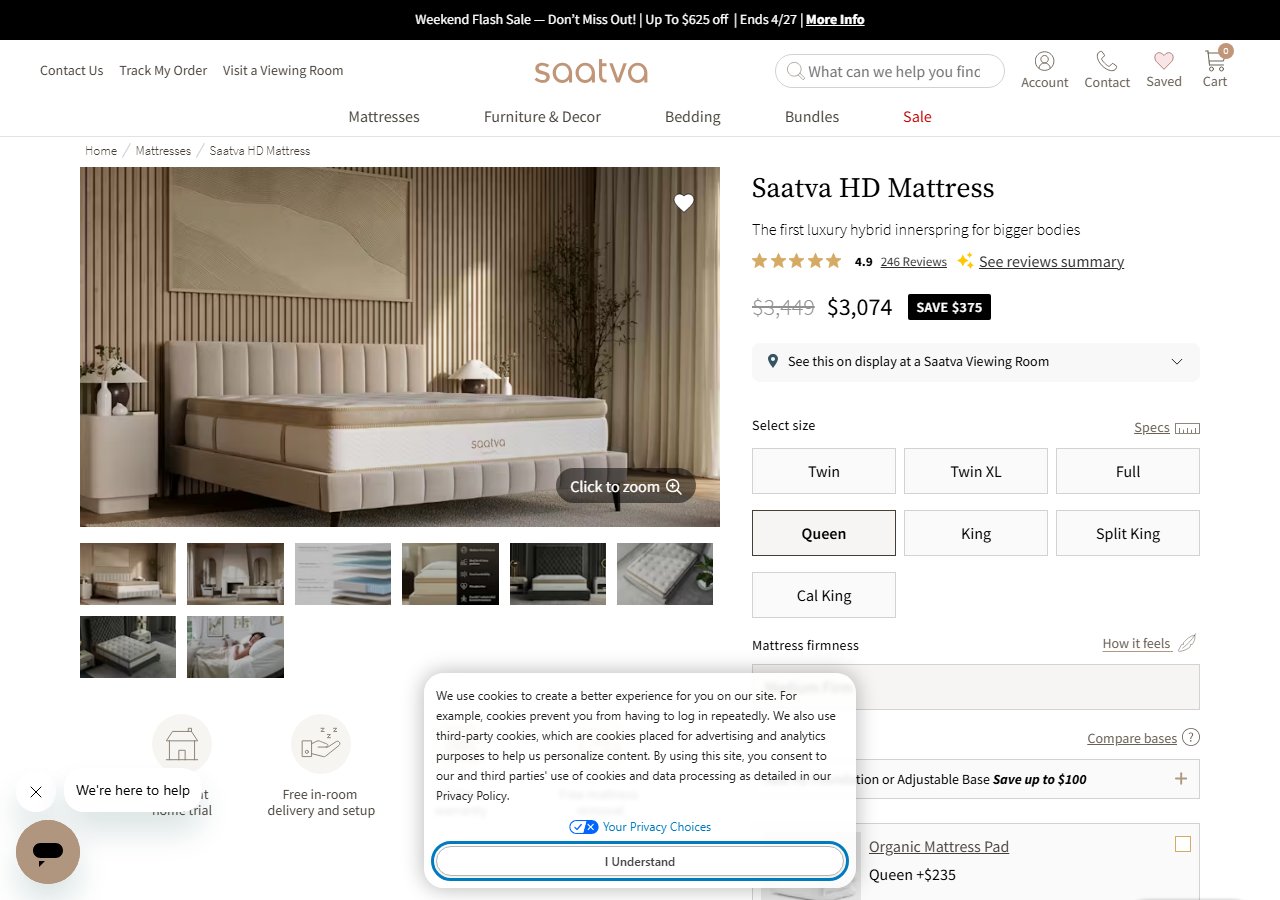
Saatva HD Mattress (Heavy-Duty)
$2,395-$3,995
See Price at Saatva →
Purple Hybrid Premier Mattress
$2,499-$4,799
See Price at Purple →The Data-to-Recovery Hierarchy, Restated
Federal occupational health data tells a coherent story for healthcare shift workers: the back injury rates are high, the downstream disability risk is documented, the sleep deficit is measurable, and the cost of chronic pain — personal, medical, and economic — is substantial. CMS Drug Spending data shows the pharmacological treatment burden of chronic pain is one of Medicare's largest line items, which reflects what happens when the upstream prevention and recovery variables are not managed.
The hierarchy matters. Lifting mechanics and body movement patterns come first. Sleep position discipline costs nothing and has NIH-level evidence behind it. Walking 30 minutes a day has the same evidence grade as most clinical interventions for chronic low back pain. When those are consistently in place and back pain is still interrupting sleep quality, then — and only then — is the sleep surface a legitimate optimization target.
For healthcare workers in that position, the three surfaces profiled here are not generic back-pain recommendations pulled from a consumer reviews aggregator. They are selected specifically because their engineering specifications — pressure redistribution, zoned lumbar support, motion isolation, thermoregulation, and edge integrity — map directly onto the recovery demands of a body that does what your work demands of it. That is the standard a healthcare shift worker should apply to every recovery investment they make.