The federal data on healthcare worker back injury is stark — and it's not improving
If you're a nurse, patient care technician, surgical tech, or floor-based hospital worker, you already know your back hurts. What you may not know is how thoroughly federal data backs you up. BLS Musculoskeletal Disorder tracking confirms that the back is the most common body part injured across all U.S. occupations with days away from work — and healthcare and social assistance consistently ranks among the industries with the highest absolute MSD case counts year over year. This is not a desk-worker problem or a warehouse-only problem. It is, measurably, a healthcare worker problem.
The downstream costs are staggering. AHRQ HCUP data identifies back pain as one of the most expensive conditions in U.S. healthcare by total inpatient and outpatient expenditure. AHRQ MEPS data shows that adults living with chronic back conditions carry annual healthcare costs that substantially exceed those of adults without such conditions — a financial burden that follows workers home from the very industry they serve. And at the population level, SSA Disability Insurance reports identify musculoskeletal disorders as the single largest category of new disability claims filed each year in the United States.
For the healthcare worker on a 12-hour shift, these are not abstract statistics. They are the injury trajectory you are trying to avoid — or the one you are already managing.
Why shift work amplifies spinal stress: the biomechanical mechanism
Understanding why your back is at particular risk requires looking at two overlapping mechanisms: the cumulative spinal loading of clinical work, and the sleep-debt-driven failure of overnight recovery.
The loading problem. Healthcare work is physically demanding in ways that are poorly appreciated outside the field. Patient transfers, repositioning, lifting supply crates, sustained standing on hard floors, and repetitive bending and reaching at low bed heights all place substantial compressive and shear force on the lumbar spine. The NIOSH Lifting Equation documents that manual material-handling tasks across healthcare settings routinely exceed recommended safe spinal loading limits — even when workers follow general guidance. This means that a compliant healthcare worker, doing their job correctly, may still be accumulating cumulative spinal stress that exceeds what the lumbar discs and supporting musculature can fully repair between shifts.
Approximately 25% of U.S. adults report doctor-diagnosed arthritis, with prevalence concentrated in occupations involving sustained physical demand. Healthcare is such an occupation. Facet joint degeneration and early disc desiccation are diagnosable in healthcare workers at younger ages than in sedentary professions — a pattern that aligns with the cumulative loading data.
The sleep problem. The loading mechanism alone would be manageable if workers had adequate recovery time. But healthcare shift schedules — 12-hour rotations, overnight shifts, rotating schedules that cycle between days and nights — structurally compress the recovery window. CDC sleep data shows that approximately 35% of U.S. adults already report sleeping fewer than 7 hours per night. Among rotating shift workers, that proportion is substantially higher. The significance of this is physiological, not anecdotal: during slow-wave and REM sleep, intervertebral discs partially rehydrate via a passive osmotic process called imbibition, paravertebral muscles release their daytime tone, and systemic inflammatory markers — including those associated with chronic musculoskeletal pain — are regulated downward by the circadian immune system. Interrupt or compress that cycle repeatedly, and recovery is incomplete. Repeat across years, and chronic pain becomes structurally entrenched.
CDC NCHS Data Brief 390 reports that approximately 20% of U.S. adults experience chronic pain, with lower back as the most common single pain location. Among healthcare workers, the occupational exposure profile makes that 20% figure a floor, not a ceiling. The intersection of high cumulative load and poor sleep recovery is not a coincidence — it is the mechanism.
And the economic consequence of that mechanism is measurable. BLS employer cost data shows that industries with high MSD incidence carry workers' compensation insurance rates 3–5 times higher than low-MSD industries. Healthcare systems pay that premium in part because the work itself creates the injury — and the injury is not fully treated during recovery hours if those recovery hours are spent on a poor sleep surface or in a sleep-disrupted state.
The cheapest intervention is the one that doesn't require buying anything
Before we discuss mattresses, we need to be direct: a new sleep surface is not the primary intervention for healthcare worker back pain. Federal occupational health guidance identifies several free or near-free interventions that have stronger evidence bases than any specific mattress. If you haven't implemented these consistently, start here.
Lifting mechanics. The majority of acute back episodes in healthcare settings are mechanical — caused by a single transfer, reach, or lift that exceeds the spine's tolerance in that moment. OSHA's ergonomics guidance is explicit: hinge at the hips rather than the lumbar spine, keep loads as close to the body as possible, and avoid twisting under load. These are rehearsable motor patterns. A five-minute review of OSHA's lifting mechanics before a shift costs nothing.
Sleep position. NIH guidance on back pain identifies sleep position as the most consequential free variable in overnight spinal recovery. Side-sleeping with a pillow between the knees, or back-sleeping with a pillow under the knees, maintains the lumbar spine in a mechanically neutral position. Stomach sleeping, by contrast, forces the lumbar spine into extension and the cervical spine into rotation — a position that worsens facet joint compression and discogenic pain. This single change, made tonight on whatever mattress you currently own, may reduce morning stiffness more than a mattress upgrade would.
Daily walking. NIH NCCIH's evidence review on low back pain finds that 30 minutes of walking most days reduces chronic low back pain as effectively as most non-drug clinical treatments. The mechanism is partly vascular (walking promotes disc nutrition via improved microcirculation) and partly neuromuscular (walking activates the posterior chain muscles that stabilize the lumbar spine). Healthcare workers who are already on their feet for 12 hours may resist this recommendation — but the type of walking matters. Twelve hours of reactive standing and load-bearing is not the same as 30 minutes of self-paced, unloaded forward locomotion on a forgiving surface.
When to replace a mattress. CDC sleep hygiene guidance notes that the sleep surface itself becomes a clinical variable when it shows visible sagging, when a sleeper wakes consistently stiffer than they went to bed, or when the mattress is older than 7 to 10 years. Even the most expensive mattress cannot compensate for poor sleep hygiene, inadequate sleep duration, or sedentary daytime behavior. Conversely, a mattress that is actively undermining spinal alignment — through visible sag or inadequate zonal support — is a legitimate contributor to morning pain that is worth addressing.
For readers who have already implemented the above — who sleep in a correct position, walk daily, use proper lifting mechanics, and are still waking with pain on a mattress that shows visible deterioration or is past its service life — a sleep surface upgrade is a rational next step. The products discussed below were evaluated specifically for healthcare workers: people who need pressure relief for heavily loaded joints, support that maintains lumbar alignment across a full 7–8 hour sleep window, and durability adequate for a body carrying the cumulative stress of clinical shift work.
When symptoms require a clinician, not a mattress
Some back pain presentations should prompt a medical appointment before any sleep surface change. NIH's National Institute of Neurological Disorders and Stroke identifies several features that distinguish mechanical low back pain — the kind influenced by sleep surfaces and movement — from neurological or systemic pathology that requires imaging or referral.
If your back pain radiates below the knee (not just into the buttock, but past the knee toward the foot), that pattern is consistent with lumbar nerve root compression and warrants evaluation before you assume a mattress change will resolve it. Pain that followed a fall, vehicle accident, or significant trauma should be imaged. Leg weakness — difficulty raising your foot, instability when walking — is a neurological sign that is not addressed by sleep surface selection. Bowel or bladder changes accompanying back pain represent a potential surgical emergency (cauda equina syndrome) and require emergency evaluation. Fever with back pain raises concern for spinal infection, particularly relevant in healthcare workers with occupational pathogen exposure.
CMS drug spending data identifies opioid and non-opioid pain medications among the most expensive Medicare drug categories — a reflection of how frequently undertreated or misattributed back pain escalates to pharmaceutical management. If your pain has progressed to the point where it is being managed primarily by medication, a sleep surface change is an adjunct, not a solution. Work with your clinician on a comprehensive plan that includes physical therapy, possible imaging, and medication review.
For healthcare workers with straightforward mechanical back pain — pain that is worse at end of shift, better with rest, and not accompanied by any of the red-flag features above — sleep surface selection is a legitimate and evidence-informed recovery tool.
Where a sleep surface actually helps: what to look for
Mattress selection for chronic back pain is not about finding the firmest or softest option. The clinical objective is spinal neutral alignment: a sleep surface that supports the lumbar curve in a back-sleeping position and allows the shoulder and hip to sink sufficiently that the spine remains straight in a side-sleeping position. Both conditions are required simultaneously across an entire sleep duration, which is why construction quality and zonal support matter far more than marketing descriptors like "orthopedic" or "therapeutic."
For healthcare workers specifically, the relevant design variables are: pressure relief at the shoulder and hip (because nurses and techs carry significant daily compressive load through these joints), lumbar support continuity (because lumbar discs that have undergone partial dehydration during a 12-hour shift need sustained positional support during the overnight rehydration window), thermal regulation (because shift workers who sleep during atypical hours — daytime sleepers after overnight shifts — often sleep in warmer ambient conditions), and durability (because a mattress that sags within three years is worse than no upgrade at all).
The Saatva Loom & Leaf Memory Foam Mattress is our primary recommendation for healthcare workers managing serious chronic back pain. It uses a multi-layer construction of gel-infused memory foam over a high-density base layer, with a lumbar zone crown that provides targeted support to the lower back regardless of sleep position. Memory foam's viscoelastic properties allow it to conform to the specific pressure map of the individual sleeper — relevant for healthcare workers because the pressure distribution after a 12-hour shift is not symmetric or uniform. Available in Relaxed Firm and Firm options, Loom & Leaf is particularly suited to back sleepers and combination sleepers who need lumbar support without sacrificing pressure relief at the hip. It is also delivered white-glove with old mattress removal, which matters for workers who cannot or should not do heavy lifting on their off days.
For healthcare workers who are larger-framed, carry more body mass, or find that standard mattresses show premature sag at the hip — a common failure mode for physically larger or more muscular workers — the Saatva HD Mattress is the appropriate pick. The HD is engineered specifically for bodies up to 500 pounds, using a high-density coil system with reinforced edge support and a durable lumbar support bar. Healthcare workers who are bigger and taller are often poorly served by standard mattresses because the support layers compress too quickly under their load profile. The Saatva HD addresses this directly with a construction spec designed for sustained high-load use — which, in the context of shift recovery, means it will maintain its support profile through years of use rather than requiring replacement within two to three years.
For healthcare workers whose primary complaint is not just back pain but joint pain and pressure sensitivity — nurses with hip bursitis, workers managing early arthritis, or anyone who experiences significant overnight hip or shoulder discomfort — the Purple Hybrid Premier Mattress offers a genuinely differentiated pressure-relief mechanism. Purple's GelFlex Grid is a hyper-elastic polymer structure that collapses under pressure points (shoulders, hips) while remaining firm under the lower-mass regions of the body (lumbar, knees). This allows it to achieve both pressure relief and spinal support simultaneously rather than trading one off against the other, which is the fundamental design challenge of conventional foam layering. The grid also runs cooler than memory foam, which is a relevant advantage for daytime sleepers working overnight shifts. The Premier tier offers a thicker grid layer (3 or 4 inches depending on size) that provides meaningfully more pressure relief than the standard Purple Hybrid for workers with acute joint sensitivity.
Sleep Surfaces Built for Healthcare Worker MSD Recovery
These three mattresses were selected specifically for the pressure-relief, lumbar support, and durability demands of healthcare workers managing chronic musculoskeletal conditions from clinical shift work.

Saatva Loom & Leaf Memory Foam Mattress
$1,695-$3,295
See Price at Saatva →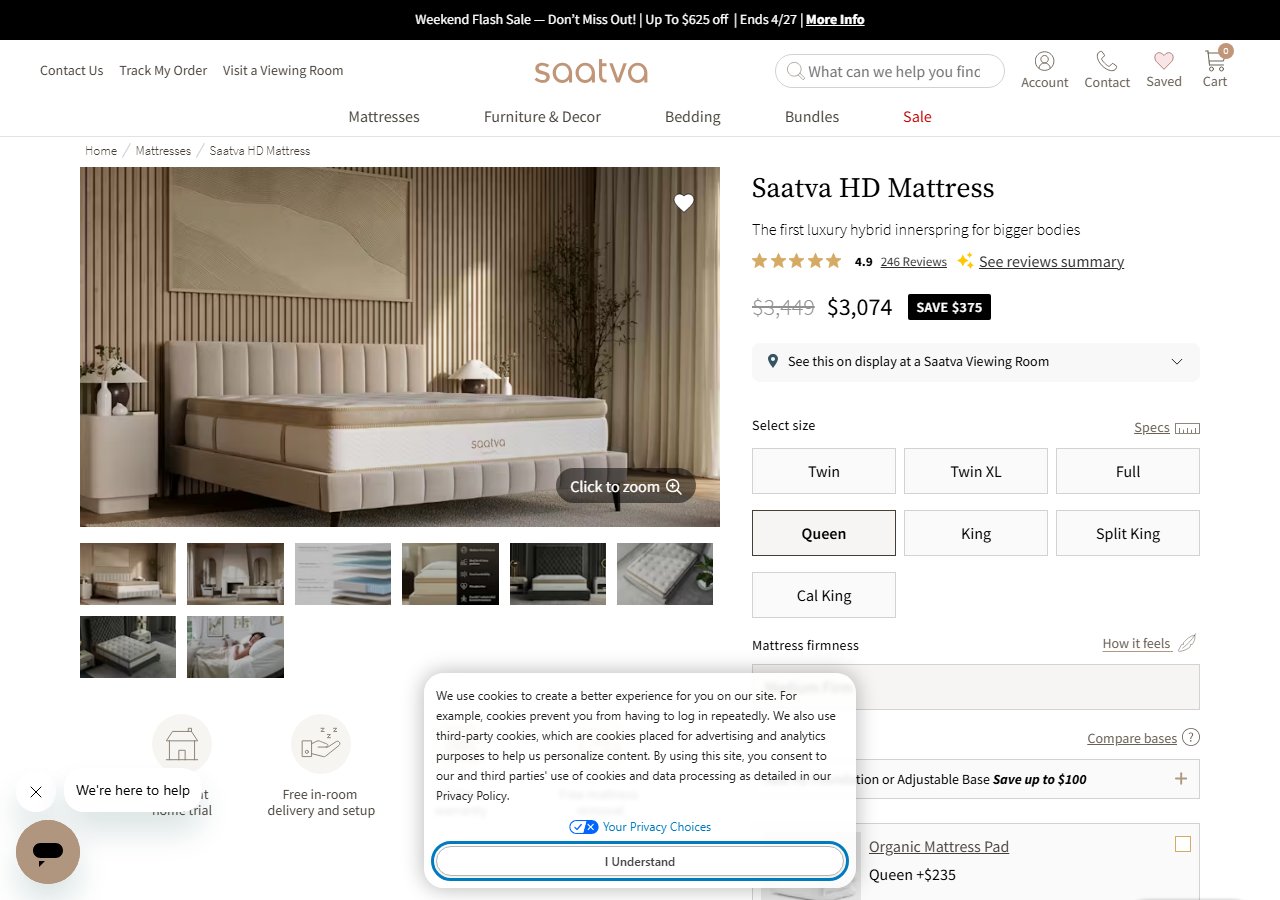
Saatva HD Mattress (Heavy-Duty)
$2,395-$3,995
See Price at Saatva →
Purple Hybrid Premier Mattress
$2,499-$4,799
See Price at Purple →How to make the choice: matching your specific clinical profile
None of these products is universally better than the others. The right choice depends on your specific presentation:
If your dominant symptom is lumbar pain and stiffness that is worse in the morning, and you are of average or lighter build, the Saatva Loom & Leaf in Firm or Relaxed Firm is your most direct match. The lumbar zone crown and dense foam support layers are specifically engineered for the positional support your discs need during the overnight recovery window.
If you are a larger-framed or heavier-weight healthcare worker — and this includes physically strong, muscular workers, not just those carrying excess body fat — the Saatva HD is not a "heavy person's mattress" in a pejorative sense. It is an engineering specification match. A 250-pound nurse and a 180-pound nurse will exert different force profiles on the same mattress. The HD is built for the former.
If joint pressure sensitivity is your primary complaint — hip pain, shoulder pain, or diagnosed arthritis that makes positional pressure acutely uncomfortable — the Purple Hybrid Premier's GelFlex Grid provides a pressure-distribution mechanism that foam cannot replicate. It is also the most expensive option in this list, which matters to workers who are already carrying the higher healthcare costs that AHRQ MEPS data associates with chronic back and joint conditions.
The summary: data first, interventions second, products third
Federal data creates a clear picture. Healthcare workers face documented, measurable, above-average MSD risk. BLS confirms the back is the most injured body part in U.S. workplaces. CDC confirms that inadequate sleep is nearly universal among U.S. adults and is far more prevalent among shift workers. SSA confirms that musculoskeletal disorders are the leading driver of new disability claims. The individual healthcare worker is living at the intersection of all three of these systems simultaneously.
The evidence-based response — in sequence — is: address the free variables first (lifting mechanics, sleep position, daily walking), see a clinician if red-flag features are present, and then evaluate the sleep surface as a legitimate recovery tool when the first two steps have been implemented. The products above represent the strongest available options for healthcare workers specifically, evaluated on the variables that matter for your clinical and occupational profile. They are tools in a broader recovery framework — not the framework itself.