The federal data on your back pain is not subtle
If you work in a hospital, a long-term care facility, or an outpatient clinic, the single most predictable injury that will end your career early is not a needle stick or a patient assault — it is a back injury. BLS Musculoskeletal Disorders by Occupation data identifies the back as the most common body part injured across all U.S. occupations with days away from work. Healthcare consistently ranks at or near the top of that injury distribution. That is not a platitude about a physically demanding job; it is a federal surveillance number that the Bureau of Labor Statistics recalculates every year, and every year it says the same thing.
The financial weight behind that statistic is enormous. AHRQ HCUP data identifies back pain as one of the most expensive conditions in U.S. healthcare by total inpatient and outpatient cost — a figure that includes the very professionals generating those costs while treating other patients. AHRQ Medical Expenditure Panel Survey (MEPS) data reinforces the point: average annual personal healthcare expenditures for adults with chronic back conditions substantially exceed costs for adults without such conditions. You are spending money, losing shifts, and filing workers' compensation claims at rates that BLS Employer Costs data shows run 3–5 times higher in high-MSD industries than in low-MSD ones.
This article is structured the way federal occupational health guidance is structured: mechanism first, free interventions second, clinical red flags third, equipment last. If you are a nurse, a surgical tech, a respiratory therapist, or a home health aide reading this at 7 a.m. after a 12-hour overnight shift, this is written specifically for you — not for someone with generic back pain sitting at a desk.
Why shift work specifically breaks down the lumbar spine
The mechanism is not mysterious, but it operates on two parallel tracks that most occupational health literature treats separately. Healthcare workers need to understand both.
Track one: cumulative spinal loading during the shift. Patient transfers, repositioning, specimen transport, equipment moves — these are manual material-handling tasks. The NIOSH Lifting Equation documents that manual material-handling tasks across healthcare routinely exceed safe spinal loading limits. The equation calculates a Recommended Weight Limit (RWL) for a given lifting task; loads above the RWL incrementally damage the intervertebral discs, the facet joints, and the paraspinal musculature. In a typical 12-hour nursing shift, a staff nurse may perform dozens of patient-assist tasks, each one modestly above the RWL, each one adding to a cumulative load that the disc cannot fully recover from before the next shift begins.
Track two: sleep-debt-driven recovery failure. This is where healthcare workers diverge sharply from other high-MSD occupations like construction or warehousing. A warehouse picker goes home at a consistent hour and sleeps in a stable circadian window. A rotating-shift nurse goes home at 7:30 a.m., tries to sleep in daylight with family noise in the background, and wakes four hours later. CDC Sleep and Sleep Disorders data shows approximately 35% of U.S. adults report sleeping fewer than 7 hours per night — the threshold the CDC associates with elevated chronic disease risk. Among rotating-shift healthcare workers, that proportion is substantially higher.
Why does sleep quality matter biomechanically? During deep non-REM sleep, intervertebral discs rehydrate. The nucleus pulposus — the gel-like core of each disc — absorbs fluid from the surrounding vertebral endplates through a process called imbibition, which depends on pressure relief (you are horizontal) and sufficient sleep duration. Truncate the sleep window, and you truncate disc recovery. Add a saggy mattress that keeps the lumbar spine in a flexed position all night, and the disc that spent 12 hours being compressed and sheared at work never gets the rehydration cycle it needs. That is the mechanism. It is not an opinion; it is basic intervertebral disc physiology.
CDC NCHS Data Brief 390 documents that approximately 20% of U.S. adults experience chronic pain, with the lower back as the most common pain location. Among healthcare workers who are also shift workers, the convergence of mechanical loading and sleep disruption makes that chronic-pain risk substantially worse. CDC Arthritis data adds another layer: approximately 25% of U.S. adults report doctor-diagnosed arthritis, with prevalence concentrated in occupations involving sustained physical demand — precisely the profile of bedside healthcare work. When arthritis overlays disc disease, sleep-surface pressure distribution stops being a comfort preference and starts being a clinical variable.
The downstream consequence of ignoring both tracks: SSA Disability Insurance data identifies musculoskeletal disorders as the largest single category of new disability claims annually. Many of those claimants worked in healthcare. The CMS Drug Spending Dashboard identifies opioid and non-opioid pain medication spending among the most expensive Medicare drug categories, reflecting how expensive the downstream treatment of undertreated chronic pain becomes. The trajectory from "my back hurts after night shifts" to "I am on a disability claim" is not inevitable, but it is well-documented.
Try these first — the cheapest interventions are the ones that cost nothing
Before this article discusses any sleep surface, you need to know that the evidence hierarchy for chronic low-back pain puts behavioral and movement interventions above passive equipment changes. A new mattress on top of poor sleep hygiene, inadequate movement, and bad lifting mechanics will underperform a cheap mattress combined with the right behavioral stack. This is not a hedge — it is what the federal clinical evidence says.
Start with sleep position, which is the most immediately actionable variable in your control tonight. NIH National Institute of Arthritis and Musculoskeletal and Skin Diseases back pain guidance is explicit: side-sleeping with a pillow between the knees, or back-sleeping with a pillow under the knees, maintains lumbar spine neutrality through the night. Stomach-sleeping, by contrast, forces the lumbar spine into extension and torques the cervical spine — a position that directly worsens the disc compression your shifts are already producing. If you currently sleep on your stomach, changing that position costs nothing and will produce measurable morning stiffness reduction within days.
Next, consider whether your current mattress has already failed. CDC Sleep Hygiene guidance advises replacing a mattress that shows visible sag, produces morning stiffness that exceeds end-of-day stiffness, or has passed the 7–10 year functional life. Even the most rigorously engineered sleep surface does not compensate for poor sleep hygiene, irregular shift scheduling, or sedentary off-days. Evaluate the mattress honestly before attributing your morning pain to it — but if it fails the sag-and-stiffness test, replacement is warranted.
For the movement side of the equation: NIH NCCIH's evidence review on low-back pain finds that walking 30 minutes on most days reduces chronic low-back pain as effectively as most non-drug clinical treatments. This is a high-quality evidence finding, not a platitude. Walking rehydrates discs through axial loading cycles, activates the multifidus and erector spinae, and reduces the inflammatory cytokine load associated with chronic pain. After a night shift, a 20–30 minute walk before sleeping is not intuitive — but the evidence supports it. Movement is the single highest-leverage intervention for healthcare workers with chronic MSD.
Finally, reconsider your lifting mechanics on the job. OSHA's ergonomics guidance specifies hinging at the hips rather than the lumbar spine, keeping loads close to the body's center of mass, and eliminating twist-under-load — the single most injurious movement pattern in clinical patient handling. Most acute back episodes in healthcare are mechanical and rehearsable: they happen because the lumbar spine moves into flexion and rotation under load, exactly the pattern OSHA's solutions are designed to interrupt. No sleep surface fixes a bad lift.
For healthcare workers who have already worked through the behavioral stack — consistent sleep position, mattress replacement triage, daily walking, and corrected lifting mechanics — and who still wake with lumbar stiffness, hip pressure pain, or shoulder impingement from side-sleeping, the sleep surface becomes a legitimate equipment variable. The evidence base for mattress firmness and back pain is smaller than the evidence base for movement interventions, but it is not absent. Pressure mapping studies and clinical trials in occupational medicine consistently show that medium-firm to firm surfaces reduce overnight lumbar flexion compared with soft surfaces — and that pressure-relieving foam or gel layers reduce the hip and shoulder pressure that forces side-sleepers to shift positions repeatedly, fragmenting sleep architecture. With that framing in place, here is what the product evidence looks like for this specific reader.
When to see a clinician — and when not to buy a mattress instead
Not all back pain in healthcare workers is mechanical MSD. Some presentations require imaging or specialist referral before any self-management strategy — including a new mattress — is appropriate. Buying equipment for a symptom that requires clinical evaluation is not just a waste of money; it delays diagnosis of potentially serious conditions.
NIH National Institute of Neurological Disorders and Stroke back pain guidance specifies the following presentations as red flags requiring prompt clinical evaluation: back pain that radiates below the knee (possible nerve root compression or disc herniation at L4-S1); pain following any trauma, including a patient-handling incident; new onset of leg weakness, numbness, or tingling; any bowel or bladder dysfunction accompanying back pain (possible cauda equina syndrome, a surgical emergency); and back pain accompanied by fever or unexplained weight loss (possible infectious or malignant etiology). If any of these features are present in your current symptom picture, do not proceed to mattress selection. See a clinician.
For healthcare workers specifically, the risk of minimizing symptoms is higher than average — you have clinical training, you know how busy urgent care is, and you are skilled at functioning through pain. The SSA disability data cited above is a reminder of where that pattern leads over a 20-year career. The AHRQ HCUP cost data reflects what delayed treatment of spine conditions costs the system — and the individual. The threshold for clinical evaluation should be lower, not higher, for people who spend 12-hour shifts handling patients.
Where sleep-surface engineering actually helps — and three products built for the load
For healthcare workers who have cleared the clinical red-flag checklist, addressed the behavioral interventions, and are still waking with the lumbar stiffness and pressure pain that characterize inadequate sleep-surface support, the mattress conversation becomes practical. The goal is specific: a surface that maintains lumbar neutrality across the full night, distributes pressure away from the greater trochanter and acromion in side-sleeping positions, and does not trap body heat — because thermoregulation disruption is a documented sleep-fragmentation driver that is already worsened by shift-work circadian disruption.
Three options are worth the attention of this specific reader.
The Saatva Loom & Leaf Memory Foam Mattress is the premium memory foam pick for healthcare workers with serious, documented back pain. Loom & Leaf uses a dual-layer American-made memory foam system — a 5-pound density comfort layer over a high-density support foam base — that produces genuine lumbar contouring without the excessive sink that puts soft-foam mattresses into lumbar flexion. It comes in Relaxed Firm (5/10) and Firm (7/10) options, and the Firm variant is specifically appropriate for healthcare workers whose primary symptom is morning lumbar stiffness after disc-loading shifts. The gel-infused top layer addresses the heat retention that is traditional memory foam's most significant clinical limitation. At $1,695–$3,295 depending on size, it is a serious purchase — but set against the AHRQ MEPS data showing substantially higher annual healthcare costs for adults with chronic back conditions, a mattress that extends working years has a calculable economic return.
The Saatva HD Mattress deserves specific attention from heavier healthcare workers and those who share a bed with a significantly heavier partner. Standard mattresses are engineered for body weights up to approximately 230–250 lbs; above that threshold, standard comfort layers compress through to the support core, eliminating the pressure relief the product was designed to deliver. The Saatva HD is engineered for individuals up to 500 lbs, using a 3-inch Talalay latex comfort layer over individually wrapped coils with a reinforced perimeter — a construction profile that maintains lumbar support across the full weight range without the premature sag that voids the therapeutic benefit of any sleep surface. For the large-frame ER nurse or the heavier surgical tech who has gone through two mattresses in five years because they compressed prematurely, this is the correct engineering solution. Priced at $2,395–$3,995, it is not budget territory, but it is the right tool for a specific structural problem.
The Purple Hybrid Premier Mattress represents a different engineering philosophy that is particularly relevant for healthcare workers whose primary off-duty symptom is pressure pain rather than lumbar instability. Purple's GelFlex Grid — a hyper-elastic polymer grid that collapses under pressure points while remaining firm under broader load zones — produces a pressure-distribution profile that traditional foam and coil systems cannot replicate. For side-sleeping healthcare workers with hip bursitis, shoulder impingement, or documented arthritis (the CDC arthritis data places this population at significant risk), the Grid's ability to offload pressure without sacrificing lumbar support is the key differentiator. The Premier uses a 3-inch or 4-inch Grid layer over individually wrapped coils, with the thicker Grid providing more pronounced pressure relief. At $2,499–$4,799, it is the highest price point in this list — justified for the specific pressure-pain presentation, less necessary for workers whose primary symptom is lumbar stiffness.
All three options are materially different in their engineering and their indicated use case. The Loom & Leaf fits the classic chronic low-back-pain profile with heat sensitivity. The Saatva HD fits the heavier worker or the worker whose previous mattresses have sagged prematurely. The Purple Hybrid Premier fits the pressure-pain presentation, particularly with comorbid arthritis or bursitis. None of them replaces the behavioral stack above.
Sleep Surfaces Engineered for Healthcare Worker MSD Recovery
These three mattresses were selected for healthcare shift workers managing chronic lumbar loading, pressure pain, and disrupted sleep recovery — not for general comfort preferences.

Saatva Loom & Leaf Memory Foam Mattress
$1,695-$3,295
See Price at Saatva →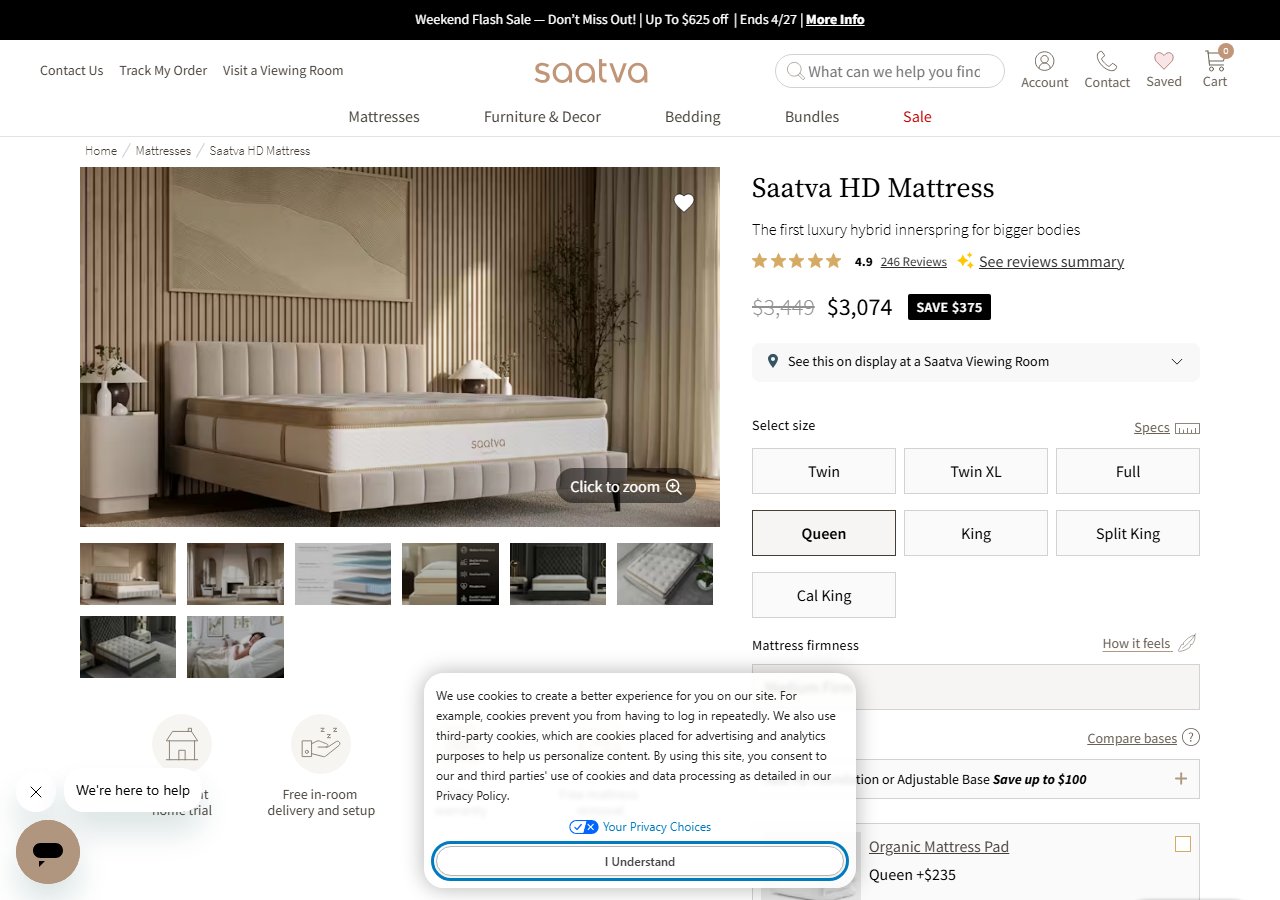
Saatva HD Mattress (Heavy-Duty)
$2,395-$3,995
See Price at Saatva →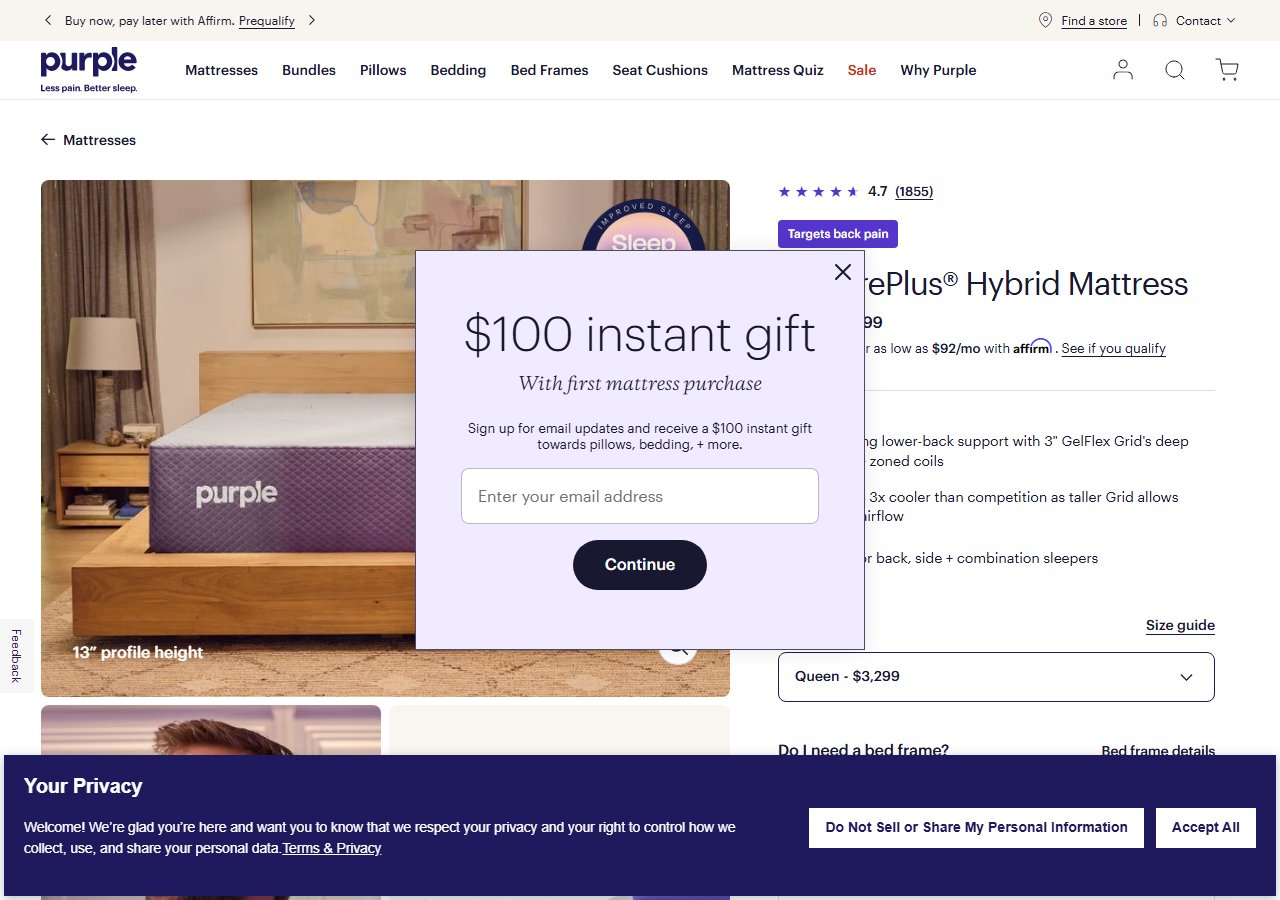
Purple Hybrid Premier Mattress
$2,499-$4,799
See Price at Purple →The data-to-decision hierarchy, stated plainly
The federal data on healthcare worker musculoskeletal disorders is not ambiguous. BLS occupational injury data puts the back at the top of the injury distribution. NIOSH's Lifting Equation documents why clinical patient handling produces that injury pattern. CDC sleep data explains why shift-work disruption prevents the nocturnal recovery that would otherwise buffer cumulative disc loading. And SSA disability data shows where the trajectory ends if neither the loading nor the recovery is addressed.
The hierarchy is: fix the mechanics first (OSHA lifting guidance), fix the movement deficit (NIH NCCIH walking evidence), fix the sleep position (NIH NIAMS guidance), then evaluate the sleep surface. If the surface fails the sag-and-stiffness test, replace it with something engineered for your specific load profile — not the mattress with the best marketing, but the one whose construction matches your weight, your primary symptom, and your dominant sleep position.
The CMS drug spending data tracking opioid and non-opioid pain medication as among the most expensive Medicare drug categories is a reminder that the chronic pain treatment pathway is expensive, long, and often inadequate. The workers who stay healthy longest in high-MSD occupations are the ones who intervene early — on the floor with mechanics, at home with movement, in the bedroom with position and surface. This article is a map of that intervention sequence, grounded in federal data that is publicly available and worth reading for yourself.