The Data Problem Healthcare Workers Are Living Inside
If you work a 12-hour nursing shift, rotate through night and day schedules, or spend any portion of your workday repositioning patients, transferring bodies, or bending over beds at awkward angles, you are operating inside one of the most musculoskeletal-damaging occupational categories the federal government tracks. According to BLS Musculoskeletal Disorders by Occupation data, the back is the most commonly injured body part across all U.S. occupations that result in days away from work — and healthcare consistently ranks among the highest-incidence industries in that dataset. This is not a coincidence. It is the predictable output of a specific set of biomechanical exposures that the federal government has been tracking for decades.
The numbers extend well beyond the workplace. CDC NCHS Data Brief 390 documents that approximately 20% of U.S. adults live with chronic pain, with the lower back as the most frequently reported pain location. For shift workers specifically, the recovery window — the sleep period during which spinal discs rehydrate, muscle microtears repair, and the central nervous system consolidates pain-modulation signals — is routinely compressed, fragmented, or shifted out of alignment with the body's circadian rhythm. When that recovery window is broken, cumulative damage accumulates faster than it heals.
And the downstream costs are staggering. AHRQ HCUP data identifies back pain as one of the most expensive conditions in U.S. healthcare by total inpatient and outpatient spend. AHRQ MEPS data shows that adults with chronic back conditions spend substantially more on personal healthcare annually than those without — a compounding burden that falls hardest on the workers generating those clinical encounters in the first place. Nurses and patient-care technicians are, in a grim statistical irony, among the most likely workers to eventually become the patients they serve.
Why Healthcare Workers Break Down: The Biomechanical Mechanism
Understanding why healthcare shift workers experience such elevated back injury rates requires a brief walk through the occupational biomechanics involved. Three mechanisms interact to create the injury profile federal data reflects.
First: repeated spinal loading beyond safe limits. The NIOSH Lifting Equation is the federal standard for quantifying safe manual material-handling loads. It documents that patient-handling tasks — repositioning a 180-pound patient in a hospital bed, transferring someone from a wheelchair to an exam table, catching a falling patient — routinely exceed the recommended weight limits, particularly because the load is unpredictable, asymmetrical, and performed under time pressure. Unlike warehouse workers who lift standardized boxes, healthcare workers lift humans who shift their weight, resist, or go limp without warning. The NIOSH equation's safety thresholds assume controlled conditions. Healthcare offers almost none.
Second: prolonged static postures between lifting events. A 12-hour shift does not mean 12 hours of movement. It often means sustained bending over patient beds at a fixed forward flexion angle, charting at workstations not designed for the user's height, and standing on hard flooring for extended periods. Static lumbar flexion compresses the posterior intervertebral discs and fatigues the erector spinae group, which reduces the muscular protection available for the next unexpected lifting event. The combination of static loading and dynamic overload is more injurious than either alone.
Third: sleep deprivation as a biological force multiplier. CDC sleep data shows that approximately 35% of U.S. adults sleep fewer than seven hours per night, the threshold associated with elevated chronic disease risk. For rotating shift workers, the number is materially higher. Night shifts suppress melatonin, elevate cortisol, and fragment the slow-wave sleep stages during which growth hormone is secreted and connective tissue repair occurs. A healthcare worker who spends eight hours loading their lumbar spine and then sleeps six fragmented hours on a mattress with a 2-inch central sag is running a tissue-repair deficit that compounds with every rotation. Over months and years, that deficit is what the BLS injury data is measuring.
CDC Arthritis Data adds another layer: approximately 25% of U.S. adults report doctor-diagnosed arthritis, with prevalence concentrated in physically demanding occupations. Healthcare workers in their 40s and 50s often carry both cumulative disc pathology from occupational loading and early osteoarthritis in the facet joints — conditions that respond differently to sleep position and surface firmness, and that require more deliberate recovery management than the general adult population.
The federal disability data completes the picture. SSA Disability Insurance data identifies musculoskeletal disorders as the single largest category of new disability claims filed annually. Healthcare workers are not immune to this trend — they are overrepresented in it. The industry's workers' compensation cost burden reflects this: industries with high MSD incidence carry workers' compensation insurance rates 3–5 times higher than low-MSD industries, a direct financial signal of the injury severity involved.
The Cheapest Intervention Is the One That Doesn't Cost Anything
Before any discussion of sleep surfaces, recovery products, or equipment purchases, the federal evidence base points clearly toward a set of behavioral and mechanical interventions that cost nothing and that, for a meaningful percentage of people with chronic low-back pain, produce clinically significant relief. This matters both practically and philosophically: a $2,000 mattress sitting on top of poor sleep hygiene, sedentary days, and bad lifting mechanics will not rescue a damaged lumbar spine. The order of operations matters.
NIH NCCIH's evidence review on low-back pain is unusually candid about what the data shows: walking 30 minutes most days reduces chronic low-back pain as effectively as most non-drug clinical treatments. That is a striking finding, and one that most pain-management marketing does not lead with. For healthcare workers who spend 12 hours on their feet, "add more walking" may seem counterintuitive — but the distinction is between occupational loading postures (bending, static flexion, unexpected lifts) and deliberate rhythmic locomotion, which lubricates facet joints, pumps nutrient-rich fluid into intervertebral discs, and activates the endogenous opioid system. A short walk before bed is a legitimate clinical tool.
Sleep position is the other zero-cost intervention that federal data supports. NIH back pain guidance is specific: side-sleeping with a pillow between the knees, or back-sleeping with a pillow under the knees, maintains spinal neutrality through the sleep period. Stomach-sleeping forces lumbar extension and cervical rotation simultaneously — both of which increase compressive loading on already-taxed posterior structures. A healthcare worker who sleeps 7 hours on their stomach is spending 7 hours reinforcing the same spinal loading pattern they spent 12 hours accumulating at work. Repositioning costs nothing.
For readers who have already addressed sleep position, already walk daily, and whose mattress is less than 7 years old with no visible sag — and who are still waking up stiffer than they went to bed — the sleep surface itself becomes a legitimate clinical variable. The question is not whether a mattress can help; federal data and occupational therapy practice both confirm it can. The question is which construction characteristics map onto the specific injury pattern healthcare workers carry.
When to See a Clinician First
No sleep surface addresses neurological compromise. Before evaluating any equipment, healthcare workers — who of all populations should recognize these signs — should note that NIH NINDS back pain guidance identifies several red flags that require prompt clinical evaluation rather than a new mattress:
- Pain that radiates below the knee, particularly with numbness or tingling in the foot or toes, suggests nerve root compression (radiculopathy) that may require imaging and clinical management. A firmer mattress will not decompress a herniated disc.
- Back pain following trauma — a patient fall, a lifting incident, a motor vehicle collision — requires structural evaluation before sleep-surface changes are clinically meaningful.
- New leg weakness, foot drop, or altered gait associated with back pain is a potential surgical emergency (cauda equina) and requires immediate evaluation.
- Bowel or bladder dysfunction accompanying back pain is similarly a red flag for cauda equina syndrome — do not delay care.
- Back pain with fever, unintentional weight loss, or night sweats may indicate infectious or oncological etiology and requires urgent workup.
If none of these apply — if the presentation is the familiar pattern of chronic mechanical low-back pain, morning stiffness that loosens with movement, diffuse aching after long shifts — then sleep-surface optimization is a reasonable next step after behavioral interventions.
Where the Sleep Surface Becomes a Clinical Variable
For healthcare workers with confirmed mechanical low-back pain or facet arthritis who have optimized sleep position, maintained a walking routine, and are sleeping on a mattress showing age or wear, the evidence for sleep-surface upgrades is real. The mechanism is straightforward: a mattress that allows the pelvis to sink while maintaining lumbar support keeps the spine in the same neutral position that clinical interventions target. A mattress that is too soft lets the pelvis crater, creating a lumbar flexion posture identical to the worst part of the work shift. A mattress that is too firm holds the pelvis up and creates a lateral shear at the lumbosacral junction for side-sleepers.
The clinical literature on mattress firmness and back pain — including a frequently cited Spanish RCT and subsequent systematic reviews — converges on medium-firm as the optimal range for most adults with chronic low-back pain. But "medium-firm" is not a standardized industry specification; it is a feel category that varies meaningfully by body weight, sleep position, and the specific tissue pathology involved. Healthcare workers who are heavier, who sleep primarily on their sides, or who carry significant facet arthritis need different construction than a 130-pound back-sleeper with simple muscle fatigue.
For healthcare workers dealing with serious chronic back pain, the Saatva Loom & Leaf Memory Foam Mattress represents one of the most considered premium memory foam options in this price tier. Its dual-layer memory foam system — a 4-pound density comfort layer over a 5-pound transition layer — provides the progressive resistance profile that occupational therapists describe as ideal for chronic back pain management: initial conforming pressure relief at the shoulder and hip, followed by firmer support at the lumbar zone that prevents the spinal flexion that worsens disc pathology overnight. The organic cotton cover and spinal zone technology reflect genuine engineering investment rather than marketing language, and the white-glove delivery with old mattress removal removes the logistical friction that keeps many shift workers from making the upgrade.
For healthcare workers who are larger-framed or who have found that standard mattresses degrade quickly under their body weight — a legitimate concern given that heavier individuals compress standard foam to its deflection limit faster — the Saatva HD Mattress was specifically engineered for higher body weights and more demanding load profiles. Its patent-pending AirCushion edge system and high-density foam core maintain support geometry that standard mattresses abandon within two to three years for heavier users. Healthcare workers in this category who have cycled through multiple mattresses without sustained relief are often failing at the structural engineering level, not the foam chemistry level.
For shift workers whose primary complaint is pressure-point pain — the shoulder and hip pain that accumulates from side-sleeping during the day when the body hasn't had a chance to fully relax — the Purple Hybrid Premier Mattress offers a fundamentally different pressure-relief mechanism. Purple's proprietary GelFlex Grid redistributes pressure by buckling under bony prominences rather than compressing uniformly, which means the shoulder and hip sink through the comfort layer while the lumbar region, which has lower pressure per square inch, receives more support. For nurses who rotate from night to day shifts and sleep in positions that vary with exhaustion level, the Grid's position-agnostic pressure relief is a meaningful engineering advantage over traditional foam zoning.
Sleep Surfaces Engineered for Shift-Worker Spinal Recovery
These three mattresses were selected specifically for healthcare workers managing occupational back stress — each addresses a distinct biomechanical need identified in the federal MSD and chronic pain data reviewed above.

Saatva Loom & Leaf Memory Foam Mattress
$1,695-$3,295
See Price at Saatva →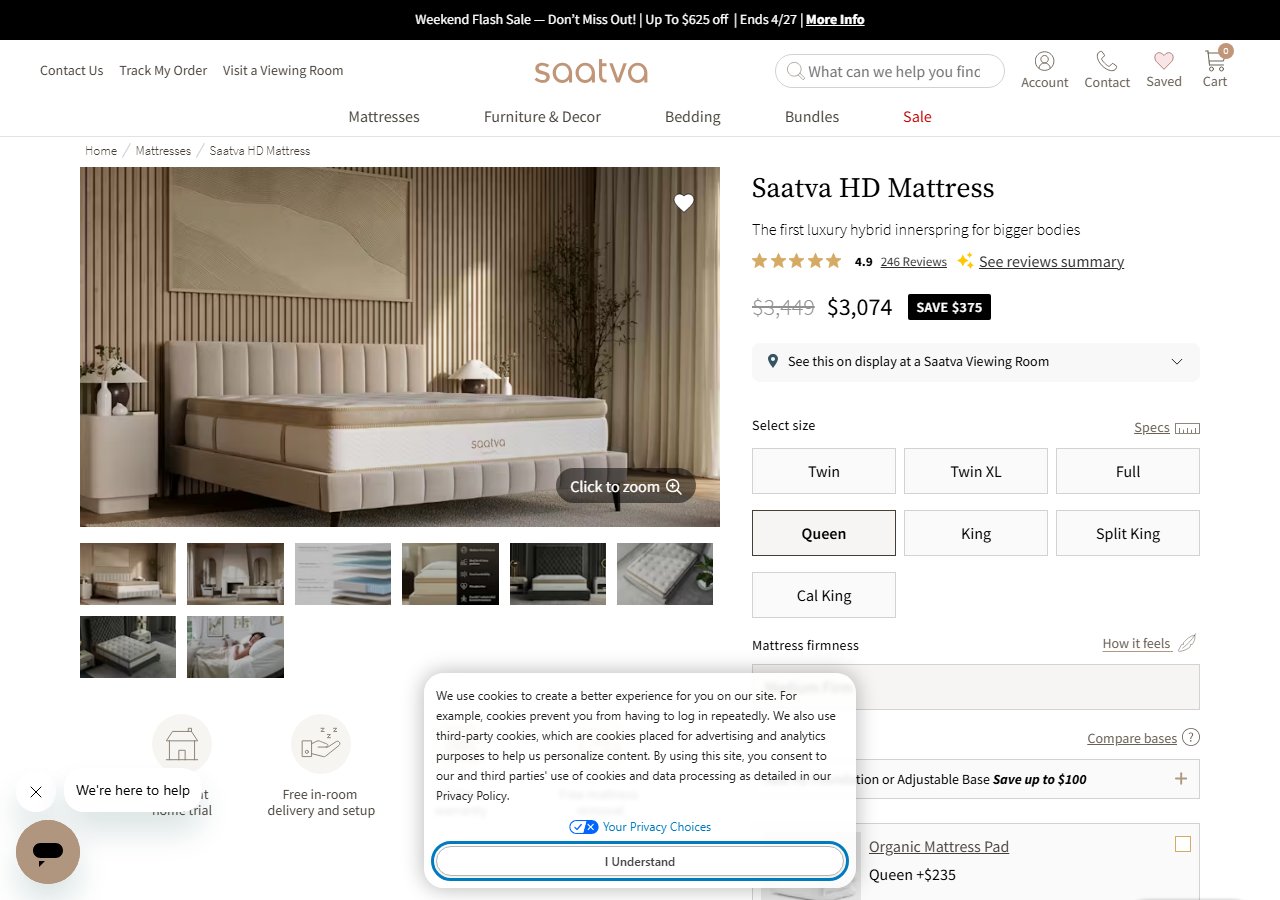
Saatva HD Mattress (Heavy-Duty)
$2,395-$3,995
See Price at Saatva →
Purple Hybrid Premier Mattress
$2,499-$4,799
See Price at Purple →The Medication Cost Dimension
One piece of context that reframes the economics of sleep-surface investment: CMS Drug Spending data identifies opioid and non-opioid pain medications among the most expensive Medicare drug categories, reflecting the scale of the chronic pain treatment burden in the U.S. For working-age healthcare workers managing chronic back pain without Medicare coverage, out-of-pocket analgesic costs, physical therapy copays, and the lost productivity of high-pain days represent a recurring expenditure that a durable sleep surface can partially offset. A mattress at $2,000 with a 10-year useful life costs approximately $200 per year — less than many adults with chronic back conditions spend on NSAIDs and topical analgesics annually.
This is not a claim that a mattress replaces medical treatment. It is a data-grounded observation that the economics of chronic pain management are complex, and that durable investments in sleep infrastructure sit within a rational cost-benefit range when the alternative is escalating pharmaceutical and clinical expenditure. AHRQ MEPS data makes clear that the annual healthcare cost differential for adults with chronic back conditions is not trivial.
Putting It Together: The Recovery Hierarchy for Healthcare Shift Workers
The federal data reviewed in this article points toward a clear hierarchy for healthcare workers managing chronic back pain and disrupted sleep recovery:
First: behavioral interventions. Correct your sleep position tonight using a pillow between or under your knees per NIH guidance. Add a 20–30 minute walk on your days off per NIH NCCIH evidence. Review your lifting mechanics against OSHA's ergonomic guidelines — hinge at the hips, keep loads close, avoid spinal rotation under load. These interventions are free, evidence-supported, and produce measurable results for a substantial fraction of people with mechanical back pain.
Second: clinical evaluation for red flags. If any of the NIH NINDS criteria apply — radicular symptoms, neurological signs, trauma history, systemic symptoms — see a clinician before changing your mattress. A new sleep surface is not a substitute for imaging when the presentation warrants it.
Third: mattress evaluation if yours fails the basic criteria. Per CDC sleep hygiene guidance, replace a mattress showing visible sag, if you wake stiffer than you went to bed, or if it is older than 7 to 10 years. If those conditions are met and behavioral interventions have been optimized, the Loom & Leaf, Saatva HD, or Purple Hybrid Premier each address specific biomechanical needs that healthcare workers carry: memory foam conforming support for disc and facet pathology, heavy-duty structural engineering for higher-weight users, and pressure-point relief for shift-disrupted side-sleepers.
The federal data on MSD incidence, chronic pain prevalence, and disability claims is not abstract. It describes real people — many of them the nurses, CNAs, surgical techs, and patient-care workers who keep the U.S. healthcare system running — and the toll their occupation takes on their bodies. Sleep recovery is not a luxury for this population. It is an occupational necessity. Get the behavioral variables right first, rule out clinical pathology, and then choose a sleep surface that reflects the specific mechanical demands your job places on your spine.