Healthcare Workers and the Back-Pain Crisis Federal Data Has Been Tracking for Years
If you are a nurse, respiratory therapist, surgical technician, or any other healthcare worker pulling 12-hour shifts, the federal data about your occupation is not encouraging — but it is clarifying. BLS Musculoskeletal Disorders by Occupation tracking identifies the back as the single most injured body part across all U.S. occupations with days away from work. That finding is not a rounding error. It is the output of decades of workers' compensation records, injury surveillance surveys, and employer-reported incident logs. Healthcare is consistently among the top industries contributing to that statistic, alongside warehousing and construction — but with an important difference: nurses and patient-care technicians lift and reposition people, not boxes. Human loads are unpredictable, asymmetric, and resist being set down when a safe moment arises.
CDC NCHS Data Brief 390 puts the downstream consequence plainly: approximately 20% of U.S. adults experience chronic pain, with the lower back as the most common pain location. Among healthcare workers in their 30s and 40s — the professional prime years — that statistic is not background noise. It is the career-trajectory threat sitting behind every call-out, every light-duty accommodation request, and every FMLA filing.
And the problem compounds at night. CDC Sleep and Sleep Disorders Data shows approximately 35% of U.S. adults already sleep fewer than the 7 hours per night associated with elevated chronic disease risk. For rotating-shift healthcare workers — who routinely transition from night shifts to day shifts within the same week, sleep in daylight hours with ambient noise, and experience circadian disruption that suppresses melatonin production — that 35% figure almost certainly undercounts the actual burden on this population.
Why 12-Hour Healthcare Shifts Produce a Specific Pattern of Spinal Damage
Understanding why healthcare workers accumulate spinal injury at elevated rates is not an academic exercise. It determines which interventions actually work and why generic back-pain advice often misses the mark for this population.
Patient handling is the primary mechanism. Repositioning a 200-pound patient in a hospital bed, transferring a patient from gurney to OR table, or assisting a fall-risk patient to ambulate all generate peak spinal compressive and shear forces that can exceed safe loading limits. The NIOSH Lifting Equation — the federal standard for manual material handling — documents that healthcare patient-handling tasks routinely exceed recommended spinal load limits, often because the geometry of the task (leaning over a bedrail, reaching across a wide hospital bed) creates severe mechanical disadvantage that multiplies the effective load on the lumbar spine.
But spinal loading during the shift is only half the equation. The other half is what happens — or fails to happen — during recovery. Intervertebral discs are largely avascular structures that rehydrate and recover during horizontal, unloaded rest. When a healthcare worker finishes a 12-hour shift, their lumbar discs have experienced hours of compressive loading with minimal recovery opportunity. The off-duty sleep window is the primary biological mechanism by which disc height and hydration restore. When that window is compressed, fragmented, or spent on a surface that maintains spinal misalignment, the recovery cycle is incomplete. Shift after shift, the cumulative deficit grows.
This is why CDC Arthritis Data showing that approximately 25% of U.S. adults have doctor-diagnosed arthritis — with prevalence concentrated in occupations with sustained physical demand — lands with particular weight for healthcare workers in mid-career. The spinal facet joints and disc structures that bear the brunt of patient-handling loads are precisely the structures most vulnerable to early degenerative change when recovery is chronically inadequate.
The financial stakes reinforce the urgency. AHRQ HCUP data identifies back pain as one of the most expensive conditions in U.S. healthcare by total inpatient and outpatient cost. AHRQ MEPS data confirms that adults with chronic back conditions carry substantially higher annual personal healthcare expenditures than those without. And SSA Disability Insurance data identifies musculoskeletal disorders as the largest single category of new disability claims nationwide — a statistic that should focus the mind of any healthcare worker who views their ability to work as a financial asset worth protecting.
BLS Employer Costs for Employee Compensation data adds one more dimension: industries with high MSD incidence carry workers' compensation insurance rates 3 to 5 times higher than low-MSD industries. That cost burden is not neutral for employees. It shapes staffing ratios, benefit structures, and the institutional willingness to invest in ergonomic equipment — all of which affects the injury environment healthcare workers enter every shift.
Try These First: Non-Product Interventions That Federal Evidence Supports
The cheapest intervention is the one that does not require buying anything. Before evaluating any mattress, the interventions below deserve honest assessment. Federal evidence supports each of them, and several have effect sizes that rival or exceed passive equipment solutions.
Start with sleep position — specifically what NIH's National Institute of Arthritis and Musculoskeletal and Skin Diseases identifies as the highest-leverage free variable for back pain during sleep. Side-sleeping with a pillow between the knees keeps the pelvis level and reduces lateral spinal flexion. Back-sleeping with a pillow under the knees reduces the lumbar lordosis load. Stomach-sleeping, by contrast, forces the lumbar spine into sustained extension and rotates the cervical spine — a position that worsens chronic lumbar pain for most people who practice it habitually. Changing sleep position costs nothing and can reduce morning stiffness substantially when done consistently.
Next, daily walking. NIH's National Center for Complementary and Integrative Health evidence review concludes that 30 minutes of walking most days reduces chronic low back pain as effectively as most non-drug clinical treatments. For healthcare workers whose shifts already involve significant standing and walking, the prescription seems counterintuitive — but structured, forward-gait walking on non-shift days promotes disc nutrition, maintains paraspinal muscle conditioning, and engages the pain-modulation pathways that passive rest does not.
Lifting and bending mechanics matter even off the unit. OSHA Ergonomics Solutions guidance recommends hinging at the hips rather than the lumbar spine, keeping loads close to the body, and strictly avoiding twisting under load. Most acute back episodes in healthcare workers are mechanical events — a single lift executed with poor geometry — and are rehearsable. Workers who internalize the hip-hinge pattern as automatic behavior reduce their acute injury exposure substantially.
Finally, mattress replacement timing. CDC Sleep Hygiene guidance and orthopedic consensus both flag visible sag, waking stiffer than you went to bed, and mattress age exceeding 7 to 10 years as signals that the sleep surface itself may be the recovery barrier. Even the most precisely engineered mattress does not undo poor sleep hygiene, inadequate shift-to-shift recovery time, or sedentary off-duty days. But a structurally failed mattress actively undermines the spinal alignment that every other intervention is trying to achieve.
For healthcare workers who have already addressed sleep position, movement habits, and lifting mechanics — and who are sleeping on a mattress that is either failed or age-appropriate for replacement — the evidence for surface selection becomes relevant. The question is not whether a better mattress helps, but which construction features address the specific spinal loading patterns that 12-hour patient-handling shifts produce.
When to See a Clinician Before Buying Anything
No mattress is a diagnostic tool. NIH National Institute of Neurological Disorders and Stroke guidance on back pain is explicit: certain presentations of back pain require imaging, specialist referral, or urgent evaluation — and purchasing a new sleep surface is not an appropriate substitute for that pathway. Healthcare workers, who often self-triage based on their clinical knowledge, are paradoxically at risk of delayed self-referral because they normalize musculoskeletal pain as occupational background noise.
The red flags for urgent evaluation are specific. Back pain that radiates below the knee — true sciatica — may signal disc herniation or nerve root compression that requires clinical assessment before any positional or surface intervention. Pain that follows trauma (a patient fall, a sudden lift) and does not resolve within days warrants imaging. Leg weakness, changes in bowel or bladder function, or back pain accompanied by fever are neurological and systemic signals that sit outside the scope of any sleep-surface conversation. CMS drug spending data identifies opioid and non-opioid pain medication spending among the most expensive Medicare drug categories — reflecting a chronic-pain treatment burden that begins, in many cases, with undertreated acute episodes that were never properly evaluated. Early clinical intervention is the deflection point for that trajectory.
For healthcare workers whose back pain is chronic, positional, and already clinically evaluated — the population for whom mattress selection is genuinely relevant — the following product analysis applies.
What the Evidence Says About Mattress Construction for Healthcare Workers
Healthcare workers have a biomechanically specific recovery need that differs from sedentary office workers with back pain. After hours of compressive spinal loading, the priority is: (1) pressure relief at the primary bony prominences — hips and shoulders — so that side-sleeping position can be maintained without pain-driven repositioning that fragments sleep architecture; (2) lumbar support that prevents the spine from sagging into flexion in the mid-mattress zone; and (3) enough surface stability to allow the positional changes (rolling, adjusting) that occur naturally during sleep without creating motion disruption that wakes the worker.
Memory foam, hybrid, and advanced polymer grid constructions all address these needs differently. The right choice depends on body geometry, dominant sleep position, and thermal comfort — factors that interact with material properties in ways that no single construction type dominates universally.
For healthcare workers with serious, clinically evaluated back pain who need targeted lumbar support alongside pressure relief, the Saatva Loom & Leaf Memory Foam Mattress is our premium memory foam recommendation. Loom & Leaf uses a layered memory foam construction with a dual tempered steel coil support core option, delivering the body-contouring pressure relief that allows hip and shoulder sinkage while maintaining spinal alignment in the lumbar zone. The organic cotton cover and cooling gel memory foam address the thermal management issue that affects healthcare workers who sleep hot after high-exertion shifts. At $1,695 to $3,295 depending on size and firmness, it is a significant investment — but in the context of AHRQ MEPS data showing that adults with chronic back conditions carry substantially higher annual healthcare costs, a sleep surface that functionally supports spinal recovery represents a different kind of cost-benefit calculation.
For healthcare workers who are larger-framed or who work in units that involve particularly heavy patient-handling loads — bariatric care, trauma, surgical — the Saatva HD Mattress is engineered for body weights up to 500 pounds with a reinforced lumbar support system and a dual-coil construction that maintains zoned support geometry under loads that compress standard memory foam constructions into ineffectiveness. Standard mattresses are rated for occupants up to approximately 250 to 300 pounds; workers above that threshold sleeping on standard-rated surfaces are frequently sleeping on a mattress that is structurally failing every night regardless of its age. Priced at $2,395 to $3,995, the HD is the most specific solution in this list for a population that is both physically large and occupationally high-risk for spinal MSDs.
For healthcare workers whose primary complaint is pressure pain at the hips and shoulders — particularly side-sleepers who experience hip bursitis or shoulder impingement symptoms exacerbated overnight — the Purple Hybrid Premier Mattress offers a distinctive engineering approach. Purple's GelFlex Grid is a polymer grid structure that collapses under pressure points to provide deep pressure relief while remaining firm in the zones between bony prominences to maintain spinal alignment. Unlike memory foam, the grid does not trap heat — a meaningful advantage for healthcare workers who run warm after high-exertion shifts and find that memory foam's heat retention disrupts sleep continuity. Priced at $2,499 to $4,799, the Purple Hybrid Premier sits at the premium end of the market, but its pressure-distribution mechanism is genuinely differentiated from foam-based alternatives for workers with point-specific overnight pain.
Sleep Surfaces Engineered for Healthcare-Worker Spinal Recovery
These three mattresses were selected specifically for the spinal loading patterns, body-weight ranges, and shift-worker sleep disruption profiles documented in federal occupational health data for healthcare workers.

Saatva Loom & Leaf Memory Foam Mattress
$1,695-$3,295
See Price at Saatva →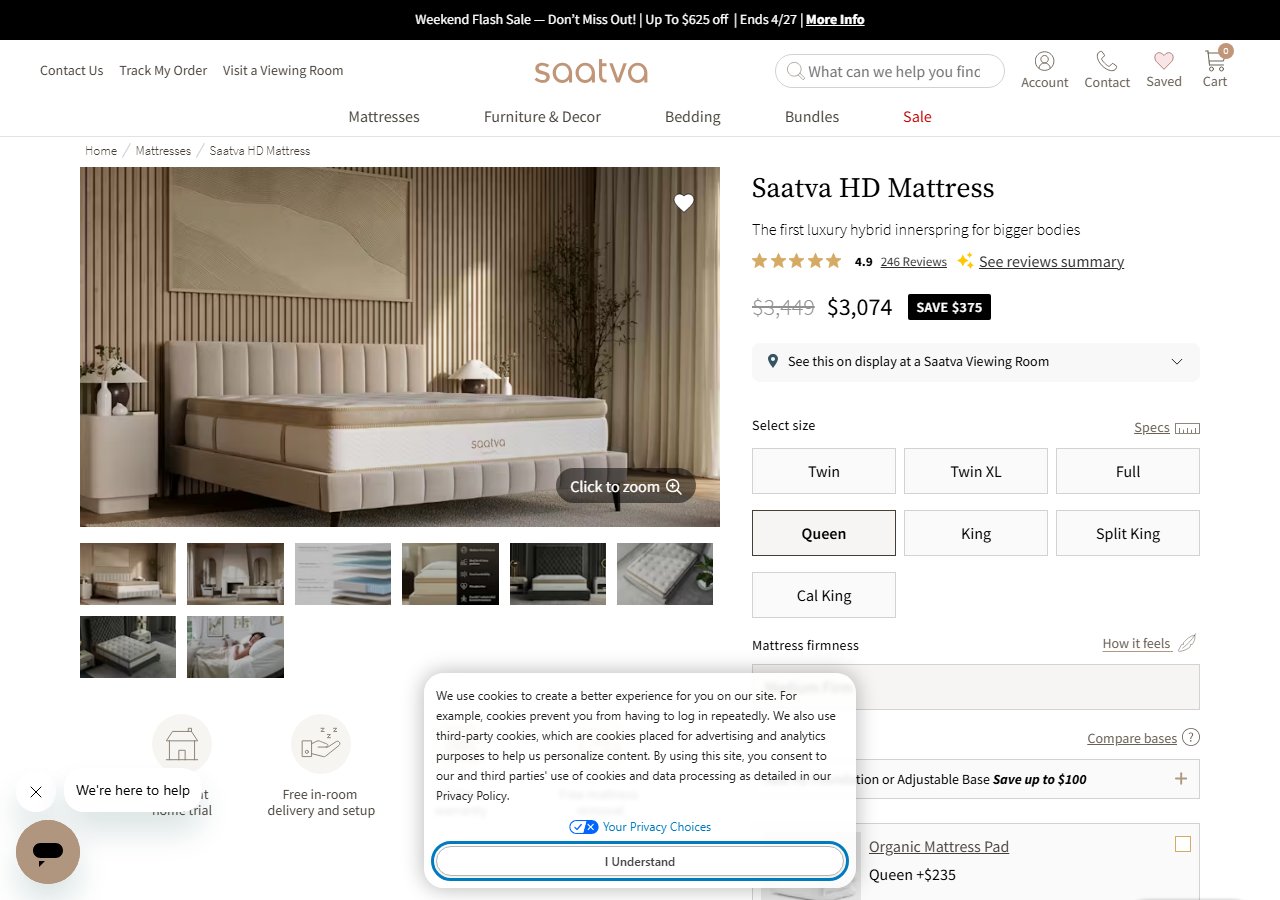
Saatva HD Mattress (Heavy-Duty)
$2,395-$3,995
See Price at Saatva →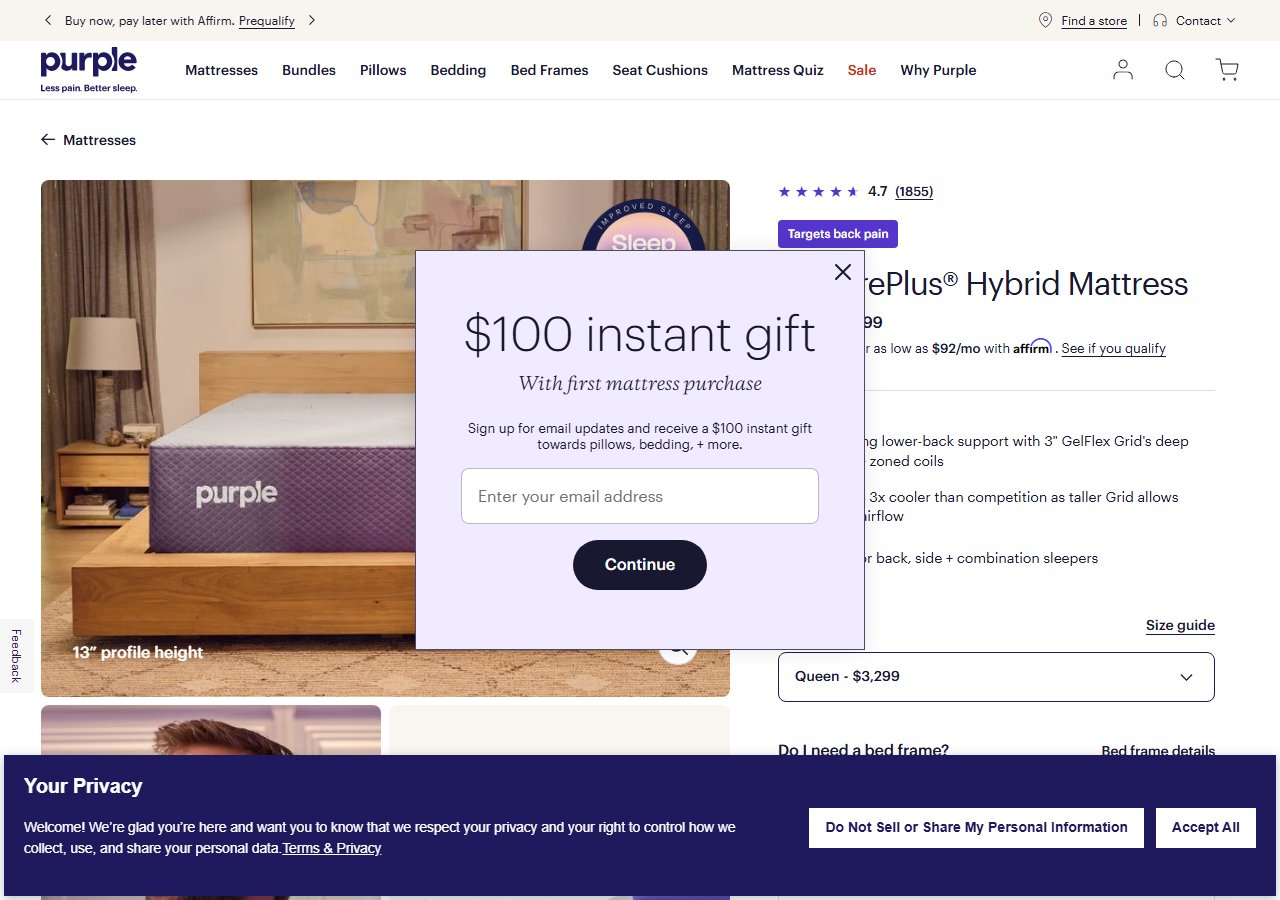
Purple Hybrid Premier Mattress
$2,499-$4,799
See Price at Purple →Pulling the Evidence Together: A Decision Framework for Healthcare Workers
The federal data reviewed in this article tells a coherent story with a clear hierarchy. BLS injury data establishes that back injury is the occupational norm for healthcare workers, not the exception. CDC chronic pain data confirms that 1 in 5 U.S. adults is already living with the downstream consequence of that injury pattern. CDC sleep data establishes that most Americans — and disproportionately, shift workers — are already sleeping below the threshold for healthy recovery. And SSA disability data establishes that musculoskeletal disorders are the primary pathway out of the workforce through disability for working-age Americans.
Against that data backdrop, the decision hierarchy is: fix mechanics first (sleep position, movement, lifting technique), replace a failed mattress if the structural indicators are present, see a clinician if red flags are present, and then — for workers whose backs are clinically evaluated and whose current mattress is genuinely the limiting factor — consider the construction-specific options above.
The Loom & Leaf is the right recommendation for most healthcare workers with documented back pain who want premium memory foam with lumbar zoning. The Saatva HD is the right recommendation for larger-framed workers whose body weight exceeds what standard mattresses are engineered to support. The Purple Hybrid Premier is the right recommendation for pressure-sensitive side-sleepers who have found memory foam too hot or insufficiently responsive at the hip and shoulder.
None of these products replace the walking prescription, the sleep position discipline, or the clinical evaluation. They are adjuncts to a recovery strategy — the platform on which the other interventions land. Treated as one tool among several in a data-informed recovery plan, the right sleep surface represents a legitimate investment in the asset that healthcare workers most depend on: the physical capacity to keep doing their jobs.