Healthcare Shift Workers Are Sleeping Their Way Into a Crisis — and Federal Data Proves It
If you work a 12-hour nursing shift, rotate through emergency department nights, or spend your days as a physical therapist lifting patients who cannot lift themselves, there is a specific federal dataset that describes your body's trajectory with uncomfortable precision. BLS Musculoskeletal Disorders by Occupation tracking identifies the back as the most commonly injured body part across all U.S. occupations with days away from work — and healthcare, which combines maximum physical load with minimum off-duty recovery time, sits near the top of every MSD incidence table the Bureau of Labor Statistics publishes.
The numbers do not stay abstract for long. CDC sleep data shows approximately 35% of U.S. adults sleep fewer than 7 hours per night, the threshold the CDC associates with elevated risk of obesity, diabetes, high blood pressure, heart disease, stroke, and mental distress. Shift workers — nurses, respiratory therapists, radiology techs, hospital pharmacists — sleep significantly fewer hours than that already-damaging average, according to multiple NIOSH-funded occupational health studies. The compounding arithmetic is brutal: you spend 12 hours stressing your spine under load, then spend the subsequent 6 to 8 hours on a surface that either allows your intervertebral discs to rehydrate and your paraspinal musculature to recover, or does not.
This article is not a product roundup dressed up with federal statistics. It is a systematic look at why healthcare workers sustain back injuries at the rates they do, what free interventions the NIH and OSHA recommend before anyone spends a dollar, what clinical presentations demand a clinician rather than a new mattress, and finally — after all of that — which specific sleep surfaces are engineered to address the load patterns healthcare workers actually carry.
Why This Happens: The Biomechanics of Healthcare Work and Spinal Loading
Healthcare work is, at its physical core, an uncontrolled manual material handling job. Unlike warehouse workers who lift predictable boxes along consistent axes, nurses and patient-care technicians lift, turn, position, and transfer human beings who are unpredictable in their weight distribution, resistance, and movement. The NIOSH Lifting Equation — the federal standard for evaluating spinal loading risk — was developed specifically because so many occupational tasks, including patient handling, routinely exceed safe spinal compression limits of roughly 3,400 Newtons at the L4-L5 vertebral disc.
Patient transfers are among the most biomechanically dangerous tasks in any occupation. A nurse repositioning a 180-pound patient who cannot assist the transfer is generating spinal compressive forces that NIOSH's own data places well above that safe limit, especially when the transfer involves lateral bending or rotation — which most real-world patient transfers do. Add to this the cumulative fatigue of a 12-hour shift with inadequate break time, dehydrated intervertebral discs by hour ten, and paraspinal muscles that are fatiguing under continuous postural demand, and you have the precise mechanism behind the MSD epidemic in healthcare.
AHRQ HCUP data identifies back pain as one of the most expensive conditions in U.S. healthcare by total inpatient and outpatient spending — a painful irony for the workers who generate those costs while treating other patients. The AHRQ Medical Expenditure Panel Survey reinforces this: average annual personal healthcare expenditures for adults with chronic back conditions substantially exceed costs for adults without such conditions. Healthcare workers with back injuries become expensive healthcare consumers.
The disability pathway is even more alarming. SSA Disability Insurance data identifies musculoskeletal disorders as the largest single category of new disability claims annually — ahead of mental illness, cardiovascular disease, and neurological disorders. For a healthcare worker in their 40s with a decade of patient-handling behind them, a serious lumbar disc injury is not just a recovery challenge; it is a potential career-ending event. BLS employer compensation data confirms the structural cost: industries with high MSD incidence carry workers' compensation insurance rates 3 to 5 times higher than low-MSD industries, which means the financial signal is real even for employers who do not respond to it.
Now add the sleep layer. CDC NCHS Data Brief 390 reports that approximately 20% of U.S. adults experience chronic pain, with lower back as the most common location. Chronic pain and sleep disruption are bidirectionally related: pain interrupts sleep architecture, and sleep deprivation lowers pain thresholds, creating a self-reinforcing cycle. For healthcare shift workers, who are already sleep-deprived from irregular schedules and compressed recovery windows, this cycle is running at full speed. The question is not whether sleep quality matters for back-pain recovery — it clearly does. The question is what levers are actually available to break the cycle.
CDC arthritis data adds another dimension: approximately 25% of U.S. adults report doctor-diagnosed arthritis, with prevalence concentrated in occupations involving sustained physical demand. Many mid-career healthcare workers are managing both MSD-type back injuries and early inflammatory joint changes simultaneously, which complicates both treatment and sleep-surface selection. A surface that is appropriate for a 28-year-old nurse with acute lumbar strain may be inadequate for a 52-year-old physical therapist managing lumbar stenosis and hip osteoarthritis.
The CMS drug spending dashboard places opioid and non-opioid pain medication spending among the most expensive Medicare drug categories — a downstream signal that non-pharmacological interventions upstream in the injury cycle, including sleep quality, deserve more serious attention than they typically receive.
Try These First: Federal-Agency-Recommended Interventions That Cost Nothing
The cheapest intervention is the one that does not require buying anything. Before evaluating any mattress, healthcare workers with back pain should work through the following interventions, each grounded in federal agency guidance. These are not soft lifestyle suggestions — they are the tier-one recommendations from NIH, NIOSH, and OSHA, the same agencies whose data describes the injury epidemic in the first place.
Daily walking is the most underrated intervention available. The NIH National Center for Complementary and Integrative Health evidence review on low back pain concludes that walking 30 minutes most days reduces chronic low back pain as effectively as most non-drug clinical treatments. This is not a wellness platitude; it is a finding from systematic review of randomized controlled trial data. Healthcare workers who spend 12 hours on their feet often resist more walking as off-duty activity — but the ambulatory nature of clinical work is not the same as sustained aerobic walking, which activates different muscular stabilization patterns and drives nutrient exchange into avascular intervertebral disc tissue.
Lifting and bending mechanics deserve the same attention off-duty as on. OSHA ergonomic guidance is explicit: hinge at the hips, not the lumbar spine; keep loads close to the body; avoid twisting under load. Healthcare workers who apply perfect body mechanics during patient transfers sometimes abandon those mechanics entirely when unloading their car, picking up a child, or moving furniture. Most acute back episodes are mechanical events that are predictable and preventable with rehearsed movement patterns.
Sleep position is the single biggest free variable available at night. NIH NIAMS back pain guidance recommends side-sleeping with a pillow between the knees, or back-sleeping with a pillow under the knees, to maintain spinal neutrality during sleep. Stomach-sleeping places the lumbar spine in sustained extension and rotation — a position that is mechanically harmful for anyone with disc pathology or facet joint irritation. No mattress can fully compensate for a harmful sleep position, which makes position awareness a prerequisite to any surface discussion.
Mattress replacement criteria matter because not every back problem is a mattress problem — but some are. CDC sleep hygiene guidance is useful here: if a mattress has visible sag, if the sleeper consistently wakes stiffer than they went to bed, or if the mattress is older than 7 to 10 years, replacement is warranted. Even the most expensive mattress available does not undo poor sleep hygiene, sedentary days, or unaddressed mechanical injury.
Many healthcare workers reading this will have already tried the above. They walk regularly, they watch their mechanics, they sleep on their side, and they are still waking up stiff, still carrying chronic lumbar pain into every shift, still reaching for ibuprofen before their morning coffee. For those readers, the evidence genuinely supports a sleep-surface upgrade — but with the understanding that the surface is an adjunct to the interventions above, not a replacement for them. The rest of this article evaluates which surfaces are actually engineered for the load patterns and pressure profiles healthcare workers carry.
When to See a Clinician: Red Flags That Require Medical Evaluation
Some back symptoms are orthopedic problems that require clinical assessment before any other intervention. NIH National Institute of Neurological Disorders and Stroke guidance identifies specific red flags that should prompt immediate clinician contact rather than a mattress purchase. These include back pain that radiates below the knee (suggesting nerve root compression or disc herniation with radiculopathy), pain that followed a fall or direct trauma, pain accompanied by leg weakness or numbness, and any back pain accompanied by bowel or bladder dysfunction (which may indicate cauda equina syndrome, a surgical emergency). Back pain with unexplained fever or in a patient with known malignancy is also a red flag requiring imaging and specialist referral.
For healthcare workers specifically, there are occupational nuances. A sudden onset of back pain following an uncontrolled patient transfer event should be evaluated radiographically, even if the pain seems mild initially — vertebral fractures in osteopenic workers can present with deceptively modest initial symptoms. Workers over 50 with new-onset back pain, particularly those with any history of prolonged corticosteroid use (which is common among workers with autoimmune conditions), should have bone density considerations discussed with their clinician before attributing symptoms to soft-tissue mechanisms. The interventions and products described in this article are appropriate for the large majority of healthcare workers dealing with non-specific chronic low back pain and MSD-type overuse injury — they are not appropriate substitutes for clinical evaluation of the red-flag presentations described above.
Where Sleep Surfaces Fit: Selecting the Right Tool for Healthcare Worker Recovery
For the healthcare worker who has cleared clinical red flags, is practicing consistent movement habits and sleep position discipline, and is sleeping on a mattress with visible sag or over 7 years of age, the sleep surface becomes a legitimate recovery variable. The selection criteria for this reader are different from generic consumer guidance in three important ways.
First, pressure-point load is asymmetric and high. A nurse who has spent a shift on her feet has significant muscular tension concentrated in the lumbar region, hip flexors, and posterior shoulder girdle. A sleep surface that is too firm will not allow the shoulder and hip to sink into neutral spinal alignment during side-sleeping. A surface that is too soft will allow the lumbar spine to sag into flexion. The clinical sweet spot — medium-firm for most adult side-sleepers — is supported by the limited but consistent body of sleep-surface research.
Second, motion transfer matters for shift workers. Healthcare workers often have spouses or partners on different schedules. A mattress that transmits motion freely will disrupt the limited sleep windows that shift workers have available. Memory foam and hybrid constructions with individually-wrapped coils isolate motion more effectively than traditional innerspring designs.
Third, durability matters at elevated body weight and activity levels. A worker who is lifting patients all day and bringing that physical load to bed every night needs a mattress with core construction engineered for sustained use, not one with cheap poly-foam cores that compress within 18 months.
With those criteria established, here are the three surfaces that best fit healthcare worker recovery needs.
For healthcare workers dealing with serious, chronic back pain — the nurse with a documented L4-L5 disc bulge, the physical therapist managing multilevel degenerative disc disease — the Saatva Loom & Leaf Memory Foam Mattress is the premium memory foam pick that most closely addresses the clinical need. Saatva constructs the Loom & Leaf with a gel-infused memory foam system over a high-density support base, a construction approach designed to provide the pressure relief that documented lumbar pathology requires without the unsupported sink that makes some memory foam mattresses a liability for back pain. The lumbar zone enhancement — a firmer region directly beneath the lower back — is the construction feature most directly relevant to healthcare workers who need support precisely where their work concentrates load. At $1,695 to $3,295, it is a significant investment, but the AHRQ MEPS data on the annual healthcare cost differential for chronic back conditions makes the comparison more tractable: better sleep-surface support is a plausible upstream cost offset.
For larger-framed healthcare workers — the ICU nurse who is 6'3" and 250 pounds, the physical therapist whose body weight itself generates elevated spinal loading — standard mattress construction often fails within a few years because the core foam or coil system was not rated for the sustained load. The Saatva HD Mattress was specifically engineered for this load pattern. Its individually-wrapped coil-on-coil architecture uses a heavier-gauge support coil layer beneath a comfort coil layer, with a base foam rated for higher sustained compression loads than standard residential mattress construction. The result is a surface that maintains its support geometry over time under elevated weight — which is the core failure mode of standard mattresses for larger users. At $2,395 to $3,995, the HD commands a premium, but for a worker whose previous mattresses have sagged visibly within two to three years, the construction difference is directly relevant to durability.
For healthcare workers whose primary complaint is pressure-point pain at the shoulder, hip, or knee during side-sleeping — the diagnostic signal here is waking with joint pain that was not present at bedtime, particularly at bony prominences — the Purple Hybrid Premier Mattress addresses a different biomechanical need. Purple's proprietary GelFlex Grid system is a polymer grid structure that collapses under concentrated pressure points while maintaining support across broader surface areas. The clinical relevance for healthcare workers: a worker with hip bursitis or shoulder impingement will experience significantly less pressure accumulation at those sites on the Purple Hybrid Premier than on a conventional foam or innerspring surface. The hybrid construction — GelFlex Grid over individually-wrapped coils — also provides the motion isolation that shift workers need and the edge support that matters for workers who tend to sleep near the mattress perimeter. At $2,499 to $4,799, the Purple Hybrid Premier is the highest-priced option in this group, but it addresses a specific pressure-relief need that memory foam alone does not fully solve.
Sleep Surfaces Engineered for Healthcare Worker Recovery Demands
These three mattresses were selected specifically for the pressure profiles, durability requirements, and motion-isolation needs of healthcare shift workers managing chronic back pain and MSD-type injury.

Saatva Loom & Leaf Memory Foam Mattress
$1,695-$3,295
See Price at Saatva →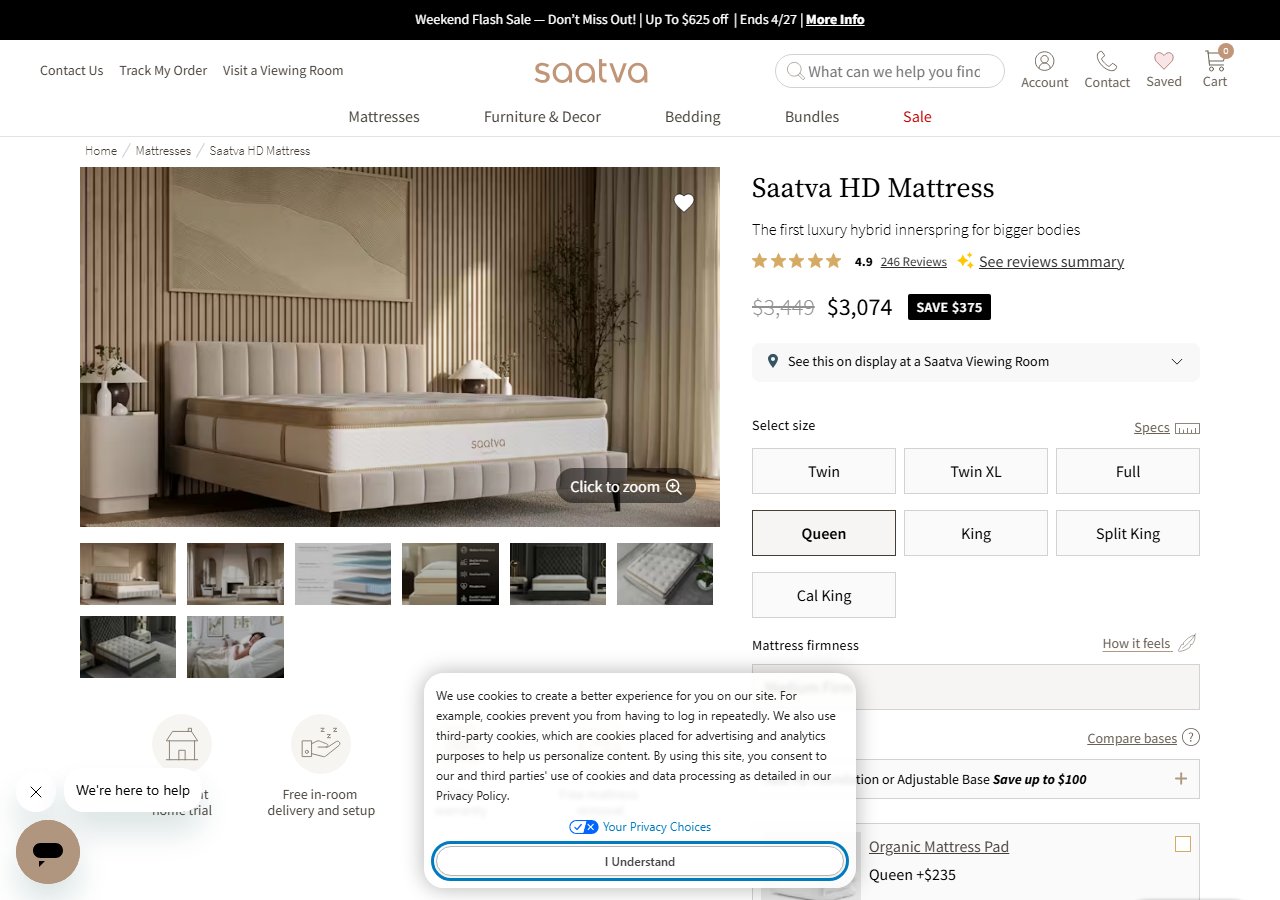
Saatva HD Mattress (Heavy-Duty)
$2,395-$3,995
See Price at Saatva →
Purple Hybrid Premier Mattress
$2,499-$4,799
See Price at Purple →The Data-to-Intervention-to-Product Hierarchy Matters
The federal data reviewed in this article traces a consistent through-line: healthcare workers sustain back injuries at rates that reflect the genuine physical demands of patient care, those injuries generate pain cycles that disrupt sleep, and disrupted sleep impairs the recovery that working bodies require. The BLS MSD occupational data, the CDC sleep statistics, the NIOSH Lifting Equation, and the SSA disability claims data all point to the same structural problem: a workforce with high physical demand, inadequate recovery infrastructure, and downstream costs that are large and largely preventable.
The hierarchy this article has tried to maintain — mechanism first, free interventions second, clinical red flags third, products fourth — is the hierarchy that actually reflects how evidence-based occupational health works. Walking matters more than mattresses. Lifting mechanics matter more than mattress firmness. Sleep position matters before sleep surface. A clinician's assessment of red-flag symptoms matters before any purchase decision.
But for the healthcare worker who has cleared those steps and is sleeping on a deteriorated surface, the right mattress is a legitimate therapeutic tool. The Saatva Loom & Leaf addresses documented lumbar pathology with a zoned memory foam construction. The Saatva HD addresses the durability gap that standard mattresses fail to fill for larger or heavier workers. The Purple Hybrid Premier addresses pressure-point accumulation at bony prominences for side-sleeping workers with joint pain. These are not interchangeable: matching the surface to the specific failure mode matters, which is why this article spent time on mechanism before arriving at products.
Healthcare workers spend their professional lives making evidence-based clinical decisions for other people. They deserve the same quality of evidence-based guidance when it comes to their own recovery infrastructure.