The federal data portrait of a healthcare worker's back
Every night shift, every double, every 12-hour stretch on the floor leaves a deposit in the musculoskeletal ledger. According to BLS Musculoskeletal Disorders by Occupation tracking, the back is the single most common body part injured across all U.S. occupations resulting in days away from work. Healthcare is not an outlier in that data — it is a leading contributor. Nurses, nursing assistants, orderlies, and patient transport workers appear in the top occupational categories for MSD-related lost-time injuries year after year. This is not a soft lifestyle finding. It is a workforce injury pattern documented in federal surveillance data and translated directly into insurance costs: BLS Employer Costs for Employee Compensation data shows that industries with high MSD incidence carry workers' compensation rates 3–5 times higher than low-MSD industries. Your employer pays that premium. The question is what you pay in quality of life.
The chronic pain burden sitting beneath those numbers is equally striking. CDC NCHS Data Brief 390 estimates that approximately 20% of U.S. adults live with chronic pain, with the lower back as the most frequently reported location. Healthcare workers are overrepresented in that population — not because they are uniquely fragile, but because the biomechanical demands of their work are unusually severe and sustained. When you spend eight to twelve hours repositioning patients, pushing medication carts, bending to insert IVs, and standing on hard tile or concrete, you are loading your lumbar spine in ways that accumulate damage across a career.
And then you go home and try to sleep — often at the wrong time of day, often in fewer hours than your body needs, and often on a sleep surface that has not been evaluated as a recovery tool. CDC Sleep and Sleep Disorders data shows that approximately 35% of U.S. adults already report sleeping fewer than 7 hours per night — the threshold below which chronic disease risk rises measurably. Shift workers, including those on rotating or night-shift healthcare schedules, sleep significantly fewer hours on average than day workers, and their sleep architecture is less restorative even when total hours are adequate. The compounding effect — high spinal loading on the job, inadequate and disrupted sleep off the job — is the engine driving chronic MSD in this workforce.
Why healthcare shift work breaks your back: the biomechanical mechanism
Understanding why back pain develops in healthcare workers is not an academic exercise. It determines what interventions actually work, and it clarifies what a sleep surface can and cannot do.
The NIOSH Lifting Equation establishes safe limits for manual material handling based on spinal compression forces. Patient repositioning, lateral transfers, and lifting from low surfaces routinely exceed those limits — in many cases dramatically. A lateral transfer of an average adult patient generates lumbar compressive forces well above NIOSH's recommended action limit for repetitive lifting tasks. Healthcare workers perform these tasks dozens of times per shift, often without mechanical lift assists, often in cramped spaces that force awkward posture. The cumulative spinal loading across a 12-hour shift is not qualitatively different from what construction or warehousing workers experience; in some task categories, healthcare workers face worse exposure because the load (a patient) is unpredictable and asymmetric in ways that a pallet or beam is not.
The intervertebral discs are the primary tissue at risk. They are avascular — they receive nutrients through diffusion driven by the alternating compression and decompression of movement and rest. When the compression is sustained and severe (a full shift on your feet, bending repeatedly), and the recovery window is shortened or degraded (a shift worker sleeping 5–6 hours on a mattress with visible sag), the disc has less time to rehydrate and repair. Over months and years, this produces the disc degeneration, facet arthritis, and nerve root irritation that shows up in imaging and, eventually, in AHRQ HCUP cost data as one of the most expensive conditions in U.S. healthcare by total inpatient and outpatient spend.
AHRQ Medical Expenditure Panel Survey data quantifies the personal financial toll: adults with chronic back conditions spend substantially more on personal healthcare annually than those without. The gap is not marginal — it represents the accumulated cost of imaging, physical therapy, specialist visits, and medication. CMS Drug Spending Dashboard data identifies opioid and non-opioid pain medication among the most expensive Medicare drug categories, reflecting how far downstream chronic back pain travels when early interventions fail. SSA Disability Insurance data names musculoskeletal disorders as the single largest category of new disability claims annually — a sobering downstream endpoint for a workforce injury pattern that begins with repetitive spinal loading on the hospital floor.
The sleep surface enters this picture at a specific, narrow point: the 7–9 hours per day (or night) when the spine is supposed to be decompressing. A mattress that allows the lumbar spine to sink into a hammock position, or that is so firm it creates pressure-point loading on the hip and shoulder, fails to provide that decompression. But a mattress that does provide it cannot undo 11 hours of spinal loading. That hierarchy — mechanism, then free interventions, then clinical care, then equipment — is the framework this article uses.
Try these first: the evidence-based interventions that cost nothing
The cheapest intervention is the one that does not require buying anything. Federal health agencies have published clear, evidence-graded guidance on non-product approaches to back pain management. Healthcare workers in particular are positioned to know this literature better than most — and also more likely to skip it because the demands of caregiving leave little time for self-care. Here is what the federal evidence actually says.
Sleep position is the most immediately actionable variable. NIH National Institute of Arthritis and Musculoskeletal and Skin Diseases guidance is explicit: side-sleeping with a pillow between the knees, or back-sleeping with a pillow under the knees, maintains lumbar spine neutrality throughout the night. Stomach-sleeping is the single worst position for chronic low back pain — it forces lumbar hyperextension and rotates the cervical spine — and it is also one of the most common default positions among people who sleep on mattresses that are too soft (the body sinks and rolls). If you change nothing else, audit your sleep position first. A rolled bath towel between your knees costs zero dollars.
Daily walking outperforms most passive interventions. An NIH National Center for Complementary and Integrative Health evidence review on low back pain found that 30 minutes of walking most days reduces chronic low back pain as effectively as most non-drug clinical treatments. This is a finding that repeatedly surprises people who expect physical therapy or spinal injections to outperform ambulatory exercise. The mechanism is straightforward: walking promotes disc nutrition through cyclic loading and unloading, activates the posterior chain musculature that supports the lumbar spine, and reduces the inflammatory load associated with sedentary recovery periods. For a shift worker who just finished 12 hours on their feet, the instinct is complete rest — and that instinct is partially wrong.
Lifting mechanics are the occupational intervention with the highest leverage. OSHA Ergonomics guidance specifies hinging at the hips rather than the lumbar spine, keeping loads close to the body, and avoiding twisting under load. Most acute back episodes in healthcare workers are mechanical in origin — they are the product of a single bad lift or a sustained bad posture — and they are rehearsable. Facilities that have implemented formal patient-handling programs with mechanical lift assists have documented significant reductions in MSD incidence. If your facility has equipment and training available, use it consistently, including on the nights when you are tired and the lift is faster to do by hand.
Know when your mattress is actually the problem. CDC Sleep Hygiene guidance points to mattress age and condition as legitimate variables in sleep quality assessment. The clinical indicators that a sleep surface is failing: visible sag or body impressions, consistent morning stiffness that resolves within 30 minutes of getting up (indicating positional compression overnight), or a mattress older than 7–10 years. Even the most precisely engineered sleep surface cannot compensate for poor sleep hygiene — irregular schedules, screen exposure before bed, caffeine in the back half of the day — but a mattress that actively misaligns your spine is a real, addressable variable.
For readers who have already worked through these interventions — who sleep in a supported position, walk daily, use proper lifting mechanics, and still wake up with back pain that is worse than when they went to bed — a sleep surface upgrade is a legitimate next step. It is not a cure, and it will not substitute for clinical evaluation of serious symptoms, but it is a real variable in the recovery equation. The question is what to look for.
When to see a clinician: red flags for healthcare workers
Healthcare workers are expert caregivers and famously poor patients — particularly when it comes to their own musculoskeletal health. The occupational culture of pushing through, combined with access to colleagues who can offer informal reassurance, creates conditions where serious pathology gets normalized. NIH National Institute of Neurological Disorders and Stroke Back Pain guidance identifies several presentations that require prompt clinical evaluation rather than a new mattress or a different stretching protocol.
Back pain that radiates below the knee — not just into the buttock or posterior thigh, but below the knee — is a red flag for nerve root compression requiring imaging. Pain or weakness in the lower extremity that follows a specific dermatomal pattern (inner ankle, outer foot, top of foot) points to specific nerve root involvement. Bowel or bladder dysfunction in a person with back pain is a medical emergency — cauda equina syndrome requires emergency imaging and often emergency surgery. Back pain that follows a traumatic mechanism (a fall, a patient-handling incident with significant force) should be evaluated before assuming a mechanical cause. Fever with back pain raises the possibility of spinal infection, which is rare but time-critical. Unintentional weight loss with back pain in an older adult warrants screening for malignancy.
CDC Arthritis Data shows that approximately 25% of U.S. adults have doctor-diagnosed arthritis, with prevalence concentrated in physically demanding occupations. For healthcare workers in their 40s and 50s, inflammatory arthropathy — not just mechanical low back pain — is a real diagnostic possibility that requires rheumatologic evaluation, not ergonomic intervention alone. If morning stiffness lasts longer than an hour and improves with movement, if pain is worst at rest and better with activity, or if there is a family history of inflammatory arthritis, a clinical workup is the appropriate first step. A sleep surface will not address inflammatory disease.
Where sleep surfaces fit in the evidence hierarchy
For the healthcare worker who has ruled out red flags, implemented sleep position and lifestyle changes, and is working with a clinician on a broader plan — a sleep surface is a genuine tool. The evidence base is not as strong as some manufacturers imply, but it is real: medium-firm mattresses consistently outperform both very firm and very soft options in randomized controlled trials on back pain outcomes. The mechanism is spinal alignment during sleep, particularly lumbar lordosis maintenance. A surface that allows the pelvis to sink while supporting the ribcage keeps the lumbar curve in a neutral position. A surface that is too firm creates pressure-point loading on the hip and shoulder, causing the sleeper to rotate and lose lumbar neutrality. A surface that is too soft allows the pelvis to sink past neutral into a hammock posture.
For healthcare workers specifically, three additional features matter beyond firmness:
Pressure relief at the shoulder and hip matters because side-sleeping — the recommended position for back pain — concentrates body weight at these contact points. Materials that contour under load distribute that pressure across a wider surface area, reducing the discomfort that causes positional shifting during the night. Positional shifting disrupts sleep architecture and reduces total restorative sleep time — the very resource healthcare shift workers are already short on.
Temperature regulation matters because sleep in a warm environment — common when working overnight and sleeping during the day against the sun's heat cycle — reduces slow-wave sleep duration. Materials that trap heat (low-density foam, thick memory foam without gel or copper infusion) worsen this effect.
Durability under concentrated load patterns matters because a mattress that shows body impressions at 18 months has lost its functional firmness gradient and is effectively providing less support than at purchase. Healthcare workers, particularly those with larger body frames from years of physical conditioning, apply higher-than-average body weight to a concentrated area during sleep.
Three products stand out in this category for healthcare workers with chronic back pain, and each addresses a different profile within that audience.
The Saatva Loom & Leaf Memory Foam Mattress ($1,695–$3,295) is the premium memory foam pick for healthcare workers with serious chronic back pain who prefer a contouring surface. Loom & Leaf uses a 5-pound density memory foam — significantly denser than the 3-pound foam in most mid-market mattresses — which provides both better contouring for pressure relief and better long-term durability. The construction includes a lumbar crown of extra support in the center third of the mattress, directly targeting the lumbar zone that takes the most stress during a healthcare shift. Saatva offers white-glove delivery and old-mattress removal, which matters for a worker whose schedule does not accommodate a complicated delivery window.
For healthcare workers who are larger-framed — above 250 pounds, or carrying significant muscle mass from years of patient handling — standard mattress construction often fails within two to three years because it is not engineered for the load. The Saatva HD Mattress ($2,395–$3,995) is purpose-built for this profile. Its coil system uses a 13.75-gauge tempered steel that is meaningfully more resistant to compression fatigue than the 14.5–15-gauge coils in standard innerspring mattresses. The foam layers above the coil system are also higher-density than standard construction, which means the firmness gradient is maintained for longer under concentrated body weight. For a nurse or surgical tech who is on their feet for 12 hours and then sleeping 7 hours on a mattress that is slowly sagging, the HD's durability profile directly addresses the failure mode.
The Purple Hybrid Premier Mattress ($2,499–$4,799) takes a different engineering approach. Purple's proprietary GelFlex Grid is a hyper-elastic polymer grid that collapses under point loads (shoulder, hip) while remaining firm under distributed loads (torso, lumbar). This means it provides pressure relief at contact points without the hammocking that soft foam creates under the pelvis — the functional equivalent of a medium-firm spring with pressure-relief foam, in a single material. For healthcare workers who sleep hot — a common complaint among those sleeping against the daytime heat cycle — the grid's open structure provides substantially better airflow than any foam-based surface. The Hybrid Premier places this grid over a pocketed coil system, adding edge support and motion isolation that matters for workers sharing a bed with a partner on a different schedule.
Mattresses Built for Healthcare Shift-Worker Spinal Recovery
These three mattresses were selected based on features directly relevant to healthcare workers managing chronic back pain: durable pressure relief, lumbar support engineering, and performance under the sustained load patterns specific to 12-hour shift workers.

Saatva Loom & Leaf Memory Foam Mattress
$1,695-$3,295
See Price at Saatva →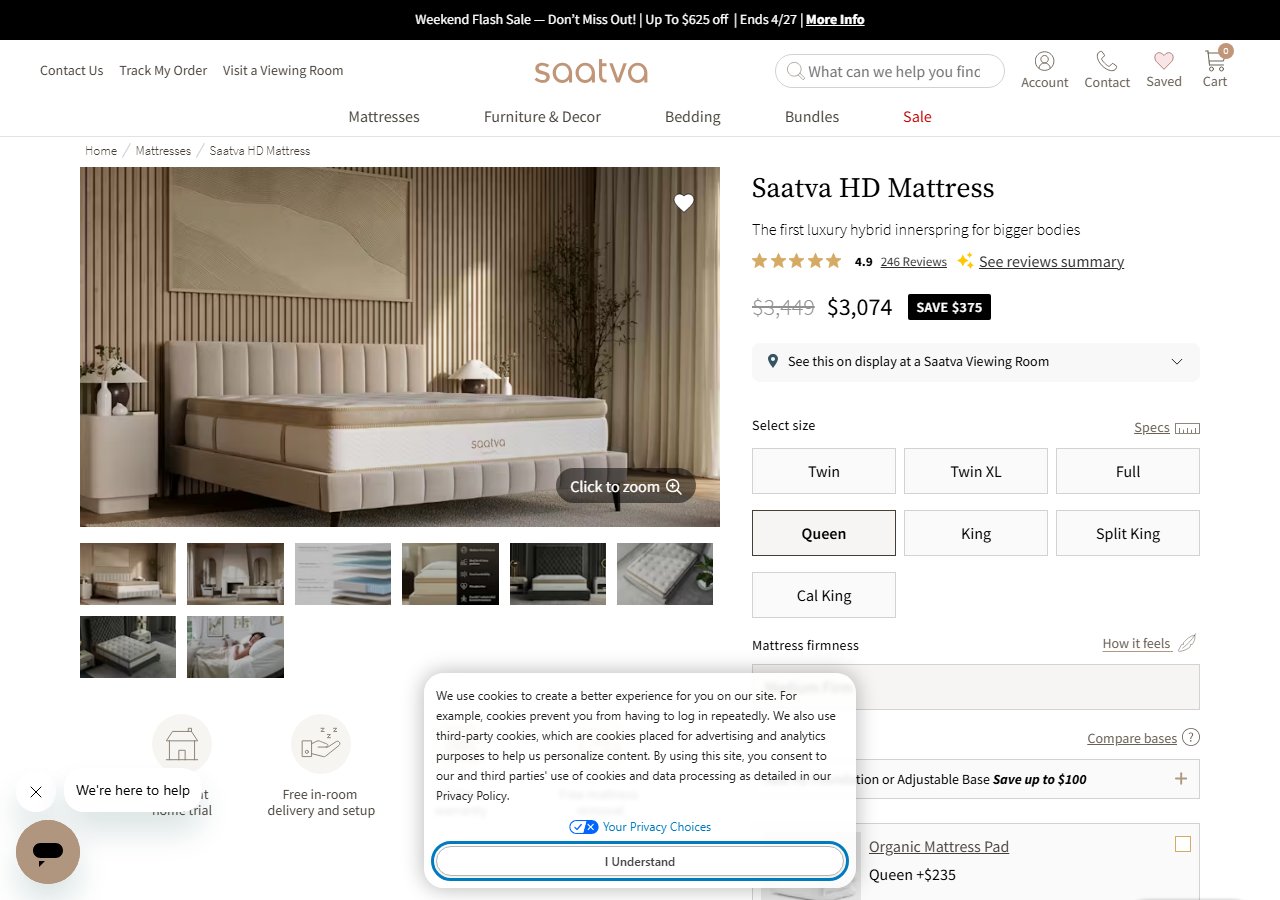
Saatva HD Mattress (Heavy-Duty)
$2,395-$3,995
See Price at Saatva →
Purple Hybrid Premier Mattress
$2,499-$4,799
See Price at Purple →Putting the evidence hierarchy to work
The federal data on healthcare worker musculoskeletal injury is not ambiguous: this is a high-incidence occupational population carrying chronic spinal loading that persists into every hour of off-duty recovery. BLS MSD tracking puts the back at the top of the occupational injury chart; NIOSH's Lifting Equation documents why healthcare-specific patient handling pushes well past safe spinal load limits; CDC sleep data confirms that the recovery window is already compressed for shift workers. The downstream costs — personal, financial, systemic — are documented from AHRQ MEPS to SSA disability rolls.
A sleep surface is one variable in that system. It is not the most important variable — movement, sleep position, lifting mechanics, and clinical evaluation all precede it in the evidence hierarchy. But it is a real variable, it is modifiable, and for a worker who has addressed the behavioral and occupational factors and still wakes up stiffer than they went to bed, it is worth evaluating systematically rather than replacing randomly. The three products above were selected because each addresses a specific feature gap — contouring memory foam durability, load-capacity engineering, and pressure-with-temperature management — that is directly relevant to the healthcare worker's off-duty recovery profile. Use the federal framework to evaluate where you sit on that spectrum. Then choose accordingly.