The federal data is unambiguous: healthcare workers break their backs at work, then go home and sleep wrong
According to BLS Musculoskeletal Disorders by Occupation tracking, the back is the single most commonly injured body part across all U.S. occupations that result in days away from work. That statistic covers every sector — construction, warehousing, agriculture — and the back still comes out on top. For healthcare workers specifically, the injury picture is even sharper. Nurses, nursing assistants, patient-care technicians, and surgical techs routinely transfer, reposition, and lift patients across 10- to 13-hour shifts with minimal mechanical assist. The loads are unpredictable, the postures are constrained by bed geometry and room layout, and the window for recovery is compressed by rotating shift schedules that make consistent, restorative sleep structurally difficult.
This is not a lifestyle problem. It is an occupational exposure problem with a documented federal data trail — and understanding the mechanism is the first step toward addressing it.
Why healthcare shift workers' backs break down: the biomechanical mechanism
The NIOSH Lifting Equation was developed specifically to define safe spinal loading thresholds for material-handling tasks. It computes a Recommended Weight Limit based on the horizontal and vertical distance of the load from the body, the degree of trunk twisting, and the frequency and duration of the task. When the actual weight lifted exceeds the Recommended Weight Limit, the resulting Lifting Index climbs above 1.0 — indicating elevated risk for low back injury. NIOSH's own analysis documents that patient-handling tasks in healthcare — repositioning a 200-pound patient in a hospital bed, transferring from wheelchair to exam table, holding a limb during a procedure — routinely produce Lifting Indexes well above safe thresholds. The problem is compounded by the fact that these tasks happen dozens of times per shift, often without adequate staffing to use two-person protocols.
The spinal structures most vulnerable in these scenarios are the lumbar intervertebral discs and the posterior facet joints. Repetitive compressive loading combined with forward flexion and twisting — the exact movement pattern of patient repositioning — accelerates disc degeneration and can produce acute disc herniation. Over months and years, chronic low-grade inflammation in the facet joints produces the dull, persistent morning stiffness that experienced floor nurses describe as "just part of the job." It is not. It is a documented occupational injury with a progressive trajectory.
Layer onto that the sleep disruption intrinsic to shift work. CDC sleep data shows approximately 35% of U.S. adults sleep fewer than 7 hours per night — the threshold below which chronic disease risk elevates substantially. For rotating-shift healthcare workers, the sleep debt problem is structural: the circadian system doesn't reset cleanly between a run of night shifts and a run of days. The deep, slow-wave sleep stages most associated with tissue repair and inflammatory clearance are the first to be lost when sleep is fragmented or mistimed. A lumbar disc that absorbed 10 hours of compressive loading during a night shift needs overnight slow-wave sleep to allow intradiscal fluid pressure to normalize. When that sleep is shortened, fragmented by environmental noise, or misaligned with circadian timing, tissue repair is incomplete — and the worker starts the next shift with accumulated microdamage.
CDC NCHS Data Brief 390 documents that approximately 20% of U.S. adults experience chronic pain, with lower back pain as the most common location. That is a population-level statistic. Among healthcare workers with years of patient-handling exposure, the prevalence is meaningfully higher. The SSA Disability Insurance data identifies musculoskeletal disorders as the largest single category of new disability claims filed annually — and healthcare occupations are disproportionately represented in those claims. This is not an abstract risk. These are careers ending on federal disability rolls.
AHRQ Medical Expenditure Panel Survey data confirms the economic dimension: adults with chronic back conditions spend substantially more on personal healthcare annually than adults without such conditions. AHRQ HCUP data identifies back pain as one of the most expensive conditions in U.S. healthcare by total inpatient and outpatient cost. CMS drug spending data shows opioid and non-opioid pain medications among the costliest Medicare drug categories — a downstream measure of how inadequately we treat the upstream occupational exposure.
Approximately 25% of U.S. adults report doctor-diagnosed arthritis, with prevalence concentrated in physically demanding occupations. For the healthcare worker in her mid-40s who has spent two decades transferring patients, arthritis layered onto chronic disc disease is a common clinical picture — and one that demands serious attention to the sleep environment where the only meaningful recovery window exists.
Try these first: free and low-cost interventions before you buy anything
The cheapest intervention is the one that does not require buying anything. Before evaluating sleep surfaces, every healthcare worker dealing with chronic back pain should have worked through the evidence-based behavioral and mechanical interventions that federal health agencies document as effective. A new mattress layered on top of poor lifting mechanics, sedentary off-duty hours, and stomach-sleeping posture will underperform. The interventions below are drawn directly from NIH, OSHA, CDC, and NIH institute guidance — not from supplement brands or wellness influencers.
Sleep position is the most immediately actionable variable. NIH National Institute of Arthritis and Musculoskeletal and Skin Diseases guidance on back pain specifies that side-sleeping with a pillow between the knees keeps the lumbar spine in neutral alignment, and that back-sleeping with a pillow under the knees reduces lumbar loading. Stomach-sleeping hyperextends the lumbar spine and rotates the cervical spine — a position that worsens facet joint compression over a 7-hour sleep period. This is a zero-cost change that every healthcare worker with back pain should implement tonight.
Daily walking is the highest-yield movement intervention. The NIH NCCIH evidence review on low back pain finds that walking 30 minutes most days reduces chronic low back pain as effectively as most non-drug clinical treatments. After a 12-hour shift, the last thing an exhausted nurse wants to do is walk. But the evidence is consistent: passive rest without movement allows the inflammatory cycle to perpetuate. Even 15 to 20 minutes of low-intensity walking on off-shift days accelerates tissue recovery more than uninterrupted horizontal rest.
Lifting mechanics are rehearsable. OSHA's ergonomics guidance recommends hinging at the hips rather than rounding the lumbar spine, keeping loads close to the body, and avoiding torso twisting under load. Most acute back episodes in healthcare workers are mechanically triggered — a patient transfer executed with a rounded lumbar spine and a simultaneous rotation. These patterns can be retrained. Many hospitals offer annual ergonomics recertification; if yours does, attend it. If not, the OSHA ergonomics page provides free guidance.
Evaluate the mattress itself as a clinical variable. CDC sleep hygiene guidance identifies mattress condition as a modifiable factor in sleep quality. The practical criteria: replace a mattress if it has visible sag, if you consistently wake stiffer than you went to bed, or if it is older than 7 to 10 years. An older mattress with a compression groove from years of sleeping in the same position is actively contributing to poor lumbar alignment during the recovery window. This is a legitimate clinical indication for replacement — not a marketing claim.
For readers who have already worked through the behavioral interventions above — who sleep on their side with a pillow between the knees, walk daily, and are maintaining decent lifting mechanics at work — and are still waking with significant morning stiffness and disrupted sleep, the sleep surface itself becomes a legitimate intervention target. The evidence on mattress firmness and back pain is less robust than the evidence on movement and posture, but it is not trivial. A sleep surface that allows the lumbar spine to sag into flexion, or that is so firm it creates pressure point pain at the hips and shoulders in side-sleepers, is adding biomechanical insult to the occupational injury. This is where sleep-surface selection, evaluated against your specific body geometry and sleep position, becomes a genuine clinical decision.
When to see a clinician before you do anything else
This article is informational analysis of federal occupational health data. It is not medical advice, and there is a category of symptoms that require a provider evaluation before any intervention — behavioral, ergonomic, or product-based — is appropriate.
NIH National Institute of Neurological Disorders and Stroke back pain guidance identifies the following as clinical red flags that warrant prompt evaluation: back pain that radiates below the knee (suggesting nerve root compression or disc herniation with neurological involvement), pain that follows a traumatic event, pain accompanied by leg weakness or numbness, any change in bowel or bladder function associated with back pain (which can indicate cauda equina syndrome, a surgical emergency), and back pain accompanied by fever (which can indicate spinal infection or malignancy). Do not manage these symptoms with a new mattress or a walking program. Get imaging and a clinical evaluation first. The BLS data on workers' compensation costs makes clear that industries with high MSD incidence carry workers' comp rates 3 to 5 times higher than low-MSD industries — which means your employer has a documented financial interest in your injury going unaddressed. Advocate for yourself.
Where sleep surfaces fit into the recovery picture
For healthcare workers who have ruled out red-flag symptoms, have already optimized sleep position and daily movement, and are sleeping on a mattress that is visibly degraded or older than a decade, the sleep surface is a legitimate next intervention. The clinical rationale is straightforward: 7 to 8 hours spent on a surface that creates pressure points at the hip and shoulder (too firm) or allows the lumbar spine to sag into flexion (too soft) is 7 to 8 hours of accumulated biomechanical stress during the only window the body has for tissue repair.
The selection criteria that matter for healthcare workers with MSD history are different from the generic "medium-firm is best" guidance you'll find in lifestyle publications. Side-sleepers — which the NIH guidance recommends for back pain sufferers — need meaningful pressure relief at the greater trochanter and acromion (hip and shoulder) so that the lumbar spine doesn't have to lateral-flex to accommodate a pressure point. Back-sleepers need a surface that supports the natural lumbar lordosis without creating a hammock sag. Workers with higher body weight need a sleep surface engineered for sustained support under their specific load — standard coil systems compress and lose progressive support faster under heavier loads, leading to earlier bottoming out and accelerating the sag profile.
With those criteria in mind, here are the three sleep surfaces that best match the occupational and biomechanical profile of healthcare workers with MSD history.
For healthcare workers with documented chronic back pain who are primarily side- or back-sleepers, the Saatva Loom & Leaf Memory Foam Mattress represents the strongest premium memory foam option in this category. Memory foam's pressure-mapping characteristics make it particularly well-suited to the hip and shoulder offloading that side-sleeping nurses and techs require. Saatva constructs the Loom & Leaf with a proprietary gel-infused memory foam layer over a high-density support foam base — a dual-layer approach that provides the conforming pressure relief of memory foam without the excessive sink that causes lumbar flexion in lighter-gauge foam systems. The spinal zone quilting — a firmer center third — is specifically designed to prevent lumbar sag in back-sleepers, which aligns directly with the clinical criteria for MSD recovery sleep surfaces. At $1,695 to $3,295 depending on size, it is a meaningful investment, but the AHRQ MEPS data on excess healthcare expenditures for chronic back conditions puts that cost in context: adults with chronic back pain spend substantially more on healthcare annually than those without it. A sleep surface that reduces morning pain and improves sleep continuity is not a luxury line item in that context.
For healthcare workers who are heavier or who have experienced previous mattress sag — a common complaint among nurses and patient-care techs who work double shifts and spend more total hours in bed on recovery days — the Saatva HD Mattress is the purpose-engineered option. Saatva designed the HD specifically for sleepers up to 500 pounds, using a dual coil system with individually wrapped steel coils over a high-gauge tempered steel base coil layer. This architecture maintains progressive support under sustained load — the property that determines long-term sag resistance. Standard mattresses are tested to approximately 250-pound loads; the HD's dual coil system is rated to sustain its support profile at significantly higher weights. For a nursing assistant or surgical tech who carries higher body weight and who has watched previous mattresses develop the central compression groove within 18 to 24 months, the HD's engineering directly addresses the failure mode. Priced at $2,395 to $3,995, it occupies the premium tier — but a mattress that does not develop premature sag has a longer functional life, which changes the cost-per-year calculus.
For healthcare workers who run hot during sleep — a common complaint among workers transitioning from night shifts, whose thermoregulation is disrupted by circadian misalignment — or who need maximum pressure relief at the hip and shoulder without the heat retention that can come with dense memory foam, the Purple Hybrid Premier Mattress offers a materially different technology. Purple's GelFlex Grid replaces the top comfort layer with a hyper-elastic polymer grid that is open by design — air circulates through the grid structure, preventing the heat trapping that plagues closed-cell foam systems. The grid also provides what Purple describes as "no-pressure support": it is soft where it needs to flex (under the shoulder and hip) and firm where it needs to support (under the lumbar spine). For shift workers whose sleep is already fragile due to circadian disruption, eliminating thermal discomfort as a sleep fragmenter is a clinically meaningful design benefit. The Hybrid Premier adds a pocketed coil base for motion isolation and edge support. At $2,499 to $4,799, it is the highest price point in this group, but the pressure-relief and thermal management characteristics are genuinely differentiated from foam-based alternatives.
Sleep Surfaces for Healthcare Worker MSD Recovery
These three mattresses were selected specifically for healthcare shift workers with musculoskeletal disorder history — evaluated against the pressure-relief, spinal support, and durability criteria that clinical guidance and federal occupational data identify as relevant to patient-handling occupational profiles.

Saatva Loom & Leaf Memory Foam Mattress
$1,695-$3,295
See Price at Saatva →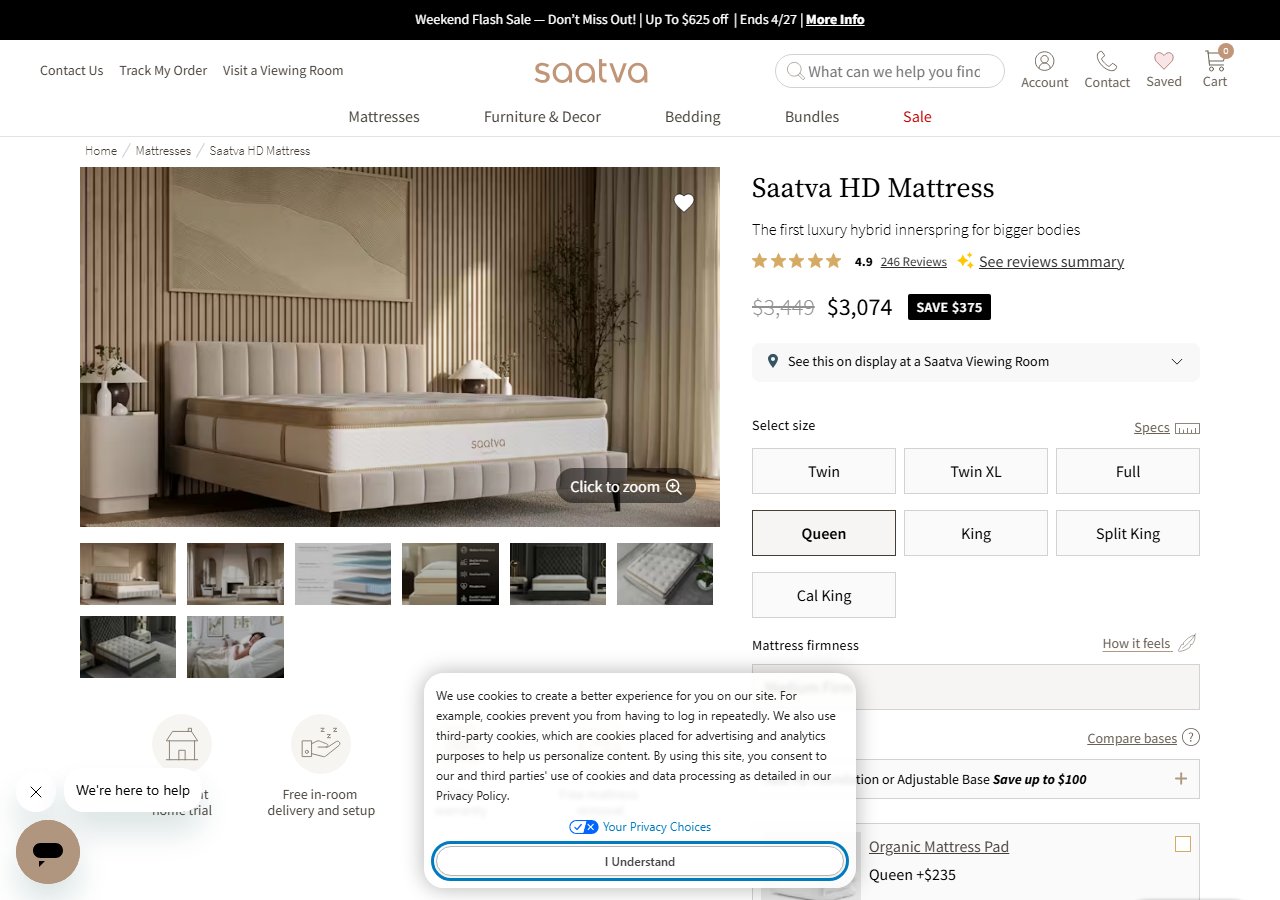
Saatva HD Mattress (Heavy-Duty)
$2,395-$3,995
See Price at Saatva →
Purple Hybrid Premier Mattress
$2,499-$4,799
See Price at Purple →The hierarchy that federal data supports
The federal data reviewed in this article traces a consistent arc: healthcare workers face occupational exposures that exceed safe spinal loading thresholds on a daily basis, those exposures produce musculoskeletal injury at rates that generate billions in workers' compensation, disability, and healthcare spending, and the off-duty recovery window — already compressed by shift schedules — is further degraded by the chronic sleep deficit that CDC data documents across 35% of the adult population.
The intervention hierarchy that this data supports is: first, behavioral changes (sleep position, daily movement, lifting mechanics) because they are free, evidence-based, and immediately actionable; second, clinical evaluation for red-flag symptoms because some back pain presentations require imaging and provider intervention before any other step; third, sleep-surface evaluation for workers who have optimized behavior and are still experiencing pain and disrupted sleep on a degraded mattress.
A new mattress does not undo 12 hours of patient transfers. It does not substitute for the slow-wave sleep that circadian-disrupted shift workers are systematically losing. But for a healthcare worker who sleeps on a decade-old mattress that sags visibly in the center, who wakes stiffer than she went to bed, and who has already built the behavioral foundation — the sleep surface is the remaining modifiable variable in the recovery equation. That is the narrow but real role that evidence supports for sleep-surface intervention in healthcare worker MSD recovery.