The Back Injury Epidemic Hidden Inside Hospital Walls
If you are a registered nurse, a certified nursing assistant, a surgical tech, or a patient-transport aide, you already know the feeling: you clock out after a 12-hour shift and your lower back doesn't just ache — it buzzes with a low-grade, grinding fatigue that no amount of ibuprofen fully quiets. Federal data confirms that feeling is not a personal weakness. It is a system-wide occupational hazard.
According to BLS Musculoskeletal Disorders by Occupation tracking, the back is the single most commonly injured body part across all U.S. occupations with days away from work. Healthcare and social assistance consistently ranks among the highest-MSD-incidence sectors in that dataset — ahead of construction, ahead of warehousing. The workers keeping patients safe are statistically among the most physically damaged workers in the American economy.
The downstream financial toll is staggering. AHRQ HCUP data identifies back pain as one of the most expensive conditions in U.S. healthcare by combined inpatient and outpatient cost. AHRQ's Medical Expenditure Panel Survey finds that adults living with chronic back conditions spend substantially more on personal healthcare every year than adults without those conditions. CMS Drug Spending Dashboard data shows opioid and non-opioid pain medications ranking among the most expensive Medicare drug categories — a direct reflection of how undertreated and expensive the chronic-pain burden has become. And SSA Disability Insurance reports identify musculoskeletal disorders as the single largest category of new disability claims filed each year.
This is not a minor inconvenience. For healthcare workers in particular, it is a career-length accumulation problem that begins in the first years on the floor and compounds with every decade of practice.
Why Healthcare Shifts Break Down the Lumbar Spine
Understanding why this happens is the prerequisite for doing anything effective about it. The mechanism is biomechanical, cumulative, and deeply tied to how shift work disrupts the body's recovery window.
The loading problem. The NIOSH Lifting Equation was developed precisely because manual material-handling tasks — across warehousing, construction, and healthcare — routinely exceed safe spinal loading limits in real-world practice. In healthcare, the payload is not a box. It is a 180-pound post-surgical patient who cannot assist their own repositioning, a dependent adult who needs to be transferred from bed to wheelchair, a bariatric patient requiring a coordinated six-person lift. NIOSH's lifting data consistently shows that even "proper" lifting mechanics fail to protect workers when the load exceeds the recommended limit or when lifts happen dozens of times per shift.
The lumbar spine, specifically the intervertebral discs between L4 and L5 and between L5 and S1, bears the compressive brunt of these forces. Disc compression during loaded bending exceeds 1,000 Newtons in common patient-handling tasks. Over years, those discs dehydrate and lose height. The result is the insidious grinding ache most experienced healthcare workers describe: not a single catastrophic event, but a slow structural erosion.
The shift schedule problem. Twelve-hour shifts, rotating days and nights, mandatory overtime — these are the scheduling norm in acute care. CDC sleep data shows approximately 35% of U.S. adults already sleep fewer than seven hours per night, the threshold below which chronic disease risk measurably rises. Healthcare workers on night or rotating shifts systematically underperform even that inadequate national average. Sleep is not a passive state: it is when intervertebral discs rehydrate, when muscles repair micro-tears, when the glymphatic system clears inflammatory metabolites from the central nervous system. Compress or fragment that window chronically and you do not just feel tired — you accelerate structural musculoskeletal deterioration.
The chronic pain feedback loop. CDC NHANES survey data shows approximately 20% of U.S. adults live with chronic pain, with the lower back as the most prevalent site. Chronic pain is not just a symptom — it is a neurological state. The dorsal horn of the spinal cord undergoes sensitization with repeated nociceptive input, meaning pain signals are amplified even when the structural insult stays constant. Healthcare workers who push through back pain for years without addressing root causes are not being tough — they are inadvertently worsening central sensitization, making recovery harder with each passing year.
CDC Arthritis Data shows approximately 25% of U.S. adults have doctor-diagnosed arthritis, with prevalence concentrated in occupations requiring sustained physical demand — exactly the population this article addresses. Arthritis layered on top of disc disease layered on top of shift-disrupted sleep is the actual clinical picture for many nurses over 45.
The workers' compensation signal. BLS Employer Costs for Employee Compensation data shows that industries with high MSD incidence carry workers' compensation insurance rates 3 to 5 times higher than low-MSD industries. Hospital systems pay into that premium. But the premium is paid in human cost first: it is the nurse who misses her daughter's graduation because she can't stand for three hours, the CNA who retires at 52 not by choice but by diagnosis.
The Cheapest Interventions Are the Ones That Cost Nothing
Before any product enters this conversation, federal evidence supports a set of behavioral and ergonomic interventions that can meaningfully reduce chronic back pain without spending a dollar. These are not preliminary caveats designed to make product recommendations feel more credible. They are the interventions with the strongest evidence base — and for some readers, they will be sufficient.
Sleep position is the most immediately modifiable variable. NIH guidance from the National Institute of Arthritis and Musculoskeletal and Skin Diseases is specific: side-sleeping with a pillow between the knees, or back-sleeping with a pillow under the knees, keeps the lumbar spine in a neutral position throughout sleep. Stomach-sleeping torques the lumbar spine by forcing cervical rotation and flattening the natural lumbar curve — it worsens chronic pain over time. This single positional change, requiring only an existing pillow, can reduce morning stiffness for many patients before any new sleep surface is purchased.
Daily walking, consistently underused, has a stronger evidence base than most passive interventions including some clinical treatments. NIH's National Center for Complementary and Integrative Health evidence review finds that walking 30 minutes on most days reduces chronic low back pain as effectively as the majority of non-drug clinical treatments. The mechanism involves disc rehydration through rhythmic loading and unloading, endorphin release, and maintenance of the paraspinal musculature that supports the lumbar spine. For a healthcare worker whose entire shift involves walking — but walking under load, in non-neutral postures — a separate 30-minute walking session done in neutral posture without carrying anything functions as active recovery, not redundant exercise.
Lifting mechanics on and off the job matter continuously. OSHA's Ergonomics Solutions guidance emphasizes hinging at the hips rather than the lumbar spine, keeping loads close to the body's center of gravity, and eliminating torso twisting under load. Most acute back episodes in healthcare are mechanical — a rotation while pulling a patient up in bed, a forward bend to reach a low supply shelf. These are movement patterns, and movement patterns are rehearsable. A healthcare worker who internalizes a hip-hinge pattern does not just protect themselves at work; they protect themselves every time they load the dishwasher or pick up a child.
Finally, the question of when your current mattress is the problem: the CDC Sleep Hygiene guidance offers a practical framework — if your mattress has visible sag, if you wake stiffer than you went to bed, or if it is more than 7 to 10 years old, the surface itself has become a structural liability. No amount of sleep-position optimization overcomes a mattress with a three-inch depression under your hips.
For readers who have addressed sleep position, integrated daily walking, and verified their current mattress isn't structurally compromised — and who are still waking up in pain — the evidence does support that sleep-surface selection matters. The mechanism is straightforward: a surface that fails to support the lumbar curve in a neutral position creates sustained mechanical stress on the posterior structures of the spine for six to eight hours every night. Over years, that is a substantial cumulative load. The right sleep surface for a healthcare worker is not the firmest option and not the softest; it is the one that keeps their specific spinal geometry in the least-stressed position throughout sleep.
When to See a Clinician Before You Do Anything Else
Some back pain presentations are not about sleep surfaces or walking programs. They are clinical emergencies or near-emergencies that require imaging, referral, or urgent evaluation. NIH's National Institute of Neurological Disorders and Stroke provides clear guidance on presentations that warrant prompt medical attention.
If your back pain radiates below the knee — particularly if it follows the sciatic nerve distribution down the back of the thigh and into the calf or foot — that is a potential nerve compression signal, not a mattress problem. If your pain began following significant trauma (a fall, a motor vehicle accident, a patient-handling incident with sudden onset), imaging is appropriate before any intervention. If you have developed leg weakness, changes in bowel or bladder function, or sexual dysfunction alongside your back pain, these are red-flag neurological signs that indicate possible cauda equina involvement — a true surgical emergency. If your back pain is accompanied by fever or unexplained weight loss, infection or malignancy must be ruled out.
Healthcare workers are uniquely at risk of minimizing these symptoms because they are trained to keep moving, because their schedules make clinic visits logistically difficult, and because they are surrounded by colleagues who normalize musculoskeletal pain as an occupational inevitability. It is not inevitable, and it is not always benign. The interventions and products discussed in this article are appropriate for mechanical chronic low back pain in the absence of these red flags — not as substitutes for clinical evaluation when those flags are present.
Where Sleep Surfaces Enter the Evidence Hierarchy
For healthcare workers with mechanical chronic back pain, no red flags, and a sleep surface that is either structurally compromised or failing to maintain spinal neutrality, a sleep-surface upgrade is a legitimate component of a broader recovery strategy. The keyword is component — it sits alongside movement, positioning, and load management, not above them.
The clinical evidence on mattresses and back pain favors medium-firm support — not uniformly, but as the most consistently supported option across heterogeneous patient populations. A 2015 randomized controlled trial in Sleep Health found medium-firm mattresses outperformed soft and hard surfaces for spinal alignment and self-reported pain. The mechanism aligns with the biomechanics: too soft, and the hips sink into a pelvic tilt that loads the lower lumbar segments; too firm, and shoulder and hip pressure points create compensatory postures that torque the spine laterally.
For healthcare workers specifically, three characteristics deserve priority: zoned pressure relief (different firmness levels for shoulders versus hips versus lumbar versus legs), temperature regulation (12-hour shifts produce heat and inflammation that a sleep surface needs to dissipate, not trap), and edge support (a worker who must sit on the edge of the bed to put on compression socks or work shoes before a 6am shift needs a surface that doesn't dump them onto the floor).
The Saatva Loom & Leaf Memory Foam Mattress is the premium memory-foam pick for healthcare workers with serious chronic back pain. Its gel-infused memory foam layering addresses the temperature-trapping problem that has plagued traditional memory foam for two decades — a meaningful concern for a nurse who runs warm after a physically demanding shift. The proprietary lumbar zone support insert directly addresses the L4-S1 loading pattern described above, providing targeted reinforcement at exactly the spinal segment most vulnerable to healthcare-specific cumulative load. At $1,695 to $3,295 depending on size, it is a significant investment, but it is also a product that won't need to be replaced for a decade if maintained properly — making it a better long-term calculation than the average consumer mattress replaced every five to six years.
For healthcare workers who are heavier-framed — or who work in patient-handling specialties that have put additional structural stress on their spines over years of practice — the Saatva HD Mattress was engineered for exactly this population. Its dual-steel coil system and high-density foam base are rated for users up to 500 pounds, meaning the support geometry does not collapse or deform under the actual body weight being placed on it. Standard mattresses, regardless of their marketing claims, compress more predictably under higher loads — the Saatva HD's construction prevents that sag-induced spinal flexion that is the proximate cause of the morning lower-back stiffness most heavier-framed patients describe.
For healthcare workers whose primary complaint is pressure-point pain — the hip and shoulder soreness that comes from side-sleeping on a surface that doesn't conform — the Purple Hybrid Premier Mattress takes a mechanistically different approach. Purple's GelFlex Grid is a polymer grid structure that collapses under pressure points while remaining firm under broader distributed loads like the pelvis and torso. The practical result is that a side-sleeping nurse's shoulder and hip sink through the grid to find neutral, while the lumbar region — which exerts lower localized pressure — is held in supported alignment. It runs $2,499 to $4,799 depending on grid thickness and size; the thicker grid options provide meaningfully better pressure distribution for serious chronic pain presentations.
Sleep Surfaces Built for Healthcare Worker Recovery Demands
These three mattresses were selected for healthcare shift workers managing chronic musculoskeletal back pain — prioritizing zoned lumbar support, temperature regulation, and pressure-point relief specific to the load patterns documented in BLS and NIOSH data.

Saatva Loom & Leaf Memory Foam Mattress
$1,695-$3,295
See Price at Saatva →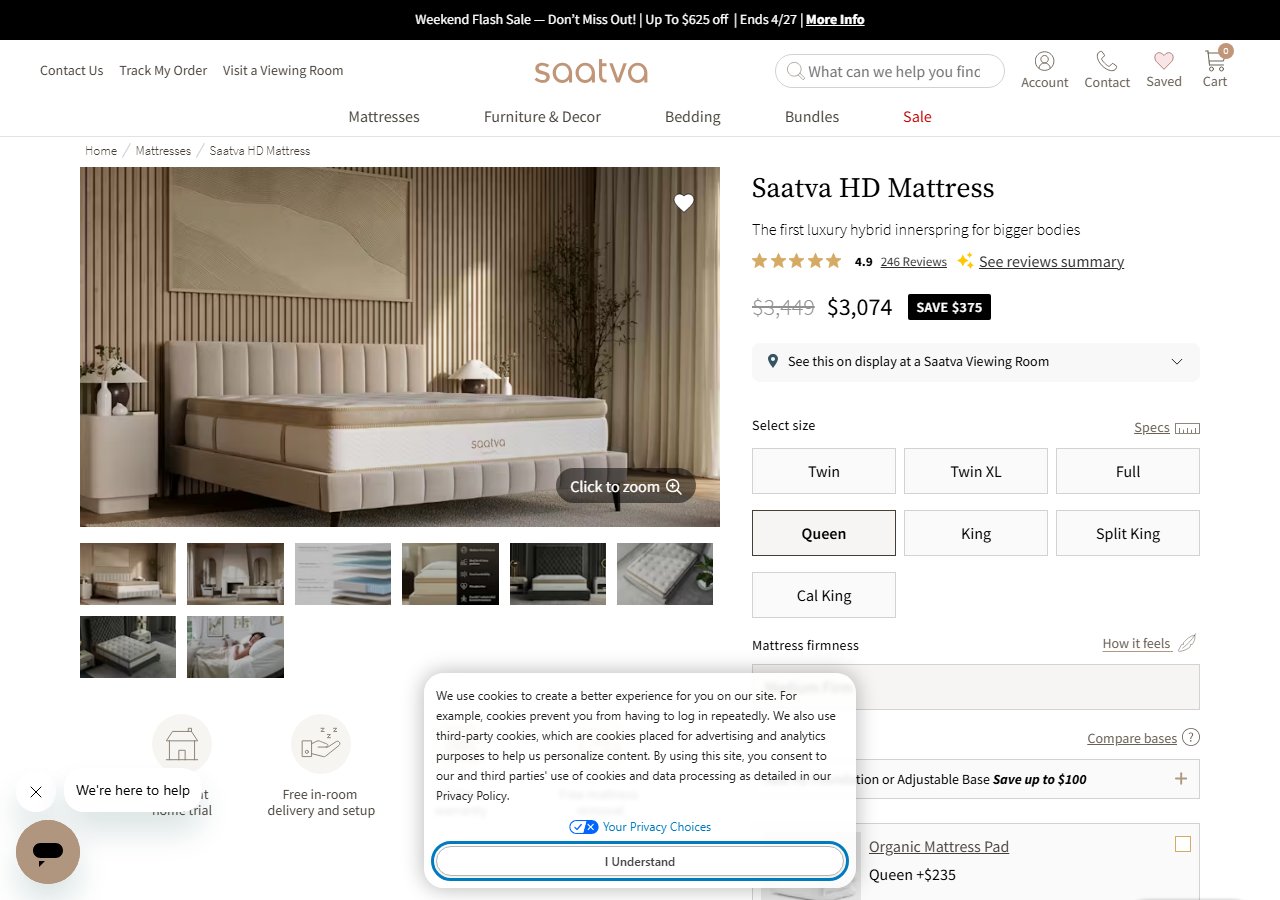
Saatva HD Mattress (Heavy-Duty)
$2,395-$3,995
See Price at Saatva →
Purple Hybrid Premier Mattress
$2,499-$4,799
See Price at Purple →Putting the Data Hierarchy Together
The federal data tells a coherent story that the healthcare industry has not fully translated into individual worker guidance. BLS tracking confirms the back injury burden. NIOSH's Lifting Equation explains the mechanism. CDC sleep data documents the recovery window compression that shifts create. SSA disability data shows where this trajectory ends when nothing intervenes.
The intervention hierarchy flows directly from that data: fix sleep position first (free, immediate, evidence-supported). Add daily walking (free, evidence-supported at the same level as most clinical treatments). Apply OSHA lifting mechanics on and off the unit. If your current mattress is structurally compromised, replace it — but choose the replacement based on your specific body geometry, sleep position, and pain pattern, not on marketing claims.
For the healthcare worker reading this at 7am after a night shift, back throbbing, wondering if a new mattress will fix what twelve years of floor nursing has done: the honest answer is that no single product will. But a sleep surface engineered for your load pattern, used alongside the movement and positional interventions that federal evidence actually supports, can meaningfully shift the trajectory of a condition that the data shows ends badly when it is not actively managed.
The workers who keep American patients safe deserve better recovery infrastructure than a ten-year-old sagging mattress and a handful of ibuprofen. This is where to start building it.