The federal data is unambiguous: healthcare work destroys backs
According to BLS Musculoskeletal Disorder by Occupation tracking, the back is the single most common body part injured across all U.S. occupations with days away from work — and healthcare consistently ranks among the highest-MSD industries in the entire U.S. economy. That is not a coincidence. It is the predictable outcome of a profession that requires repeated patient lifting, prolonged standing on hard floors, twisting under load, and doing all of it in 8- to 12-hour shift blocks with irregular sleep windows. If you are a nurse, surgical tech, CNA, EMT, phlebotomist, or hospital housekeeper reading this, the federal data is essentially describing your Tuesday.
The lived experience matches the numbers. You come off a 12-hour night shift, your lumbar spine has been under compression loading for the better part of half a day, your cortisol is dysregulated from reversed circadian rhythm, and you need to extract maximum recovery from the 6 or 7 hours you have before the next shift. Whether the surface you sleep on helps or hinders that recovery is not a trivial question. It sits at the intersection of occupational medicine, sleep science, and musculoskeletal rehabilitation — and the federal data offers a surprising amount of guidance.
Why healthcare shift work does specific, compounding damage
Understanding the mechanism matters before reaching for any solution. The NIOSH Lifting Equation documents that manual material-handling tasks in healthcare — repositioning patients, transferring individuals from bed to wheelchair, assisting with ambulation — routinely exceed safe spinal loading limits. Unlike warehouse picking, which is at least mechanically predictable, patient handling involves asymmetric, unpredictable loads on a spine that is already fatigued from sustained standing. A 180-pound patient shifted at an awkward angle generates compressive forces on the lumbar discs that the NIOSH equation would flag as high-risk even in a rested, ideally positioned worker. Do that repeatedly across a 12-hour shift and you have accumulated microtrauma that, without adequate recovery, becomes cumulative injury.
Shift rotation compounds this biology. The body's circadian rhythm governs not just sleep depth but also tissue repair, inflammation regulation, cortisol secretion, and pain sensitivity. Night-shift and rotating-shift workers — a large fraction of the healthcare workforce — have disrupted melatonin cycles that impair the deep slow-wave sleep stages where physical tissue repair is most active. CDC sleep data shows approximately 35% of U.S. adults report sleeping less than 7 hours per night, the threshold associated with elevated chronic disease risk. Among shift workers, that percentage is substantially higher. Sleep deprivation does not just make you groggy; it down-regulates the anti-inflammatory pathways that govern musculoskeletal recovery, meaning the microtrauma from Tuesday's shift does not fully resolve before Wednesday's shift begins.
Over years, this compounds into chronic pathology. CDC NCHS Data Brief 390 reports approximately 20% of U.S. adults experience chronic pain, with the lower back as the most common location. Healthcare workers reach that threshold earlier in their careers than the general population precisely because of this accumulation loop: high spinal loading during shifts, poor sleep recovery overnight, incomplete tissue repair, lowered pain threshold, heightened sensitivity to the next day's loads. CDC Arthritis Data further shows roughly 25% of U.S. adults report doctor-diagnosed arthritis, with prevalence concentrated in occupations involving sustained physical demand — occupations like yours.
The downstream cost is staggering. AHRQ MEPS data shows average annual personal healthcare expenditures for adults with chronic back conditions substantially exceed costs for those without. AHRQ HCUP data identifies back pain as one of the most expensive conditions in U.S. healthcare by total inpatient and outpatient cost. CMS drug spending data places opioid and non-opioid pain medication spending among the most expensive Medicare drug categories — a direct reflection of how undertreated and poorly managed chronic musculoskeletal pain becomes. SSA Disability Insurance reports identify MSDs as the largest single category of new disability claims annually. None of these trajectories are inevitable, but they require deliberate interruption — starting with the cheapest interventions before moving to equipment.
Try these first — the evidence for free interventions is strong
The cheapest intervention is the one that does not require buying anything, and the federal evidence base for non-product approaches to shift-worker back pain is substantial. Before evaluating any sleep surface, work through the following four interventions, because a high-end mattress placed on top of poor mechanics, no movement, and a wrong sleep position will underperform a medium-firm mattress used correctly.
Sleep position is the biggest free variable. NIH guidance on back pain is explicit: side-sleeping with a pillow between the knees, or back-sleeping with a pillow under the knees, maintains spinal neutral alignment throughout the night. Stomach-sleeping torques the lumbar spine into extension and lateral rotation simultaneously, which is exactly the loading pattern your discs have already been absorbing all shift. Changing your sleep position costs nothing and directly reduces the compressive forces your spine experiences during the recovery window.
Daily walking outperforms most passive treatments. NIH NCCIH's evidence review on low back pain finds that walking 30 minutes on most days reduces chronic low back pain as effectively as most non-drug clinical treatments. The mechanism is multi-modal: walking increases disc hydration through cyclic loading and unloading, maintains core stabilizer activation, regulates the inflammatory cytokine pathways disrupted by poor sleep, and improves circadian rhythm entrainment by exposing the body to natural light. Healthcare workers often feel too tired post-shift to exercise, which is understandable and physiologically real — but even 15 to 20 minutes of walking matters.
Lifting and bending mechanics reduce accumulation damage. OSHA's ergonomics guidance specifies hinging at the hips rather than the lumbar spine, keeping loads close to the body, and avoiding twisting under load. Most acute back episodes experienced by healthcare workers are mechanical and rehearsable: the intervention is not equipment, it is motor pattern. CNAs and nurses who have received targeted manual-handling training show measurably lower MSD incidence. If your unit has not provided that training, OSHA's online resources are free.
Mattress age and condition are often overlooked. CDC sleep hygiene guidance points out that sleep surface quality directly affects sleep architecture. A mattress with visible sag, one you wake up stiffer from than when you went to bed, or one older than 7 to 10 years is actively working against recovery — not just failing to help. The entire sleep surface discussion that follows is premised on a mattress that is still within functional life. No premium product recommendation below applies to a structurally compromised mattress that needs replacement regardless of brand.
For readers who have already addressed sleep position, are walking regularly, have reviewed their lifting mechanics, and have a mattress within functional life — and who are still waking with lumbar stiffness, shoulder tension, or hip pain that correlates with their sleep surface — the question of surface selection becomes genuinely relevant. A sleep surface is not a treatment. It is a recovery environment. The distinction matters because it frames realistic expectations: the right surface reduces mechanical loading during sleep and improves sleep quality enough to enhance the tissue repair that the rest of your recovery strategy is enabling.
When to see a clinician — red flags specific to shift workers
Before discussing products, this section must be clear: certain back and leg symptoms require clinical evaluation before any other intervention, including buying a new mattress. Healthcare workers are paradoxically at high risk of dismissing their own symptoms — you have seen more serious presentations and may rationalize that yours are minor by comparison. The NIH National Institute of Neurological Disorders and Stroke back pain guidance identifies specific red flags that should prompt prompt clinical evaluation:
- Pain that radiates below the knee, especially if accompanied by numbness, tingling, or a burning quality, suggests nerve root involvement — potentially a herniated disc pressing on the sciatic nerve. No sleep surface resolves nerve compression.
- Back pain following trauma — a patient fall, a slip, a lifting incident with sudden acute pain — warrants imaging to rule out fracture before any other management.
- Leg weakness, foot drop, or difficulty with stairs alongside back pain suggests motor nerve involvement and needs urgent neurological evaluation.
- Bowel or bladder dysfunction accompanying back pain is a potential emergency (cauda equina syndrome) and requires immediate emergency evaluation.
- Back pain with fever, unexplained weight loss, or history of cancer requires clinical workup to rule out infectious or neoplastic etiology.
These presentations account for a small percentage of back pain cases, but healthcare workers — given their mechanical exposure and cumulative load — are at higher baseline risk for disc pathology and should not self-manage through these red flags. See a clinician. The product discussion below is for the majority presentation: mechanical lower back pain and shift-related sleep disruption in the absence of neurological signs.
Where a sleep surface actually helps — and what the evidence supports
With mechanism, free interventions, and clinical red flags addressed, we can now evaluate sleep surfaces rationally. The relevant literature here is not abundant with large RCTs, but orthopedic and sleep medicine consensus converges on a few clear principles: medium-firm to firm surfaces reduce lumbar sag and maintain spinal alignment better than soft surfaces for back pain sufferers; pressure relief at the shoulder and hip is disproportionately important for side-sleepers, which is the recommended position; and temperature regulation matters for shift workers because circadian disruption elevates core body temperature, and a surface that traps heat will further impair sleep quality.
For healthcare workers with serious chronic back pain — the kind accumulated over years of patient handling, where lumbar sensitivity has become a daily feature of life — Saatva Loom & Leaf Memory Foam Mattress represents the clearest first look. Saatva builds this mattress with a gel-infused memory foam comfort layer atop a high-density support foam base, a construction approach that delivers the conforming pressure relief memory foam is known for while mitigating the heat retention that makes standard memory foam problematic for thermally disrupted shift workers. The lumbar zone reinforcement addresses the specific spinal region that bears the greatest load during patient-handling work. At $1,695 to $3,295 depending on size, it is an investment that makes most sense after you have confirmed your symptoms are mechanical rather than structural, and after you have exhausted the free interventions above.
For heavier-framed healthcare workers — particularly those who do more physically demanding work such as patient transport, orthopedics, or surgical positioning — standard mattress construction can bottom out prematurely, creating the same sag-related misalignment problems as a worn-out consumer mattress. The Saatva HD Mattress was specifically engineered for higher body-weight load profiles, with a dual tempered steel coil system rated to support greater sustained weight than standard innerspring or hybrid constructions. The BLS and NIOSH data on spinal loading in physically demanding occupations is directly relevant here: workers whose spinal columns have absorbed higher cumulative load need surfaces whose support cores can maintain alignment under elevated body weight without progressive compression. The Saatva HD ranges from $2,395 to $3,995 depending on size.
For healthcare workers whose primary complaint is pressure pain — hip bursitis, shoulder impingement, or thoracic tension from sustained static postures — rather than pure lumbar instability, the pressure-mapping performance of the sleep surface becomes the critical variable. The Purple Hybrid Premier Mattress uses Purple's GelFlex Grid, a polymer grid structure that behaves differently from either foam or coil: it collapses fully under bony prominences (creating near-zero pressure at the shoulder and hip) while simultaneously maintaining firm support under the lumbar spine and torso. For side-sleeping healthcare workers whose rotator cuffs and hip joints have absorbed years of static load and positional stress, this pressure-differential behavior is meaningfully different from what foam or standard innerspring achieves. The Purple Hybrid Premier ranges from $2,499 to $4,799.
Sleep Surfaces Selected for Shift-Worker MSD Recovery
These three mattresses were selected specifically for healthcare workers managing accumulated musculoskeletal load — evaluated on lumbar support, pressure relief at key pain sites, heat management for circadian-disrupted sleepers, and structural durability under sustained physical demand.

Saatva Loom & Leaf Memory Foam Mattress
$1,695-$3,295
See Price at Saatva →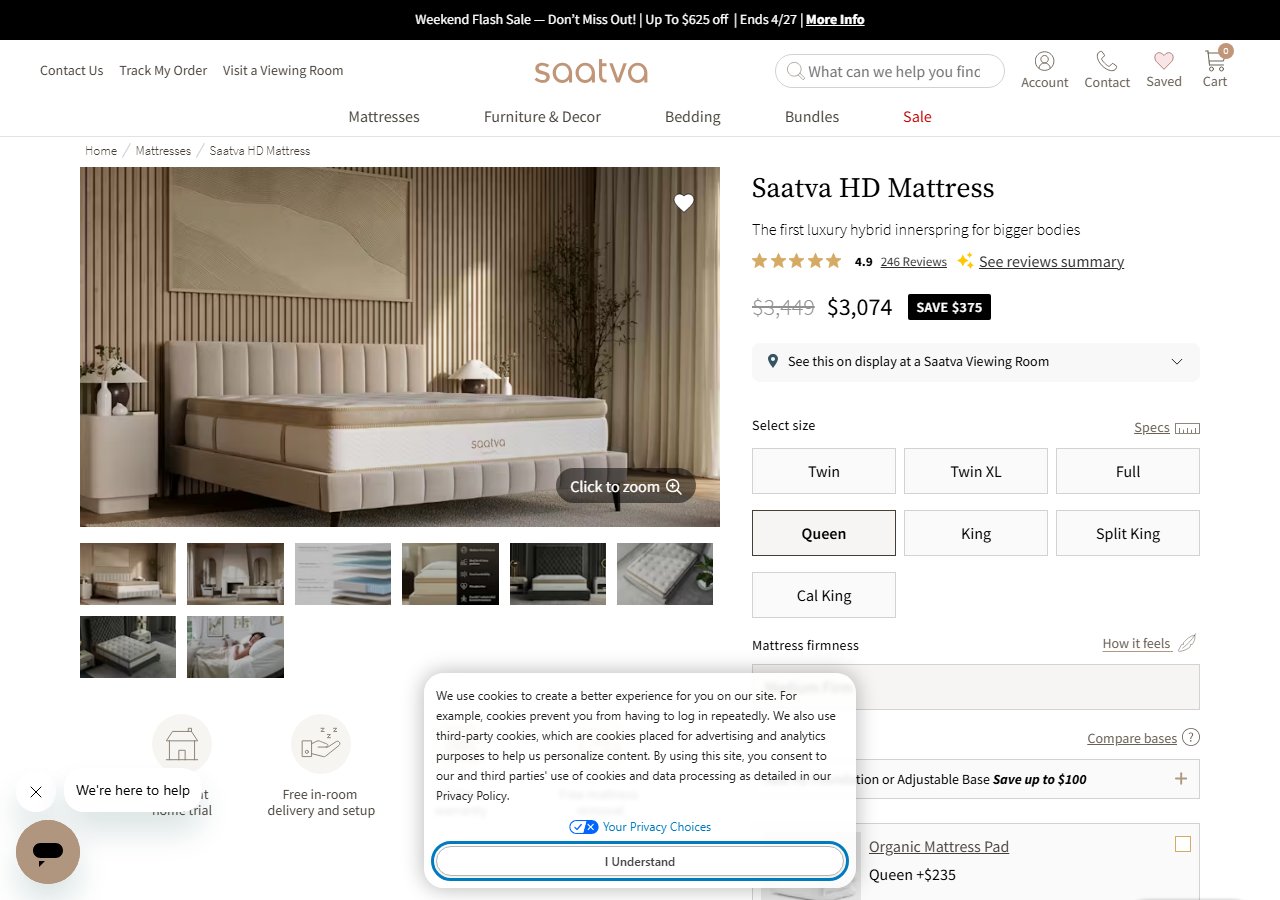
Saatva HD Mattress (Heavy-Duty)
$2,395-$3,995
See Price at Saatva →
Purple Hybrid Premier Mattress
$2,499-$4,799
See Price at Purple →Putting the hierarchy together
The federal data tells a coherent story that the healthcare industry and its workforce largely know but rarely has articulated in recovery terms. BLS data establishes the back as the top injury site across all U.S. occupations. NIOSH documents that the specific tasks healthcare workers perform routinely exceed safe spinal loading thresholds. CDC sleep data shows shift workers are disproportionately represented in the 35% of U.S. adults not getting the 7 hours associated with health maintenance. BLS Employer Costs data shows high-MSD industries carry workers' compensation rates 3 to 5 times those of low-MSD industries — meaning the economic case for prevention is overwhelming.
The intervention hierarchy that follows from this data is clear: correct sleep position first (free), add daily walking (free), reinforce proper lifting mechanics (free to low-cost), confirm the mattress is not visibly degraded (assess before purchasing), see a clinician if neurological red flags are present, and then — if all of the above has been addressed — evaluate whether a better sleep surface can meaningfully improve the quality of the recovery window you are working with. The products mentioned above are evidence-informed tools for that final step. They are not shortcuts past the steps before them.