The shift never really ends — what federal data says about healthcare worker recovery
The alarm goes off at 5:45 a.m. for a 7 a.m. hospital start. By the time the 12-hour shift ends, a floor nurse has repositioned patients dozens of times, stood on hard linoleum for hours, and absorbed the low-grade mechanical insult of a job that never stops moving. According to BLS Musculoskeletal Disorders by Occupation data, the back is the single most common body part injured across all U.S. occupations that result in days away from work — and healthcare and social assistance consistently rank among the industries with the highest absolute numbers of those cases. That is not a coincidence. It is the predictable output of an occupation that combines prolonged standing, repeated bending, patient transfers, and shift-distorted sleep into a daily physiological tax that the body can only pay back during off-duty hours.
The off-duty window is shorter than most healthcare workers realize. After a 12-hour shift, commute, meals, and basic life administration, most nurses, CNAs, respiratory therapists, and surgical techs are left with six to eight hours of horizontal time before the next shift begins — or before a rotating schedule flips them to nights. CDC sleep data shows approximately 35% of U.S. adults already sleep fewer than 7 hours per night, the threshold associated with elevated chronic disease risk. For shift workers whose circadian rhythms are chemically and socially disrupted, that number is almost certainly higher. What happens during those hours on a mattress — whether the spine decompresses, whether soft tissue inflammation resolves, whether the nervous system cycles fully through restorative sleep stages — is not trivial. It is the biological margin between managing a career and losing it to a musculoskeletal disability claim.
Why healthcare shifts destroy the lower back: the biomechanical mechanism
Understanding why recovery matters requires understanding exactly what is being recovered from. The lumbar spine is a load-bearing column under constant compressive and shear stress during healthcare work. Intervertebral discs — the fibrocartilage pads between vertebral bodies — are avascular. They receive nutrients through diffusion, and that diffusion is most efficient during horizontal unloaded rest. When a nurse transfers a patient from bed to chair without proper equipment, the compressive force on the L4-L5 disc can exceed safe limits by a significant margin. NIOSH's Lifting Equation was developed precisely to quantify this: it defines a Recommended Weight Limit (RWL) based on load weight, horizontal distance, vertical position, asymmetry, and frequency — and healthcare tasks like patient repositioning routinely push the Lifting Index above 3.0, a level NIOSH associates with substantially elevated injury risk.
The injury is not always acute. More often it is cumulative. Repeated sub-threshold loading compresses disc height over the course of a shift. Paraspinal muscles — the erector spinae and multifidus groups that stabilize the lumbar spine — fatigue over a 12-hour period and begin to transfer load onto passive structures: ligaments, facet joints, and the disc annulus. Facet joint capsules become inflamed. The multifidus, a deep stabilizing muscle, is particularly prone to atrophy following even a single episode of low back pain, meaning that one bad shift can compromise the neuromuscular architecture the worker needs for all subsequent shifts. This is the cascade that turns occupational exposure into chronic pain. CDC NCHS Data Brief 390 reports that approximately 20% of U.S. adults already live with chronic pain, with lower back as the most common site — and healthcare occupations are a disproportionate contributor to that population.
The workers' compensation data underscores the financial reality. BLS Employer Costs for Employee Compensation data shows that industries with high MSD incidence carry workers' compensation insurance rates 3 to 5 times higher than low-MSD industries. When those costs are passed to workers through benefit trade-offs, or when an injury ends a career, the downstream cost is staggering. AHRQ HCUP data identifies back pain as one of the most expensive conditions in U.S. healthcare by total inpatient and outpatient spending. AHRQ MEPS data adds that average annual personal healthcare expenditures for adults with chronic back conditions substantially exceed costs for those without. And at the far end of the disability pipeline, SSA Disability Insurance data identifies musculoskeletal disorders as the single largest category of new disability claims filed each year. The biomechanical insult at the bedside becomes the financial catastrophe at the disability hearing — unless recovery actually happens in between.
Arthritis, shift work, and the compounding problem
Chronically stressed spinal joints do not recover on a linear timeline. Healthcare workers who have been in the field for more than a decade are increasingly likely to carry some degree of facet joint or sacroiliac joint degeneration. CDC Arthritis Data shows approximately 25% of U.S. adults report doctor-diagnosed arthritis, with prevalence concentrated in physically demanding occupations. For a 45-year-old ER nurse with a 20-year career, facet joint osteoarthritis is not a distant concern — it is a present clinical reality that affects morning stiffness, sleep quality, and the amount of time the body needs in a neutral, decompressed position before it can tolerate another shift. The mattress becomes a recovery tool in a way it simply is not for a sedentary office worker.
Night-shift and rotating-shift healthcare workers face an additional layer of complexity: circadian misalignment. The body's pain-modulation systems — including the descending inhibitory pathways that regulate spinal cord sensitization — follow circadian rhythms. Sleep deprivation and circadian disruption are independently associated with lowered pain thresholds and heightened central sensitization, meaning the same disc compression that a well-rested worker shrugs off becomes genuinely painful to a sleep-deprived one. This is why CMS Drug Spending Dashboard data shows opioid and non-opioid pain medication spending among the most expensive Medicare drug categories — the chronic pain treatment burden is enormous, and inadequate recovery sleep is one of its upstream drivers.
Try these first — non-product interventions with federal evidence
The cheapest intervention is the one that does not require buying anything. Before evaluating any mattress, a healthcare worker dealing with chronic back pain should exhaust the behavioral, movement-based, and ergonomic interventions that federal health agencies have documented as effective. This is not a disclaimer — it is a genuine clinical hierarchy. Evidence shows that free interventions frequently outperform purchased ones, and that products layered on top of poor sleep hygiene or sedentary recovery habits underperform their specifications.
Start with sleep position. NIH National Institute of Arthritis and Musculoskeletal and Skin Diseases guidance recommends side-sleeping with a pillow between the knees, or back-sleeping with a pillow under the knees — both positions keep the lumbar spine in a neutral posture during horizontal rest. Stomach-sleeping torques the lumbar spine into extension and lateral rotation, worsening the exact facet joint and disc pathology that a healthcare shift creates. This one change costs nothing and is supported by federal clinical guidance. Next, address movement. NIH NCCIH's evidence review on low back pain finds that walking 30 minutes on most days reduces chronic low back pain as effectively as most non-drug clinical treatments. The instinct after a brutal 12-hour shift is to stay horizontal, but passive rest beyond the initial pain phase is counterproductive. Walking promotes disc hydration, paraspinal muscle activation, and endorphin release. Add lift mechanics at work: OSHA's ergonomics guidance recommends hinging at the hips rather than the lumbar spine, keeping loads close to the body, and avoiding twisting under load — the same principles NIOSH encoded in its Lifting Equation. Many acute back episodes are mechanical, caused by a single technique failure, and rehearsing correct mechanics is genuinely preventive.
Finally, apply the mattress replacement test honestly. Per CDC Sleep Hygiene guidance, the signals that a mattress has stopped functioning as a recovery tool are concrete: visible sagging, waking stiffer than you went to bed, or age exceeding 7 to 10 years. If none of those apply, the mattress may not be the variable to change.
For healthcare workers who have genuinely addressed sleep position, movement, and workplace mechanics — and who are still waking with stiffness, still managing chronic lumbar pain, and sleeping on a mattress that fails the replacement test — the sleep surface is a legitimate next variable. The evidence base for mattress firmness and back pain is modest by pharmaceutical trial standards, but biomechanically, a surface that allows the lumbar spine to maintain its natural lordotic curve during sleep is materially different from one that either collapses under load or is so rigid it bridges the lumbar gap entirely. This is where specific construction characteristics begin to matter.
When to see a clinician first
Not every back problem that a healthcare worker experiences between shifts is a sleep-surface problem or even a mechanical MSD. Some require clinical evaluation before any self-management strategy — including mattress selection — is appropriate. NIH National Institute of Neurological Disorders and Stroke guidance on back pain identifies specific presentations that warrant prompt clinical evaluation rather than self-management. These are not edge cases; they are patterns that emergency and critical care workers, who may minimize their own symptoms, should take seriously.
Radicular pain — pain or numbness that travels from the lower back down the leg, below the knee — suggests nerve root involvement, either from disc herniation or foraminal stenosis, that imaging can characterize and that a clinician must manage. Pain that follows trauma, such as a patient-handling incident, fall, or vehicle accident, should be evaluated for fracture before the worker concludes it is just a soft tissue strain. New onset of bowel or bladder dysfunction alongside back pain is a red flag for cauda equina syndrome, a surgical emergency. Back pain accompanied by fever suggests infectious or inflammatory etiology. Weight loss combined with new severe back pain in a worker over 50 requires oncological rule-out. None of these presentations are appropriate for a mattress trial. The right first step is imaging and referral.
Where the sleep surface fits: what to look for and why
For the healthcare worker who has cleared the clinical bar and is genuinely looking to optimize off-duty spinal recovery, the mattress selection framework comes down to three biomechanical priorities: zoned support, pressure relief at the shoulder and hip, and thermal management for the elevated skin temperature of a sleep-deprived shift worker. Zoned support — in which the lumbar zone is firmer than the shoulder and hip zones — allows the pelvis and shoulders to sink to appropriate depths while maintaining lumbar lordosis. Pressure relief matters because healthcare workers who shift-sleep in irregular positions need a surface that accommodates deviation from the textbook neutral without creating pressure points that trigger repositioning arousals.
The Saatva Loom & Leaf Memory Foam Mattress is the premium memory foam pick for this specific reader. It uses a dual-layer memory foam construction with a lumbar zone enhancement — a denser foam insert in the center third of the mattress — that provides targeted support where the healthcare worker's spine is most likely to lose its neutral curve. The comfort layer uses a 5-lb-density gel-infused memory foam that absorbs the compressive forces created by the hip and shoulder, allowing the spine to float at its natural depth rather than either bridging or sinking. For healthcare workers who run warm after a shift — elevated core temperature is common after sustained physical exertion — the gel infusion and breathable organic cotton cover address thermal regulation. Saatva offers it in Relaxed Firm and Firm configurations; most healthcare workers with chronic lumbar pain who side-sleep will find Relaxed Firm optimal.
For larger-framed healthcare workers — ICU nurses, surgical techs, and orderlies who routinely handle bariatric patients and may themselves be in the higher BMI range — standard mattresses often underperform because their support cores are not engineered for the load. The Saatva HD Mattress was purpose-built for this gap. Its support system uses a stacked coil architecture — individually wrapped 13-gauge coils over a foundation of high-gauge perimeter coils — that provides zone-differentiated support at higher body weights without the progressive collapse that causes standard mattresses to fail for larger-framed sleepers within a few years. The comfort layer uses a high-resilience foam that returns to neutral quickly, preventing the "stuck" sensation that memory foam can produce when a larger-bodied sleeper needs to reposition. For healthcare workers who log patient transfers and heavy manual tasks, this is the construction that matches the load profile.
The Purple Hybrid Premier Mattress takes a materially different engineering approach that addresses a specific healthcare worker complaint: pressure-induced waking. Purple's GelFlex Grid — a polymer grid matrix rather than foam or coil — collapses under pressure points (shoulders and hips) while remaining rigid under distributed lower loads (the lumbar spine). This creates pressure relief and support simultaneously, without the trade-off that traditional foam and coil systems require. For healthcare workers who experience shoulder or hip pain in addition to lumbar pain — a common pattern in nurses who perform extended lateral patient positioning — the Grid's bimodal response is biomechanically well-matched. The Hybrid Premier uses a 3-inch or 4-inch Grid layer over a pocketed coil base, making it both pressure-responsive and motion-isolated for workers who share a bed with a partner on a different shift schedule.
All three mattresses represent a meaningful investment. That investment is only justified if the non-product interventions have been tried, the mattress replacement criteria have been met, and the worker understands that a mattress is a recovery adjunct — not a treatment for a condition that requires clinical management.
Mattresses Built for Healthcare Shift-Worker Spinal Recovery
These three mattresses were selected for their zoned support architecture, pressure-relief performance, and durability under the load profiles specific to healthcare workers with chronic musculoskeletal conditions.

Saatva Loom & Leaf Memory Foam Mattress
$1,695-$3,295
See Price at Saatva →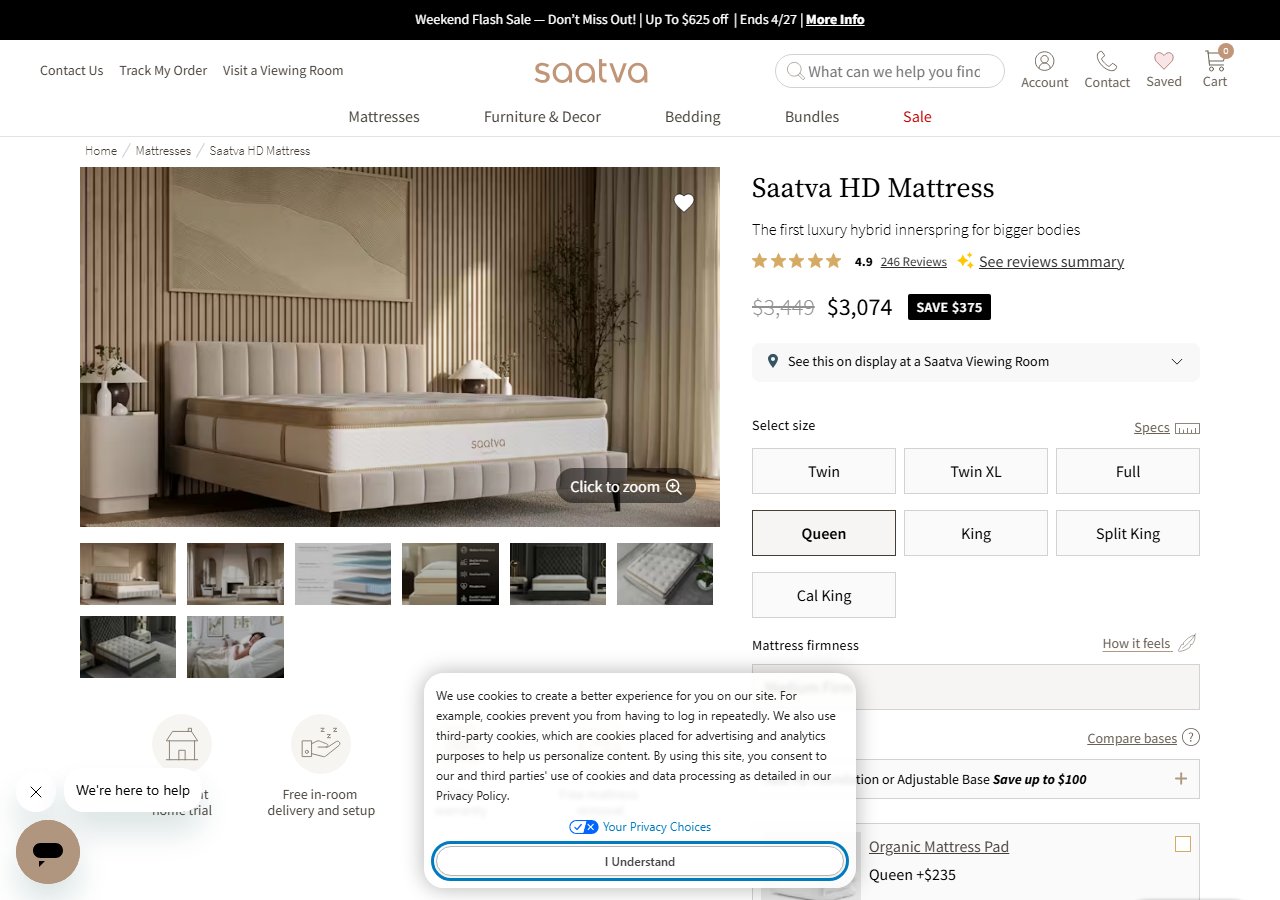
Saatva HD Mattress (Heavy-Duty)
$2,395-$3,995
See Price at Saatva →
Purple Hybrid Premier Mattress
$2,499-$4,799
See Price at Purple →Putting it together: the recovery hierarchy for healthcare workers
The federal data converges on a clear picture. Healthcare workers face spinal loading that exceeds NIOSH-recommended limits during their shifts. They recover in sleep windows compressed by shift length, commute, and circadian disruption. A third of American adults already sleep fewer than 7 hours per night; shift workers systematically do worse. Chronic pain afflicts 1 in 5 U.S. adults, with the lower back as the leading site. Musculoskeletal disorders drive more new disability claims than any other category in the SSA system. The off-duty recovery window is not a lifestyle preference — it is the physiological mechanism that determines whether a healthcare worker can sustain a career.
The hierarchy is: sleep position first, daily movement second, proper lift mechanics at work third, clinical evaluation for red flag presentations, and then — for workers who have genuinely cleared those gates — a sleep surface that is engineered for the specific load profile of healthcare shift work. The Loom & Leaf for the typical back-pain-dominant sleeper. The Saatva HD for larger-framed workers whose standard mattresses are failing under load. The Purple Hybrid Premier for workers whose primary complaint is pressure-related waking at the shoulders or hips. Each addresses a real biomechanical problem. None of them replace the free interventions that should come first.