The injury data no one hands you at orientation
BLS Musculoskeletal Disorders by Occupation tracking documents a finding that should be posted in every break room in America: the back is the single most commonly injured body part across all U.S. occupations that result in days away from work. Not the shoulder. Not the knee. The back — every year, across every sector. For workers who are already carrying 250 pounds or more, that statistic is not abstract. It is the reason you felt yesterday's shift in your lumbar spine before the alarm went off this morning.
The compounding problem is what happens after the shift ends. CDC sleep surveillance data shows that approximately 35% of U.S. adults report sleeping fewer than seven hours per night — the threshold the CDC associates with elevated risk for chronic disease. Sleep is when intervertebral discs rehydrate, when soft tissue repairs, and when the nervous system consolidates the mechanical insults of the day. When a sleep surface bottoms out under a heavier body — when the coils compress fully and the foam collapses — none of that recovery architecture works the way it should. The spine spends eight hours in roughly the same load pattern it spent all day trying to escape.
This article will not lead with product recommendations. It will lead with what the federal data actually shows about why heavier bodies break down faster, which free interventions the evidence supports, when to see a clinician, and only then — after that groundwork — which sleep surfaces are engineered to handle the specific load patterns a 250-plus-pound body creates overnight.
Why heavier bodies face compounding spinal stress
The occupational load side of the equation
The NIOSH Lifting Equation is the federal government's primary tool for calculating whether a manual-handling task is within safe spinal compression limits. The recommended weight limit it produces is 51 pounds under ideal conditions — and most real-world lifting tasks in warehousing, healthcare, and construction fall well outside ideal conditions. Asymmetric lifts, floor-level loads, and high-frequency repetition all reduce the safe limit dramatically. NIOSH research consistently documents that tasks in these sectors routinely exceed safe spinal loading thresholds.
For a worker already carrying significant bodyweight, the math worsens in a specific biomechanical way. The compressive force on the lumbar spine during a lift is not just the weight of the external load — it includes the weight of the upper body itself. A person weighing 260 pounds has roughly 130 to 140 pounds of upper-body mass that the lumbar extensors must brace against during every forward-flexed movement. Add a 40-pound box at floor level and the L4-L5 disc is managing a compressive load that would exceed NIOSH thresholds even if the lift were performed perfectly.
BLS workers' compensation cost data reflects this reality at the macro level: industries with high musculoskeletal disorder incidence carry workers' compensation insurance rates 3 to 5 times higher than low-MSD industries. Those premiums exist because the injuries are real, frequent, and expensive to treat. AHRQ HCUP data identifies back pain as one of the most expensive conditions in U.S. healthcare when measured by total inpatient and outpatient spending combined. The AHRQ Medical Expenditure Panel Survey separately documents that adults with chronic back conditions spend substantially more on personal healthcare annually than adults without such conditions — a gap that compounds across decades of physical work.
The overnight side of the equation
CDC NCHS Data Brief 390 reports that approximately 20% of U.S. adults live with chronic pain, and that the lower back is the most commonly reported pain site. That 20% figure almost certainly underrepresents workers in physically demanding occupations, who tend to underreport to avoid job-jeopardizing light-duty assignments. Chronic lower back pain is not just a daytime problem. It interrupts sleep architecture, reduces time in slow-wave sleep (the phase most associated with physical repair), and creates a feedback loop: poor sleep increases pain sensitivity, increased pain sensitivity further disrupts sleep.
For heavier individuals, the sleep surface adds a third variable. A standard consumer mattress is typically engineered with a weight threshold of around 200 to 230 pounds — an industry convention, not a labeled spec, but one that shows up in the foam density specifications and coil gauge choices that manufacturers use. When a 280-pound person sleeps on a mattress built for a 200-pound person, the comfort layers compress fully within the first few months of use, leaving only the base foam or coil system providing support. The result is a surface that effectively hammocks the body — the heaviest points (hips and shoulders) sink deepest while the lumbar region loses the even support that keeps the spine neutral overnight.
This is not a hypothetical. The SSA Disability Insurance program identifies musculoskeletal disorders as the largest single category of new disability claims filed annually. Many of those claims trace to occupational injuries that were inadequately managed across years — injuries that were perhaps never serious enough for surgery but chronic enough to erode function over time. The overnight recovery environment is one of the few variables a worker can actually control.
Arthritis as the long-term amplifier
CDC arthritis surveillance data shows that approximately 25% of U.S. adults report doctor-diagnosed arthritis, with prevalence notably concentrated in occupations involving sustained physical demand. For heavier adults, excess load on weight-bearing joints — hips, knees, lumbar facets — accelerates articular cartilage wear. Arthritic facet joints are exquisitely sensitive to sleep position and surface firmness: too firm, and the bony prominences of the hip and shoulder create pressure-point pain that forces position changes and fragments sleep; too soft, and the spine falls into flexion, loading already-inflamed facets. The target zone — neutral spine, even pressure distribution — is narrower for someone with arthritis and higher bodyweight than for a lighter, asymptomatic sleeper.
CMS drug spending data identifies opioid and non-opioid pain medications among the most expensive Medicare drug categories, reflecting the enormous chronic-pain treatment burden that arrives after years of inadequately managed musculoskeletal injury. The sleep surface is not the only lever — it is not even the biggest lever — but it is a lever, and one that many high-bodyweight workers have never been told about.
Try these first — before you spend a dollar on a new mattress
The cheapest intervention is the one that does not require buying anything. Federal and NIH clinical guidance supports several free or near-free strategies that demonstrably reduce chronic lower back pain. Before evaluating any sleep surface, a high-bodyweight worker with back pain should work through this list honestly. Sleep position mechanics, daily walking, and proper lifting technique each have stronger evidence bases than any specific mattress construction.
Sleep position is the most immediate free variable. NIH National Institute of Arthritis and Musculoskeletal and Skin Diseases guidance recommends side-sleeping with a pillow between the knees, or back-sleeping with a pillow under the knees, to maintain lumbar neutral alignment. Stomach-sleeping forces the lumbar spine into sustained extension and rotates the cervical spine — a position that, over eight hours, generates meaningful mechanical stress even on a surface that would otherwise be supportive. This is not a minor recommendation. For many people, position change alone reduces morning stiffness substantially.
Daily walking is the most underused clinical intervention for chronic lower back pain. An NIH National Center for Complementary and Integrative Health evidence review found that walking 30 minutes most days reduces chronic low back pain as effectively as most non-drug clinical treatments. Walking loads the lumbar discs rhythmically, drives nutrient exchange into avascular disc tissue, and activates the paraspinal musculature that provides dynamic spinal stability. No mattress replicates this effect.
Lifting and bending mechanics matter more than most workers realize after injury onset. OSHA's ergonomics guidance documents the core principle: hinge at the hips, not the lumbar spine; keep loads close to the torso; avoid twisting under load. Most acute back episodes are mechanical and therefore modifiable through technique rehearsal. A worker who learns to hip-hinge correctly reduces lumbar disc loading on every repetition for the rest of their career.
Evaluate your current mattress before buying a new one. CDC sleep hygiene guidance points to visible mattress sag, waking stiffer than when you went to sleep, or mattress age beyond 7 to 10 years as the key replacement indicators. Even the most structurally sophisticated mattress on the market does not compensate for poor sleep hygiene, sedentary daytime behavior, or an unaddressed clinical condition.
If you have worked through these free interventions consistently for several weeks — corrected your sleep position, added daily walking, addressed lifting mechanics, and confirmed your current mattress is either new or visibly failing — and you are still waking with significant spinal pain, then a reinforced sleep surface becomes a legitimate next step. The products described below are not replacements for the interventions above. They are adjuncts that address the specific mechanical failure mode — inadequate load distribution for high-bodyweight sleepers — that free interventions cannot fix.
When to see a clinician before doing anything else
Not all back pain responds to sleep surface changes, and some back pain is a clinical emergency. NIH National Institute of Neurological Disorders and Stroke guidance on back pain is explicit: seek prompt medical evaluation for back pain that radiates below the knee, that follows trauma, that is accompanied by leg weakness or numbness, or that comes with bowel or bladder changes or unexplained fever. These presentations can indicate nerve root compression, spinal cord involvement, cauda equina syndrome, or systemic illness — none of which are addressed by a new mattress.
For high-bodyweight individuals specifically, the risk of delayed presentation is real. Physical workers often self-manage pain for years, attributing clinical symptoms to occupational wear. The SSA Disability Insurance data showing musculoskeletal disorders as the top new claims category reflects, in part, the outcome of that delayed-presentation pattern. If your back pain has changed character — new radiation, new neurological symptoms, onset after a specific mechanical event — see a clinician before purchasing any sleep product.
Where products help — and what engineering actually matters for 250+ lbs
Sleep surface design for heavier bodies is a legitimate engineering problem, not a marketing one. The variables that matter are coil gauge and count (thicker, more numerous coils resist compression under sustained higher loads), foam density (high-density foams measured in pounds per cubic foot compress more slowly and recover more fully than low-density foams), and transition layer construction (the layer between comfort and base that determines whether the spine finds a neutral position or hammocks into flexion).
The Saatva HD Mattress is built from the ground up for this specific use case. Saatva positions it as a heavy-duty hybrid designed for sleepers up to 500 pounds, with a 13.5-gauge tempered steel coil system that is meaningfully stiffer than the 14.5-gauge coils used in standard consumer mattresses, an additional lumbar zone with targeted support, and a higher-density foam transition layer. For a warehouse worker or construction professional at 270 pounds who has spent the day exceeding NIOSH-defined safe lifting limits, this construction approach directly addresses the overnight hammocking failure mode described above. The Saatva HD is priced at $2,395 to $3,995 — not a casual purchase, but one that amortizes across the 7-to-10-year replacement cycle the CDC recommends.
For sleepers whose primary complaint is not just support failure but pressure-point pain — the hip and shoulder pain that accompanies arthritis or high-contact-area sleeping positions — the Saatva Loom & Leaf Memory Foam Mattress offers a different engineering approach. Loom & Leaf uses a 5-pound-density memory foam in the comfort layer, which is substantially denser than the 2- to 3-pound foams common in mass-market memory foam mattresses. Higher-density foams distribute pressure across a larger surface area, reducing peak pressure at bony prominences. The Loom & Leaf is available in Relaxed Firm and Firm, and for a heavier sleeper dealing with the arthritis prevalence documented in CDC arthritis data, the Relaxed Firm variant offers the pressure relief of high-density foam without the hammocking risk of a softer surface. Price range is $1,695 to $3,295.
The Purple Hybrid Premier Mattress takes a fundamentally different material approach: the Purple Grid, a hyper-elastic polymer grid that behaves differently from both foam and coil systems. Unlike foam, the Grid does not compress uniformly under load — it collapses locally at pressure points while maintaining column strength in low-pressure zones. For a heavier sleeper, this means the hip and shoulder regions can yield while the lumbar region retains support, without the soft-then-hard hammocking failure mode of over-compressed foam. The Hybrid Premier adds a pocketed coil base for additional motion isolation and edge support. At $2,499 to $4,799, it is the highest price point in this group, but the material science addresses a pressure-distribution problem that neither standard foam nor standard coil systems solve well for high-bodyweight sleepers dealing with the joint sensitivity that CDC arthritis prevalence data makes statistically likely in this population.
Reinforced Sleep Surfaces Built for 250+ lb Spinal Load Patterns
Each of these mattresses was selected specifically for high-bodyweight sleepers dealing with occupational back stress — built with coil gauges, foam densities, or grid architectures that standard consumer mattresses do not deliver.

Saatva Loom & Leaf Memory Foam Mattress
$1,695-$3,295
See Price at Saatva →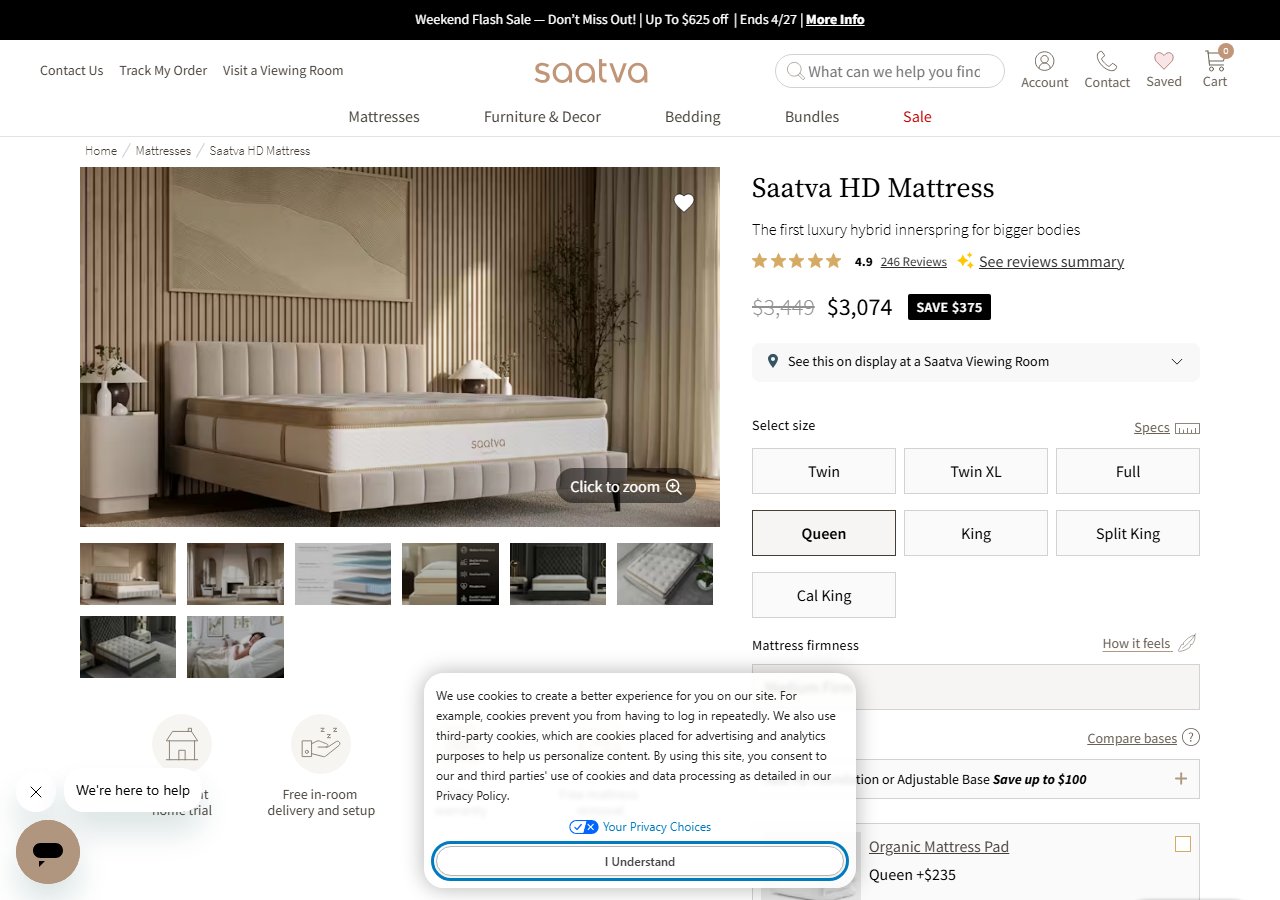
Saatva HD Mattress (Heavy-Duty)
$2,395-$3,995
See Price at Saatva →
Purple Hybrid Premier Mattress
$2,499-$4,799
See Price at Purple →The data-to-decision hierarchy
The AHRQ HCUP data on back pain as one of the most expensive healthcare conditions in the United States is not a footnote — it is a description of where inadequately managed spinal health arrives, financially and physically, over a lifetime of physical work. The SSA disability data identifying musculoskeletal disorders as the top new disability claims category tells the same story from a different angle.
For a high-bodyweight individual in a physically demanding occupation, the decision hierarchy that the evidence supports is this: correct the free variables first (sleep position, daily walking, lifting mechanics, sleep hygiene). See a clinician if neurological symptoms are present. Replace your sleep surface if it fails the visible-sag or wake-stiffness test, choosing a product engineered for your actual weight range rather than one built for the median consumer body. The NIOSH lifting equation cannot be unwritten — the spinal loads of physical work are real and cumulative. But the overnight recovery window is yours to optimize, and for heavier adults, that optimization starts with a surface that does not replicate the compressive insult of the day.