The federal data most heavier workers have never seen
Start with a number from the Bureau of Labor Statistics: the back is the most commonly injured body part across every major U.S. occupation that results in days away from work, according to BLS Musculoskeletal Disorders by Occupation tracking. That data point is cited in every ergonomics meeting, every safety briefing, every workers' compensation settlement negotiation — and yet it is usually treated as a generic workforce problem. It is not generic. It is dramatically more acute for workers who weigh 250 pounds or more, and it does not clock out at the end of a shift.
The same bodies absorbing spinal compression forces during a warehouse pick-and-pack shift, a hospital patient transfer, or a concrete pour are then going home and sleeping on mattresses engineered for a 180-pound reference human. The cumulative load — compressive, rotational, and shear forces across a 16-hour cycle of work and inadequate rest — is what the federal injury data is actually measuring, even if the data does not say so explicitly.
CDC NCHS Data Brief 390 reports that approximately 20% of U.S. adults experience chronic pain, with the lower back as the most common pain location. That figure is not randomly distributed across the population. It clusters in physically demanding occupations and in individuals whose body mass creates greater baseline loading on the lumbar spine, hip joints, and intervertebral discs during both waking and sleeping hours.
Why this happens — the biomechanical and occupational mechanism
The physics are not complicated. The lumbar spine is a load-bearing column. Every pound of body weight above what the spine's supporting musculature is conditioned to carry translates into additional compressive force on the intervertebral discs — particularly L4-L5 and L5-S1, the two levels responsible for the majority of herniated disc diagnoses. For a worker at 280 pounds lifting a 50-pound box, the effective load at the lumbar spine — accounting for the mechanical disadvantage of the trunk acting as a lever arm — can exceed 700 to 800 pounds of compressive force in a single lift. The NIOSH Lifting Equation documents that manual material-handling tasks across warehousing, construction, and healthcare routinely exceed safe spinal loading limits, even without accounting for the amplifying effect of higher body mass.
The disc damage is cumulative. Discs are avascular — they receive nutrition through osmotic exchange during rest and movement, not through direct blood supply. Sustained compressive loading, particularly overnight on a sagging or insufficiently supportive sleep surface, reduces that osmotic exchange and slows disc recovery. A 250+ pound individual sleeping on a standard mattress not rated for their weight will typically experience measurable surface sag within 18 to 24 months of purchase. That sag forces the lumbar spine into a flexed or laterally bent position for 6 to 8 hours per night. Over months and years, this is not a comfort problem. It is a structural problem.
The occupational context compounds the recovery deficit. BLS Employer Costs for Employee Compensation data shows that industries with high musculoskeletal disorder incidence carry workers' compensation insurance rates 3 to 5 times higher than low-MSD industries. That cost signal reflects the real-world frequency and severity of the injuries — it is the insurance market pricing the risk. High-physical-demand workers are the population bearing the clinical consequence of that risk, and inadequate sleep-surface support at night is one of the few modifiable variables they can control independently of their employer.
Arthritis adds another layer. CDC Arthritis data shows approximately 25% of U.S. adults report doctor-diagnosed arthritis, with prevalence concentrated in occupations involving sustained physical demand. Arthritis in the facet joints of the lumbar spine — the small synovial joints that guide spinal movement — is both worsened by sustained compressive loading and directly responsive to sleep surface quality. A surface that allows the hips to sink below the lumbar spine creates a position that closes the facet joints and increases arthritic pain signaling through the night.
The downstream cost of unmanaged chronic back pain is substantial. AHRQ HCUP data identifies back pain as one of the most expensive conditions in U.S. healthcare by total inpatient and outpatient cost. AHRQ MEPS data confirms that average annual personal healthcare expenditures for adults with chronic back conditions substantially exceed costs for adults without such conditions. CMS drug spending data identifies opioid and non-opioid pain medication spending among the most expensive Medicare drug categories — a direct reflection of a system managing the downstream consequences of spinal load injuries that were often preventable upstream. And at the end of the spectrum, SSA Disability Insurance data identifies musculoskeletal disorders as the largest single category of new disability claims filed annually in the United States.
Sleep deprivation makes it worse — by a measurable margin
CDC Sleep and Sleep Disorders data reports that approximately 35% of U.S. adults sleep fewer than 7 hours per night — the threshold below which chronic disease risk, including pain sensitization, is demonstrably elevated. For heavier individuals dealing with back pain, that shortfall is often not a choice. It is a direct consequence of sleeping on a surface that does not maintain spinal alignment. They wake up from pain, shift positions repeatedly, and accumulate sleep debt that impairs the body's tissue repair mechanisms — the same mechanisms that need to be working overnight to recover from the spinal loading of the workday.
This is the cycle the federal data describes without naming: high physical demand work loads the spine beyond safe limits during the day; an inadequate sleep surface fails to support recovery at night; disrupted sleep impairs the body's repair capacity; pain sensitization increases; and the worker's injury risk and healthcare spending both climb. Interrupting that cycle requires addressing both the daytime and nighttime variables.
Try these first — the interventions that cost nothing
Before discussing any sleep surface, the honest intervention hierarchy has to be stated directly: the cheapest intervention is the one that does not require buying anything. Federal health agencies have documented several free or near-free interventions that move the needle on chronic low back pain more reliably than any product purchase. A new mattress is a useful tool in the right context — but it is not the first tool, and for some readers it is not the right tool at all.
Daily walking is the single most evidence-supported free intervention for chronic low back pain. The NIH National Center for Complementary and Integrative Health evidence review concludes that walking 30 minutes on most days reduces chronic low back pain as effectively as most non-drug clinical treatments. Walking increases blood flow to the paravertebral muscles, promotes the osmotic disc nutrition described above, and reduces the inflammatory signaling that drives pain sensitization. For a 280-pound warehouse worker with chronic lumbar pain, 30 minutes of walking after shift is not easy — but the federal evidence base for its effectiveness is stronger than for most products sold for back pain.
Sleep position mechanics are the second free intervention with direct relevance. NIH guidance from the National Institute of Arthritis and Musculoskeletal and Skin Diseases is explicit: side-sleeping with a pillow between the knees, or back-sleeping with a pillow under the knees, keeps the lumbar spine in a neutral position and reduces overnight pain. Stomach-sleeping torques the lumbar spine and is the position most associated with worsening chronic pain. Correcting sleep position costs nothing and can produce noticeable symptom improvement within a week.
Lifting and bending mechanics address the root cause of most acute back episodes. OSHA's ergonomics guidance is unambiguous: hinge at the hips, not the lumbar spine; keep loads close to the body; avoid twisting under load. For workers at 250+ pounds, the combination of body mass and poor lift mechanics creates spinal loading that can acutely damage structures that were already under chronic stress. Correcting mechanics is rehearsable — it can be practiced and habituated — and it directly reduces the cumulative load that a sleep surface is then asked to help recover.
Mattress replacement timing is worth naming explicitly. CDC Sleep Hygiene guidance notes that sleep environment quality is a meaningful variable in sleep health outcomes. A mattress with visible sag, one that produces more morning stiffness than going-to-bed stiffness, or one older than 7 to 10 years is no longer performing its structural function. This is the scenario where a product purchase is legitimate — not as a first intervention, but as a correction of a documented failure in the sleep environment.
For readers who have already addressed the free variables — who walk regularly, have corrected their sleep position, lift with proper mechanics, and are still waking up with lumbar pain on a mattress that's showing visible sag — the sleep surface itself is the remaining modifiable variable. And for heavier individuals, the surface specification matters in ways that standard mattress marketing does not communicate clearly.
When to see a clinician — and what cannot wait
Before discussing any sleep surface, a clear red-flag screen is necessary. Not all back pain responds to sleep surface optimization, and some back pain presentations require imaging, neurological evaluation, or emergency intervention that no mattress can substitute for.
NIH National Institute of Neurological Disorders and Stroke back pain guidance identifies several presentations that require prompt clinical evaluation: back pain that radiates below the knee (suggesting nerve root compression or spinal stenosis); pain that follows a traumatic event such as a fall or vehicle accident; pain accompanied by leg weakness, numbness, or tingling; any back pain with bowel or bladder dysfunction (a potential cauda equina emergency requiring same-day evaluation); and back pain accompanied by unexplained fever or unintentional weight loss (which can signal infection or malignancy). For heavier workers in high-demand occupations, the temptation to attribute all back pain to occupational wear is understandable — but these red flag presentations have specific clinical etiologies that imaging and clinical examination must rule out before any self-management approach, including sleep surface changes, is appropriate.
For back pain without red flags — mechanical low back pain that is positional, worse after activity, improved with rest and movement, and without neurological signs — self-management through the interventions above, combined with an appropriate sleep surface, is a reasonable and federally evidence-supported approach.
Where the sleep surface specification actually matters
For individuals at 250 pounds and above, a mattress specification is not a preference decision — it is an engineering decision. Three variables determine whether a mattress will maintain spinal alignment under higher body mass: support core construction, layer density and durometer, and weight capacity rating.
Standard innerspring and foam mattresses are typically engineered to a 250-pound per-person loading assumption. Under greater load, the comfort layers compress beyond their design range, the support core deflects, and the surface sag described earlier begins. The solution is a mattress constructed with higher-density foam layers, heavier-gauge coil springs, or a support grid engineered for higher load — plus an explicit manufacturer weight capacity rating at or above the actual user's weight.
The Saatva HD Mattress is the most directly engineered product for this specific reader. Saatva designed the HD explicitly for heavier sleepers — it carries a 500-pound per-side weight capacity, uses a dual coil system with individually wrapped 14.5-gauge tempered steel coils over a high-carbon steel Bonnell base, and incorporates a 3-inch lumbar zone pad that provides targeted support at L4-L5, the spinal segment most commonly implicated in occupational back injuries. For a 280-pound warehouse worker dealing with chronic lumbar pain, this is not marketing language — it is a construction specification that directly addresses the mechanical failure mode of standard mattresses under higher load.
For heavier individuals whose primary complaint is pressure buildup at the hips and shoulders — common in side-sleepers and in individuals with arthritis — memory foam engineered to higher density is the relevant specification. The Saatva Loom & Leaf Memory Foam Mattress uses 5-pound density memory foam in the comfort layer, which is substantially denser than the 2 to 3-pound foam common in mass-market memory foam beds. Higher density foam maintains its contouring properties under greater load, distributes pressure more evenly across the hip-to-shoulder profile, and does not bottom out the way lower-density foam does under a heavier body. The Loom & Leaf also uses a cooling spinal gel layer designed to counteract the heat retention that is a common complaint for heavier sleepers on memory foam.
For individuals who are primarily looking for zonal pressure relief combined with airflow — particularly those with hip arthritis or who sleep hot — the Purple Hybrid Premier Mattress offers a materially different construction approach. Purple's GelFlex Grid is a hyper-elastic polymer grid rather than foam — it collapses under pressure points (hips, shoulders) and remains rigid under non-pressure areas (lumbar spine), creating a zonal support profile that no foam achieves through passive compression. The Hybrid Premier version adds a pocketed coil base for additional support and edge reinforcement. For heavier sleepers who have tried high-density foam and still experience morning hip pain, the grid construction represents a genuinely different engineering approach rather than a marginal variation.
Mattresses Built for 250+ Pound Bodies with Chronic Back Pain
Each mattress below was selected specifically for its documented weight capacity, support-layer engineering, and construction approach relevant to heavier individuals dealing with occupational or chronic lower back pain — not for general comfort ratings.

Saatva Loom & Leaf Memory Foam Mattress
$1,695-$3,295
See Price at Saatva →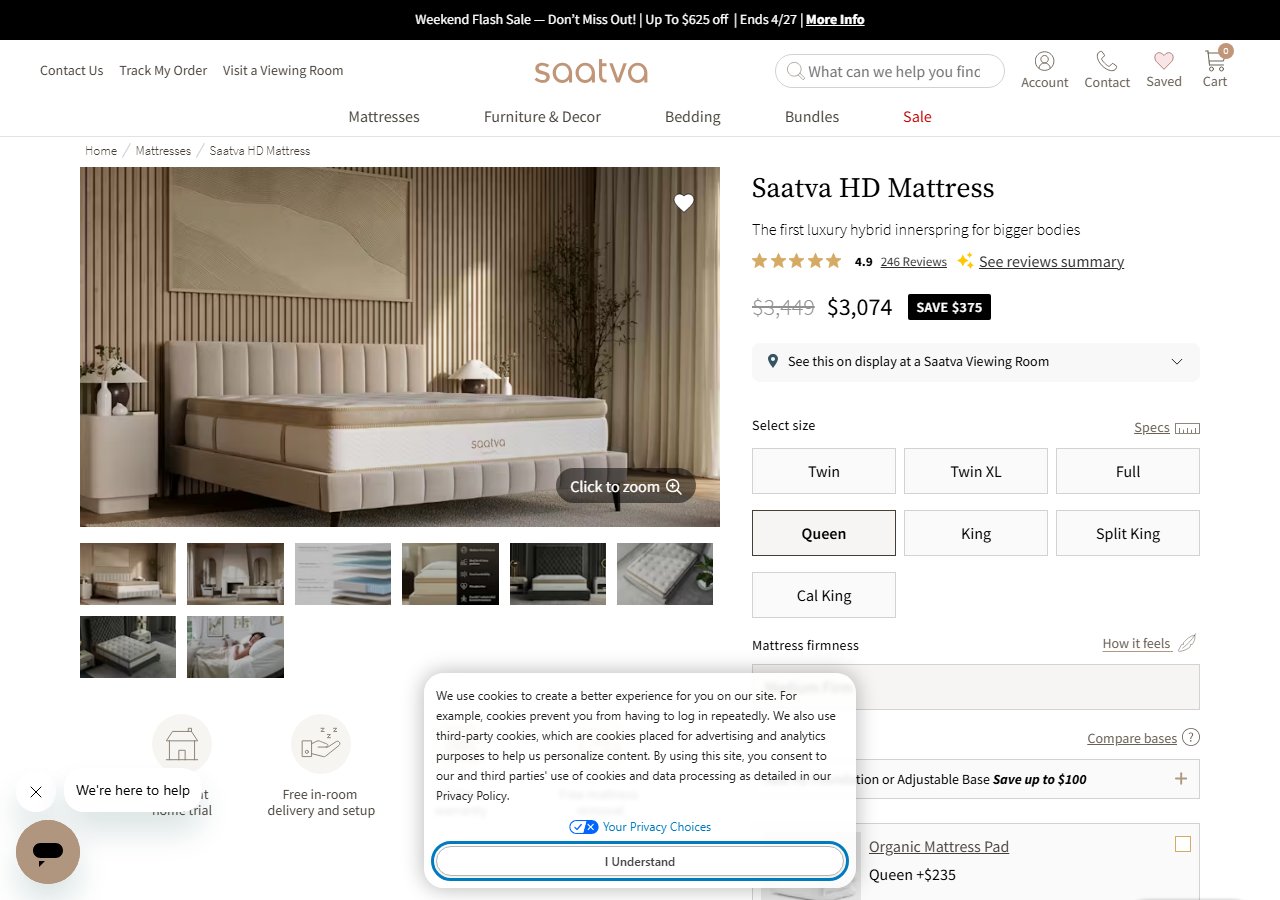
Saatva HD Mattress (Heavy-Duty)
$2,395-$3,995
See Price at Saatva →
Purple Hybrid Premier Mattress
$2,499-$4,799
See Price at Purple →What the data actually tells you to do
The federal evidence base for chronic back pain in heavier, physically-demanding-occupation workers points to a clear hierarchy of intervention. The BLS identifies the back as the most commonly injured body part across all U.S. occupations. NIOSH documents that the spinal loading demands of those occupations routinely exceed safe limits. CDC shows that 20% of adults are already living with chronic pain as a result. SSA shows where the endpoint of unmanaged musculoskeletal disease lands. And CDC sleep data shows that 35% of Americans are not getting the sleep their bodies need to run the overnight repair cycle that keeps that cascade from progressing.
The intervention sequence that the data supports: walk daily, correct sleep position, correct lift mechanics, replace a failing mattress with one engineered for your actual body weight, and see a clinician promptly for any red-flag symptoms. A sleep surface is one lever in that sequence — an important one for heavier individuals on aging or undersized mattresses, but one lever, not the whole solution.
The products described above — the Saatva HD for load capacity and lumbar zoning, the Saatva Loom & Leaf for high-density pressure relief, and the Purple Hybrid Premier for grid-based zonal pressure mapping — are the three constructions in this price tier that address the specific mechanical failure modes that matter for 250+ pound individuals with back pain. They are not the only answer. But they are the answer that the engineering specification, the federal data on what goes wrong at night for these bodies, and the occupational injury context all point toward.