The federal data on spinal loading and bodyweight is not ambiguous
According to the BLS Musculoskeletal Disorders by Occupation tracking, the back is the most common injured body part across all U.S. occupations that result in days away from work. That is not a finding limited to a single industry. It holds in warehousing, healthcare, construction, transportation, and retail — every high-demand sector of the U.S. labor market. For adults carrying 250 lbs or more, the numbers land harder than they do for the general working population. Here is why.
The human lumbar spine operates under compressive load all day. In an average adult, simply standing upright generates roughly 700 to 1,000 newtons of compressive force across the L4–L5 disc — the most commonly injured segment in the lower back. At higher body weights, that baseline load is proportionally greater before any occupational lifting, bending, or twisting is added. When the NIOSH Lifting Equation models safe lifting limits for manual material-handling tasks, it uses a recommended weight limit derived from a reference population that does not account for the additional axial loading a heavier torso already places on lumbar structures. In plain terms: a 280-lb warehouse selector lifting a 40-lb case is working under meaningfully higher total spinal compression than a 170-lb worker performing the identical task.
This compounding effect has downstream consequences that extend well past the workday. After 8 to 12 hours of elevated spinal loading, the intervertebral discs are compressed, the paraspinal musculature is fatigued, and the body enters the recovery window — which, for most adults, is sleep. CDC NHANES survey data published in NCHS Data Brief 390 documents that approximately 20% of U.S. adults live with chronic pain, with lower back identified as the most common pain location. A disproportionate share of those adults are in physically demanding occupations. The sleep surface they recover on is not a peripheral variable in that picture. It is a central one.
Why heavier bodies create unique spinal stress — the biomechanical mechanism
Understanding the mechanism matters because it changes what interventions actually make sense. Spinal compression during sleep is not the same problem as spinal compression during lifting, but the two are connected through the same tissue system: the lumbar intervertebral discs.
Discs are viscoelastic structures. During the day, under compressive load, they lose fluid — a process called creep. During sleep in an unloaded or minimally loaded position, they rehydrate. This nightly rehydration cycle is how discs maintain their height and function. When that rehydration cycle is compromised — either by inadequate sleep duration or by a sleep surface that does not maintain spinal alignment — disc recovery is incomplete. The next workday begins with slightly more compromised tissue.
For high-bodyweight adults, two specific failure modes occur on conventional mattresses. First, excessive sinkage: a mattress with insufficient support layers under higher body mass allows the hips and torso to sink well below the surface plane. This places the lumbar spine in flexion — the same posture associated with disc herniation risk during lifting. Second, pressure concentration: when a denser body presses into an insufficiently reinforced sleep surface, contact pressure concentrates at the heaviest points — hips and shoulders — rather than distributing across the whole body. Concentrated pressure impairs local circulation and triggers positional shifts throughout the night, fragmenting the deep sleep stages most associated with tissue repair.
CDC Sleep and Sleep Disorders Data shows approximately 35% of U.S. adults already report sleeping fewer than 7 hours per night, the threshold the CDC associates with elevated chronic disease risk. High-bodyweight adults with physically demanding jobs face a compounded deficit: not only is sleep duration often short, but sleep quality on undersupported surfaces may be further degraded.
The downstream cost is real and federally documented. AHRQ HCUP data identifies back pain as one of the most expensive conditions in U.S. healthcare by total inpatient and outpatient cost. AHRQ Medical Expenditure Panel Survey (MEPS) data shows that adults with chronic back conditions carry substantially higher average annual personal healthcare expenditures than those without. And at the workforce level, BLS Employer Costs for Employee Compensation data documents that industries with high musculoskeletal disorder incidence carry workers' compensation insurance rates 3 to 5 times higher than low-MSD industries — a cost that ultimately flows back to workers through suppressed wages and reduced benefits.
The SSA Disability Insurance annual reports put the endpoint in sharpest focus: musculoskeletal disorders are the single largest category of new disability claims filed each year. Back problems — largely preventable and manageable with the right combination of movement, sleep, and workplace ergonomics — are driving Americans out of the workforce.
What arthritis adds to the picture
For high-bodyweight adults in physically demanding occupations, arthritis is not a distant concern. CDC Arthritis Data shows approximately 25% of U.S. adults report doctor-diagnosed arthritis, with prevalence concentrated in occupations involving sustained physical demand. Osteoarthritis of the lumbar facet joints is particularly common in this population. Facet arthritis is aggravated by both axial compression (loading) and poor sleep positioning (sustained lumbar extension or rotation). A sleep surface that cannot maintain neutral spinal alignment under higher body weight compounds facet joint stress through all the hours the body is supposed to be recovering. This is the biomechanical case for a reinforced sleep surface in this population — not marketing language, but tissue physiology.
Try these first — non-product interventions backed by federal research
The cheapest intervention is the one that does not require buying anything. Before evaluating sleep surfaces, high-bodyweight adults with back pain should work through the following evidence-based, cost-free or low-cost interventions. Federal health agencies have documented the efficacy of each of these approaches, and several outperform passive interventions — including new mattresses — in head-to-head comparisons.
Daily walking: NIH NCCIH's evidence review on low-back pain finds that walking 30 minutes most days reduces chronic low back pain as effectively as most non-drug clinical treatments. The mechanism is multifactorial: walking pumps fluid into compressed discs, strengthens paraspinal stabilizers, and improves systemic inflammation markers. For heavier individuals, walking also offloads lumbar structures by redistributing force through the kinetic chain. This costs nothing and is available immediately.
Lifting and bending mechanics: OSHA's Ergonomics Solutions guidance documents that most acute back episodes in physically demanding jobs are mechanical in origin — meaning they follow from specific movement patterns that can be retrained. Hinging at the hips rather than the lumbar spine, keeping loads close to the body, and avoiding twisting under load are rehearsable skills. High-bodyweight workers in warehousing, construction, or healthcare face higher total spinal loads during lifting, which makes proper mechanics proportionally more protective.
Sleep position: NIH National Institute of Arthritis and Musculoskeletal and Skin Diseases guidance on back pain identifies sleep position as a major modifiable variable. Side-sleeping with a pillow between the knees maintains pelvic neutrality. Back-sleeping with a pillow under the knees reduces lumbar extension. Stomach-sleeping torques the lumbar spine and is associated with worse chronic pain outcomes. Changing sleep position is a zero-cost intervention that can be implemented tonight — and often produces measurable morning stiffness reduction within days.
Mattress replacement criteria: CDC Sleep Hygiene guidance anchors mattress replacement to functional indicators rather than calendar time: visible sag, waking stiffer than you went to sleep, or a mattress older than 7 to 10 years. These are the triggers for replacement evaluation — not the desire to upgrade. Even the most engineered sleep surface on the market cannot compensate for poor sleep hygiene, inadequate sleep duration, sedentary daytime behavior, or unaddressed occupational ergonomics.
For readers who have addressed the upstream variables — who are walking regularly, sleeping in a supported position, and applying sound lifting mechanics — and who are still waking with back pain on a mattress showing functional decline, the sleep surface itself becomes the next variable to optimize. The research on what that surface should look like for high-bodyweight adults is specific enough to be actionable.
When to see a clinician before you buy anything
Some back pain symptoms in this population are not mattress problems. They are clinical problems that require evaluation before any consumer product decision is made. NIH National Institute of Neurological Disorders and Stroke guidance on back pain identifies a specific set of red flags that warrant prompt medical evaluation rather than a product purchase.
High-bodyweight adults with physically demanding jobs face elevated risk for several of these conditions — specifically lumbar disc herniation with nerve root compression (which can produce radiating leg pain), lumbar spinal stenosis (narrowing that worsens with standing and walking), and facet-mediated pain that refers into the buttocks and thighs. These conditions require imaging, professional assessment, and potentially physical therapy, injection therapy, or surgical consultation. A new mattress may be part of a broader management plan, but it is not the first step.
If your back pain is accompanied by any of the red flags listed below, see a clinician before purchasing any sleep surface. The clinical red flags section below is drawn directly from NIH and federal health guidance.
What reinforced sleep surfaces actually do — and where products fit
For the reader who has cleared the clinical threshold — no red flags, functioning well but recovering poorly — the sleep surface engineering question is well-defined. High-bodyweight adults need three things from a mattress that standard-weight-rated beds do not reliably provide: higher coil count or reinforced coil gauge to resist sinkage under greater mass, zoned support architecture that provides firmer resistance at the hips while allowing pressure relief at the shoulders, and foam or comfort layers dense enough (typically 4 lbs per cubic foot or higher for memory foam) to resist body-impression development over time.
The Saatva HD Mattress is the most directly engineered product for this audience. Saatva built the HD specifically for sleepers up to 500 lbs, using a dual-coil system — a 980-count tempered steel innerspring base layer topped by individually wrapped coils — with a lumbar zone enhancement that increases support precisely where the lower back contacts the sleep surface. For warehouse workers, construction laborers, and healthcare workers at higher body weights who are experiencing the compressive disc loading pattern described above, this architecture addresses the mechanical failure modes directly: it resists hip sinkage that forces the lumbar spine into flexion, and it distributes body mass across a reinforced support system rather than concentrating it. Priced from $2,395 to $3,995 depending on size, the Saatva HD represents a serious infrastructure investment for serious spinal recovery needs.
For readers whose primary symptom is pain at pressure points — hips, shoulders, sacrum — rather than lumbar instability, memory foam with sufficient density offers a different solution. The Saatva Loom & Leaf Memory Foam Mattress uses a multi-layer construction with a 5-lb density memory foam comfort layer — among the highest density available in the consumer market — over a spinal zone quilting pattern designed to support lumbar curvature. The high foam density is critical for heavier sleepers: lower-density memory foam (2–3 lbs per cubic foot) compresses too quickly under higher body mass, losing its contouring properties and developing permanent body impressions within 1 to 2 years. The Loom & Leaf's 5-lb density foam resists that failure mode. It ranges from $1,695 to $3,295 and is Saatva's premium memory foam line.
For sleepers who need both pressure relief and spinal support without the heat retention associated with dense foam, gel-grid construction offers a third architecture. The Purple Hybrid Premier Mattress uses Purple's proprietary GelFlex Grid — a polymer grid structure that neither compresses nor springs back the way foam does, but instead buckets under pressure points while remaining firm elsewhere. This pressure-differentiation behavior is the functional equivalent of zone support in coil systems, achieved through material science rather than mechanical engineering. For high-bodyweight adults with both pressure-point pain and a tendency to sleep hot, the grid architecture addresses both variables simultaneously. The Purple Hybrid Premier ranges from $2,499 to $4,799 and sits at the premium tier of pressure-relief technology.
Sleep Surfaces Engineered for Higher Body Weight and Back Recovery
These three mattresses were selected specifically for adults at 250 lbs or more who carry occupational spinal loading into their nightly recovery window — each addresses a distinct failure mode standard mattresses exhibit under greater body mass.

Saatva Loom & Leaf Memory Foam Mattress
$1,695-$3,295
See Price at Saatva →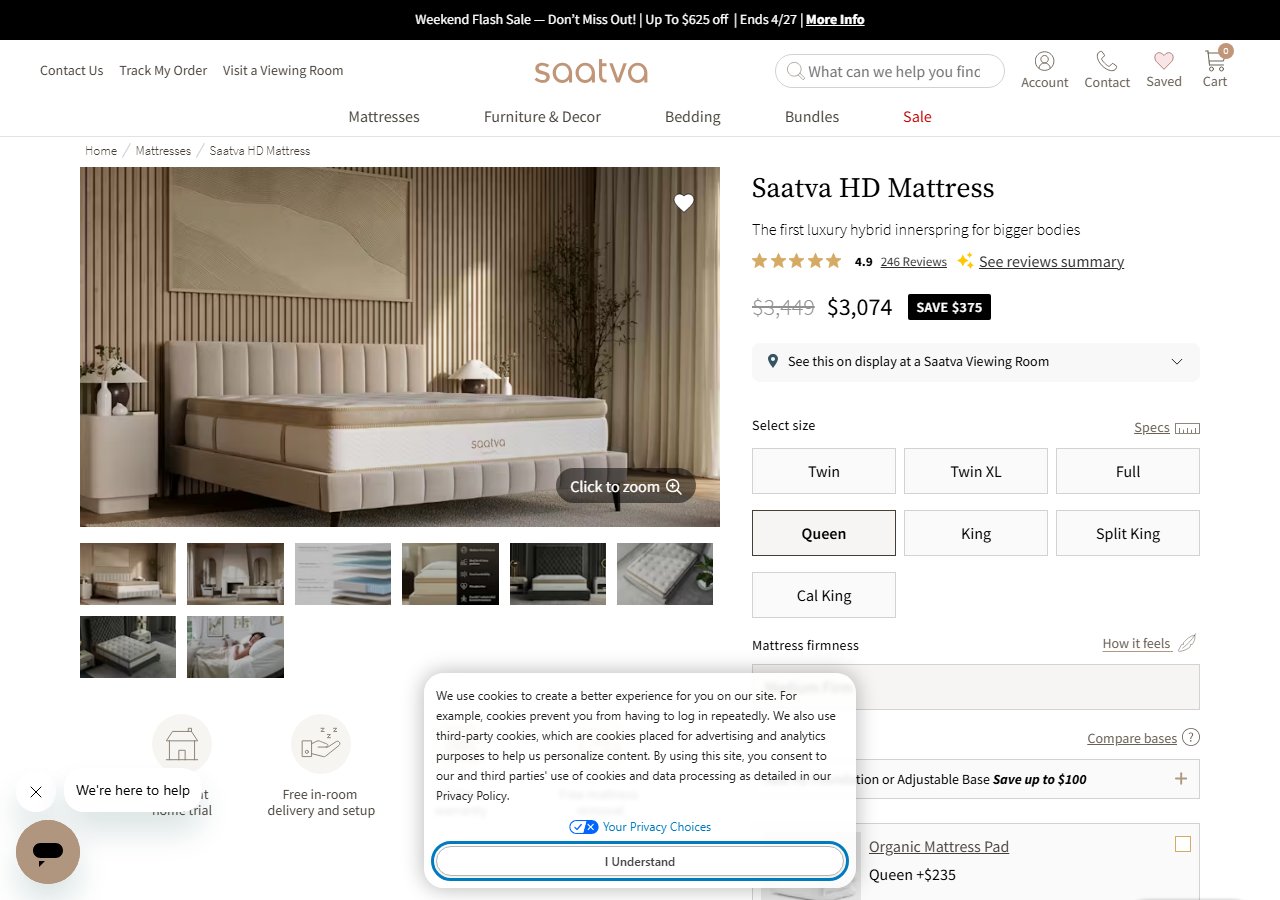
Saatva HD Mattress (Heavy-Duty)
$2,395-$3,995
See Price at Saatva →
Purple Hybrid Premier Mattress
$2,499-$4,799
See Price at Purple →Connecting the federal data back to the buying decision
The CMS Drug Spending Dashboard identifies opioid and non-opioid pain medication spending among the most expensive Medicare drug categories — a direct reflection of what happens when chronic back pain is managed pharmacologically rather than through the upstream interventions federal agencies consistently recommend. Walking, sound sleep positioning, proper lifting mechanics, and an adequately supportive sleep surface are not aesthetic choices. They are the behavioral and environmental conditions under which back tissue either recovers or degrades.
For high-bodyweight adults in physically demanding occupations — the exact population driving the BLS injury statistics, the SSA disability claim rates, and the AHRQ expenditure data cited throughout this article — the sleep surface question is not a luxury question. It is a recovery infrastructure question. The three products discussed above are tools for that recovery infrastructure: purpose-built for higher body mass, engineered for the specific failure modes that standard mattresses exhibit under greater load, and positioned as one component of a broader intervention stack that starts with movement, mechanics, and sleep hygiene.
The federal data is clear about where this population stands. What you do with that information — starting with tonight's sleep position and tomorrow's 30-minute walk — is the higher-leverage move. The mattress is the last variable to optimize, not the first. But when it is time to optimize it, the engineering matters.