The compounding load problem no one talks about
The body keeping score at 2 a.m. is not imagining things. According to the BLS Musculoskeletal Disorders by Occupation tracking, the back is the single most common body part injured across every U.S. occupation that results in days away from work — not the shoulder, not the knee, the back. And that injury pattern does not clock out when the shift ends. For workers carrying 250 pounds or more, the physics of spinal loading operate during every waking and sleeping hour, across every surface that body contacts. The sleep surface is not a luxury variable. It is an eight-hour-per-night mechanical input that either aids spinal recovery or compounds the same compression forces the job already imposed.
The scale of this problem is not abstract. CDC NCHS Data Brief 390 reports that approximately 20% of U.S. adults experience chronic pain, with lower back consistently identified as the most common pain location. That is one in five adults — and the rate climbs sharply among workers in physically demanding occupations. The AHRQ HCUP database identifies back pain as one of the most expensive conditions in U.S. healthcare by total inpatient and outpatient cost. This is not a personal failing. This is a structural collision between occupational demand, body composition, and a healthcare system that has historically underprioritized sleep-surface engineering for non-average body weights.
Why this happens: spinal loading, bodyweight, and the sleep recovery gap
To understand why higher-bodyweight workers face disproportionate back pain risk, start with the NIOSH Lifting Equation. NIOSH's engineering model quantifies spinal compression at the L4–L5 and L5–S1 discs — the most commonly injured vertebral segments in the lower lumbar spine — during manual material handling. The equation documents that warehousing, construction, and healthcare tasks routinely exceed the recommended weight limit of 51 pounds under ideal conditions, and far exceed that limit under real-world asymmetric, floor-level, or extended-reach conditions. Every lift beyond that threshold deposits microstress into the posterior disc structures, the facet joints, and the surrounding ligamentous tissue.
Now layer body weight on top of occupational load. Spinal compression is not only a function of what you lift — it is also a function of the mass your spine supports statically throughout the day. Adults at 250 pounds or above carry axial load on lumbar structures that is mechanically analogous to wearing a moderate-weight vest all day, every day. The intervertebral discs are avascular structures: they receive nutrition through diffusion driven by cycles of compression and decompression. When axial load is high and sustained — as it is for heavier workers standing or sitting eight to twelve hours on the job — that diffusion cycle is impaired. Recovery depends on the decompression phase, which happens primarily during sleep in the recumbent position.
This is exactly where the sleep surface becomes a biomechanical variable rather than a comfort preference. A mattress that sags or that lacks the progressive-resistance core appropriate for higher body weight does two damaging things simultaneously: it allows the heavier sections of the body (hips and shoulders) to sink beyond the neutral-spine plane, creating lateral lumbar flexion for side sleepers; and it fails to distribute pressure evenly across the posterior chain, concentrating load at the sacrum and lumbar spine rather than dissipating it across the full body surface area. The result is that the eight hours that should decompress the lumbar spine instead continue compressing it — just in a different plane.
CDC sleep data already shows that 35% of U.S. adults report sleeping fewer than seven hours per night, a threshold the CDC associates with elevated chronic disease risk. For heavier workers with existing lumbar stress, the problem is not only duration — it is mechanical quality. Six hours of genuinely decompressive sleep on the right surface may outperform eight hours of loaded, twisted, pressure-pointed sleep on the wrong one.
The financial consequences are serious and federally documented. AHRQ MEPS data shows that adults with chronic back conditions carry substantially higher annual personal healthcare expenditures than adults without them. SSA Disability Insurance data identifies musculoskeletal disorders as the single largest category of new disability claims filed each year in the United States — larger than cardiovascular disease, larger than mental health diagnoses. The BLS Employer Costs for Employee Compensation data shows industries with high MSD incidence carry workers' compensation insurance rates three to five times higher than low-MSD industries. These are not coincidental numbers. They trace a direct line from the repetitive mechanical load of physical occupations through inadequate recovery to the healthcare and disability systems that absorb the downstream cost.
The chronic pain burden also carries a pharmaceutical tail that strains individuals and federal programs alike. CMS Drug Spending Dashboard data identifies opioid and non-opioid pain medication spending among the most expensive Medicare drug categories — a direct reflection of the chronic-pain treatment burden that inadequate spinal recovery contributes to. And CDC arthritis surveillance data shows that approximately 25% of U.S. adults report doctor-diagnosed arthritis, with prevalence concentrated in occupations involving sustained physical demand. Arthritis and disc degeneration are not the same condition, but they frequently co-occur in heavier workers in physical trades, creating a compounded inflammatory load that sleep surface quality either mitigates or worsens.
The cheapest intervention is the one that doesn't require buying anything
Before discussing any product, the evidence demands a clear statement: most back pain — including back pain in heavier workers — responds meaningfully to behavioral and mechanical interventions that cost nothing. The NIH NCCIH evidence review on low-back pain finds that daily walking for approximately 30 minutes most days reduces chronic lower back pain as effectively as most non-drug clinical treatments. Not yoga, not traction, not an expensive mattress — walking. The aerobic demand of walking increases disc perfusion, activates the posterior chain musculature that stabilizes the lumbar spine, and reduces the systemic inflammation that chronic pain depends on.
Sleep position is the second lever, and it is entirely free. NIH guidance on back pain is specific: side-sleeping with a pillow between the knees keeps the pelvis level and prevents the upper hip from torquing the lumbar spine forward. Back-sleeping with a pillow under the knees reduces the lumbar lordosis and takes compressive load off the posterior facet joints. Stomach-sleeping does the opposite — it forces lumbar hyperextension and cervical rotation simultaneously, compounding stress at both ends of the spine. A heavier sleeper who switches from stomach to side-sleeping with correct pillow support may notice meaningful pain reduction within two weeks without spending a dollar.
For workers in warehousing, construction, or any occupation involving lifting: OSHA's ergonomics guidance is explicit that most acute back episodes are mechanical and rehearsable. Hinging at the hips rather than rounding the lumbar spine under load, keeping loads inside the body's base of support, and eliminating axial twist under resistance — these mechanics reduce spinal loading in ways that compound over a career. NIOSH's own lifting equation was built to prevent the kind of disc loading that becomes chronic pain in middle age.
Finally, the mattress itself deserves honest evaluation before replacement. CDC sleep hygiene guidance provides practical criteria: if your mattress has visible sagging or body impressions, if you consistently wake stiffer than you went to bed, or if it is seven to ten years old or older, the surface itself is likely contributing to pain rather than relieving it. Those are legitimate signals to replace. But if the mattress is structurally sound and the pain is new, changing the surface before addressing movement, sleep position, and lifting mechanics is spending money on the wrong variable.
Some readers will recognize all of that — they have adjusted their sleep position, they walk regularly, they have correct lifting mechanics — and they are still waking up with lumbar pain that tracks directly to how they slept. For those readers, the sleep surface genuinely is the limiting variable, and the rest of this article is written for them. But the interventions above should be running in parallel regardless of what surface you sleep on. They are not alternatives to a better mattress; they are the foundation that makes a better mattress work.
When to see a clinician — red flags that no mattress addresses
Some back pain presentations require imaging, specialist referral, or urgent evaluation — and buying a new mattress while these conditions are undiagnosed is not just unhelpful, it can delay care that matters. The following red flags are drawn from NIH National Institute of Neurological Disorders and Stroke guidance on back pain and are specifically relevant to higher-bodyweight workers in physical occupations:
See a clinician promptly if your back pain is accompanied by any of the following: pain that radiates consistently below the knee (not just into the buttock — below the knee, into the calf or foot); leg weakness, numbness, or tingling that is new or worsening; bowel or bladder dysfunction of any kind; back pain that developed after a fall, collision, or acute trauma; fever, unexplained weight loss, or night sweats accompanying back pain; or pain that is unrelenting at rest and does not vary with position. These presentations are not mechanical back pain. They are neurological compression, spinal cord involvement, infection, fracture, or systemic disease presenting through the back — and they require clinical evaluation, not a new sleep surface.
For heavier workers specifically, the CDC arthritis surveillance data underscores an important nuance: osteoarthritis of the facet joints and lumbar spondylosis are common in workers over 40 who have carried high axial loads across their careers. These conditions can mimic mechanical back pain but may require specific management approaches that an occupational medicine physician or physiatrist is better positioned to provide than a retail mattress purchase.
Where a purpose-built sleep surface fits into the recovery equation
For the reader who has done the movement work, corrected sleep position, addressed lifting mechanics, and confirmed that the mattress is legitimately past its useful life or inadequate for higher body weight — here is what the evidence and engineering say about surface selection.
The core problem with standard mattresses for sleepers at 250 pounds and above is progressive sinkage without return force. Most consumer mattresses are engineered and tested to a median body weight in the 150–180-pound range. At 250 or more pounds, the same materials compress into a different — often inadequate — support zone. The result is the lumbar bridging and hip sinkage described earlier. A purpose-built surface for higher bodyweight needs three things: a higher-density foam or reinforced coil core that maintains progressive resistance at actual body weight, a comfort layer thick enough to relieve pressure at the hip and shoulder without collapsing through to the base, and edge support robust enough that the sleeper doesn't spend the night fighting toward the center.
The Saatva HD Mattress is the most directly engineered option on this list for warehouse workers and higher-bodyweight users specifically. Saatva HD uses a dual-coil architecture — a supportive base of individually wrapped coils topped by a secondary micro-coil layer — combined with a high-density foam perimeter and a comfort layer rated explicitly for users up to 500 pounds. That construction approach directly addresses the load-distribution problem the NIOSH lifting data and the bodyweight mechanics above describe: the coil-on-coil system maintains progressive resistance without the sinkage that single-layer foam or lower-gauge coil constructions allow at higher body weights. At $2,395–$3,995, it is an investment with a narrowly defined purpose — and that purpose is exactly the scenario this article documents.
For workers whose primary complaint is pressure pain — the kind associated with hip and shoulder compression in side-sleepers, and often co-occurring with the arthritis prevalence CDC data identifies — the Saatva Loom & Leaf Memory Foam Mattress offers a different engineering approach. Loom & Leaf uses a multi-layer organic cotton and memory foam construction built on a high-density support foam base. The memory foam comfort system provides genuine pressure redistribution — viscoelastic material deforms to body contour and distributes load across a larger surface area, reducing the peak pressure at the hip and shoulder that triggers pain in side-sleeping heavier workers. At $1,695–$3,295, it occupies the premium memory foam tier and is the appropriate pick when pressure relief is the dominant concern alongside support.
The third option in this analysis, the Purple Hybrid Premier Mattress, takes a structurally different approach through Purple's proprietary GelFlex Grid comfort layer. The grid architecture is engineered to collapse under pressure points (hips, shoulders) while remaining rigid under lighter-load areas (lumbar, calves), which theoretically provides simultaneous pressure relief and lumbar support without the heat retention that dense memory foam can produce. At $2,499–$4,799, it is the premium pressure-relief option for higher-bodyweight sleepers who have found that traditional foam retains heat or creates pressure points despite adequate support. The hybrid coil base maintains the support-floor rigidity that heavier sleepers require.
Sleep Surfaces Built for High-Bodyweight Spinal Recovery
These three mattresses were selected specifically for adults at 250 pounds or above whose back pain is compounded by physically demanding occupations — each addresses a distinct aspect of the load-distribution and pressure-relief problem the federal data describes.

Saatva Loom & Leaf Memory Foam Mattress
$1,695-$3,295
See Price at Saatva →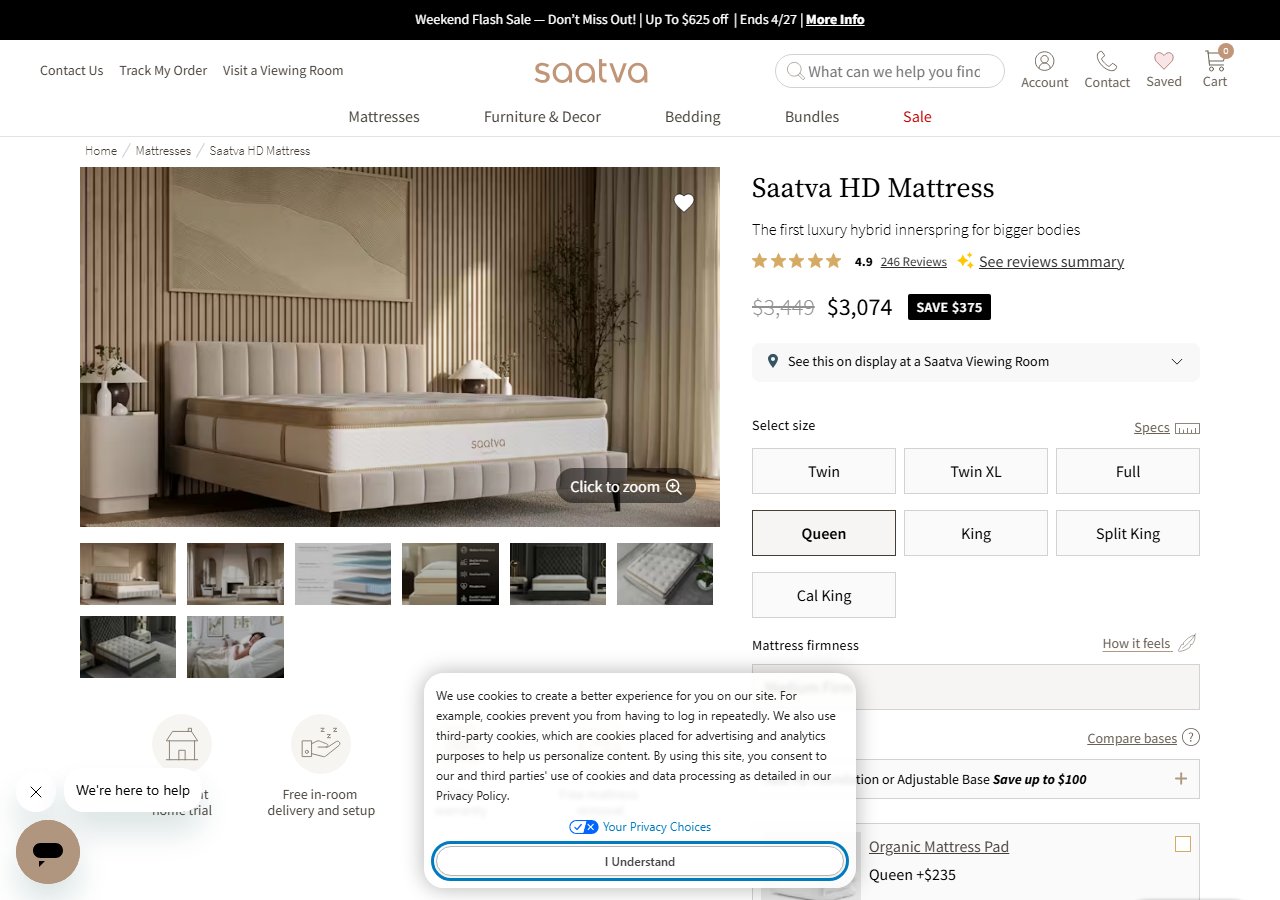
Saatva HD Mattress (Heavy-Duty)
$2,395-$3,995
See Price at Saatva →
Purple Hybrid Premier Mattress
$2,499-$4,799
See Price at Purple →The data-to-recovery framework, summarized
The federal data reviewed in this article traces a clear and troubling arc: physically demanding jobs routinely exceed safe spinal load limits by NIOSH standards; the back is the most-injured body part in U.S. occupational data; chronic back pain drives some of the largest healthcare expenditures in the country per AHRQ; and musculoskeletal disorders are the leading driver of new disability claims per SSA. For higher-bodyweight workers, this occupational load is compounded by the biomechanical reality that standard consumer sleep surfaces were not engineered for their body weight, extending the spinal loading cycle into the night hours that should be providing decompressive recovery.
The intervention hierarchy matters. Walk daily. Correct your sleep position before you replace your mattress. Address lifting mechanics with OSHA-endorsed technique. Screen your mattress honestly against the CDC's useful-life criteria. Rule out clinical red flags with a provider visit if any apply. And if, after all of that, you are still waking with lumbar pain on a surface that has failed you mechanically, the three options above represent the best-engineered solutions in the market for this specific load profile — starting with the Saatva HD for maximum structural support, the Loom & Leaf for pressure-forward relief, and the Purple Hybrid Premier for the sleeper who needs both pressure response and thermal neutrality.
The sleep surface is eight hours of mechanical input, every night, for years. Get that input wrong at 250 pounds-plus and the federal data on chronic back pain, disability claims, and healthcare costs is describing your likely trajectory. Get it right, and you have closed the most consistently overlooked gap in occupational back pain recovery.