The federal data no one shows high-bodyweight workers
If you weigh 250 pounds or more and spend your working hours lifting, stacking, bending, or standing, the federal data on your injury risk is not subtle. According to BLS Musculoskeletal Disorders by Occupation tracking, the back is the single most common body part injured across all U.S. occupations with days away from work — not the hands, not the knees, not the shoulders. The back. And the NIOSH Lifting Equation, the federal government's own standard for assessing manual material handling, documents that warehousing, construction, and healthcare tasks routinely exceed safe spinal compression limits even for average-sized workers. For a worker whose body generates 20–40% more ground reaction force on every lift, every step, and every sleeping surface, the margin shrinks further.
This is not an abstract occupational health statistic. The CDC's NCHS Data Brief 390 estimates that approximately 20% of U.S. adults experience chronic pain, with the lower back identified as the most common pain location. And the SSA Disability Insurance reports track what happens when that chronic pain becomes disabling: musculoskeletal disorders are the single largest category of new disability claims filed annually. These are not worst-case numbers. They are population-wide averages, and the distribution falls harder on high-bodyweight adults in physically demanding roles.
The financial stakes match the physical ones. AHRQ HCUP data identifies back pain as one of the most expensive conditions in U.S. healthcare by combined inpatient and outpatient cost. AHRQ's Medical Expenditure Panel Survey further shows that adults managing chronic back conditions spend substantially more on personal healthcare annually than adults without such conditions. And CMS drug spending data places opioid and non-opioid pain medication among the most expensive drug categories in the Medicare system — a direct downstream consequence of undertreated and poorly managed musculoskeletal disease. For employers, BLS Employer Costs for Employee Compensation data shows that industries with high musculoskeletal disorder incidence carry workers' compensation insurance rates 3 to 5 times higher than low-MSD industries. The cost is not just personal. It cascades.
Why heavier bodies face a compounding mechanism
Understanding why back pain clusters the way it does in high-bodyweight adults requires a short biomechanics lesson, because the mechanism is not simply "carrying more weight." It is systemic load amplification across every phase of the day — including the hours you spend asleep.
During occupational lifting, spinal compressive force is not equal to bodyweight. It is a product of bodyweight, load position relative to the spine, and trunk muscle activation. The NIOSH Lifting Equation models this: a 200-pound load lifted at arm's length creates compressive forces at the L4-L5 disc exceeding 700 pounds in an average worker. Add a heavier baseline body mass, and the resting compressive forces at lumbar discs — even during low-load tasks like bending to tie a shoe — are meaningfully higher. The NIOSH Lifting Equation documentation defines an Action Limit of 3,400 Newtons of lumbar compression as a threshold beyond which injury risk rises steeply. High-bodyweight workers cross this threshold with lighter loads and more routine movements than average-sized workers.
This is compounded by the arthritis burden. CDC arthritis data shows approximately 25% of U.S. adults carry a doctor-diagnosed arthritis diagnosis, with prevalence concentrated in occupations involving sustained physical demand. Arthritic joints are less tolerant of repetitive compressive loading — meaning the same workday that causes soreness in a younger, lighter colleague may cause tissue-level damage in a worker with established joint disease and higher body mass.
Then come the sleep hours. A standard mattress is designed around an average weight distribution, typically tested and rated for a body between 130 and 230 pounds. A 270-pound adult sleeping on a standard consumer mattress — particularly one with inadequate coil gauge, insufficient foam density, or aging materials — will create a hammocking effect: the heaviest body regions (hips, shoulders) sink past neutral, flexing the lumbar spine into a prolonged lateral bend or extension. Eight hours of spinal malalignment is not recovery. It is additional cumulative loading stacked on top of an already-stressed system. This is the physiological link between mattress design and occupational back pain — not marketing language, but basic tissue mechanics.
CDC sleep data already shows that approximately 35% of U.S. adults sleep fewer than 7 hours per night, the threshold below which chronic disease risk rises substantially. For high-bodyweight adults with active back pain, poor sleep quality becomes a second mechanism of injury perpetuation: sleep deprivation is associated with heightened pain sensitivity, slower tissue repair, and reduced next-day physical performance — the exact performance capacities needed to safely execute the lifting and bending tasks that caused the injury in the first place.
Try these first — the cheapest interventions require no purchase
Before this article discusses any product, it is worth being direct: the cheapest intervention is the one that requires no spending at all. Federal research agencies have produced clear, actionable guidance for back pain management that most high-bodyweight adults in physically demanding jobs have never been formally shown. These interventions will not substitute for clinical care when red flags are present, and they will not replace a mattress that has visibly failed. But for the majority of people with mechanical low back pain, behavioral changes are the highest-leverage first move.
Lifting mechanics are the single most modifiable occupational risk factor. OSHA's ergonomics guidance is explicit: hinge at the hips, not the lumbar spine; keep loads as close to the body as possible; avoid rotational loading under weight. Most acute back episodes are mechanical and, importantly, rehearsable. Workers who consciously practice hip hinging — a movement pattern that loads the stronger posterior chain rather than the vulnerable lumbar discs — reduce their per-lift spinal compression even before anything else changes. This is not opinion; it is the engineering rationale behind the NIOSH Lifting Equation itself.
Sleep position is the other free variable most often overlooked. NIH guidance from the National Institute of Arthritis and Musculoskeletal and Skin Diseases recommends side-sleeping with a pillow between the knees or back-sleeping with a pillow under the knees to maintain spinal neutrality through the night. Stomach sleeping, by contrast, forces cervical rotation and lumbar extension simultaneously — a position that, held for hours, adds mechanical stress to already-sensitized structures. This adjustment costs nothing and can be started tonight.
Daily walking is consistently undervalued as a therapeutic tool. NIH's NCCIH evidence review on low back pain finds that 30 minutes of walking most days reduces chronic low back pain with an effectiveness comparable to most non-drug clinical treatments. For high-bodyweight workers who are already physically active at work, this may feel counterintuitive — but occupational movement is not the same as therapeutic movement. A controlled 30-minute walk maintains disc hydration, activates stabilizing musculature, and reduces the neurological sensitization that amplifies pain perception over time.
Mattress replacement criteria also belong in this section because replacing a mattress is only useful when the current one has objectively failed. CDC sleep hygiene guidance recommends replacing a mattress when it shows visible sagging, when you consistently wake stiffer than you went to bed, or when it exceeds 7 to 10 years of age. Even the most expensive reinforced mattress available will not compensate for poor sleep hygiene, sedentary days, or inadequate pain management. The mattress is one variable in a system.
For readers who have already addressed sleep position, adjusted lifting mechanics, and replaced or evaluated their current sleep surface — and who are still experiencing sleep-disrupting back pain — a reinforced sleep surface designed for higher body mass may represent a meaningful adjunct. Not a cure, not a substitute for the above, but a structural tool that addresses the hammocking and spinal malalignment mechanism described earlier. The products below were evaluated specifically against that criterion: do they provide the coil gauge, foam density, and edge support architecture needed to keep a 250-plus-pound body in spinal neutral through the night?
When to see a clinician — red flags this audience should not wait on
High-bodyweight adults in physically demanding occupations face one specific clinical hazard: the tendency to normalize pain. When back pain is an almost-daily occupational reality, it becomes easy to absorb new symptoms into the background noise and delay care that could prevent serious harm. NIH's National Institute of Neurological Disorders and Stroke back pain guidance is unambiguous about which symptoms require prompt clinical evaluation — not a new mattress, not a posture adjustment, but a provider visit.
The red flags most relevant to this reader are radiating pain that travels below the knee (a possible sign of nerve root compression or disc herniation), any back pain following trauma (falls, vehicle accidents, or high-load incidents), progressive leg weakness, and any change in bowel or bladder function associated with a new back complaint. Fever accompanying back pain may indicate infection. For adults with established arthritis — recall that CDC data places arthritis prevalence at roughly 25% of the adult population, concentrated in physically demanding occupations — new or changing back pain patterns warrant evaluation because arthritic progression and secondary nerve involvement can develop insidiously. Do not buy a new mattress if any of these presentations are present. Get imaging or a referral.
Where reinforced sleep surfaces fit into this picture
For readers who have cleared the clinical threshold, addressed free interventions, and determined their current mattress is a structural contributor to their pain, the evidence points toward specific construction features rather than brand names. High-bodyweight adults need coil systems with sufficient gauge to resist progressive compression under dynamic nightly load — standard consumer innersprings typically use 13–15 gauge coils rated for average body mass; reinforced systems use 12.5 gauge or lower with higher coil counts. Foam layers need minimum density ratings to prevent accelerated body-impression formation. Edge support needs to be robust enough to prevent rollout from sleeping positions near the mattress perimeter, which high-bodyweight sleepers are more vulnerable to given the greater central compression.
The Saatva Loom & Leaf Memory Foam Mattress is the premium memory foam option most directly aligned with serious back pain management at higher body weights. Its 5-pound-density memory foam core addresses the body-impression problem that causes standard memory foam to fail heavy sleepers within a few years. The lumbar zone enhancement — a denser central third — is specifically intended to resist the hip-sinking that creates lumbar flexion during side sleep. For a 250-plus-pound adult with chronic low back pain who prefers the pressure-contouring of memory foam over the responsiveness of a hybrid, this is the construction architecture most likely to maintain spinal neutrality through the night.
For warehouse workers, construction laborers, and others in the physically demanding occupations BLS tracks as highest-MSD-incidence, the Saatva HD Mattress is the more purpose-built option. Saatva explicitly engineered the HD for sleepers up to 500 pounds, using a dual-coil system — individually wrapped coils over a tempered steel base layer — that provides the progressive resistance needed to prevent hammocking under significant body mass. The coil gauge is heavier than standard, the foam encasement is denser, and the quilted Euro top uses materials rated for durability under sustained high-load compression. This is not a mattress that happens to accommodate larger bodies; it is one designed around their load profile from the ground up. For the BLS-tracked worker in warehousing or construction who is dealing with the accumulated spinal loading described in the NIOSH data above, this is the most mechanically appropriate option in this list.
For sleepers whose primary complaint is pressure-point pain — often experienced at the hips and shoulders in side-sleeping positions at higher body weights — the Purple Hybrid Premier Mattress offers a materially different mechanism. Purple's GelFlex Grid is not foam and not a traditional coil-top; it is a polymer matrix that collapses under point pressure (reducing pressure-point loading at the hip) while remaining supportive across distributed load (preventing the spinal sag that standard memory foam allows under heavier bodies). For high-bodyweight adults whose back pain has a strong hip-pressure component, or who sleep warm and find traditional foam mattresses thermally uncomfortable, the Purple Hybrid Premier's grid layer provides a pressure-relief mechanism that foam cannot replicate.
Reinforced Sleep Surfaces for High-Bodyweight Back Pain Sufferers
These three mattresses were selected specifically for adults at 250+ lbs dealing with occupational back pain — evaluated on coil gauge, foam density, edge support, and weight rating, not marketing claims.

Saatva Loom & Leaf Memory Foam Mattress
$1,695-$3,295
See Price at Saatva →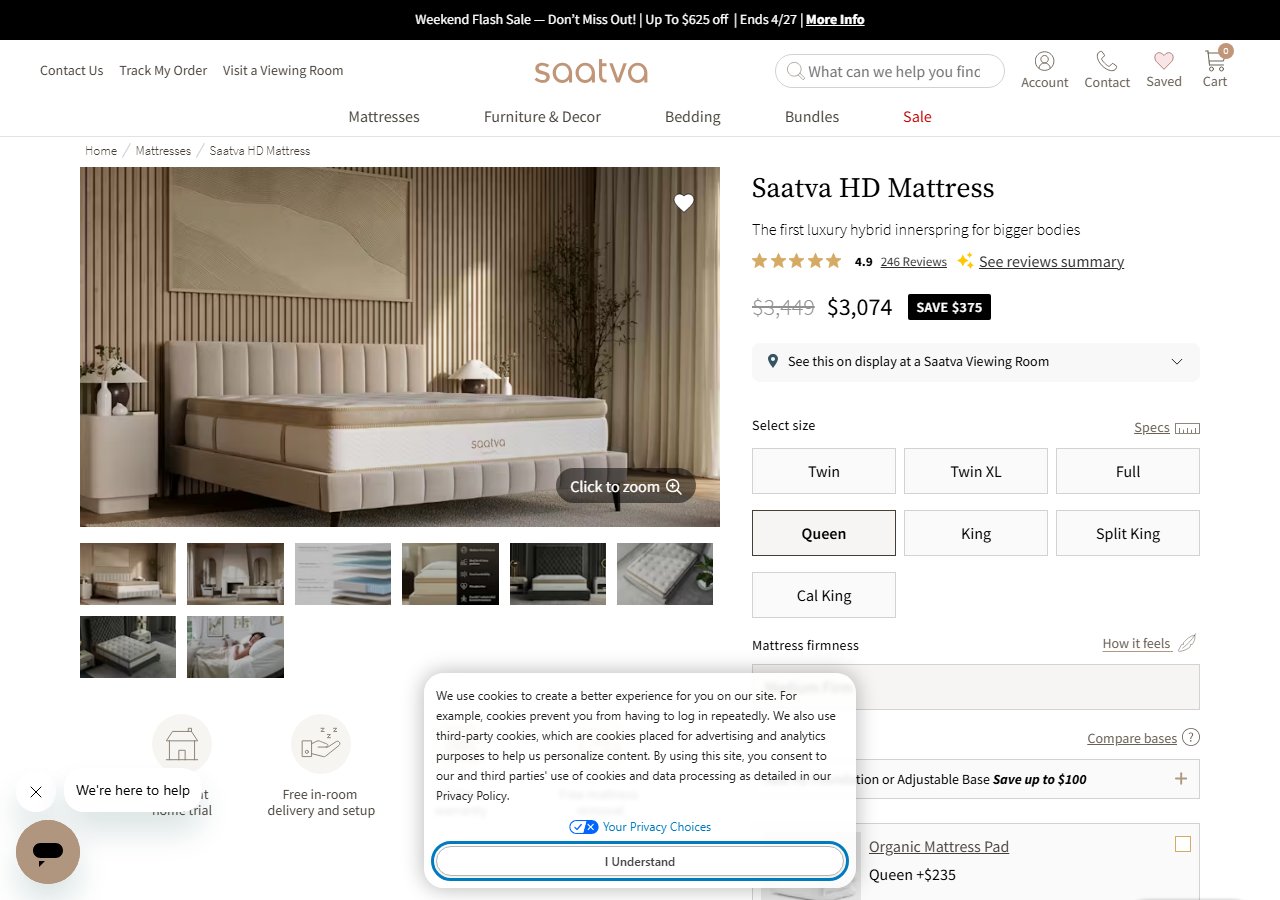
Saatva HD Mattress (Heavy-Duty)
$2,395-$3,995
See Price at Saatva →
Purple Hybrid Premier Mattress
$2,499-$4,799
See Price at Purple →The data-to-action hierarchy, summarized
Federal data from BLS, NIOSH, CDC, AHRQ, and SSA converges on a consistent picture: high-bodyweight adults in physically demanding occupations face the highest-concentration risk profile for musculoskeletal injury, chronic back pain, and the downstream disability and healthcare cost that follows. The back is the most commonly injured body part. Lifting tasks routinely exceed safe spinal loading thresholds. Sleep deprivation compounds pain sensitivity and slows recovery. And the financial cost — personal, employer, and systemic — is enormous.
The response hierarchy matters. Lifting mechanics and sleep position adjustments are free, evidence-supported by NIH and OSHA, and should be implemented immediately regardless of any other decision. Clinical evaluation should precede any product purchase when red flags are present. A reinforced sleep surface becomes a rational adjunct only after the behavioral and clinical layers have been addressed — and only when the current mattress meets objective replacement criteria per CDC guidelines.
When a reinforced surface is warranted, construction specifics matter more than brand marketing. Coil gauge, foam density, edge support integrity, and weight rating are the variables that determine whether a mattress will maintain spinal neutrality for a 270-pound adult through a full night's sleep — or whether it will begin sagging within 18 months and reintroduce the problem it was meant to solve. The three options outlined in this article — the Saatva Loom & Leaf for serious-pain memory foam users, the Saatva HD for warehouse and construction workers at higher body weights, and the Purple Hybrid Premier for pressure-point-dominant pain — represent the construction architectures most aligned with the biomechanical needs this federal data identifies. They are tools. Use them in that context.