The federal data behind why your back breaks down at work — and what happens while you sleep
Start with a number that federal agencies have been tracking for decades: according to BLS Musculoskeletal Disorders by Occupation data, the back is the single most common body part injured across all U.S. occupations resulting in days away from work. Not hands. Not knees. The back. And for workers above 250 lbs — warehouse associates, long-haul drivers, construction laborers, hospital orderlies — that injury burden does not clock out at the end of a shift. It follows you home, through dinner, and into your mattress. What happens in those eight hours of horizontal recovery is not passive. It is the primary physiological window your spinal discs have for rehydration, your soft tissues have for repair, and your nervous system has for downregulating the pain signals that accumulated across a ten-hour shift. If the sleep surface you are lying on is working against your spine rather than with it, you are compounding an injury load that is already at or above safe limits before 7 a.m.
The NIOSH Lifting Equation — the federal standard for calculating safe manual material-handling loads — documents that tasks common to warehousing, construction, and healthcare routinely exceed the Recommended Weight Limit (RWL) the equation establishes. The RWL is calculated for the average working adult. It does not account for the additional axial compressive force that higher body weight places on lumbar vertebrae and intervertebral discs with every lift, every squat, every awkward reach. For a worker at 280 lbs pulling pallets or repositioning patients, the cumulative spinal load across a shift is not modestly above the NIOSH limit — it is substantially above it, every day, five or six days a week.
The downstream cost is not abstract. AHRQ HCUP data identifies back pain as one of the most expensive conditions in U.S. healthcare by total inpatient and outpatient cost. SSA Disability Insurance data identifies musculoskeletal disorders — the category that includes chronic back conditions — as the single largest category of new disability claims filed annually. And BLS Employer Costs for Employee Compensation data shows that industries with high musculoskeletal disorder incidence carry workers' compensation insurance rates 3 to 5 times higher than low-MSD industries. The math is unambiguous: back injuries are expensive at the individual level, at the employer level, and at the system level.
For the individual worker reading this, the more immediate number comes from CDC NCHS Data Brief 390: approximately 20% of U.S. adults report chronic pain, with the lower back as the most common pain location. If you are over 250 lbs and working a physically demanding job, you are not in a low-risk subgroup of that 20%. You are disproportionately represented in it.
Why this happens: the biomechanics of spinal overload at higher body weights
To understand why sleep surface engineering matters for this reader specifically, you need to understand what is actually happening to the spine across a workday — and what the body needs the mattress to do while it repairs overnight.
The human lumbar spine bears the cumulative weight of everything above it. In a neutral standing posture, that load is distributed across the vertebral bodies, the intervertebral discs, and the facet joints in a ratio that the spine handles well under normal conditions. Introduce higher body mass and the math changes at every joint. The intervertebral discs — the fibrocartilaginous shock absorbers between each lumbar vertebra — experience increased compressive load in proportion to body weight. Over a ten-hour shift involving repeated lifting, bending, or prolonged standing, those discs are progressively compressed and dehydrated. The term for the fluid they lose is nuclear pulposus hydration; the process of regaining it is called imbibition, and it happens primarily during sleep, when the spine is unloaded and horizontal.
For this process to occur efficiently, the sleeping surface needs to keep the lumbar spine in a neutral curve — neither collapsed into flexion (which happens on a mattress that is too soft and allows the hips to sag) nor hyperextended (which happens on a surface too firm for the shoulder and hip width of a heavier body). A standard mattress designed for a 150-lb user will compress differently under a 280-lb user. The support core — whether innerspring coils, foam base layers, or hybrid constructions — experiences greater deflection. If the mattress was not engineered for that load, it sags in the center, and a sagging mattress does not keep the lumbar spine neutral. Instead of recovery, the spine spends eight hours in the same compromised position it spent ten hours fighting at work.
CDC sleep data shows approximately 35% of U.S. adults already report sleeping fewer than 7 hours per night — the threshold below which chronic disease risk measurably increases. For a worker whose sleep is further disrupted by pain from an unsupportive sleep surface, that 35% figure is a floor, not a ceiling. And CDC Arthritis data documents that approximately 25% of U.S. adults report doctor-diagnosed arthritis, with prevalence concentrated in occupations involving sustained physical demand — exactly the occupational profile of the reader this article is written for. Arthritis in the facet joints of the lumbar spine is both a consequence of sustained occupational loading and a condition that requires precise pressure management during sleep.
The CMS Drug Spending Dashboard identifies opioid and non-opioid pain medication spending among the most expensive Medicare drug categories, a downstream reflection of how undertreated and undertreated-at-the-source chronic back pain has become. A reinforced sleep surface is not a pharmaceutical substitute. But it is a recoverable variable in the nightly repair cycle that medications cannot replicate.
Try these first: the interventions that cost nothing
The cheapest intervention is the one that does not require buying anything. Before this article reaches product recommendations, it covers the behavioral and clinical interventions that federal health agencies — OSHA, NIH, NIOSH, CDC — have documented as effective for the specific injury pattern at issue here: chronic low back pain in high-bodyweight workers with occupational spinal loading histories. These are not consolation prizes for readers who cannot afford a new mattress. They are the foundation on which any sleep surface improvement sits. A $3,000 reinforced mattress placed under a body that lifts with lumbar flexion every day and sleeps on its stomach will not hold up its end of the deal.
The interventions below are sequenced by the order of leverage they offer before a purchasing decision makes sense.
For readers who have worked through these interventions consistently for 8 to 12 weeks — who have adjusted their lifting mechanics at work, added daily walking, corrected their sleep position, and confirmed their current mattress is not visibly sagging or older than 7 to 10 years — and who still wake with lumbar stiffness, pressure-point pain at the hips or shoulders, or interrupted sleep from discomfort, the evidence does support examining the sleep surface itself. The key word is "examined." The question is not "which mattress is most popular" but rather "which construction characteristics match the load-bearing and pressure-relief requirements of a body over 250 lbs with a history of occupational spinal loading." That is an engineering question, and the answer has specific parameters.
When to see a clinician before buying anything
This section exists because the most expensive mistake a person with back pain can make is spending money on a sleep surface when the underlying condition requires imaging, referral, or clinical treatment. NIH National Institute of Neurological Disorders and Stroke back pain guidance is explicit about the symptom patterns that indicate something more serious than mechanical low back pain from occupational loading. A new mattress is not the appropriate first response to any of the following presentations.
See a clinician promptly — not a chiropractor, not a wellness provider, an MD or DO with imaging capability — if your back pain radiates continuously below the knee (suggesting lumbar nerve root compression or disc herniation with radiculopathy), if it follows a traumatic event, if you have associated leg weakness or difficulty controlling your foot during gait, if you have any change in bowel or bladder function, or if the pain is accompanied by fever, unexplained weight loss, or night sweats. These are red flags for conditions — spinal fracture, cauda equina syndrome, spinal infection, or malignancy — where delayed imaging causes permanent harm. AHRQ Medical Expenditure Panel Survey data documents that adults with chronic back conditions carry substantially higher annual healthcare costs than those without — but the gap is even larger when the underlying diagnosis is missed and the condition progresses without treatment.
For readers who do not have red-flag symptoms, whose pain is positional and worse after sleep or prolonged sitting, and whose current mattress is visibly worn, a sleep surface evaluation is clinically reasonable. That is who the product section below is written for.
Where a reinforced sleep surface fits: construction characteristics that matter for 250+ lb users
A mattress designed for a high-bodyweight user needs to solve two simultaneous engineering problems that are in partial tension with each other: it needs to be firm enough that the support core does not bottom out under higher load (which would allow the hips to sag and the lumbar spine to flex), and it needs to have sufficient pressure-relief in the comfort layers that heavier shoulder and hip girdles do not experience painful point pressure that disrupts sleep position and circulation.
Conventional mattresses typically fail one test or the other. An aggressive firm mattress prevents sag but hammers the greater trochanter and the acromion into sleeplessness. A plush mattress cushions those points but allows the lumbar spine to collapse overnight. Mattresses engineered specifically for higher body weights address this by using higher-gauge or more-numerous coil systems in the support core (to resist compression under load), higher-density foam in the transition and support layers (to prevent foam fatigue over time), and sufficient comfort-layer thickness and material quality to manage pressure at the hip and shoulder without sacrificing spinal alignment.
Three products meet these engineering criteria and are worth examining for this reader profile. The Saatva HD Mattress is the most specifically engineered of the group: it is Saatva's purpose-built heavy-duty hybrid, rated to 500 lbs per side, with a dual-coil system (individually wrapped steel coils over a tempered steel base layer) that delivers genuine zoned support under higher axial load. The lumbar zone uses denser coil configurations to resist the sagging that undermines overnight disc recovery. For a warehouse worker or construction laborer above 250 lbs with a documented history of lumbar strain, this is the construction profile that matches the biomechanical requirement most directly.
For readers whose primary complaint is pressure-point pain — hip pain in side-sleeping, shoulder pain from a too-firm surface — alongside the need for spinal support, the Saatva Loom & Leaf Memory Foam Mattress offers an alternative construction approach. Loom & Leaf uses high-density memory foam throughout (no innerspring), with a 5-lb density memory foam comfort layer that conforms to the body's contour more precisely than standard 3-lb memory foam. For a heavier user, higher-density foam is not a luxury specification; it is a durability requirement. Lower-density foams compress permanently under sustained load, creating the same sag problem as a worn-out innerspring over time. Loom & Leaf's foam specification is built to hold its geometry under heavier use.
The third option — the Purple Hybrid Premier Mattress — addresses pressure relief through a fundamentally different material: Purple's proprietary GelFlex Grid, a hyperelastic polymer grid that collapses under concentrated pressure points (hip, shoulder) while remaining firm under distributed load (the lumbar region). For a heavier user who has tried traditional foam and found it either too conforming or too firm regardless of ILD rating, the GelFlex Grid offers a pressure-relief mechanism that does not depend on foam density alone. The Hybrid Premier pairs this grid with a pocketed-coil support system, giving it the edge-support and load-bearing characteristics that a higher-weight user needs from the support core.
Pricing across these three options runs from $1,695 to $4,799 depending on size, and all three offer free in-home delivery with setup — relevant for a reader who should not be lifting and maneuvering a heavy mattress with an already-stressed lumbar spine.
Reinforced Sleep Surfaces Engineered for 250+ Lb Workers with Back Pain
These three mattresses were selected specifically for high-bodyweight users with occupational spinal loading histories — prioritizing support-core load capacity, comfort-layer density, and durability under sustained heavier use.

Saatva Loom & Leaf Memory Foam Mattress
$1,695-$3,295
See Price at Saatva →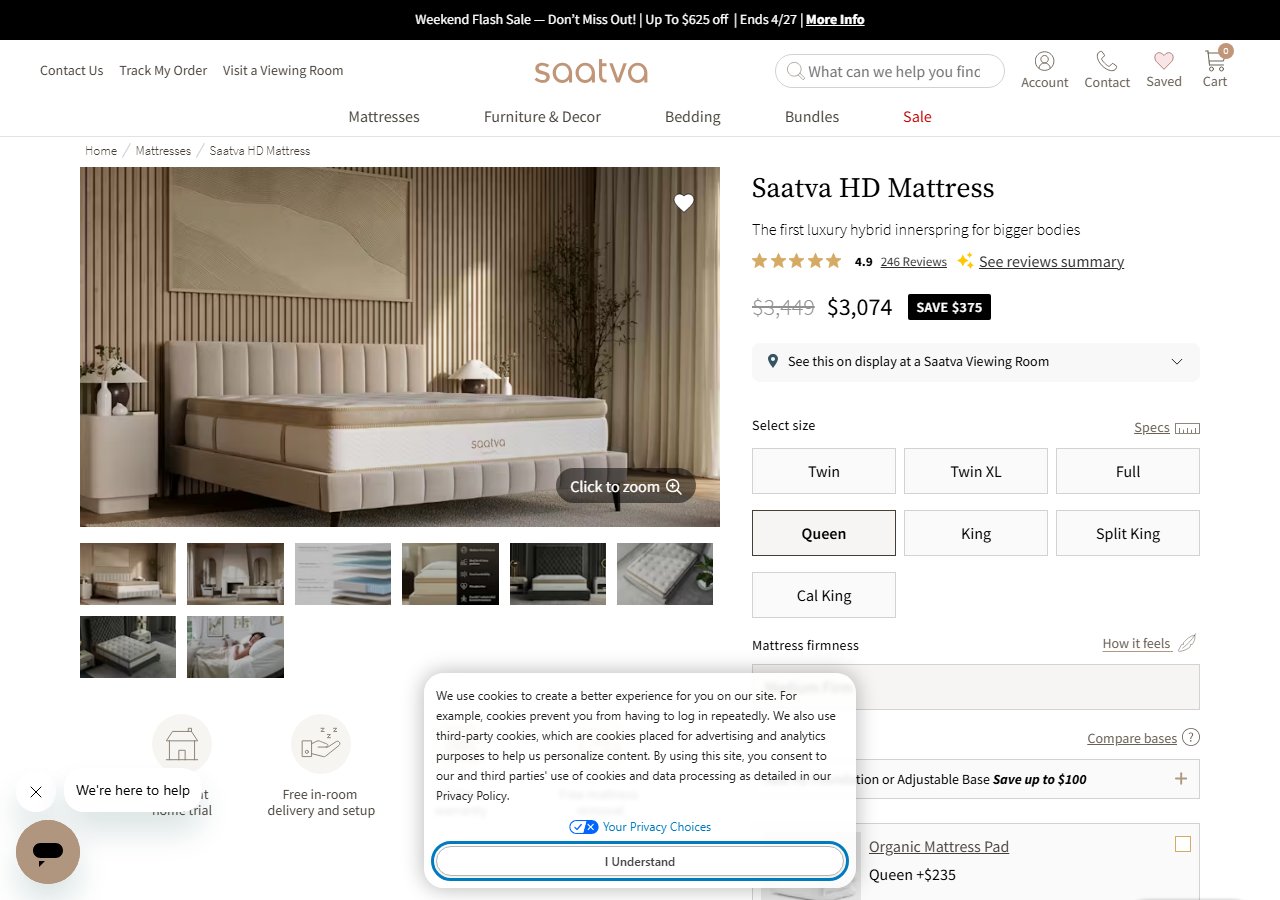
Saatva HD Mattress (Heavy-Duty)
$2,395-$3,995
See Price at Saatva →
Purple Hybrid Premier Mattress
$2,499-$4,799
See Price at Purple →What the federal data tells you to do in sequence
The hierarchy that emerges from the federal data reviewed in this article is not subtle. BLS MSD data tells you the back is the most injured body part in American workplaces. NIOSH lifting guidance tells you that the tasks generating those injuries routinely exceed safe spinal loading limits. CDC chronic pain surveillance tells you one in five Americans is already living with the downstream result. And SSA disability data tells you where that trajectory ends for workers who do not interrupt it.
The sequence that interrupts it starts with mechanics — how you lift, how you move, how you sleep. It continues with clinical evaluation if red-flag symptoms are present. It includes honest assessment of the current sleep surface if the mattress is old, visibly degraded, or demonstrably not built for your body weight. And it ends, where appropriate, with a sleep surface specifically engineered for the spinal load profile of a higher-bodyweight worker who is already giving 40 to 60 hours a week to physically demanding labor.
A $2,000 to $4,000 mattress is not a trivial purchase. But AHRQ MEPS data documenting the healthcare cost differential for adults with versus without chronic back conditions, and AHRQ HCUP data on back pain's rank among the most expensive inpatient and outpatient conditions in the U.S., suggest that the cost calculus runs in both directions. The question is not whether you can afford to address your sleep surface. It is whether the nightly recovery window your spine depends on is being supported or undermined by what you are sleeping on right now.