The Federal Data Most Back-Pain Articles Won't Show You
Here is a number that rarely appears in mattress marketing copy: according to BLS Musculoskeletal Disorders by Occupation tracking, the back is the single most common body part injured across every major U.S. occupation that results in days away from work. Not the shoulder. Not the knee. The back — every time, every industry, every year the Bureau of Labor Statistics has collected the data. For the roughly 75 million American adults who weigh 250 pounds or more, that statistic is not abstract. It is the ache that greets them before the alarm goes off.
This article is specifically for that reader: the warehouse associate, the construction tradesperson, the home health aide, the long-haul truck driver — people whose jobs already push their spines beyond safe loading limits during the day, and whose bodies are given an undersized, understiffened sleep surface to recover on at night. The federal data connecting daytime occupational loading to nighttime recovery failure is extensive. The interventions — some free, some clinical, some equipment-based — are well-documented. What has been missing is a clear through-line connecting BLS injury surveillance to the biomechanics of what happens to a 280-pound body on a mattress that was engineered for someone 80 pounds lighter.
This article builds that through-line.
Why High-Bodyweight Bodies Break Down Faster: The Biomechanics
The NIOSH Lifting Equation is one of the most consequential and least-read documents in occupational health. It establishes the maximum safe spinal compression load for repetitive manual material handling at approximately 3,400 Newtons — roughly 765 pounds of force on the lumbar spine. NIOSH research documents that workers in warehousing, construction, and healthcare routinely exceed this limit during normal job tasks: lifting boxes from floor level, repositioning patients, moving building materials overhead. What the equation cannot account for is the additional baseline compression that a heavier body imposes on spinal structures simply by existing — standing, walking, or lying down on an inadequate surface.
Here is the biomechanical reality that a 250-plus-pound person experiences that a 165-pound person does not: intervertebral disc pressure scales with body mass. The lumbar discs — L3-L4, L4-L5, L5-S1 — are the most frequently herniated and degenerated in the American population precisely because they bear cumulative compressive and shear loads from every waking moment. For a heavier worker doing physically demanding labor, those discs are absorbing compressive loads during the day that exceed what NIOSH considers safe for the average worker. Then, at night, if the sleep surface sags or lacks sufficient zoned support, the spine cannot achieve the neutral decompression position it needs for tissue repair.
The clinical consequence shows up in federal data in several ways. CDC NCHS Data Brief 390 documents that approximately 20% of U.S. adults experience chronic pain, with the lower back as the most prevalent anatomical location. AHRQ HCUP data identifies back pain as one of the most expensive conditions in U.S. healthcare measured by total inpatient and outpatient cost. SSA Disability Insurance Reports identify musculoskeletal disorders as the largest single category of new disability claims filed annually — not heart disease, not cancer, not diabetes. Musculoskeletal. The body's structural system failing under load.
For high-bodyweight workers specifically, the compounding risk is real and measurable. CDC Arthritis Data reports approximately 25% of U.S. adults carry a doctor-diagnosed arthritis diagnosis, with prevalence concentrated precisely in the occupations involving sustained physical demand — the same occupations where BLS documents the highest back-injury rates. Arthritis and disc degeneration are not the same pathology, but they share a common accelerant: mechanical overloading repeated over years without adequate recovery periods.
Sleep is the primary recovery window the body has. CDC Sleep and Sleep Disorders Data documents that approximately 35% of U.S. adults sleep fewer than 7 hours per night, the threshold below which chronic disease risk measurably rises. For heavy-bodied workers who are already managing cumulative spinal loads from demanding jobs, sleeping fewer than 7 hours on an inadequate surface is not a minor inconvenience. It is a compounding insult to a structural system that is already running at or beyond its load tolerance.
The Economic Cost Nobody Is Talking About
Before moving to interventions, it is worth naming the economic stakes plainly, because they are significant — and because high-bodyweight workers in physically demanding jobs are often least positioned to absorb healthcare costs.
BLS Employer Costs for Employee Compensation data shows that industries with high musculoskeletal disorder incidence carry workers' compensation insurance rates 3 to 5 times higher than low-MSD industries. That cost is ultimately passed through to workers in the form of suppressed wage growth, reduced benefits, and increased cost-sharing for healthcare. AHRQ Medical Expenditure Panel Survey data shows that average annual personal healthcare expenditures for adults with chronic back conditions substantially exceed costs for adults without them — a gap that compounds annually as the condition progresses. CMS Drug Spending Dashboard data identifies opioid and non-opioid pain medication spending among the most expensive Medicare drug categories, reflecting a chronic-pain treatment burden that is, in substantial part, a downstream consequence of undertreated musculoskeletal injury.
The point is not to be alarmist. The point is that preventing spinal degeneration — through movement, posture, sleep surface support, and appropriate clinical care — is not a luxury purchase decision. It is a healthcare decision with measurable economic implications.
Try These First: Free and Low-Cost Interventions That Federal Research Supports
The cheapest intervention is the one that does not require buying anything. Before reaching for a new mattress or any other product, the federal evidence base supports a specific set of behavioral and mechanical changes that can meaningfully reduce chronic back pain burden — particularly for high-bodyweight individuals whose pain has a strong mechanical origin.
Sleep position is the biggest free variable available to you. NIH National Institute of Arthritis and Musculoskeletal and Skin Diseases back pain guidance is specific: side-sleeping with a pillow between the knees keeps the pelvis level and the lumbar spine neutral; back-sleeping with a pillow under the knees reduces lumbar lordosis and disc pressure. Stomach-sleeping twists the cervical spine and forces lumbar hyperextension — it is the worst mechanical position for anyone with existing low back pain, and the physics are more punishing at higher body weights because the abdomen sinks deeper into the sleep surface and exaggerates the lumbar curve. This costs nothing to change. It takes about two weeks of conscious repositioning to retrain the habit.
Daily walking is among the most evidence-supported interventions for chronic low back pain. An NIH NCCIH evidence review on low back pain found that 30 minutes of walking on most days reduces chronic low back pain as effectively as most non-drug clinical treatments — including many physical therapy protocols. For heavy-bodied workers who are already on their feet for long shifts, this guidance may feel counterintuitive: more walking when the job already involves standing? The difference is in the mechanical quality of the movement. Walking on a flat surface at a self-selected pace activates lumbar stabilizers without imposing the asymmetric shear loads that manual material handling generates. It is therapeutic locomotion, not occupational loading.
Lifting and bending mechanics reduce acute injury risk in measurable ways. OSHA's Ergonomics Solutions guidance specifies the key mechanical habits: hinge at the hips rather than rounding the lumbar spine, keep loads close to the body's center of mass, avoid twisting under load. Most acute back episodes in warehouse and construction settings are not freak accidents — they are the predictable result of mechanical habits that place shear force on discs that are already under compressive load. These mechanics are teachable and rehearsable. They are also the most important behavioral intervention for workers whose jobs require manual material handling, because a mattress cannot protect a disc that is failing under a 600-Newton shear load during a 10-hour shift.
When the mattress itself is the problem, replace it. CDC Sleep Hygiene guidance points to sleep surface condition as a meaningful contributor to sleep quality. Practical indicators that the mattress is actively contributing to pain: visible sag or body impressions deeper than about three-quarters of an inch, waking up stiffer than you went to bed consistently across multiple weeks, or a mattress older than 7 to 10 years. Even the most expensive replacement mattress on the market does not undo poor sleep hygiene or a sedentary lifestyle — but a mattress that is actively sagging and failing to support a heavier body is compounding the structural damage the daytime load is already doing.
Some readers will have already worked through the behavioral interventions above — they sleep on their side, they walk, they have replaced a sagging mattress — and they still wake up with significant lumbar pain or hip pressure. For that reader, the problem is not behavior. It is that most mattresses are not engineered for bodies above 250 pounds. The coil gauge, the foam density, the edge-support system, the pressure-relief zoning — all of it is typically calibrated for a population median that is 80 to 100 pounds lighter. The following section covers clinical red flags that warrant a clinician visit before any equipment decision, followed by a curated set of sleep surfaces that are specifically engineered for heavier load profiles.
When to See a Clinician Before Buying Anything
Back pain in high-bodyweight individuals carries a broader differential diagnosis than the same symptom in someone without the biomechanical risk factors documented above. A sleep surface change is appropriate for mechanical, positional back pain — the kind that is worse in the morning, improves with movement, and has no neurological features. It is not appropriate, and may delay important care, when pain has features that indicate something more serious.
NIH National Institute of Neurological Disorders and Stroke back pain guidance is specific about red flags that require prompt clinical evaluation rather than a product intervention. These are detailed in the red flags section below. The short version for a high-bodyweight worker: if your pain radiates below the knee (not just into the buttock or upper thigh), if you have any change in bladder or bowel function, if the pain followed a fall or direct trauma, or if you have unexplained fever alongside back pain — stop reading mattress reviews and make a clinician appointment. Those symptoms can indicate nerve compression, spinal instability, or in rare cases, systemic disease. No mattress addresses any of those.
The economic data is also relevant here: AHRQ MEPS data documents that delayed diagnosis of progressive spinal conditions significantly increases lifetime healthcare costs. An early imaging study or physiatrist evaluation is dramatically cheaper than the downstream costs of an untreated condition that progresses to surgical intervention or permanent disability. The SSA Disability Insurance data on musculoskeletal disorders as the leading new disability category is, in part, a record of conditions that were not caught and managed early.
Where Products Help: Sleep Surfaces Engineered for Heavier Bodies
For the reader who has addressed sleep position, maintains regular movement, has a job with physical demands that cannot be fully mitigated, and does not have red-flag symptoms — the sleep surface becomes a clinically meaningful variable. The distinction between a mattress engineered for a 175-pound occupant and one engineered for a 300-pound occupant is not marketing language. It is a matter of coil gauge, foam density, and progressive support systems that either function or fail under compressive load.
The first product worth considering for this reader profile is the Saatva HD Mattress. Saatva built the HD specifically for the heavy-duty use case — it is rated for occupants up to 500 pounds per side and uses a dual-coil system with a 13-gauge tempered steel base layer topped by a micro-coil comfort layer, which provides progressive resistance that increases as bodyweight compresses the surface. For a 280-pound warehouse worker with chronic lumbar pain, this architecture matters: a standard innerspring mattress will begin to bottom out at high bodyweight, eliminating the pressure-relief zone and transferring load directly to the coil base. The HD's dual-coil system maintains both pressure relief and spinal support across the weight range this reader actually inhabits. At $2,395 to $3,995 depending on size, it is a significant purchase — but in the context of the AHRQ MEPS data showing substantially higher lifetime healthcare costs for adults with chronic back conditions, the math for a purpose-engineered sleep surface is more defensible than it might appear.
For the reader whose primary complaint is pressure buildup at the hips and shoulders — common in heavier side-sleepers whose pressure points generate significantly more force per square inch than lighter occupants — the Saatva Loom & Leaf Memory Foam Mattress is the premium foam option to evaluate. The Loom & Leaf uses a multi-layer construction with cooling gel memory foam over a high-density base foam, and Saatva offers it in both Relaxed Firm and Firm configurations. For a heavy-bodied side-sleeper, the Relaxed Firm configuration provides the contouring needed to reduce hip and shoulder pressure while the high-density base foam resists the progressive sag that lower-density foam exhibits under sustained high bodyweight. Memory foam's visco-elastic properties allow it to distribute load across a larger surface area than coil systems, which can reduce peak pressure at bony prominences — relevant for any reader who is waking with hip pain or lateral leg numbness.
The third option addresses a different problem: heat retention and pressure relief simultaneously. Heavier bodies generate more heat at the sleep surface and exert higher compressive force on foam layers, which can cause heat-trapping foam to feel uncomfortable across a full sleep cycle. The Purple Hybrid Premier Mattress uses Purple's proprietary GelFlex Grid — a hyper-elastic polymer grid that does not foam-compress under heat, maintains its pressure-relief geometry across the full bodyweight range, and allows airflow through the grid structure. For a heavy-bodied worker who has tried memory foam and found it hot and eventually bottoming-out, the Purple Hybrid Premier offers a materially different mechanical approach: the grid provides column-buckling pressure relief at high-load points (hips, shoulders) while maintaining pushback and support at lower-load points (lumbar, calves). At $2,499 to $4,799, it is the highest price point of the three, but for a reader who has already cycled through two or three foam mattresses that failed under their bodyweight, the durability argument of a non-foam comfort layer is worth the premium.
Sleep Surfaces Engineered for High-Bodyweight Back Pain Relief
These three mattresses were curated specifically for adults 250 pounds and above who carry occupational spinal loading risk — each addresses a distinct failure mode that standard mattresses exhibit under heavier bodyweight.

Saatva Loom & Leaf Memory Foam Mattress
$1,695-$3,295
See Price at Saatva →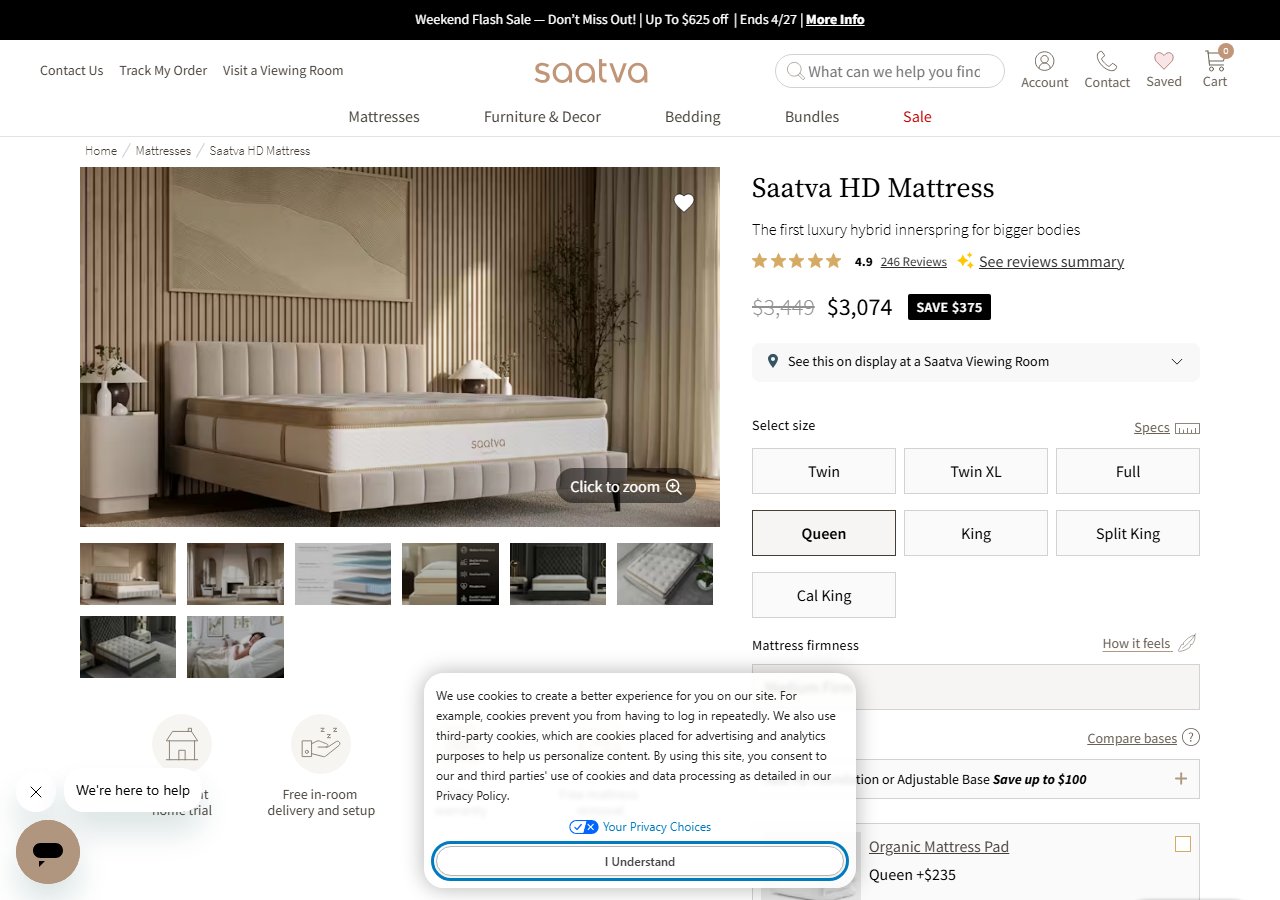
Saatva HD Mattress (Heavy-Duty)
$2,395-$3,995
See Price at Saatva →
Purple Hybrid Premier Mattress
$2,499-$4,799
See Price at Purple →What the Data Actually Recommends
Pulling the federal evidence base together, the through-line for a high-bodyweight adult managing chronic or recurrent back pain is consistent across agencies and data sets. The BLS documents the injury. NIOSH documents the mechanism. CDC documents the prevalence and the sleep shortfall. SSA documents the disability endpoint. AHRQ documents the economic cost. And the NIH and NCCIH document what actually helps, in priority order: movement, sleep position, mechanical hygiene during the workday, and — when those are optimized — an appropriate sleep surface.
A mattress engineered for a lighter occupant is not neutral for a 280-pound body. It is an active stressor. It sags, it creates pressure points, it fails to maintain the spinal alignment that the back's overnight repair process depends on. That is not a sales argument for any specific product — it is a mechanical reality that follows from the same engineering principles the NIOSH Lifting Equation uses to set safe spinal load limits during the workday.
The Saatva HD, the Saatva Loom & Leaf, and the Purple Hybrid Premier each address specific failure modes that standard mattresses exhibit under high-bodyweight loading. None of them is a substitute for the behavioral interventions — sleep position, daily walking, proper lifting mechanics — that the NIH and NCCIH evidence base consistently identifies as the highest-leverage chronic back pain interventions. But for the reader who has done the behavioral work and is still waking up in pain on a surface that was not built for their body, the federal data and the biomechanics both point in the same direction: the sleep surface is not a luxury variable. It is a recovery infrastructure decision with real health consequences.
For any reader with red-flag symptoms — radiating leg pain, neurological changes, post-trauma pain, fever — the answer is a clinician appointment, not a new mattress. The federal data on delayed musculoskeletal diagnosis is unambiguous on that point. But for the large and underserved population of heavier adults managing mechanical back pain from demanding occupational loading, the combination of free behavioral interventions and a purpose-engineered sleep surface represents the most evidence-grounded path to consistent, restorative sleep.