The compounding load problem nobody talks about
According to BLS Musculoskeletal Disorders by Occupation data, the back is the most commonly injured body part across every occupational category that generates days away from work in the United States. That fact alone is alarming. But for adults weighing 250 pounds or more, the underlying injury math is considerably worse — because bodyweight does not pause when the work shift ends. It follows you home, onto your couch, and into your bed, where it either gets managed by a sleep surface engineered for the load or quietly grinds another eight hours of wear into already-stressed spinal structures.
CDC NCHS Data Brief 390 reports that approximately 20% of U.S. adults experience chronic pain, with the lower back identified as the single most common pain location. The same federal surveillance infrastructure that tracks this chronic pain burden also documents the cost spiral: AHRQ HCUP data places back pain among the most expensive conditions in American healthcare by combined inpatient and outpatient expenditure, and AHRQ MEPS data confirms that adults living with chronic back conditions carry personal healthcare expenditures that substantially exceed those of adults without such conditions. The CMS Drug Spending Dashboard further identifies opioid and non-opioid pain medication among the most expensive Medicare drug categories — a downstream consequence of undertreated and poorly-managed back pain that could, in many cases, have been interrupted earlier in the disease progression.
This is not a small population problem. SSA Disability Insurance data identifies musculoskeletal disorders as the single largest category of new disability claims filed annually in the United States. That number has real names behind it: warehouse associates who spent years loading trailers at weights exceeding the NIOSH Lifting Equation's recommended spinal load limits, construction workers whose daily material-handling tasks routinely pushed past safe compression thresholds, healthcare aides who transferred patients shift after shift without adequate mechanical assist. For heavier workers in these occupations, the injury risk is not additive — it is multiplicative.
Why bodyweight changes the biomechanics of back injury
Spinal compression during lifting and bending is not a linear function of effort — it is a function of body weight, moment arm, and load positioning. The NIOSH Lifting Equation was designed to identify when manual material-handling tasks exceed a recommended weight limit that accounts for spinal compression forces; it documents that tasks across warehousing, construction, and healthcare routinely violate those limits even for average-weight workers. For a worker at 280 pounds executing the same lift as a 170-pound coworker, the lumbar compressive force is meaningfully higher — because the trunk weight itself is part of the moment load on the L4-L5 and L5-S1 discs that bear the brunt of nearly every bending and lifting motion.
Intervertebral discs are hydraulic structures. They absorb compressive force during waking hours and rehydrate during sleep — but only if the spine is held in a roughly neutral position during that rest period. A mattress that sags under higher body weight forces the lumbar spine into flexion or extension throughout the night, effectively denying those discs the recovery window they need. After years of occupational overload followed by nights of poor positional support, the cumulative disc degeneration is exactly what you would predict from basic biomechanics — and exactly what the BLS injury surveillance data reflects.
CDC Arthritis data shows that approximately 25% of U.S. adults report doctor-diagnosed arthritis, with prevalence concentrated in occupations involving sustained physical demand. Arthritis and disc degeneration are not the same condition, but they share a common risk amplifier in higher-bodyweight individuals: excess mechanical load on joints and discs over decades of work and sleep. The facet joints of the lumbar spine, the sacroiliac joint, and the hip joints all contribute to chronic back pain in this population, and all of them are load-sensitive structures that respond to both daytime mechanics and nighttime positioning.
The sleep deprivation layer adds another compounding factor. CDC sleep surveillance data shows approximately 35% of U.S. adults report sleeping fewer than 7 hours per night — the threshold below which chronic disease risk climbs substantially. Pain is bidirectional with sleep: pain disrupts sleep architecture, and sleep deprivation amplifies pain sensitivity through well-documented neurological pathways. Higher-bodyweight adults with back pain who sleep on inadequate surfaces are often caught in exactly this cycle: their sleep surface aggravates their pain, their pain fragments their sleep, and their sleep fragmentation heightens their pain perception the following day.
BLS Employer Costs for Employee Compensation data shows that industries with high musculoskeletal disorder incidence carry workers' compensation insurance rates 3 to 5 times higher than low-MSD industries. That rate premium reflects the actual injury frequency and severity employers are experiencing — and for workers in those industries who are also managing higher body weight, the personal injury risk is concentrated even further. Back injury is not an abstract actuarial risk for this reader. It is a lived occupational reality with documented federal data behind every dimension of its cost and prevalence.
Try these first: the interventions that cost nothing
Before this article gets anywhere near a product recommendation, it is worth stating plainly: the cheapest intervention is the one that does not require buying anything. Federal research supports several non-product approaches to chronic back pain management that have better evidence behind them than most marketed sleep products. If you have not systematically tried these, start here.
Sleep position is the largest free variable in your overnight spinal load. NIH guidance on back pain recommends side-sleeping with a pillow between the knees, or back-sleeping with a pillow placed under the knees, to maintain lumbar neutral alignment. Stomach-sleeping torques the lumbar spine into extension and rotation simultaneously — one of the most mechanically hostile positions for degenerated discs or facet arthritis — and should be actively avoided. A pillow repositioning costs nothing.
Daily movement has a stronger evidence base than most people expect. The NIH NCCIH evidence review on low back pain documents that walking 30 minutes on most days reduces chronic low back pain as effectively as most non-drug clinical treatments. This is a federal agency's own synthesis of the comparative evidence. A new mattress helps maintain a neutral sleep position; it does not substitute for the muscular conditioning that walking, swimming, or physical therapy builds into the supporting structures around the lumbar spine.
Lifting mechanics are rehearsable. OSHA's ergonomics guidance recommends hinging at the hips rather than the lumbar spine, keeping loads close to the body's center of mass, and avoiding twisting under load. Most acute back episodes are mechanical events — preventable with practiced movement patterns rather than passive treatment. For workers in physical occupations, this is not optional ergonomics training; it is the difference between a reinjury cycle and a durable recovery.
Mattress replacement criteria are more objective than marketing suggests. CDC sleep hygiene guidance supports replacing a mattress when it shows visible sag, when you wake consistently stiffer than you went to bed, or when it is older than 7 to 10 years. A mattress past these thresholds is actively undermining your recovery, regardless of what you paid for it.
For readers who have already addressed sleep position, added regular walking, corrected their lifting mechanics, and replaced a visibly degraded mattress — but who still wake with stiffness and pain — the evidence supports looking at sleep surface engineering more specifically. Higher-bodyweight adults require mattresses built to different specifications than average-population products: deeper comfort layers, higher-density support cores, edge support rated for greater load distribution, and materials that resist progressive compression over years of nightly use. The next section covers when symptoms warrant a clinical referral before any equipment decision, followed by three surfaces that actually meet the load specifications this reader needs.
When to see a clinician: red flags that a mattress cannot fix
Back pain in higher-bodyweight adults carries a somewhat different differential diagnosis than it does in the general population, and certain symptom patterns demand clinical evaluation — not a new mattress, not a foam topper, not a trial of OTC anti-inflammatories. NIH neurological disorder guidance on back pain identifies the following as reasons to seek prompt medical evaluation: pain that radiates below the knee (possible nerve root compression or disc herniation with radiculopathy), pain that developed following trauma, pain accompanied by leg weakness or sensory changes, pain associated with bowel or bladder dysfunction, and pain accompanied by fever or unexplained weight loss. These are not presentations where sleep surface optimization is the right lever.
For heavier adults specifically, clinicians should also be evaluating for sleep apnea as a co-occurring condition that independently fragments sleep architecture and amplifies pain perception. A sleep surface that elevates the head of the bed may reduce apneic episodes in mild cases, but diagnosed obstructive sleep apnea requires formal treatment — typically CPAP therapy — not equipment substitution. If you are waking repeatedly through the night without a clear mechanical explanation, ask your clinician about a sleep study before attributing the problem entirely to your mattress. The CDC sleep surveillance data that shows 35% of U.S. adults sleeping under 7 hours per night does not distinguish between sleep disruption caused by pain, by apnea, by poor sleep hygiene, or by an inadequate surface — but your clinician can.
Where a reinforced sleep surface actually helps
For higher-bodyweight adults who have cleared the clinical red flag checklist, addressed the free interventions above, and are still experiencing the specific pattern of waking with lumbar stiffness that improves over the first hour of the morning — a reinforced sleep surface is a legitimate tool. The key qualifier is "reinforced." Standard consumer mattresses are engineered for median body weights, which means their support cores and comfort layers are calibrated to roughly 180 to 200 pounds. At 250, 280, or 300-plus pounds, those cores compress beyond their design range, sagging becomes chronic within 2 to 3 years, and the lumbar support that the mattress was advertised as providing effectively disappears under load.
Three surfaces meet the engineering specifications this reader actually needs.
The Saatva HD Mattress is the most direct engineering answer to the heavy-bodyweight problem on this list. Saatva engineered the HD explicitly for users up to 500 pounds, using a dual-coil construction — individually wrapped microcoils on top of a tempered steel Bonnell spring base — that distributes load across a larger contact surface than any single-layer coil or foam system. The lumbar zone reinforcement in the HD targets the L4-L5 area specifically, which is precisely the spinal segment that BLS and NIOSH data shows bears the highest compressive load in lifting and bending tasks common to physical occupations. This is not a rebranded standard mattress with a higher weight rating sticker; the HD's coil gauge, coil count, and foam density specifications are meaningfully different from Saatva's standard line. For warehouse workers, construction workers, and healthcare workers in the 250-plus-pound range who are managing occupational back injury histories, the HD's engineering rationale is directly traceable to the biomechanical problem federal data documents.
The Saatva Loom & Leaf Memory Foam Mattress addresses a different but overlapping subset of this reader population: adults whose primary complaint is pressure-point pain — hips, shoulders, and lumbar — rather than the global support failure that comes from a mattress core collapsing under load. Loom & Leaf uses a 5-pound-density memory foam comfort layer, which is at the upper end of the consumer density range and resists the premature compression that lower-density foams (2 to 3 pounds per cubic foot) develop within the first year under heavier users. The gel-infused top layer addresses the heat retention that memory foam is historically criticized for — relevant for heavier sleepers who run warmer. Loom & Leaf is available in a Relaxed Firm configuration that the company recommends specifically for back sleepers managing lumbar pain, which aligns with the NIH guidance on sleep position referenced above. For adults whose back pain manifests primarily as morning hip and shoulder stiffness — typical of arthritis in the facet joints and SI joint — the pressure-relieving properties of high-density memory foam over a stable support core offer a biomechanically sensible intervention.
The Purple Hybrid Premier Mattress occupies a distinct engineering category from either Saatva option. Purple's GelFlex Grid is a hyperelastic polymer grid rather than foam or coil — it collapses under point-pressure loads (like bony prominences at the hip and shoulder) while simultaneously providing firm, consistent support under broader distributed loads (like the lumbar region). For combination sleepers — adults who shift between side and back positions through the night — the grid's pressure-responsive behavior means the mattress adapts to different load geometries without requiring the sleeper to stay in a single position. The Hybrid Premier places the GelFlex Grid over a pocketed coil base, which provides the edge support and motion isolation that matters for heavier adults sharing a bed. The grid does not retain body heat the way foam does, which addresses a comfort complaint that disproportionately affects higher-bodyweight sleepers. Purple's Hybrid Premier is the most expensive option on this list, and its engineering is genuinely differentiated from foam and spring competitors — but it is also the least validated by long-term industry wear testing at high bodyweights, which is worth acknowledging.
Sleep Surfaces Engineered for High-Bodyweight Spinal Support
These three mattresses were selected specifically for adults 250 pounds and over managing occupational back injury histories — each chosen for load-rated construction, lumbar zone support, and materials that resist premature compression under sustained high bodyweight use.

Saatva Loom & Leaf Memory Foam Mattress
$1,695-$3,295
See Price at Saatva →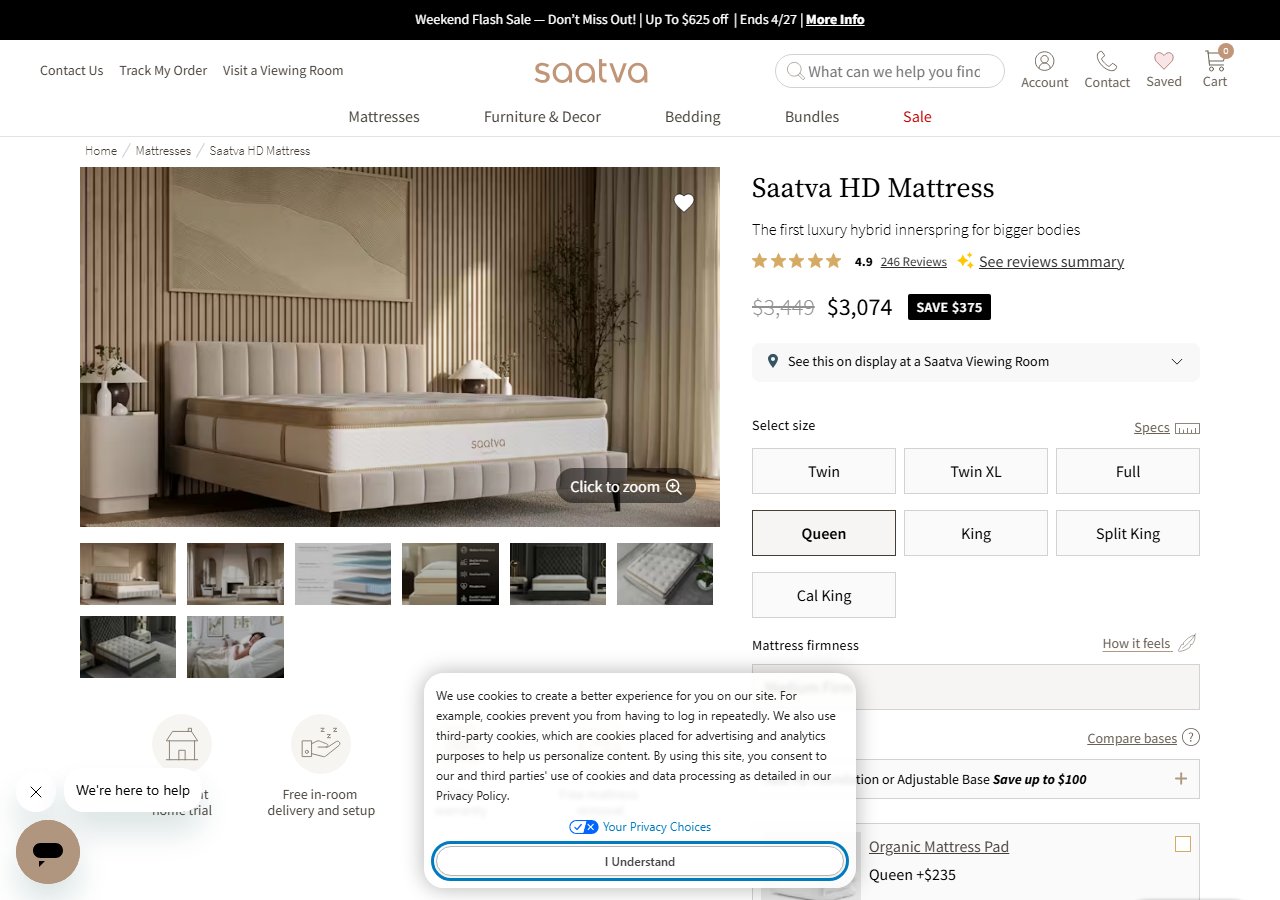
Saatva HD Mattress (Heavy-Duty)
$2,395-$3,995
See Price at Saatva →
Purple Hybrid Premier Mattress
$2,499-$4,799
See Price at Purple →Putting it together: a data-to-intervention hierarchy
The federal data tells a consistent story. BLS surveillance confirms the back as the most common injury site across U.S. occupations. NIOSH's Lifting Equation documents that the tasks generating those injuries routinely exceed safe spinal compression limits — a problem that is amplified by higher body weight. CDC chronic pain data shows 20% of U.S. adults living with the downstream consequences. AHRQ cost data quantifies the financial burden of undertreating that pain, and SSA disability data documents where severe cases ultimately land.
None of that data points to a mattress as the primary solution. The primary solutions are movement (walking, physical therapy, strength training), lifting mechanics, sleep position optimization, and clinical management of underlying conditions. A reinforced sleep surface is a legitimate adjunct for the specific subgroup of higher-bodyweight adults who have addressed those upstream variables and still experience the overnight load management failure that inadequate mattress engineering produces.
If you are in that subgroup, the three surfaces above were selected because their engineering specifications — coil gauge, foam density, load rating, and lumbar zone reinforcement — are traceable to the actual biomechanical problem federal data documents. They are not the cheapest options available, and they are not the only options. But for adults whose backs have spent years absorbing occupational load at the upper end of what the NIOSH equation considers safe, a sleep surface that holds up under that same load for 8 to 10 years is not a luxury purchase. It is part of the recovery infrastructure.