The federal injury record is unambiguous: your back is the most likely thing to break
According to BLS Musculoskeletal Disorders by Occupation tracking, the back is the single most commonly injured body part across all U.S. occupations that result in days away from work. Not hands. Not knees. The back — the structure you sleep on for seven to eight hours a night, then load repeatedly through every lift, carry, bend, and twist of a working day. For workers in physically demanding trades — warehousing, construction, long-haul transport, healthcare — that injury pattern is not a statistical abstraction. It is a lived reality that shows up as stiffness at 5 a.m., ibuprofen at lunch, and a grinding calculation about how many more years the body can sustain the current workload.
For individuals at or above 250 lbs, the mathematics of spinal loading change in ways that neither standard ergonomic guidance nor standard consumer mattresses fully account for. This article is built around the federal data that explains why, the free and low-cost interventions that should come first, and — for readers who have already tried those — the class of reinforced sleep surfaces that engineering and materials science have developed for higher-bodyweight sleepers.
Why this happens: the biomechanics of spinal load and bodyweight
The NIOSH Lifting Equation is the federal government's primary framework for quantifying safe spinal loading during manual material handling. It establishes a Recommended Weight Limit — the load below which 99% of male workers and 75% of female workers can perform a task without unacceptable spinal compression. The critical finding for this audience: across warehousing, construction, and healthcare, NIOSH documents that actual task loads routinely exceed these limits. That means millions of workers are already accumulating spinal microtrauma during their working hours, before they ever lie down.
Bodyweight amplifies this mechanism in two compounding ways. First, higher body mass increases the compressive load on lumbar intervertebral discs during any weight-bearing task — standing, walking, and especially lifting — because the spine must support not just the external load but the mass of the torso above it. Research in occupational biomechanics consistently shows that lumbar disc pressure scales with body mass index even in static postures. Second, and critically for this article, the same principle applies in the horizontal position during sleep. A person weighing 280 lbs places roughly 40–50% more pressure per unit area on a standard mattress than a 175-lb person does. If the mattress lacks the structural foundation to maintain support under that load, the heavier sleeper's hips and shoulders sink disproportionately, driving the lumbar spine out of neutral alignment — often into flexion or lateral bend — for the entire sleep period.
The result is a compounding cycle that occupational health researchers describe as incomplete recovery. The spine arrives at the sleep surface already stressed from the day's loading. If the sleep surface cannot maintain spinal neutral, the 7–8 hours that should allow disc rehydration and soft tissue repair instead extend the inflammatory period. The sleeper wakes stiffer, starts the next working day with a higher pain baseline, and moves less efficiently — increasing the risk of the acute injury event that BLS data is capturing.
CDC NCHS Data Brief 390 puts a population number on the downstream consequence: approximately 20% of U.S. adults live with chronic pain, and lower back pain is the most common reported location. Meanwhile, CDC Sleep and Sleep Disorders data shows that roughly 35% of U.S. adults sleep fewer than the 7-hour threshold associated with elevated chronic disease risk. These two figures overlap heavily in the physically demanding worker population — a group that often works irregular shifts, has limited access to preventive care, and carries higher rates of obesity-associated comorbidities that further load the spine.
The downstream economic signal is severe. AHRQ HCUP data identifies back pain as one of the most expensive conditions in U.S. healthcare by combined inpatient and outpatient cost. AHRQ MEPS data shows that adults with chronic back conditions spend substantially more annually on personal healthcare than those without. CMS drug spending data identifies opioid and non-opioid pain medication among the most expensive Medicare drug categories — a direct reflection of the chronic-pain treatment burden that inadequately resolved musculoskeletal injury creates. And SSA Disability Insurance data confirms that musculoskeletal disorders are the largest single category of new disability claims filed annually — meaning back injury is not just a healthcare cost driver but an employment disruption event at population scale.
For employers, BLS Employer Costs for Employee Compensation data shows that industries with high MSD incidence carry workers' compensation insurance rates 3–5 times higher than low-MSD industries. The worker bears the pain; the employer bears the premium; the healthcare system absorbs the spending. None of that math includes the cost of the sleep surface.
Try these first — the interventions that cost nothing
Before we discuss any product, the federal evidence record is clear that several high-leverage interventions are available at zero cost or very low cost. The cheapest intervention is always the one that does not require buying anything. For the high-bodyweight worker with chronic or recurrent back pain, four interventions have meaningful federal-evidence backing and should be exhausted — or at minimum attempted — before a mattress purchase enters the decision.
Sleep position is the most immediately actionable. NIH National Institute of Arthritis and Musculoskeletal and Skin Diseases guidance recommends side-sleeping with a pillow between the knees, or back-sleeping with a pillow under the knees, to maintain lumbar neutral. Stomach-sleeping — common in higher-bodyweight individuals who feel pressure discomfort in other positions — torques the lumbar spine into hyperextension and exacerbates chronic pain. A $12 pillow repositioned between the knees is often worth trying before a $2,000 mattress upgrade.
Daily walking has a stronger evidence base for chronic low back pain than most people expect. NIH NCCIH's Low-Back Pain In Depth review documents that 30 minutes of walking most days reduces chronic low back pain as effectively as most non-drug clinical treatments. For workers in sedentary-adjacent roles — long-haul driving, desk-based supervision, post-injury light duty — the movement deficit may be as much a pain driver as the sleep surface deficit.
Lift and bending mechanics are modifiable before the injury event, not after. OSHA's Ergonomics Solutions guidance codifies what the NIOSH Lifting Equation implies: hinge at the hips, not the lumbar spine; keep loads close to the body; never twist under load. Most acute back episodes in physically demanding work are mechanical and rehearsable. Employers are required to provide ergonomics training; workers should demand it.
Mattress replacement criteria matter before the brand decision. CDC Sleep Hygiene guidance and general sleep medicine consensus support replacing a mattress when there is visible sag, when waking stiffness exceeds bedtime stiffness, or when the mattress is older than 7–10 years. Those are the meaningful diagnostic criteria. If none of these apply, a new mattress is unlikely to resolve the pain.
For readers who have already applied sleep position changes, incorporated movement, corrected lifting mechanics, and are still sleeping on a sagging or structurally inadequate surface — or who have always slept on a mattress engineered for a 175-lb sleeper when they weigh 285 lbs — the evidence that sleep surface architecture matters for spinal support is real, and the engineering differences between standard and reinforced mattresses are meaningful. The following sections address that decision specifically.
When to see a clinician — red flags that a mattress cannot fix
There is a subset of back pain presentations for which a sleep surface change is not only insufficient but potentially a delay of necessary care. NIH National Institute of Neurological Disorders and Stroke back pain guidance identifies several clinical red flags that require prompt professional evaluation rather than a lifestyle or product intervention. These include pain that radiates below the knee (suggesting nerve root compression), back pain that follows a traumatic event, pain accompanied by leg weakness or numbness, any change in bowel or bladder function associated with the back pain episode, and back pain accompanied by unexplained fever or unintended weight loss.
For the higher-bodyweight worker population specifically, two additional signals warrant attention. First, CDC Arthritis data shows that approximately 25% of U.S. adults have doctor-diagnosed arthritis, with prevalence highest in physically demanding occupations. Inflammatory arthritis involving the spine — ankylosing spondylitis, psoriatic arthritis — presents with morning stiffness lasting more than 45 minutes and improves with movement, a pattern that can be misattributed to mattress inadequacy. Second, obesity-associated lumbar spinal stenosis produces positional pain (worse with standing and walking, relieved by flexion) that requires imaging to distinguish from simple mechanical back pain. If your pain does not follow the pattern of mechanical low back pain — worse with specific movements, improved with position change or rest — see a clinician before spending money on any sleep surface.
Where products help — and which ones are engineered for this load
For the reader who has addressed sleep position, incorporated movement, is not presenting red-flag symptoms, and is sleeping on a mattress that sags, is older than a decade, or was simply never designed for a sleeper above 200 lbs — the engineering of the sleep surface matters in ways that are quantifiable.
A standard innerspring or foam mattress is typically engineered to support sleepers in the 130–200 lb range. Above that range, several structural failure modes emerge: foam compression rates increase, independently pocketed coil systems bottom out, and edge support — critical for heavier sleepers getting in and out of bed and for spinal alignment near the perimeter — degrades faster. Reinforced or heavy-duty mattresses address these failure modes through higher-density foam layers, stronger gauge coil systems with higher coil counts, and reinforced perimeter edge support structures.
The three products identified for this article were selected specifically for their engineering credentials relative to higher-bodyweight sleepers and chronic back pain presentations.
Saatva HD Mattress is Saatva's purpose-built heavy-duty model, engineered specifically for sleepers up to 500 lbs and priced between $2,395 and $3,995 depending on size. The structural architecture includes a high-gauge tempered steel coil system — 12.5 gauge versus the 14–15 gauge coils typical in standard models — layered with lumbar zone targeting and high-resilience foam. For the warehouse worker or construction laborer at 270 lbs who has been sleeping on a conventional mattress that offers neither the coil strength nor the zone differentiation their weight and injury history requires, this is the most directly matched product in this list. The lumbar support zone is not a marketing claim — it is a distinct foam density variation in the center third of the mattress that resists the sag pattern most damaging to the already-loaded lumbar spine.
Saatva Loom & Leaf Memory Foam Mattress is the premium memory foam option in this set, priced $1,695 to $3,295. For higher-bodyweight sleepers who present primarily with pressure pain — hip pain, shoulder pain in side-sleeping positions — rather than lumbar instability, dense memory foam has a stronger evidence base for pressure redistribution than open-coil systems. The Loom & Leaf uses 5-pound density memory foam, significantly denser than the 3–3.5 pound foam in most bed-in-a-box competitors, which translates to better load distribution and slower compression degradation under higher bodyweights. The Relaxed Firm option — the firmer of the two available feels — is the appropriate selection for most higher-bodyweight side-sleepers with back pain history, providing the pressure relief of memory foam without the excessive sink that would drive the spine out of neutral.
Purple Hybrid Premier Mattress rounds out the set as the premium pressure-relief pick, priced $2,499 to $4,799. Purple's GelFlex Grid is a meaningfully different material from foam: a hyper-elastic polymer grid that collapses under point pressure (shoulders, hips) while remaining rigid under distributed pressure (the lower back and thighs). For a higher-bodyweight sleeper with concurrent hip and lumbar pain, this dual behavior is architecturally relevant — it does what neither memory foam nor innerspring does cleanly, which is simultaneously relieve pressure at bony prominences while maintaining support at the lumbar spine. The Hybrid Premier adds a coil support layer beneath the grid, which extends the load-bearing capacity meaningfully above what the grid-only models provide.
Reinforced Sleep Surfaces for Higher-Bodyweight Sleepers with Back Pain
These three mattresses were selected for their structural engineering credentials relative to sleepers at 250 lbs and above — specifically for coil gauge, foam density, lumbar zone targeting, and edge support durability under higher sustained loads.

Saatva Loom & Leaf Memory Foam Mattress
$1,695-$3,295
See Price at Saatva →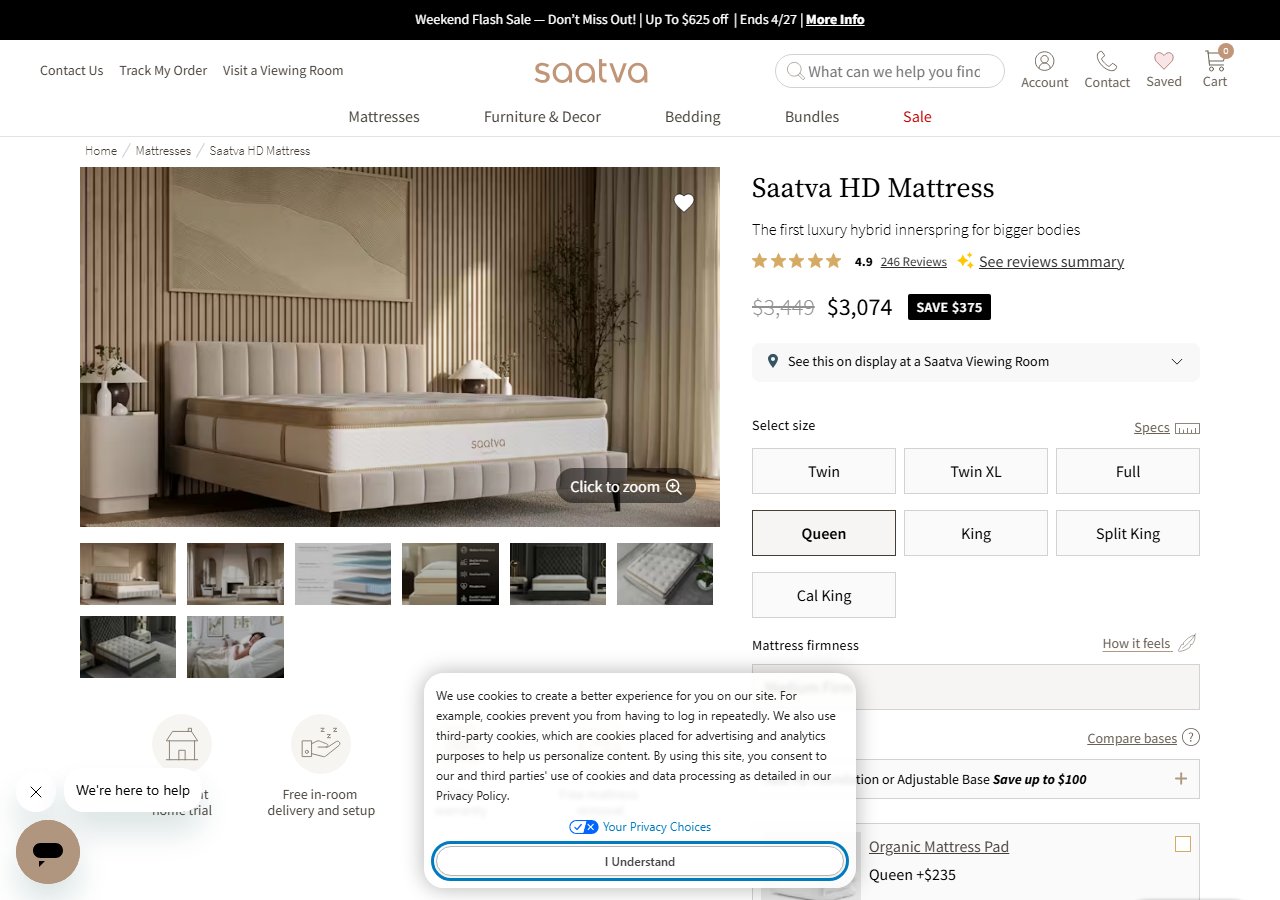
Saatva HD Mattress (Heavy-Duty)
$2,395-$3,995
See Price at Saatva →
Purple Hybrid Premier Mattress
$2,499-$4,799
See Price at Purple →The hierarchy that federal data supports
The sequence in this article is deliberate and rooted in what the federal evidence record actually supports. BLS documents the injury. NIOSH quantifies the mechanical overload. CDC NHANES captures the population-level chronic pain prevalence. AHRQ and SSA document the cost cascade when the injury is not resolved. And the interventions — sleep position correction, daily walking, proper lift mechanics — have stronger evidence support for chronic low back pain management than any specific mattress does.
That does not mean sleep surfaces are irrelevant. For a 280-lb warehouse worker sleeping on a nine-year-old mattress with visible sag, the sleep surface is actively prolonging the inflammatory cycle that their workday is creating. In that specific case, upgrading to a reinforced mattress — one of the three described above — is a meaningful intervention. But it is the final variable to address, not the first.
The workers who get the most durable recovery from chronic back pain are the ones who correct the mechanical inputs at work (lifting mechanics, ergonomic tool selection), add consistent daily movement, optimize sleep position, and then ensure their sleep surface is structurally adequate for their bodyweight. That sequence reflects what NIOSH, NIH NCCIH, and CDC actually recommend. A mattress is one variable in a multi-variable problem. Federal data tells you where it ranks.