The federal data nobody in the mattress industry wants to lead with
BLS Musculoskeletal Disorders by Occupation data is unambiguous: the back is the single most commonly injured body part across every U.S. occupation that results in days away from work. Not the knee. Not the shoulder. The back — and for workers in warehousing, construction, and healthcare, the injury rates aren't even close. If you weigh 250 pounds or more and you spend your workdays lifting, loading, pushing, or pulling, you are operating in a risk category that federal occupational health data tracks with particular concern.
This isn't a minor inconvenience story. SSA Disability Insurance Reports identify musculoskeletal disorders as the single largest category of new disability claims filed every year in the United States. AHRQ HCUP data shows back pain is one of the most expensive conditions in the entire U.S. healthcare system by combined inpatient and outpatient cost. And CMS Drug Spending Dashboard data puts opioid and non-opioid pain medication among the costliest Medicare drug categories — a downstream reflection of how badly chronic back pain is undertreated or mistreated at the source.
The question this article answers is narrower and more actionable: for a 250-plus-pound adult who already carries the occupational and biomechanical load described above, what does sleep surface research actually say? And what should you try before spending two or three thousand dollars on a mattress?
Why this happens: the biomechanical mechanism for high-bodyweight back pain
The NIOSH Lifting Equation — the federal standard for evaluating manual material-handling risk — documents that routine warehouse, construction, and healthcare tasks regularly push spinal compressive forces beyond the 3,400-newton action limit that NIOSH considers the threshold for elevated injury risk. For a 250-plus-pound worker, the math gets worse in two ways simultaneously.
First, body mass itself adds to spinal compressive load independent of any external object being lifted. Every time a high-bodyweight individual bends forward — even without a load in hand — the lever-arm mechanics of the lumbar spine mean the erector spinae and surrounding musculature are working against a significantly larger moment force than they would for a lighter person performing the identical movement. Second, the cumulative fatigue pattern across a physical shift means that the neuromuscular stabilization that protects the lumbar spine degrades faster, and the compensatory movement patterns that follow — hip dropping, trunk rotation under load, asymmetric carrying — are precisely the movement signatures associated with disc herniation and facet-joint injury.
CDC NCHS Data Brief 390 puts chronic pain prevalence at roughly 20% of U.S. adults, with the lower back as the most common location. That population skews heavily toward physically demanding occupations. CDC Arthritis data shows approximately 25% of U.S. adults report doctor-diagnosed arthritis, with prevalence concentrated in workers whose jobs involve sustained physical demand — the same population NIOSH lifting data flags as high-risk. These are not independent phenomena. Occupational mechanical stress and chronic musculoskeletal disease are iterative: each shift's loading worsens the underlying tissue environment; impaired tissue tolerates loading less well on the next shift.
Now add the sleep variable. CDC Sleep and Sleep Disorders Data shows approximately 35% of U.S. adults already report sleeping fewer than 7 hours per night — the threshold below which the CDC associates measurably elevated chronic disease risk. For workers managing back pain, sleep quality and sleep quantity are not separate from the injury picture. They are part of it. Pain disrupts sleep architecture. Poor sleep amplifies pain sensitivity. A sleep surface that fails to keep a 250-plus-pound body in spinal alignment doesn't just mean a bad night — it means arriving at the next shift already compromised.
The BLS Employer Costs for Employee Compensation data shows that industries with high MSD incidence carry workers' compensation rates 3 to 5 times higher than low-MSD industries. That's the financial signal that employers and insurers have already priced in what federal injury data predicts. The individual worker pays the human cost.
The structural problem with most consumer mattresses for bodies over 250 lbs
The U.S. mattress industry designs and tests its products predominantly for average-weight adults. Comfort layers that provide appropriate pressure relief for a 160-pound adult often compress fully — what engineers call "bottoming out" — under a 270-pound adult, creating a hammock effect that keeps the lumbar spine in sustained flexion throughout the night. Sustained lumbar flexion during sleep is the positional equivalent of the poor lifting mechanics OSHA's ergonomics guidance warns against during the workday: the disc is loaded in a direction it wasn't built to tolerate for extended periods.
Separately, standard-gauge innerspring or hybrid coil systems are typically tempered and gauged for loads well below what a high-bodyweight sleeper places on the support core. Over months and years, this produces the visible sag and soft spots that CDC Sleep Hygiene guidance flags as objective indicators that a mattress has exceeded its useful life. For a 250-plus-pound adult, that degradation timeline compresses significantly compared to the 7-to-10-year average cited for standard-weight users.
This is the structural case for why a high-bodyweight adult needs a different category of mattress — not a more expensive version of the same product, but one engineered around a different load model. We will get to those products. But first, the interventions that cost nothing.
The cheapest intervention is the one that doesn't require buying anything
Before evaluating any sleep surface, there are four evidence-based interventions that federal health agencies document as effective for back pain management — and every one of them is free or near-free. A new mattress is a capital purchase that will depreciate. These interventions compound.
Sleep position is the largest free variable most people never optimize. NIH National Institute of Arthritis and Musculoskeletal and Skin Diseases back pain guidance is specific: side-sleeping with a pillow placed between the knees maintains the pelvis in neutral and prevents the top hip from internally rotating and pulling the lumbar spine into lateral flexion. Back-sleeping with a pillow under the knees reduces lumbar compressive load by flattening the lumbar lordosis against the mattress surface. Stomach-sleeping torques the lumbar spine into rotation and extension simultaneously — a position that chronically loads facet joints and can worsen disc pathology over time. Changing your sleep position costs nothing and the evidence behind it is backed by the NIH.
Lifting and bending mechanics during the workday are directly addressed by OSHA Ergonomics guidance: hinge at the hips and knees rather than the lumbar spine, keep loads as close to the body centerline as possible, avoid combined bending-and-twisting under load. Most acute back episodes in physical-labor workers are mechanical in origin — meaning they are caused by identifiable movement errors that can be rehearsed and corrected. A mattress does not fix a lifting technique problem.
Daily walking has a stronger evidence base than most people realize. NIH NCCIH's evidence review on low-back pain documents that 30 minutes of walking most days reduces chronic low back pain as effectively as most non-pharmacological clinical treatments. Walking promotes lumbar disc hydration via cyclical compressive loading, activates the deep stabilizer muscles that support the spine, and is accessible to nearly everyone regardless of fitness level or income.
Knowing when the mattress actually is the problem matters too. CDC Sleep Hygiene guidance provides the objective indicators: visible sag or body impressions, waking stiffer than you went to bed, or a mattress older than 7 to 10 years (again, shorter timelines apply for high-bodyweight users). If none of these apply, the mattress is probably not the primary driver of your symptoms.
For readers who have already corrected their sleep position, addressed their lifting mechanics, added walking to their routine, and are still waking up with back pain — or whose mattress shows objective signs of failure — a properly engineered sleep surface becomes a legitimate clinical tool. The research on spinal alignment during sleep, pressure distribution at high bodyweights, and foam density requirements for heavy users is specific enough to make evidence-based product decisions. Here is what that research points toward.
When to see a clinician first
Before any product decision, a subset of readers with back pain need medical evaluation — not a mattress. NIH National Institute of Neurological Disorders and Stroke back pain guidance identifies the red flags that require prompt clinical assessment rather than self-managed conservative care.
The clinical picture that warrants immediate attention includes back pain that radiates below the knee (which may indicate nerve root compression or disc herniation with neurological involvement), pain that follows a traumatic event, back pain accompanied by leg weakness or numbness, any bowel or bladder changes associated with back pain (a potential indicator of cauda equina syndrome, which is a surgical emergency), or back pain with constitutional symptoms like fever or unexplained weight loss, which can indicate infectious or neoplastic causes.
AHRQ MEPS data documents that average annual personal healthcare expenditures for adults with chronic back conditions substantially exceed those for adults without them — a finding that underscores why early, accurate diagnosis matters economically as well as medically. Getting the right diagnosis early is less expensive and less morbid than managing a misdiagnosed condition for years. A mattress is not a diagnostic tool. If any of the red flags above apply to you, the next call is to a clinician, not a mattress retailer.
Where a properly engineered sleep surface actually helps
For the reader who has cleared the clinical red flags, who has optimized their sleep position and daytime mechanics, and whose mattress is visibly degraded or demonstrably inadequate for their bodyweight — this is where equipment enters the picture as a legitimate intervention adjunct.
The biomechanical requirements for a high-bodyweight adult's sleep surface are specific and different from what standard mattress marketing communicates. The support core needs to be heavy-gauge — typically 13-gauge or lower coil wire, with higher coil counts and individually pocketed construction to prevent motion transfer and localized collapse. The comfort layer needs sufficient density to provide pressure relief without fully compressing under sustained load; memory foam layers below 5 pounds per cubic foot density will degrade quickly under repeated high-bodyweight loading. And the mattress needs to distribute load broadly enough that no single spinal segment — particularly L4-L5 and L5-S1, the two most commonly injured lumbar levels in both occupational and general-population data — bears disproportionate concentrated pressure.
Three products meet these criteria in ways that are directly traceable to the load requirements described above.
The Saatva HD Mattress is the most specifically engineered product on this list for the high-bodyweight reader. Saatva built the HD with a dual-coil support system — a lumbar zone innerspring layer sitting atop a base of high-gauge tempered steel coils — explicitly rated for users up to 500 pounds. The comfort layer uses high-density memory foam and a pillow-top constructed to provide pressure relief without the bottoming-out problem that standard-weight mattresses create for 250-plus-pound users. This is the product most directly analogous to what NIOSH's load-management framework would call "engineering controls" applied to the sleep environment: the structural solution matched to the actual load.
For readers whose primary complaint is pressure-point pain — the hip and shoulder loading that occurs in side-sleepers with broader body frames — the Saatva Loom & Leaf Memory Foam Mattress offers a premium all-foam construction built around 5-pound-density memory foam throughout, which is meaningfully denser than the 3-to-4-pound foam used in most consumer mattresses. The Loom & Leaf is Saatva's answer for the back-pain sufferer whose primary problem is pressure-point pain rather than support failure — it uses a dual-layer foam architecture with a lumbar crown feature designed to provide additional support specifically at the mid-back. At $1,695 to $3,295 depending on size, it sits at the lower end of the premium segment, which matters given that AHRQ MEPS data documents the substantial ongoing healthcare expenditure that unmanaged chronic back conditions generate — context that makes a durable sleep surface investment look different against the total cost of chronic pain.
The third option in this tier is the Purple Hybrid Premier Mattress, which uses a different engineering approach entirely. Purple's GelFlex Grid — a hyper-elastic polymer grid rather than conventional foam — is designed to simultaneously collapse under pressure points (hips and shoulders) and remain firm under areas that need postural support (lumbar). For high-bodyweight users, the practical advantage is that the grid material does not compress and stay compressed the way foam does; it returns to neutral geometry with each position change. Paired with individually pocketed coils in the Hybrid Premier configuration, the result is a sleep surface that adapts dynamically to load rather than gradually conforming to a fixed body impression. At $2,499 to $4,799, it's the most expensive option on this list, but the underlying material technology is meaningfully different from foam-based alternatives — not just a premium label on familiar construction.
Sleep Surfaces Engineered for High-Bodyweight Spinal Support
Each of these mattresses was selected specifically for its engineering characteristics relevant to adults 250 lbs and above with chronic or occupational back pain — not for marketing claims, but for documented construction features that match the load requirements federal health data identifies.

Saatva Loom & Leaf Memory Foam Mattress
$1,695-$3,295
See Price at Saatva →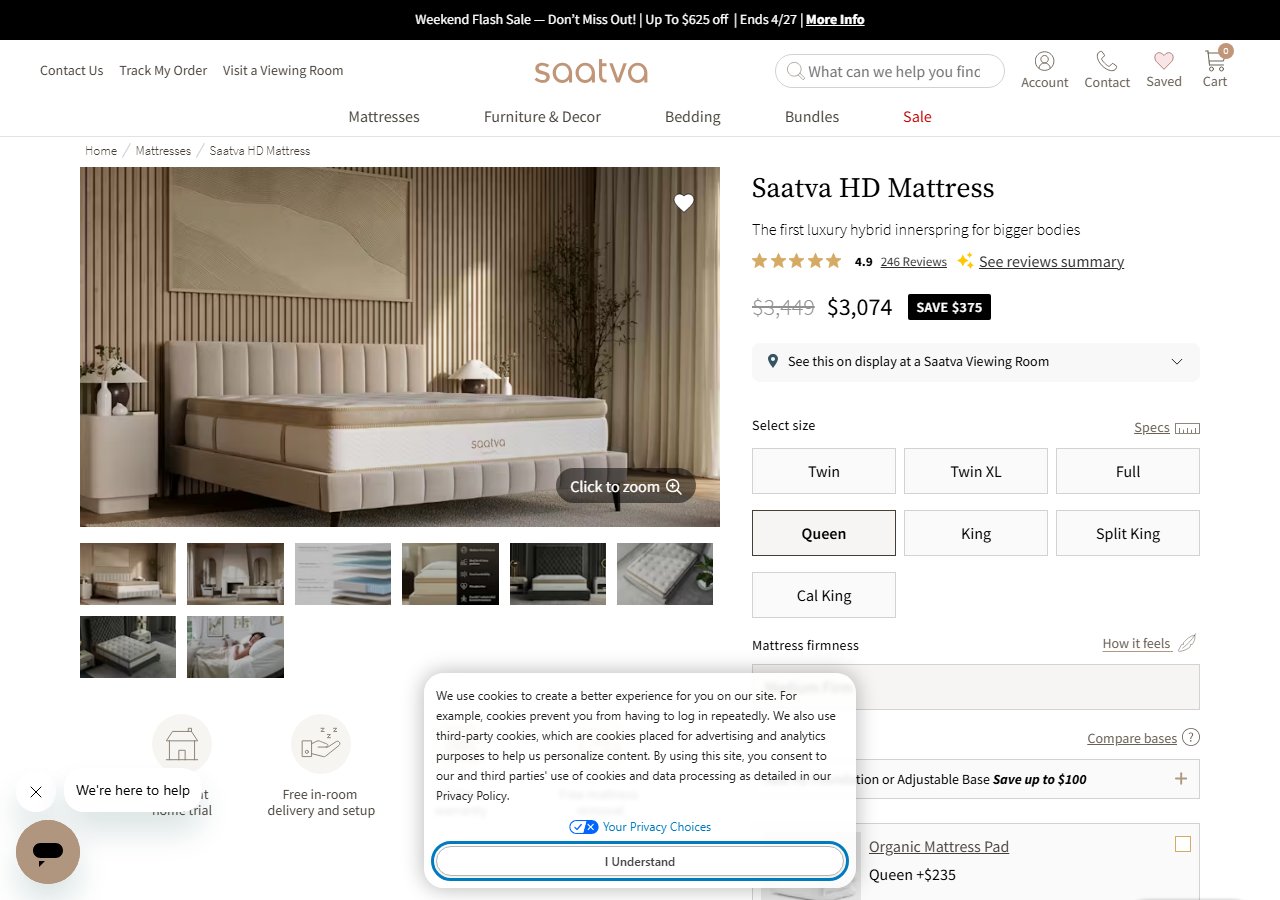
Saatva HD Mattress (Heavy-Duty)
$2,395-$3,995
See Price at Saatva →
Purple Hybrid Premier Mattress
$2,499-$4,799
See Price at Purple →What the federal data hierarchy actually tells you to do
Working backward from the federal data produces a clear priority order that is different from what the mattress industry's marketing hierarchy suggests.
Start with the occupational mechanism. NIOSH Lifting Equation data tells you that the physical load your job places on your lumbar spine regularly exceeds safe limits. The primary intervention for that problem is mechanical — improved lifting technique, load management, rotation of high-intensity tasks. OSHA Ergonomics guidance provides the specific movement protocols. That comes before any sleep-surface conversation.
Add the movement intervention. NIH NCCIH data documents that daily walking at 30 minutes most days is as effective as most non-drug clinical treatments for chronic low back pain. It costs nothing. Do it before spending three thousand dollars on a mattress.
Optimize sleep position. NIH NIAMS guidance is specific about the positions that maintain spinal neutrality. A twenty-dollar pillow placed correctly can produce a meaningfully different outcome than the same mattress used with poor sleep position.
Then evaluate the mattress. If it's visibly sagging, if it's more than 7 to 10 years old (less for high-bodyweight users), or if you are waking consistently stiffer than you went to bed despite correct sleep position, the mattress is a legitimate variable. CDC Sleep Hygiene guidance confirms these as objective replacement indicators.
For high-bodyweight adults who have run that decision tree and landed on needing a new mattress, the products recommended above — the Saatva HD for load-specific structural engineering, the Saatva Loom & Leaf for pressure-relief-focused foam construction, and the Purple Hybrid Premier for adaptive grid technology — represent the evidence-anchored tier of the market for this specific reader.
The federal data context matters here for one more reason. SSA Disability Insurance Reports show musculoskeletal disorders driving the largest single category of new disability claims annually. Those outcomes aren't inevitable. They accumulate through years of inadequately managed mechanical stress, disrupted sleep, and deferred intervention. The hierarchy in this article — mechanism first, free interventions second, clinical evaluation where warranted, equipment last — is the sequence that the federal data supports. Start there.