The federal data behind your morning back pain
If you weigh 250 pounds or more and spend your days loading freight, pulling patients, swinging a hammer, or standing production-line hours, there is a federal paper trail that explains exactly why your back hurts when you wake up. It is not bad luck. It is cumulative spinal loading meeting an inadequate recovery surface — and the data is specific enough to act on.
BLS Musculoskeletal Disorder tracking identifies the back as the single most commonly injured body part across all U.S. occupations that result in days away from work. That is every occupation — not just heavy industry. When you layer in the NIOSH Lifting Equation, which documents that manual material-handling tasks in warehousing, construction, and healthcare routinely exceed safe spinal compression limits, you start to understand why back injury is not evenly distributed across the workforce. The workers most likely to exceed NIOSH's recommended weight limits are the same workers most likely to be carrying higher bodyweight themselves — because bodyweight and physically demanding occupations are not independent variables in the U.S. labor market.
The downstream cost data is striking. AHRQ HCUP analysis positions back pain among the most expensive conditions in U.S. healthcare by total inpatient and outpatient spending. The Social Security Administration's Disability Insurance reports identify musculoskeletal disorders as the single largest category of new disability claims filed annually. BLS Employer Costs for Employee Compensation data shows that industries with high musculoskeletal disorder incidence carry workers' compensation insurance rates three to five times higher than low-MSD industries. The system is pricing in the injury risk that high-demand, high-bodyweight workers carry every shift.
Why this happens: the biomechanics of compounding spinal load
Understanding why a high-bodyweight worker's spine is uniquely vulnerable requires a short biomechanics lesson. The lumbar spine — the five vertebrae at the base of your back — bears the cumulative compressive load of everything above it. At 250 pounds of bodyweight, the lumbar discs already manage significantly higher baseline compressive forces than a 180-pound counterpart, even at rest. Add a physically demanding occupation and the physics become stark.
The NIOSH Lifting Equation defines a Recommended Weight Limit (RWL) for manual lifting tasks by factoring in load weight, horizontal distance from the spine, vertical travel, frequency, and trunk twist. When any of those variables worsen — as they routinely do in warehouse, healthcare, and construction environments — the actual spinal compression forces on the L4-L5 and L5-S1 discs can exceed 3,400 Newtons, the limit NIOSH identifies as a threshold above which injury risk increases substantially. For workers already carrying 250-plus pounds of bodyweight, the baseline compressive load before any lift is already elevated. Stacking occupational loads on top of an already-loaded spine is how acute disc episodes happen — and how the chronic, grinding low back pain described in CDC NCHS Data Brief 390 — which identifies approximately 20% of U.S. adults as experiencing chronic pain, most commonly in the lower back — accumulates over a career.
Here is the recovery piece that most discussions miss: the intervertebral discs are avascular. They receive nutrients primarily through diffusion — a process that is most efficient during recumbent, unloaded rest. Sleep is not merely time offline; it is the primary biological window during which disc hydration and nutrient exchange occur. A sleep surface that fails to keep the lumbar spine in a neutral position — either because it sags under high bodyweight, bottoms out, or creates pressure points at the hips and shoulders that force compensatory spinal positions — interrupts that recovery window every single night. Over months and years, it contributes to the degenerative disc changes that CDC arthritis data associates with physically demanding occupations. Approximately 25% of U.S. adults report doctor-diagnosed arthritis, with prevalence concentrated in exactly these occupational groups.
CDC sleep surveillance data shows that approximately 35% of U.S. adults already sleep fewer than 7 hours per night — the threshold below which chronic disease risk, including musculoskeletal pain amplification, rises measurably. Physically demanding workers are overrepresented in that 35%. Short sleep, poor sleep position, and an inadequate sleep surface form a compounding disadvantage for high-bodyweight workers who need recovery more than most and are getting it less.
The cost of inaction is not abstract
AHRQ Medical Expenditure Panel Survey data shows that adults with chronic back conditions spend substantially more annually on personal healthcare than adults without such conditions. CMS Drug Spending Dashboard data identifies opioid and non-opioid pain medications among the most expensive Medicare drug categories — a downstream reflection of the chronic-pain burden that untreated or under-treated spinal loading produces. These are not abstract policy statistics. They are the financial trajectory of a high-bodyweight worker who never addresses the compounding load pattern: occupational lifting above safe limits during the day, inadequate spinal recovery at night, and eventual progression to the disability-claim and pharmaceutical-cost statistics the federal data documents.
The cheapest intervention is the one that does not require buying anything. Before we talk about sleep surfaces, let us work through what federal and NIH evidence identifies as the first-order levers for high-bodyweight workers with chronic low back pain. These matter more than any mattress.
Try these first: free and low-cost interventions with federal evidence support
The following interventions are drawn directly from NIH, NIOSH, OSHA, and CDC guidance. Most cost nothing. For workers who have not systematically applied all of them, these are the correct starting point — not a new mattress.
Sleep position is the most immediately changeable variable. NIH back pain guidance from NIAMS identifies side-sleeping with a pillow between the knees, or back-sleeping with a pillow under the knees, as the positions most likely to maintain lumbar neutrality. Stomach-sleeping applies sustained rotational force to the lumbar spine and consistently worsens chronic low back pain symptoms. For high-bodyweight individuals, a firm pillow between the knees when side-sleeping also reduces the lateral flexion of the lumbar spine caused by gravity pulling a heavier hip toward the mattress surface.
Daily walking is one of the most effective chronic low-back-pain interventions in the literature. NIH NCCIH's evidence review on low-back pain concludes that walking 30 minutes on most days reduces chronic low back pain as effectively as most non-drug clinical treatments. This is a remarkable finding because it is free, progressive, and compatible with every body size. For high-bodyweight workers who spend shifts in static postures — standing lines, seated forklifts, patient transport — walking outside of work hours is not optional recovery; it is evidence-based treatment.
Lifting mechanics are rehearsable and the evidence for them is OSHA-grade. OSHA's ergonomics guidance specifies: hinge at the hips rather than the lumbar spine, keep loads close to the body centerline, and avoid twisting under load. Most acute back episodes are mechanical events that follow predictable failure patterns — the same patterns the NIOSH Lifting Equation was designed to predict. Workers who consciously practice hip-hinge mechanics reduce the spinal shear forces that accumulate into chronic injury. This applies at work and at home.
Know when your mattress is actually the problem. CDC sleep hygiene guidance offers a useful diagnostic: replace a mattress if it shows visible sag or body impressions, if you consistently wake stiffer than you went to sleep, or if the mattress is older than 7 to 10 years. Even the most precisely engineered sleep surface does not compensate for poor sleep hygiene, sedentary days, or unaddressed occupational exposures. If you are waking stiff on a mattress that passes this diagnostic, the mattress is not likely the primary cause.
Some readers will have worked through the above and still be sleeping on a mattress that sags under their bodyweight, bottoms out at the hip, or provides uneven support. For those readers, a sleep surface designed for high-bodyweight spinal support is a legitimate clinical and ergonomic tool. The distinction matters: products work as adjuncts to movement, sleep hygiene, and occupational mechanics. They are not a substitute for them.
When to see a clinician first
Before evaluating any product, there is a set of symptoms that require a physician, not a mattress. High-bodyweight workers with chronic back pain sometimes normalize symptoms that warrant urgent evaluation because the pain has become a constant background feature of their lives.
NIH National Institute of Neurological Disorders and Stroke back pain guidance specifies the following as red flags requiring prompt clinical evaluation: back pain that radiates below the knee (suggesting nerve root compression or disc herniation at a level requiring imaging), pain that follows significant trauma, pain accompanied by leg weakness or numbness, any change in bowel or bladder control associated with back pain (a potential cauda equina emergency), and back pain accompanied by fever or unexplained weight loss. Do not purchase a new mattress as a first response to any of these symptoms. The SSA Disability Insurance data showing musculoskeletal disorders as the leading source of new disability claims is a measure of what happens when mechanical back pain is not appropriately evaluated and treated at earlier stages.
For high-bodyweight workers specifically, the clinical picture has additional nuance. Obesity-associated metabolic changes can accelerate disc degeneration independently of mechanical load. CDC arthritis surveillance data identifies higher BMI as a direct risk factor for arthritic joint change, which can present as back pain with a very different treatment pathway than mechanical disc pain. A physician who knows your full clinical picture — bodyweight history, occupational load profile, sleep duration, and pain radiation pattern — is the right first stop when symptoms are worsening, not stable.
Where sleep surface engineering actually helps
With the mechanism understood, the free interventions applied, and the red flags screened out, there is a legitimate case for sleep surface investment — specifically for high-bodyweight workers whose current mattress fails the sag-and-stiffness diagnostic above.
The engineering requirements for this reader are distinct from the general population. A mattress that performs adequately for a 175-pound side-sleeper will not maintain lumbar neutrality for a 280-pound worker. The relevant variables are zonal support (dedicated lumbar reinforcement, softer shoulder zones), coil count and gauge for innerspring or hybrid designs (lower-gauge steel handles higher compressive loads without premature sag), foam density (high-density memory foam resists body-impression formation over time), and weight capacity ratings that account for partner weight if applicable.
The Saatva Loom & Leaf Memory Foam Mattress is the premium memory-foam pick for high-bodyweight workers whose primary complaint is pressure buildup at the hips and lumbar spine during the night. Loom & Leaf uses a 5-pound-density memory foam construction — a density specification that matters for heavy workers, because lower-density foams compress fully under sustained load and lose their contouring properties within months. The dual-layer memory foam system is designed to distribute surface pressure while the firmer base maintains overall spinal alignment. For workers dealing with the kind of hip-and-shoulder pressure points that interrupt the disc rehydration process described above, a high-density memory foam surface addresses a real biomechanical problem.
For workers at the higher end of the bodyweight range — 275 pounds and above, or couples where combined weight is substantial — the Saatva HD Mattress is the purpose-built option. Saatva engineered the HD specifically for high-bodyweight sleepers, with a patent-pending lumbar zone ActiveSupport system, a pillow-Euro top that prevents the foam-compression bottoming-out that undermines most standard mattresses for heavy users, and weight-tested construction rated for higher per-side loads than standard innerspring designs. This is the product that most directly mirrors what the NIOSH and BLS data describes: a worker whose spine has been under sustained compressive load all day needs a surface that actively maintains lumbar neutrality at higher bodyweights, not one that simply fails to sag for a few months before losing its structural integrity.
For workers whose primary complaint is pressure-point pain — the hip burning, shoulder numbness, or side-sleeping discomfort that interrupts sleep continuity — the Purple Hybrid Premier Mattress offers a materially different pressure-relief mechanism. Purple's GelFlex Grid is a polymer grid rather than foam; it does not trap heat the way memory foam does and it provides column-buckling pressure relief at bony prominences (hip, shoulder, lumbar spine) while maintaining firm support in the zones between those prominences. For high-bodyweight workers who have found memory foam either too soft overall or too hot, the grid architecture is a distinct alternative. The Hybrid Premier pairs the grid with a pocketed coil system, which provides the zonal support high-bodyweight sleepers need without the edge-softness that all-foam designs often develop under sustained load.
Sleep Surfaces Engineered for High-Bodyweight Spinal Recovery
These three mattresses were selected specifically for workers weighing 250 pounds or more who carry occupational spinal load during the day and need a sleep surface that maintains lumbar neutrality — not just for one night, but over the years of sustained use.

Saatva Loom & Leaf Memory Foam Mattress
$1,695-$3,295
See Price at Saatva →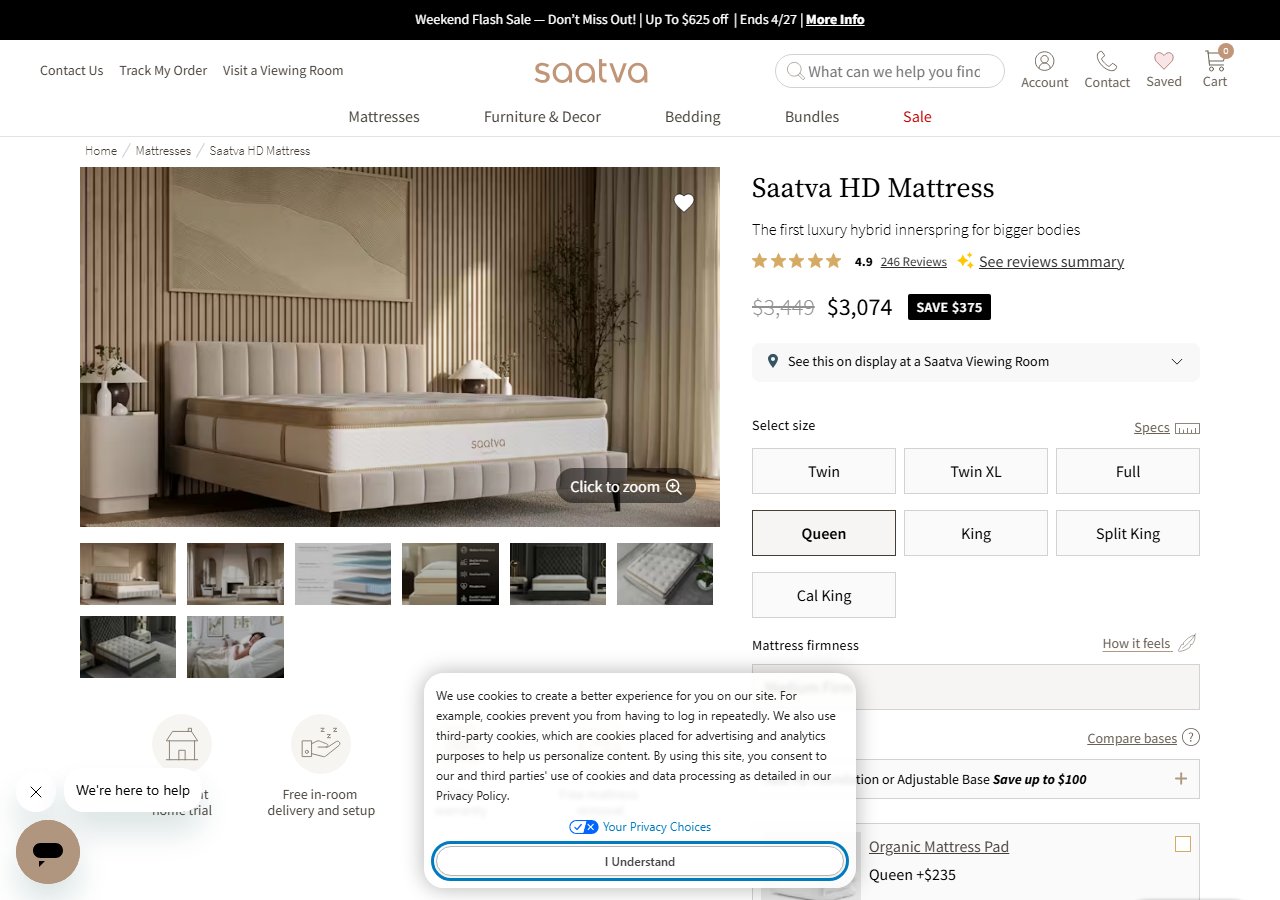
Saatva HD Mattress (Heavy-Duty)
$2,395-$3,995
See Price at Saatva →
Purple Hybrid Premier Mattress
$2,499-$4,799
See Price at Purple →What the data hierarchy means for your next decision
The federal data on back pain, occupational spinal loading, and sleep quality converges on a clear decision hierarchy — one that looks nothing like a typical product-first mattress guide.
First: if you have any of the clinical red flags described above, see a physician. The AHRQ HCUP data showing back pain as one of the most expensive conditions in U.S. healthcare reflects a system where mechanical problems are under-addressed early and expensive to treat late. Early clinical evaluation is the highest-leverage intervention available.
Second: apply the free interventions. The NIH NCCIH evidence review showing daily walking as equivalent to most non-drug treatments is a stunning finding. The NIAMS sleep-position guidance is implementable tonight at zero cost. The OSHA lifting guidance is rehearsable at work starting this week. These interventions address the actual causal mechanisms — spinal loading and recovery — not just the symptoms.
Third: if your mattress fails the sag-and-stiffness test from CDC sleep hygiene guidance, and you are a high-bodyweight worker whose sleep surface has never been selected with your bodyweight and occupational load profile in mind, a sleep surface upgrade is a legitimate component of a back-health strategy. The products above — particularly the Saatva HD for pure load capacity and the Loom & Leaf for pressure-relief-first needs — are engineered for the specific biomechanical requirements the federal data identifies.
The CMS drug spending data identifying pain medication as among the most expensive Medicare drug categories is the destination that begins with untreated compounding spinal load. The interventions described in this article — movement, position, mechanics, and then sleep surface when warranted — are the evidence-based path to a different outcome.