The federal data on why your back doesn't recover overnight
BLS Musculoskeletal Disorders by Occupation tracking is unambiguous: the back is the single most commonly injured body part across every major U.S. occupation with days away from work. That statistic spans warehousing, construction, nursing aides, home health workers, truck drivers, and meatpacking — industries that collectively employ tens of millions of Americans who happen to perform the highest volumes of manual material handling per shift. If you are reading this article and you weigh 250 pounds or more, you likely already knew that number in your body before you ever read it in a government report.
What is less widely understood is the mechanism connecting daytime occupational spinal loading to nighttime spinal recovery — and why that mechanism is meaningfully different for high-bodyweight adults than for the median adult the sleep industry typically designs for. This article unpacks that mechanism using federal data, gives you free interventions to try before spending a dollar, tells you exactly which symptoms require a clinician rather than a new mattress, and then — only then — walks through three sleep surfaces that are structurally engineered for higher compression loads.
Why the back is the target: biomechanics of occupational spinal loading
The NIOSH Lifting Equation was developed precisely because the occupational safety community recognized that manual material-handling tasks routinely exceed safe spinal loading limits. The equation defines a Recommended Weight Limit (RWL) and a Lifting Index — a ratio of actual load to recommended load. An index above 1.0 signals elevated injury risk. NIOSH research consistently finds that real-world warehouse, construction, and healthcare tasks produce lifting indices well above 1.0, especially when workers are fatigued, rushing, or twisting under load.
Here is what that means biomechanically. Each lumbar disc — the cartilaginous shock absorber between your vertebrae — is subjected to compressive force equal to roughly 10 times the weight of the load being lifted, due to the mechanical disadvantage of the erector spinae muscles pulling against a long lever arm. A 50-pound box, lifted with a Lifting Index already flagged as excessive by NIOSH standards, generates hundreds of pounds of compressive force across L4-L5, the most commonly degenerated lumbar segment in working-age adults. Do that 80 to 200 times per shift, five days a week, for years, and you accumulate microtrauma that the discs can only partially repair during sleep — when intradiscal pressure drops, fluid rehydrates cartilage, and the inflammatory mediators from the day's loading begin to clear.
Now layer in bodyweight. For a 250-pound adult, basal compressive loading on the lumbar spine during standing is already substantially higher than for a 160-pound adult. The joints, discs, and supporting musculature are under greater baseline load at rest. When that same 250-pound adult is performing lifting tasks that already breach NIOSH's Recommended Weight Limit for a 160-pound worker, the cumulative daily spinal load is categorically different — not just incrementally higher. CDC NCHS Data Brief 390 reports that approximately 20% of U.S. adults experience chronic pain, with lower back identified as the most common pain location. The prevalence of chronic low back pain increases with BMI — a relationship documented across multiple NHANES survey cycles.
The SSA Disability Insurance program tracks where workers end up after years of accumulating this load: musculoskeletal disorders are the largest single category of new disability claims filed annually in the United States. That is not an abstract policy statistic. It represents the downstream endpoint of occupational spinal loading that was never adequately offloaded — during shifts, during rest, or during sleep.
What sleep has to do with spinal recovery — and where the mattress enters the equation
CDC sleep data shows that approximately 35% of U.S. adults already sleep fewer than 7 hours per night — the threshold below which chronic disease risk, inflammatory markers, and pain sensitization all increase measurably. For high-bodyweight manual workers, that statistic compounds badly. Chronic pain disrupts sleep architecture; disrupted sleep elevates pain sensitivity; elevated pain sensitivity makes manual work harder and injury more likely. This is a documented positive feedback loop, not a hypothesis.
The mattress enters the equation at a specific mechanical point: pressure distribution at the sleep surface. A mattress that was designed for a 160-pound median adult — the load distribution most innerspring and foam mattresses are engineered around — will allow a 250-pound adult to sink past the comfort layers into the transition or support core. When that happens, the spine cannot maintain neutral alignment. The lumbar region either hyperextends (on a too-soft surface) or remains laterally flexed (on a too-firm surface that doesn't accommodate hip and shoulder width). Neither position allows the overnight disc rehydration and inflammatory clearance that spinal recovery depends on.
This is not marketing copy. It is basic materials science applied to sleep biomechanics. The coil count, wire gauge, foam ILD (Indentation Load Deflection), and layer sequencing that determines whether a mattress will support neutral spinal alignment under a 250-pound load are engineering specifications — and most consumer mattresses are not engineered to those specifications.
The financial stakes are not trivial. AHRQ HCUP data identifies back pain as one of the most expensive conditions in U.S. healthcare by total inpatient and outpatient cost. AHRQ MEPS data shows that adults with chronic back conditions carry substantially higher annual personal healthcare expenditures than adults without such conditions. CMS Drug Spending Dashboard data flags opioid and non-opioid pain medication as among the most expensive Medicare drug categories — a direct reflection of the chronic-pain treatment burden borne by the workers this article is written for. A $2,000 mattress, in that context, is not a luxury purchase. It is a capital allocation decision with a measurable expected value, provided it is the right mattress and you have done the other things first.
The cheapest intervention is the one that costs nothing
Before this article discusses any product, it is worth being direct: a substantial proportion of chronic low back pain in manual workers is addressable through behavioral changes that require no purchase. The interventions below are drawn from federal and NIH-affiliated sources, not from mattress manufacturers. Start here.
Daily walking is the single most evidence-supported free intervention for chronic low back pain. An NIH NCCIH evidence review found that walking 30 minutes on most days reduces chronic low back pain as effectively as most non-drug clinical treatments. For workers who spend eight hours on their feet doing heavy lifting, the idea of walking on off days feels counterintuitive. The research says otherwise: controlled ambulatory movement promotes disc hydration, reduces paraspinal muscle stiffness, and interrupts the pain-sensitization cycle. This is the highest-leverage free variable available to you.
Lifting and bending mechanics are the second free lever. OSHA's ergonomics guidance documents the principles that the NIOSH Lifting Equation was built on: hinge at the hips, not the lumbar spine; keep loads close to your center of gravity; eliminate twisting under load wherever operationally possible. Most acute back episodes are mechanical in origin and are to a meaningful degree preventable through rehearsed movement patterns. If your employer has not provided this training, OSHA's public-facing ergonomics resources are free.
Sleep position is the third free variable — and for many readers, the most immediately actionable. NIH National Institute of Arthritis and Musculoskeletal and Skin Diseases back pain guidance identifies side-sleeping with a pillow between the knees and back-sleeping with a pillow under the knees as the positions most likely to maintain lumbar neutral alignment. Stomach-sleeping — common among heavier adults who find other positions uncomfortable — torques the lumbar spine and worsens chronic pain. Changing sleep position costs nothing and, for some readers, resolves morning stiffness without any other intervention.
Mattress replacement timing is the fourth consideration. CDC Sleep Hygiene guidance and clinical consensus support replacing a mattress when it shows visible sag, when you consistently wake stiffer than you went to bed, or when the mattress exceeds seven to ten years of use. These are objective indicators that the support structure has failed — not marketing rationale. Even the most expensive mattress on this list does not undo poor sleep hygiene, sedentary recovery days, or lifting mechanics that exceed NIOSH's recommended limits.
Some readers will have already tried all of the above — they walk, they lift correctly, they sleep on their side, and they replaced their mattress two years ago — and they are still waking with lumbar pain that compounds across the week. For those readers, the engineering specifications of the sleep surface matter, and the products below were selected specifically for high-bodyweight adults with documented back pain. But the hierarchy stands: movement, mechanics, position, and timing come first.
When a clinician needs to be in this conversation
A new mattress is an appropriate tool for chronic mechanical back pain in a worker who has no neurological symptoms, no recent trauma, and no systemic illness. It is not an appropriate first response to any of the following red flags, which according to NIH National Institute of Neurological Disorders and Stroke back pain guidance require prompt clinical evaluation:
- Pain that radiates below the knee — particularly with numbness, tingling, or burning — suggests nerve root compression or lumbar disc herniation that may require imaging and possibly intervention.
- Back pain following any trauma — a fall, a motor vehicle accident, a heavy impact — warrants evaluation for fracture before any other intervention.
- Back pain accompanied by leg weakness — difficulty dorsiflexing the foot, unexpected knee buckling, or loss of grip in the toes — is a potential cauda equina or cord compression emergency.
- Bowel or bladder changes concurrent with back pain — urinary retention, incontinence, or new constipation — is a cauda equina red flag requiring same-day emergency evaluation.
- Back pain with fever, unexplained weight loss, or night sweats — suggests infectious, inflammatory, or oncologic etiology that a mattress cannot address.
If any of these are present, stop reading about mattresses and call a clinician. CDC Arthritis Data notes that approximately 25% of U.S. adults report doctor-diagnosed arthritis, with higher prevalence in physically demanding occupations — meaning many readers in this demographic are already carrying an inflammatory component to their back pain that warrants medical management alongside any equipment changes.
Where engineered sleep surfaces enter the evidence hierarchy
For readers who have cleared the clinical red flags above, are doing the behavioral work, and still need a sleep surface that won't fail under their load — here is what the engineering specifications actually need to look like at 250-plus pounds.
A high-bodyweight adult needs a support core with sufficient coil count and wire gauge to prevent bottoming out — the term for the moment when a sleeper's mass compresses through all functional foam layers and rests effectively on the metal or base substrate. Bottoming out eliminates pressure distribution entirely and guarantees spinal misalignment. For foam-dominant mattresses, the ILD rating of the support layer matters: general consumer foams run 14–25 ILD; a 250-pound adult typically requires support-layer ILD values at the upper end of that range or higher, combined with a comfort layer soft enough to accommodate hip and shoulder contour without collapsing under sustained load.
The Saatva HD Mattress is the product on this list most explicitly engineered for this reader. Saatva HD was designed specifically for sleepers up to 500 pounds, with a 3-inch euro pillow top, a lumbar zone with a micro-coil layer, and a high-gauge tempered steel innerspring system that is meaningfully heavier-duty than Saatva's standard coil specification. For the warehouse worker, construction laborer, or healthcare aide who is 280 pounds and has spent a decade accumulating occupational spinal load — this is the engineering match the data points to. It prices between $2,395 and $3,995 depending on size, which against the AHRQ HCUP cost data on back pain treatment is a defensible capital allocation.
For readers whose primary complaint is pressure buildup at the hips and shoulders — a common pattern in side-sleeping high-bodyweight adults, where the greater trochanter and acromion create focal pressure that wakes them through the night — the Saatva Loom & Leaf Memory Foam Mattress addresses a different engineering requirement. Loom & Leaf uses a gel-infused, temperature-regulated memory foam construction with a 5-pound-density foam core — above the density threshold that begins to differentiate durable, load-bearing memory foam from the sub-3-pound density foam common in consumer-tier products. Memory foam's viscoelastic properties allow it to conform to body geometry under sustained load, which is biomechanically relevant for sleepers whose hip-to-waist ratio creates a large spinal lateral flexion angle on a firm, non-conforming surface. Loom & Leaf prices between $1,695 and $3,295 — the lower end of this list, which matters for workers whose healthcare expenditures are already elevated per the AHRQ MEPS data.
The third option on this list addresses a distinct clinical pattern: the reader who has tried multiple foam and innerspring products and finds that both sag (too soft) and rigidity (too firm) cause pain — suggesting a pressure-and-support duality problem. The Purple Hybrid Premier Mattress uses Purple's GelFlex Grid — a hyper-elastic polymer grid that behaves fundamentally differently from foam under load. The grid buckles under focal pressure points (hips, shoulders) while remaining stiff under distributed loads (lumbar region, thoracic spine) — a material behavior that approximates what an ideal sleep surface would do for a high-bodyweight back pain patient: yield where the body is widest, support where the spine needs alignment. The hybrid coil base provides the motion separation and edge support that higher-weight sleepers need for getting in and out of bed without destabilizing the support zone. It prices between $2,499 and $4,799.
Sleep Surfaces Engineered for High-Bodyweight Back Pain Recovery
These three mattresses were selected for adults 250 pounds and above who are managing occupational back stress — each chosen for documented engineering specifications that address the pressure distribution and spinal support failure modes common in heavier sleepers.

Saatva Loom & Leaf Memory Foam Mattress
$1,695-$3,295
See Price at Saatva →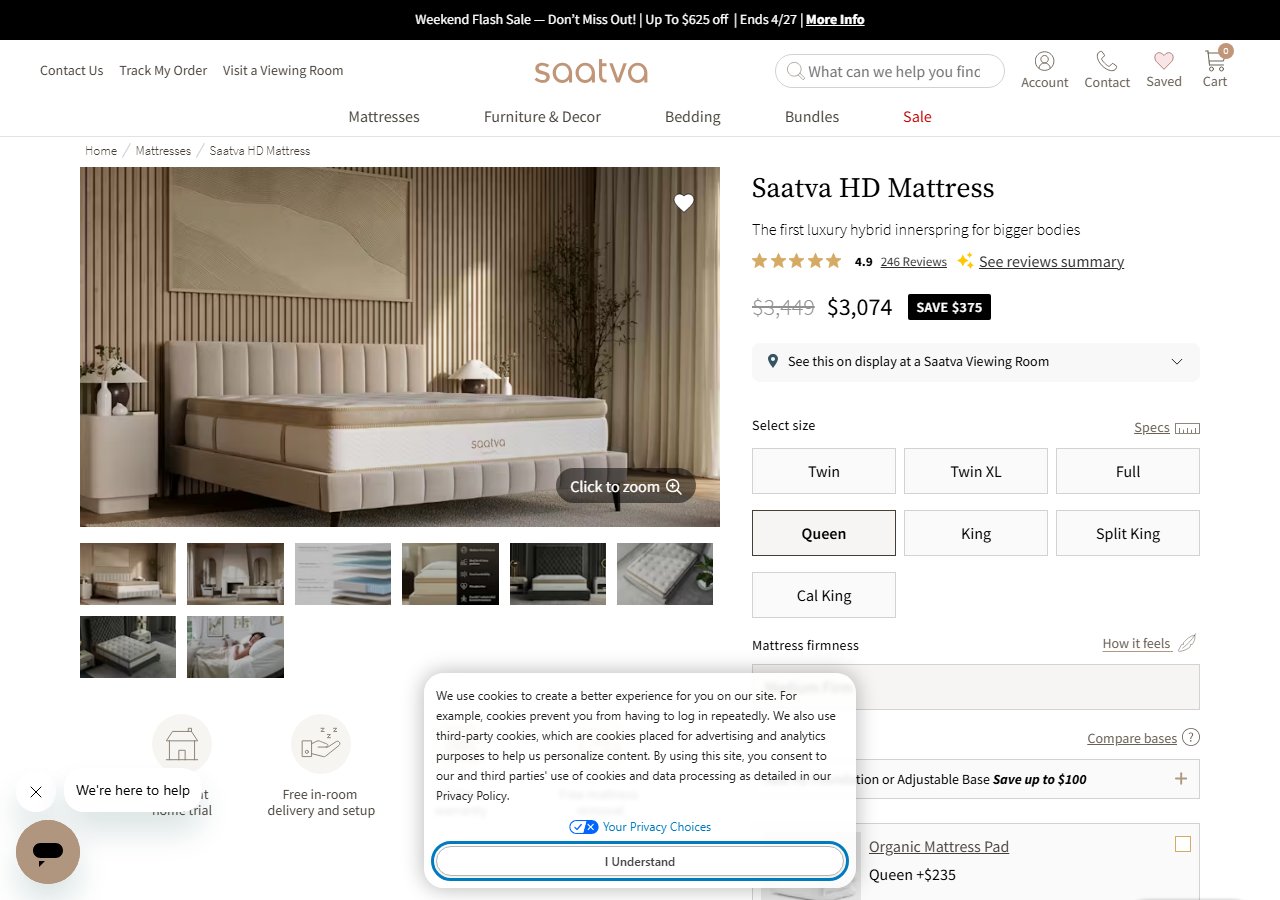
Saatva HD Mattress (Heavy-Duty)
$2,395-$3,995
See Price at Saatva →
Purple Hybrid Premier Mattress
$2,499-$4,799
See Price at Purple →Putting the federal data hierarchy together
The data trail here is coherent and consistent. BLS occupational injury data documents that the back absorbs more occupational trauma than any other body part in the U.S. workforce. NIOSH's Lifting Equation shows that the tasks producing that trauma routinely exceed safe spinal loading limits — and those limits were set for median-weight workers, not for 250-pound adults carrying higher baseline spinal loads. CDC chronic pain data confirms that the downstream result is a 20% chronic pain prevalence nationwide, concentrated in the lower back. SSA disability data shows where that ends for the workers who can't manage the load long-term. And CMS drug spending data quantifies the pharmacological treatment burden that results when the spinal loading problem is addressed chemically rather than biomechanically.
A sleep surface engineered for high-bodyweight adults is not a solution to occupational spinal loading. It is one component of a recovery system that also requires daily movement, corrected lifting mechanics, appropriate sleep position, clinical evaluation when red flags are present, and — if arthritis is in the picture — active medical management. BLS workers' compensation cost data shows that industries with high MSD incidence carry compensation insurance rates 3 to 5 times higher than low-MSD industries, which means the economic stakes of this injury pattern are borne not just by individual workers but by entire labor sectors.
The products recommended in this article were selected because their engineering specifications are documented to address the specific failure modes — bottoming out, pressure concentration, lateral spinal flexion — that high-bodyweight adults experience on standard consumer mattresses. They are one tool. Use them in the right order, alongside the free tools that federal research has already validated.