The federal data on back injuries is blunt — and it gets worse if you weigh more
According to BLS Musculoskeletal Disorders by Occupation tracking, the back is the single most commonly injured body part across all U.S. occupations that result in days away from work. Not shoulders. Not knees. The back — and the injury rate has remained stubbornly high for more than a decade despite ergonomics investment across industries. If you are reading this article because your back hurts and you weigh 250 pounds or more, federal occupational health data has a specific and sobering message for you: you are not imagining that your job is making things worse, and the surface you sleep on is not a luxury question.
The mechanism starts at work. The NIOSH Lifting Equation — the federal government's engineering standard for safe manual material handling — documents that lifting tasks across warehousing, construction, and healthcare routinely exceed recommended spinal loading limits even for average-sized workers. Body weight is a compounding variable. Every lift, carry, bend, and sustained static posture imposes compressive and shear forces on the lumbar discs and facet joints. For a 250-pound worker, the gravitational load on L4-L5 during a forward bend is substantially higher than for a 170-pound coworker doing the same task. The NIOSH equation does not adjust its recommended weight limits upward for larger workers; if anything, higher bodyweight means the personal risk index for a given task is higher, not lower.
That occupational damage accumulates. CDC NCHS Data Brief 390 documents that approximately 20% of U.S. adults live with chronic pain, with the lower back as the most commonly reported pain location. CDC Arthritis surveillance data shows roughly 25% of U.S. adults have doctor-diagnosed arthritis, with prevalence concentrated in occupations involving sustained physical demand — the same occupations where back injuries are most common. These conditions are not independent; degenerative disc disease and facet arthropathy frequently co-occur in physically demanding workers, and both are aggravated when recovery — including sleep — is inadequate.
Why the night shift matters as much as the day shift
The body repairs spinal tissue during sleep. Intervertebral discs are avascular — they rehydrate via diffusion during periods of unloaded rest. If you are sleeping on a surface that cannot adequately support and distribute a 250-plus-pound body, two things happen: pressure points at the hips and shoulders interrupt sleep architecture, and the spine is held in a laterally bent or extended posture for hours at a time, preventing the neutral-spine decompression that allows disc rehydration.
CDC Sleep and Sleep Disorders data shows approximately 35% of U.S. adults report sleeping fewer than 7 hours per night — the threshold below which chronic disease risk, including musculoskeletal inflammation, rises measurably. For high-bodyweight workers already carrying occupational spinal load, short sleep is not just tiredness. It is truncated tissue repair at precisely the time the body needs the most recovery.
The economic consequences are not hypothetical. AHRQ HCUP data identifies back pain as one of the most expensive conditions in U.S. healthcare by combined inpatient and outpatient cost. AHRQ MEPS data shows that adults with chronic back conditions carry substantially higher annual personal healthcare expenditures than those without. SSA Disability Insurance data identifies musculoskeletal disorders as the single largest category of new disability claims filed annually. And BLS Employer Compensation data shows that industries with high MSD incidence carry workers' compensation insurance rates 3–5x higher than low-MSD industries. The systemic cost of undertreated back pain is immense — and better sleep surface support is one of the few modifiable variables entirely within an individual worker's control at home.
The biomechanics of inadequate support at high bodyweight
A standard consumer mattress is typically engineered and tested for a weight range centered around 130–180 pounds per sleeping position. The coil gauges, foam densities, and edge-support systems are calibrated to that load. When a 250-pound or heavier adult lies on a surface designed for a lighter body, several failure modes occur simultaneously.
First, the comfort layer compresses fully — what engineers call "bottoming out" — and the sleeper is effectively resting on the transition or support layer, which is not designed for direct contact pressure distribution. This dramatically reduces pressure relief at the hips and shoulders. Second, inadequate edge support means that a heavier sleeper who naturally migrates toward the edge of a mattress during the night risks a postural tilt that holds the lumbar spine in a laterally deviated position for hours. Third, softer foams degrade faster under higher sustained loads, meaning a mattress purchased four years ago by a high-bodyweight adult may already be functionally equivalent to a mattress with eight or nine years of normal wear.
This is not brand marketing language. This is materials science. Higher-density foams (measured in pounds per cubic foot) resist compression deformation better over time. Higher-gauge coil systems (typically 13–14 gauge for heavy-duty applications versus 15–17 gauge in standard mattresses) provide firmer, more durable lateral support. Zoned lumbar support systems — where the center third of the mattress is firmer than the head and foot zones — allow the heaviest part of a body (the pelvis and lower back) to resist sinking while shoulders can still contour. These are engineering specifications that matter, and they are measurably different between standard and heavy-duty sleep surfaces.
Try these first — the interventions that cost nothing
The most important thing to say before discussing any product is this: the cheapest intervention is the one that does not require buying anything. Federal health guidance documents multiple free variables that have strong evidence for reducing back pain. A new mattress will not fix a broken sleep position, will not substitute for daily movement, and will not protect you from a lifting injury at work. These interventions come first because they are free and effective.
Sleep position is the single highest-leverage free variable. NIH NIAMS back pain guidance is specific: side-sleeping with a pillow between the knees keeps the pelvis neutral and reduces lumbar rotational stress. Back-sleeping with a pillow under the knees reduces lumbar extension. Stomach-sleeping — common among heavier adults because it feels like it offloads pressure — actually hyperextends the lumbar spine and compresses the posterior disc structures for hours at a time. If you sleep on your stomach and your back hurts in the morning, the position is almost certainly a contributor regardless of what mattress you own.
Daily walking is the movement intervention with the strongest evidence base. NIH NCCIH's evidence review of low back pain treatments documents that 30 minutes of walking most days reduces chronic low back pain as effectively as most non-drug clinical treatments. This is not a warm-up recommendation. It is a primary intervention supported by clinical trial data. For a high-bodyweight worker who spends 8–10 hours in physically demanding work, this might feel counterintuitive — but the movement pattern of walking is neurologically and mechanically distinct from occupational lifting. It promotes fluid exchange in the discs, reduces inflammatory cytokine levels, and improves muscular endurance in the spinal stabilizers.
Lifting mechanics at work are modifiable and worth rehearsing. OSHA's ergonomics guidance is explicit: hinge at the hips rather than rounding the lumbar spine, keep loads close to the body's center of gravity, and avoid twisting under load. Most acute disc episodes in warehouse and construction workers are mechanical events — they follow a predictable pattern of repeated lumbar flexion under load followed by a threshold event. These injury patterns are rehearsable and preventable through technique. If your employer has an ergonomics program, the NIOSH Lifting Equation is the standard they use; understanding it helps you self-assess your own task risk.
Finally, evaluate whether your current mattress is the actual problem before buying a new one. CDC sleep hygiene guidance identifies visible mattress sag, waking stiffer than you went to bed, or a mattress older than 7–10 years as legitimate replacement triggers. But the same guidance makes clear that even a clinically appropriate sleep surface does not compensate for poor sleep hygiene, inconsistent sleep schedules, or screen exposure before bed.
For readers who have already worked through the free interventions — who sleep on their side, walk regularly, use correct lifting mechanics, and are still waking up with significant back pain — the sleep surface itself becomes a legitimate clinical variable. Occupational therapists, physiatrists, and spine-focused physical therapists increasingly recommend specific sleep surface characteristics for high-bodyweight patients with chronic back pain. What they are recommending is not a brand; it is a set of engineering specifications. Below, we identify three surfaces that meet those specifications for adults at 250 pounds and above.
When to see a clinician before buying anything
Not all back pain is mechanical, and not all mechanical back pain should be managed with equipment upgrades before a clinical evaluation. NIH NINDS back pain guidance identifies specific red flags that require prompt clinical evaluation — imaging, referral to a specialist, or emergency assessment. These include back pain that radiates below the knee (suggesting nerve root compression or spinal stenosis), pain that follows a traumatic event, pain accompanied by leg weakness or numbness, and pain associated with bowel or bladder changes or fever.
For high-bodyweight adults, two additional considerations are worth noting. First, obesity is an independent risk factor for lumbar spinal stenosis and degenerative disc disease — conditions that can mimic mechanical back pain but require different treatment pathways. Second, high-bodyweight adults with untreated sleep apnea often have significantly disrupted sleep architecture regardless of their sleep surface, because apnea events fragment the deep-sleep stages during which the body performs most spinal tissue repair. If you are a heavy snorer, wake frequently, or have a bed partner who observes stopped breathing, a sleep study is a higher priority clinical intervention than any mattress upgrade. CMS drug spending data shows opioid and non-opioid pain medications among the most expensive Medicare drug categories — evidence that untreated chronic pain drives medication escalation. The right clinical intervention, earlier, reduces that trajectory.
Where purpose-engineered sleep surfaces actually help
For the reader who has clear mechanical back pain, is not experiencing red-flag symptoms, sleeps in a position-correct way, and weighs 250 pounds or more, the sleep surface is a legitimate therapeutic tool. The three surfaces below were selected because they meet engineering criteria specifically relevant to high-bodyweight spinal support: coil gauge, foam density, weight capacity ratings, edge support construction, and lumbar zoning.
The Saatva HD Mattress is the most structurally specific product on this list for the target reader. Saatva engineered the HD (Heavy-Duty) explicitly for sleepers up to 500 pounds per side, using a dual-tempered steel coil system with a 13-gauge upper coil layer and a 12.5-gauge Bonnell base coil — gauges measurably heavier than those in standard Saatva models. The lumbar zone uses a firmer coil arrangement designed to resist pelvic sinking, which is the primary postural failure mode for high-bodyweight back sleepers. For a warehouse worker or construction laborer at 280–400 pounds who has been waking up with significant lumbar stiffness, this is the surface with the most purpose-built structural argument. Priced from $2,395, it is not a budget purchase — but it is a surface specifically calibrated for this load.
The Saatva Loom & Leaf Memory Foam Mattress addresses a different subset of this population: heavier adults who want the pressure-contouring properties of memory foam but need higher-density construction than standard foam mattresses provide. Loom & Leaf uses 5-pound-density memory foam — substantially denser than the 3–3.5 lb foam used in most mid-tier foam mattresses — which means it resists permanent body impressions better over time under higher sustained loads. The gel-infused top layer addresses the heat-retention complaint common among heavier sleepers. For a 250–320-pound adult with both back pain and significant pressure-point sensitivity at the hips and shoulders, the contouring of high-density memory foam over a supportive base layer is a different biomechanical argument than the HD's coil-forward approach. Priced from $1,695, it is the lower entry point among the Saatva options here.
The Purple Hybrid Premier Mattress brings a genuinely different engineering approach: the proprietary GelFlex Grid — a hyper-elastic polymer grid that neither foam nor coil can replicate. The grid's column-buckling design means it collapses under bony prominences (hips, shoulders) for pressure relief while remaining firm under larger surface areas (lower back, torso). For high-bodyweight adults with significant hip or shoulder pressure sensitivity alongside back pain, this pressure-mapping behavior is distinctly different from what foam or innerspring can provide. The Hybrid Premier's 4-inch grid depth (the deepest Purple makes) provides more articulation for heavier body masses than the standard 2-inch grid. Priced from $2,499, it sits at the premium tier — but for a reader whose primary complaint is pressure pain disrupting sleep as much as or more than lumbar pain, the grid's mechanical behavior is the most differentiated engineering on this list.
Sleep Surfaces Engineered for High-Bodyweight Spinal Support
These three mattresses were selected specifically for adults at 250 pounds and above with back pain driven by occupational spinal loading — each chosen for verifiable engineering specifications (coil gauge, foam density, weight capacity, lumbar zoning) rather than brand marketing language.

Saatva Loom & Leaf Memory Foam Mattress
$1,695-$3,295
See Price at Saatva →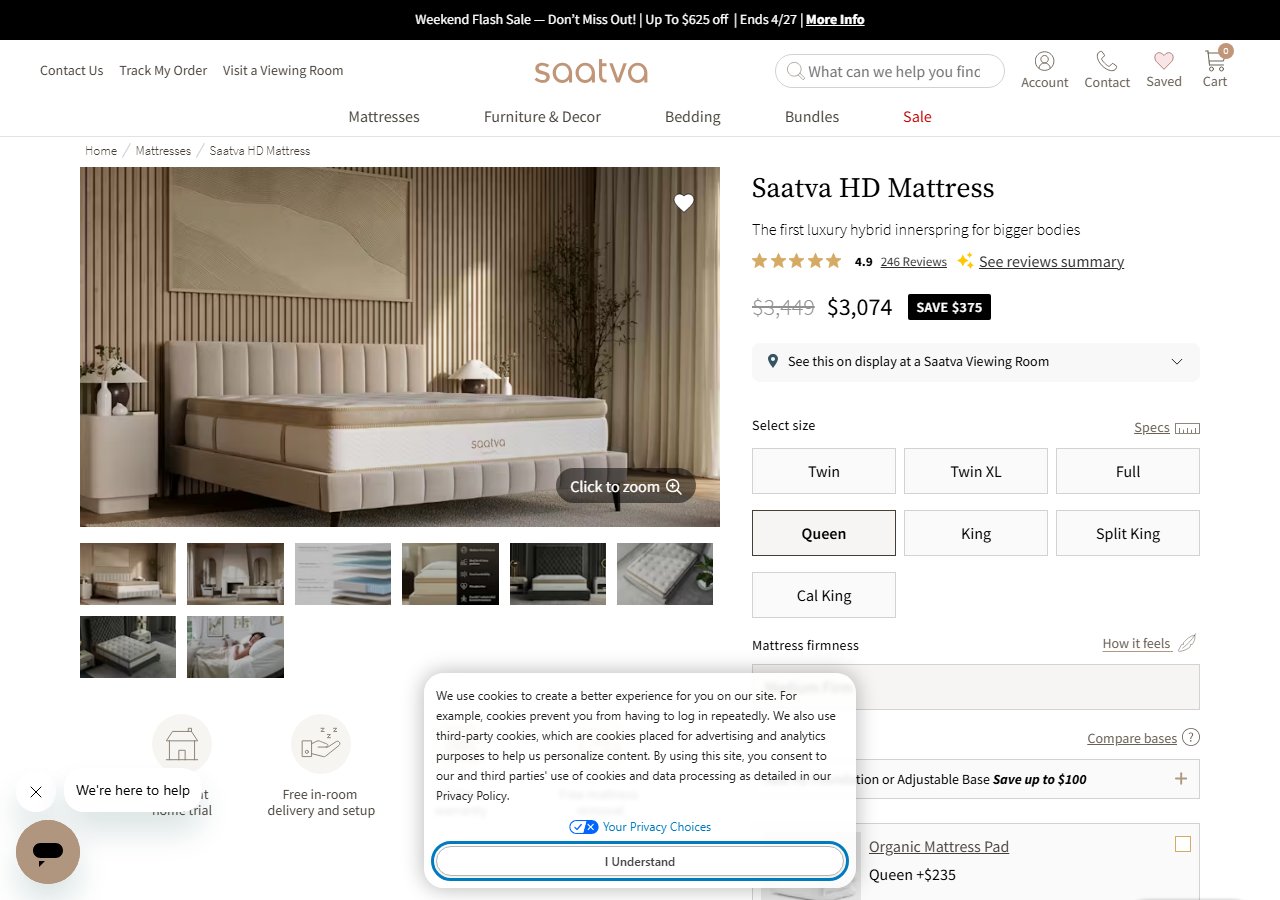
Saatva HD Mattress (Heavy-Duty)
$2,395-$3,995
See Price at Saatva →
Purple Hybrid Premier Mattress
$2,499-$4,799
See Price at Purple →The data-to-intervention-to-product hierarchy, restated
The federal data makes the stakes clear. BLS back injury data shows the back is the most injured body part in American workplaces. NIOSH's Lifting Equation documents that the tasks responsible for those injuries routinely exceed safe loading limits — and high bodyweight compounds the mechanical risk. SSA Disability Insurance reports show musculoskeletal disorders are the leading driver of disability claims. The personal and systemic cost of untreated chronic back pain is enormous, and it begins with daily spinal loading that never fully recovers because the recovery environment — the sleep surface — is inadequate for the load.
The hierarchy of interventions matters. Free interventions — sleep position correction, daily walking, lifting mechanics training, and honest mattress age assessment — should precede any purchase decision. Clinical evaluation should precede equipment decisions whenever red-flag symptoms are present. And when those steps have been taken and a sleep surface upgrade is genuinely warranted, the engineering specifications matter more than the brand story. For adults at 250 pounds and above, that means coil gauge, foam density, weight capacity ratings, and lumbar zoning — not thread counts and brand aesthetics.
The three surfaces identified here meet those engineering criteria by different mechanical paths. The Saatva HD is the most purpose-built for heavy-duty structural support. The Loom & Leaf is the choice for high-density foam contouring. The Purple Hybrid Premier is the differentiated option for readers whose pain profile includes significant pressure sensitivity. None of them is a substitute for movement, clinical care, or correct sleep position. All of them are meaningfully better than a standard consumer mattress bottomed out under a high-bodyweight sleeper trying to recover from a physically demanding workday.