Joint pain after 60 is a federal data problem, not just a personal one
CDC arthritis surveillance data shows approximately 25% of U.S. adults carry a doctor-diagnosed arthritis diagnosis. That figure does not distribute evenly across the lifespan. Prevalence climbs steeply after 60, with osteoarthritis — the wear-pattern variant driven by decades of joint loading — dominating the picture. Combine that with CDC sleep data showing approximately 35% of all U.S. adults already sleep fewer than seven hours per night, and the arithmetic gets grim fast for older adults: a population with the highest burden of joint degeneration is also operating inside a national sleep-deprivation epidemic. The overlap is not coincidental. Pain and sleep deprivation are bidirectional — each one worsens the other through overlapping neurological pathways — and the consequences for adults over 60 are measurably worse than for younger cohorts.
The financial signal in the federal data reinforces the severity. CMS drug spending data identifies pain medication — both opioid and non-opioid categories — among the most expensive Medicare drug expenditure lines, a direct reflection of how poorly the U.S. healthcare system manages chronic musculoskeletal pain at the population level. AHRQ HCUP data confirms that back pain ranks among the most expensive conditions in the entire U.S. healthcare system when measured by combined inpatient and outpatient costs. And AHRQ MEPS data quantifies the personal hit: adults living with chronic back conditions carry substantially higher annual personal healthcare expenditures than those without. For older adults on fixed incomes, this is not an abstract data point. It is the difference between financial stability and medical debt.
None of this means a new mattress is the answer. It means the stakes are high enough to be rigorous about what the evidence actually shows — and to work through free interventions, clinical evaluation, and biomechanics before we ever get to a product recommendation.
Why joint pain and sleep deteriorate together after 60
The mechanism is not mysterious once you work through the physiology. Cartilage in the hips, knees, lumbar facet joints, and shoulders thins progressively after middle age. That thinning reduces the joint's ability to distribute compressive load, which means that positions comfortable at 35 become actively inflammatory at 65. The lumbar spine is especially vulnerable. BLS musculoskeletal disorder data confirms that the back is the single most commonly injured body part across all U.S. occupations with days away from work — a statistic that reflects a lifetime of spinal loading that most adults over 60 have already accumulated across decades of work. By the time someone reaches retirement age, the spine has absorbed tens of thousands of loading cycles from careers in nursing, construction, warehousing, teaching, and every other physically demanding occupation the BLS tracks.
The NIOSH Lifting Equation documents that manual material-handling tasks in warehousing, construction, and healthcare routinely exceed safe spinal loading limits — but most workers do not discover the cumulative toll until the disc degeneration, facet arthropathy, or stenosis shows up on imaging in their 50s or 60s. What presents as "sleeping badly" at 62 is often the delayed consequence of decades of occupational spinal compression.
The sleep disruption mechanism works like this: inflammatory joint pain lowers the pain threshold during the parasympathetic state of sleep, when the body's natural cortisol suppression removes one of its primary anti-inflammatory buffers. Older adults have reduced sleep architecture depth — less slow-wave sleep, more frequent micro-arousals — meaning the pain threshold required to wake them is lower to begin with. Add an arthritic hip pressing into a mattress that no longer distributes pressure adequately, and you have a reliable formula for fragmented sleep, early morning waking, and the chronic fatigue that older adults with arthritis describe so consistently.
CDC NCHS Data Brief 390 places approximately 20% of U.S. adults in chronic pain, with lower back as the most frequently cited location. That figure is almost certainly an undercount among adults over 60, where musculoskeletal conditions are normatively undertreated and patients frequently self-manage with over-the-counter medications rather than seeking formal diagnosis. The SSA Disability Insurance data is the most consequential downstream number: musculoskeletal disorders are the single largest category of new disability claims every year in the United States. The disability pathway from unmanaged arthritis and chronic back pain to functional limitation is well-documented and entirely consistent with the sleep disruption data.
The cheapest intervention is the one that requires no purchase
Before this article discusses any product, it is worth being direct: the federal evidence base for non-product interventions in older adults with arthritis and chronic back pain is robust, and several of these approaches carry stronger evidence than any mattress on the market. The product industry does not have a randomized controlled trial budget. The NIH does. The CDC does. Start there.
The most important free variable is sleep position. NIH NIAMS back pain guidance is explicit: side-sleeping with a pillow between the knees keeps the lumbar spine and hip joints in neutral alignment, eliminating the torsional load that stomach-sleeping places on already-degenerated facet joints. Back-sleeping with a pillow under the knees achieves a similar result by reducing lumbar lordosis. For older adults with hip or knee osteoarthritis, the pillow-between-knees recommendation is not just about the spine — it prevents the femoral head from grinding against the acetabulum during the extended immobility of sleep. This costs nothing.
Daily walking is the movement intervention with the strongest evidence. NIH NCCIH's evidence review on low back pain concludes that walking 30 minutes most days reduces chronic low back pain as effectively as most non-drug clinical treatments. For older adults, this also addresses the synovial fluid circulation that arthritic joints require — cartilage is avascular and depends entirely on the compression-and-release cycle of movement to receive nutrients and clear metabolic waste. Extended sedentary periods, including prolonged time in bed on a poorly supportive surface, are actively harmful to arthritic joints.
Mattress lifespan matters more than most older adults realize. CDC sleep hygiene guidance is consistent with clinical consensus that a mattress showing visible sag, producing increased morning stiffness compared to bedtime, or exceeding 7 to 10 years of use is no longer performing its primary function. The mechanism is straightforward: as foam and spring materials fatigue, the sleep surface loses its ability to maintain spinal neutrality and distribute pressure away from bony prominences. An older adult with hip osteoarthritis sleeping on a 12-year-old innerspring that has developed a body impression is not experiencing a mattress problem — they are experiencing a materials-failure problem that is actively worsening their joint symptoms.
Lifting and bending mechanics remain relevant even in retirement. OSHA ergonomics guidance documents the correct approach: hinge at the hips, not the lumbar spine; keep loads close to the body; avoid axial rotation under load. Most acute back episodes in older adults are still mechanical in origin — a garden bed, a grandchild, a grocery bag — and most are preventable with rehearsed movement mechanics.
For readers who have already worked through the free interventions — who are sleeping in a good position, walking daily, and have a relatively new mattress that still isn't providing adequate relief — the evidence does support targeted mattress selection as an adjunct. The key word is adjunct. A mattress cannot replace movement, cannot undo years of occupational spinal loading, and cannot substitute for clinical evaluation of a serious joint condition. But for older adults with documented pressure-sensitivity from arthritis, or with documented spinal conditions where surface firmness affects morning pain levels, the construction details of a sleep surface matter.
When symptoms require clinical evaluation before any product decision
Some presentations of back pain and joint pain in older adults are not sleep-surface problems. They are medical problems that require imaging and clinical management. Buying a mattress for these symptoms is not just unhelpful — it can delay care and allow treatable conditions to progress.
NIH National Institute of Neurological Disorders and Stroke back pain guidance identifies the following as red flags requiring prompt clinical evaluation: back pain that radiates below the knee (potential nerve root compression or spinal stenosis), pain following acute trauma, pain accompanied by leg weakness or numbness, bowel or bladder dysfunction, and pain associated with fever. In older adults specifically, the risk of vertebral compression fracture from osteoporosis — presenting as acute mid-back or lower-back pain without a clear mechanical trigger — is a clinical emergency that no mattress can address and that cortisone injections and conservative care can significantly improve if caught early.
Older adults are also at elevated risk for referred pain from non-spinal sources: hip osteoarthritis commonly refers pain to the groin and anterior thigh; kidney pathology can present as flank pain misidentified as lumbar back pain; aortic aneurysm in older men can produce back pain as a first symptom. The appropriate response to new or changing pain patterns after 60 is always clinical evaluation before consumer product acquisition.
What the evidence supports in mattress construction for older adults with arthritis
For readers who have passed the clinical screening, tried the free interventions, and are genuinely looking at sleep surface replacement, the evidence points toward three construction variables that matter most for older adults with arthritis and chronic back pain: pressure distribution, zoned support, and edge stability for egress.
Pressure distribution is the primary concern for arthritic joints. Hip and shoulder pressure points are the most common sources of sleep-disrupting pain in older adults with osteoarthritis. The biomechanics are simple: a sleep surface that cannot conform to the contour of the greater trochanter (hip bone prominence) concentrates compressive stress on already-inflamed tissue. Memory foam and gel-grid constructions address this differently — memory foam through viscoelastic conforming, gel-grid through column-based deformation — but both outperform traditional innerspring designs for bony-prominence pressure relief.
Zoned support matters for spinal alignment. An older adult spine is not a uniform structure. The lumbar region typically needs firmer support to prevent sinkage that increases lumbar lordosis and compresses facet joints. The shoulder region needs softer material to allow the shoulder complex to sink and keep the cervical spine neutral. Mattresses with differentiated firmness zones — softer at shoulder and hip, firmer at lumbar and lower leg — address this directly.
Edge support and egress ease is a frequently overlooked variable in mattress recommendations for older adults, but it is functionally critical. Adults with hip or knee arthritis who struggle to rise from a sleep surface need a perimeter that maintains height and firmness under the load of a pivot-and-stand movement. A mattress with poor edge support compresses under this load, increasing the mechanical demand on arthritic hips and knees at the moment of highest vulnerability — first thing in the morning, when joints are stiffest.
With those construction criteria in mind, here is how the specific products in this evaluation address the older adult with arthritis:
The Saatva Loom & Leaf Memory Foam Mattress is the direct memory foam answer to arthritic pressure sensitivity. Saatva builds this mattress in two firmness options — Relaxed Firm and Firm — which is important because older adults with both pressure sensitivity and spinal instability need to find their specific optimal firmness rather than defaulting to either extreme. The high-density memory foam layer provides the viscoelastic conforming that redistributes pressure away from bony prominences, while the lumbar zone enhancement addresses the spinal support differential that zoned construction requires. For older adults who have spent decades in physically demanding work and are now living with the accumulated joint damage that BLS MSD data tracks so precisely, this construction directly addresses the pressure-distribution failure mode of aging innerspring mattresses. Pricing ranges from $1,695 to $3,295 depending on size.
The Saatva HD Mattress was engineered for heavier body weights and carries specific relevance for older adults whose body composition has shifted — a common pattern as muscle mass declines with age — and who may find that standard-weight mattresses compress beyond their rated performance range. Older adults who spent careers in warehousing, construction, or healthcare at higher body weights will recognize the pattern: mattresses that performed well at 180 pounds sag prematurely at 220. The HD's reinforced coil system and enhanced perimeter support address both the weight-distribution problem and the egress-ease variable discussed above. Pricing ranges from $2,395 to $3,995.
The Purple Hybrid Premier Mattress takes a fundamentally different approach to pressure relief through its GelFlex Grid construction — a polymer grid that collapses under bony prominences while supporting surrounding tissue, producing a pressure-relief profile that Purple's own clinical-adjacent testing suggests outperforms traditional memory foam at concentrated pressure points. For older adults with hip or shoulder arthritis where the pressure problem is highly localized, this construction characteristic is directly relevant. The hybrid coil base also provides the edge support stability that the egress variable requires. Pricing ranges from $2,499 to $4,799.
Mattresses Built for Arthritic Joints and Aging Spines
These three mattresses were selected specifically for older adults with arthritis, chronic back pain, or both — evaluated against the pressure-distribution, zoned-support, and egress-stability criteria that the federal biomechanics and clinical evidence identifies as most relevant after 60.

Saatva Loom & Leaf Memory Foam Mattress
$1,695-$3,295
See Price at Saatva →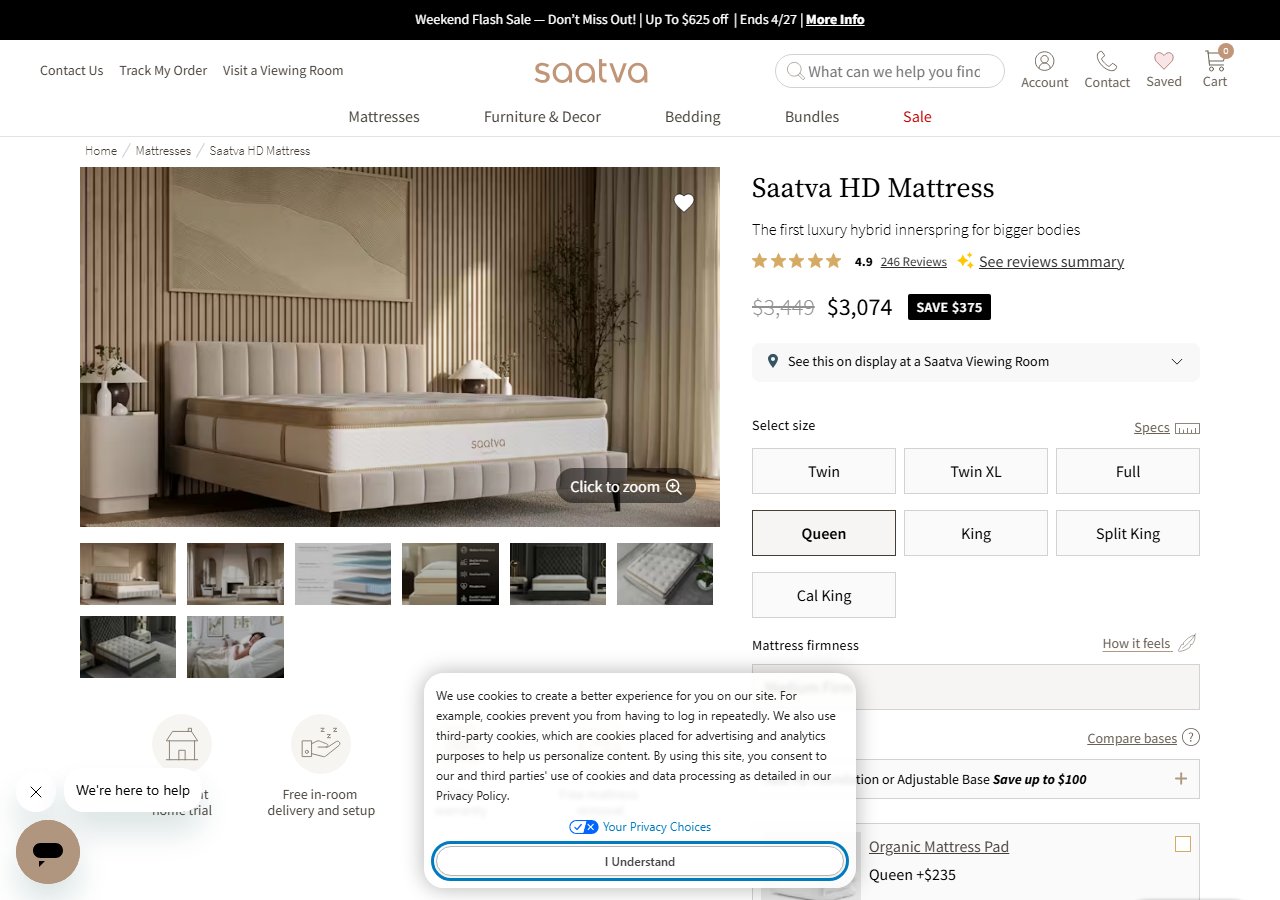
Saatva HD Mattress (Heavy-Duty)
$2,395-$3,995
See Price at Saatva →
Purple Hybrid Premier Mattress
$2,499-$4,799
See Price at Purple →Putting the evidence hierarchy in order
The federal data in this article paints a consistent picture. CDC arthritis surveillance shows one in four U.S. adults is already in the arthritic population, and that prevalence accelerates after 60. CDC sleep data shows the national sleep deficit is already substantial. The downstream costs — CMS drug spending, AHRQ HCUP inpatient costs, AHRQ MEPS personal expenditure data, SSA disability claims — all point in the same direction: undertreated musculoskeletal pain in older adults is one of the most expensive failure modes in U.S. healthcare.
The response hierarchy, in order of evidence strength: first, rule out red-flag symptoms that need clinical care; second, address sleep position and movement behavior (free and evidence-supported by NIH); third, evaluate your current sleep surface for materials failure (age, visible sag, morning stiffness pattern); fourth, if the surface is the problem and the clinical and behavioral interventions have been addressed, select a replacement based on the construction variables that match your specific joint-pain pattern — pressure distribution for arthritis, zoned support for spinal conditions, edge stability for egress.
The products discussed in this article — the Saatva Loom & Leaf for arthritic pressure relief, the Saatva HD for heavier frames and egress ease, and the Purple Hybrid Premier for localized bony-prominence pressure — represent the upper tier of constructions that address these specific variables. They are not cheap, and they should not be the first thing an older adult with joint pain buys. But for the reader who has done the work on sleep position, daily movement, and clinical screening, and who is sleeping on a deteriorated surface that is actively compressing arthritic joints for seven or eight hours each night, the mattress upgrade is no longer a luxury purchase. It is a materials-failure correction with a direct evidence chain from the federal data to the biomechanics to the construction specification.