When the Night Shift Becomes the Most Painful Part of the Day
You worked decades in a physically demanding job — or simply lived in a body that accumulated the ordinary wear of aging — and now the cruelest part is that sleep, the one period of the day that should offer relief, has become its own source of pain. You wake stiff. Your hips ache from lying on your side. Your lower back feels worse in the morning than it did when you went to bed. This is not a coincidence, and it is not inevitable.
CDC arthritis surveillance data reports that approximately 25% of U.S. adults have received a doctor-diagnosed arthritis diagnosis — and that prevalence rises sharply with age, making it one of the defining health conditions for adults 60 and older. Layered on top of that, CDC sleep and sleep disorders data documents that approximately 35% of U.S. adults sleep fewer than seven hours per night, the threshold below which chronic disease risk — including cardiovascular disease, metabolic dysfunction, and worsened pain perception — climbs measurably. For older adults managing arthritis, those two statistics do not simply add together. They multiply each other.
Understanding why this happens — mechanically and physiologically — is the prerequisite for fixing it. And fixing it requires a specific sequence: free behavioral changes first, clinical evaluation when red flags appear, and then, for those who have genuinely addressed the behavioral layer, a sleep surface engineered for the load patterns aging joints present.
Why Aging Joints and Sleep Surfaces Collide
The biomechanical story of joint pain and sleep starts with what happens to cartilage, synovial fluid, and soft tissue over decades. Osteoarthritis — the most common form affecting adults over 60 — degrades the cartilage cushioning joints and reduces synovial fluid production. The result is that bones that would once glide smoothly against one another now grind, and joints that would once absorb compressive load now transmit it directly to pain-sensitive subchondral bone.
During sleep, the body is in sustained static load in a way it rarely is during waking hours. A side-sleeping adult with hip osteoarthritis is placing the full weight of the upper body — distributed across a mattress surface — against a greater trochanter and iliac crest that have diminished cushioning capacity. If the sleep surface is too firm, it creates concentrated pressure points at those bony prominences. If it is too soft, it allows the spine to sag out of neutral alignment, placing sustained tensile stress on the facet joints and intervertebral discs that are themselves often arthritic by the seventh decade of life.
CDC NCHS Data Brief 390 documents that approximately 20% of U.S. adults live with chronic pain, with the lower back identified as the single most common pain location. For adults 60 and older, that figure is not an abstraction — it is the morning alarm they did not set. The lumbar spine accumulates a lifetime of compressive loading: BLS musculoskeletal disorder tracking consistently identifies the back as the most commonly injured body part across all U.S. occupations with days away from work, which means the older adult who spent a career in nursing, warehousing, construction, or retail has likely deposited decades of mechanical stress into a lumbar spine that now spends eight hours per night on a sleep surface. The quality of that surface matters.
The cost dimension is stark. AHRQ HCUP data identifies back pain as one of the most expensive conditions in U.S. healthcare by total inpatient and outpatient cost. AHRQ MEPS data shows that annual personal healthcare expenditures for adults with chronic back conditions substantially exceed those for adults without such conditions. And CMS drug spending data identifies both opioid and non-opioid pain medication spending among the costliest Medicare drug categories — a direct reflection of how many older Americans are managing pain pharmacologically that might be partially addressable through better sleep biomechanics and surface support.
SSA Disability Insurance data identifies musculoskeletal disorders as the largest single category of new disability claims annually. That is the downstream terminus of a chronic-pain pipeline that often begins with inadequate recovery during sleep. The preventive case for getting the sleep environment right is not aesthetic — it is economic and functional.
Try These First — The Free Interventions
Before evaluating any sleep surface, older adults with arthritis and back pain should audit the behavioral and positional variables that cost nothing to change. The cheapest intervention is the one that does not require buying anything. Federal health agencies have documented several interventions with meaningful evidence bases — and for many readers, these changes alone will produce measurable improvement.
Sleep position is the most powerful free variable you have. NIH guidance from the National Institute of Arthritis and Musculoskeletal and Skin Diseases is explicit: side-sleeping with a pillow between the knees keeps the pelvis level and the lumbar spine in neutral alignment. Back-sleeping with a pillow under the knees reduces lumbar extension and unloads the facet joints. Stomach-sleeping torques the lumbar spine into sustained rotation and extension — the exact forces that worsen both disc and facet arthritis. A pillow costs less than ten dollars. Changing your sleep position costs nothing. This is where the intervention cascade should start.
Daily walking produces back-pain relief that most passive interventions cannot match. The NIH National Center for Complementary and Integrative Health evidence review on low back pain documents that walking 30 minutes most days reduces chronic low back pain as effectively as most non-drug clinical treatments. For older adults, the synovial fluid dynamics are relevant here: joint movement pumps fresh synovial fluid into cartilage, which functions as both lubrication and nutrition. A sedentary day followed by eight hours of static loading on a mattress is a worse combination than an active day followed by eight hours of appropriate surface support. Move first, then optimize the sleep surface.
Audit whether the mattress itself is the structural problem. CDC sleep hygiene guidance and clinical practice both support a simple rule: if your mattress has visible sag, if you consistently wake stiffer than when you went to bed, or if it is older than seven to ten years, the surface has likely lost the structural integrity required to maintain spinal alignment. Even the most carefully engineered mattress does not undo poor sleep hygiene or a sedentary daytime routine — but a degraded mattress can actively worsen joint pain regardless of how well you manage everything else.
For some readers, the interventions above will be sufficient. But a meaningful portion of adults 60 and older are already doing the behavioral work — walking daily, managing sleep position, replacing aging mattresses on schedule — and still waking with hip pain, shoulder pain, and lumbar stiffness that traces directly to inadequate pressure relief and spinal support from their current sleep surface. For those readers, the construction characteristics of the mattress itself become clinically relevant, and the products below represent the clearest match between engineering specifications and the biomechanical needs of arthritic, aging joints.
When to See a Clinician — Red Flags That a Mattress Cannot Address
Not every back pain or joint pain episode in an older adult is a sleep surface problem. Some presentations require medical evaluation urgently, and optimizing your sleep environment while a serious condition goes undiagnosed is both dangerous and futile.
NIH guidance from the National Institute of Neurological Disorders and Stroke is direct about the red flags: back or joint pain that radiates below the knee, that followed a fall or trauma, that is accompanied by leg weakness or numbness, that comes with bowel or bladder changes, or that is accompanied by unexplained fever requires prompt clinical evaluation — not a new mattress. In older adults specifically, new-onset severe back pain without a clear mechanical cause warrants imaging to rule out vertebral fracture (especially in patients with osteoporosis), spinal stenosis requiring surgical consultation, or malignancy. These are not rare events in the 60-plus population. If your pain has escalated in severity over weeks, if it is present at rest and not just with movement, or if you have lost weight unintentionally alongside back pain, see a clinician before spending money on sleep equipment.
The clinical pathway and the sleep surface optimization pathway are not mutually exclusive — but they are sequential. Establish that your pain is mechanical and not red-flag in nature, work with a physician or physical therapist to confirm that sleep surface optimization is appropriate for your presentation, and then use the product guidance below as a reference for what construction characteristics matter for your specific joint pain pattern.
How Surface Firmness and Construction Actually Affect Arthritic Joints
Once you have established that your pain is mechanical and that behavioral interventions are in place, the mattress construction question becomes substantive. For older adults with arthritis, two properties are in necessary tension: pressure relief (the surface must deform enough to cradle bony prominences without creating concentrated load at the hip, shoulder, or knee) and spinal support (the surface must resist sag enough to keep the lumbar spine in neutral alignment through the night).
Memory foam achieves excellent pressure distribution by conforming closely to body contours — but traditional memory foam can trap heat (a significant issue for older adults whose thermoregulatory efficiency has declined) and can feel insufficiently supportive at lower density formulations. Hybrid designs — foam comfort layers over pocketed coil support cores — offer a more controlled pressure-relief-to-support ratio and typically sleep cooler than all-foam options. Zoned support systems, which vary coil gauge or foam density across the mattress's surface area, attempt to solve the tension directly by providing softer material under the hips and shoulders while maintaining firmer support under the lumbar spine.
The Saatva Loom & Leaf Memory Foam Mattress is the premium memory foam pick for older adults with serious back and joint pain. Saatva constructs the Loom & Leaf with a five-pound-density memory foam comfort layer — significantly denser than the two-to-three-pound foam found in mass-market mattresses — which means the material resists bottoming out under sustained load from heavier hip and shoulder areas. The mattress comes in two firmness options (Relaxed Firm and Firm), and the Relaxed Firm variant is specifically calibrated for side sleepers who need meaningful contouring without the spinal sag risk of softer all-foam designs. The gel-infused top layer addresses the heat retention problem. For older adults whose joint pain is most acute at pressure points — hip and shoulder in side sleepers, sacrum in back sleepers — this density and construction approach directly addresses the mechanism.
For older adults who are heavier or who have experienced visible sag in previous mattresses despite their age, the Saatva HD Mattress is built to a different load specification. The HD uses a lumbar zone active spinal wire system and a 3-inch Euro pillow top over dual tempered steel coil layers engineered for adults up to 500 pounds. The relevance for older adults is not exclusively about body weight — it is about the compressive load dynamics of a body whose joints have limited ability to shift load away from painful sites. A mattress that begins to sag under the hip or shoulder of an arthritic older adult within the first year or two of ownership fails the clinical purpose faster than its price tag suggests. The HD's reinforced construction extends the useful support life of the surface.
For older adults whose primary complaint is acute pressure-point sensitivity — particularly those with hip osteoarthritis, shoulder arthritis, or both — the Purple Hybrid Premier Mattress addresses pressure relief through a fundamentally different material engineering approach. Purple's GelFlex Grid does not compress in a uniform foam pattern; it collapses under bony prominences while remaining firm under areas that need support. The four-inch Grid variant (the Premier's thickest option) produces pressure mapping scores that significantly outperform conventional foam in third-party testing. For an arthritic older adult who has tried medium-firm foam mattresses and still wakes with hip or shoulder pain, the Grid's non-linear pressure response is worth the premium price.
Mattresses Built for Arthritic Joints and Aging Bodies
Each mattress below was selected for its documented pressure-relief architecture and spinal support characteristics — the two variables that matter most for adults 60+ managing arthritis and chronic back pain.

Saatva Loom & Leaf Memory Foam Mattress
$1,695-$3,295
See Price at Saatva →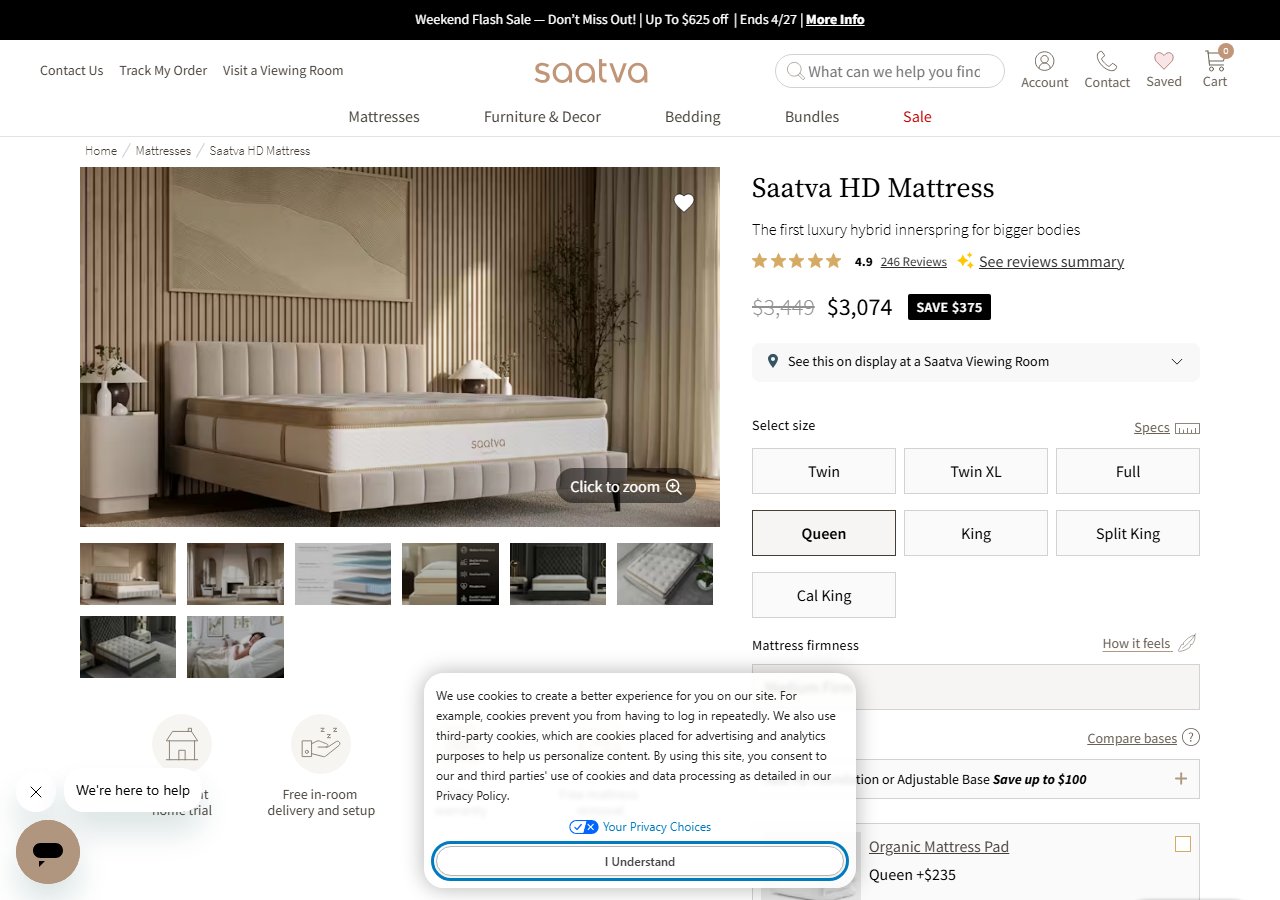
Saatva HD Mattress (Heavy-Duty)
$2,395-$3,995
See Price at Saatva →
Purple Hybrid Premier Mattress
$2,499-$4,799
See Price at Purple →What the Federal Data Tells You About the Cost of Getting This Wrong
The financial framing matters here, because the objection to a $2,000 or $3,000 mattress is a real one for older adults on fixed incomes or Medicare. But AHRQ MEPS data documents that chronic back condition costs substantially exceed non-back-pain healthcare expenditures annually. CMS drug spending dashboards capture the prescription medication cost downstream. AHRQ HCUP data shows back pain generating some of the highest total inpatient and outpatient costs in the U.S. healthcare system — costs that largely fall on Medicare in the 65-plus population, but that begin accumulating in personal out-of-pocket terms well before that.
None of that data argues that a premium mattress is a substitute for clinical care or behavioral change. It argues the inverse: that the compounding cost of undertreated chronic pain — in medication, in clinic visits, in functional decline — dwarfs the one-time cost of a well-engineered sleep surface used for a decade. An adult who sleeps 7.5 hours per night will spend approximately 2,700 hours per year on their mattress. At that utilization rate, a $2,500 mattress with a ten-year useful life costs roughly 92 cents per night. The cost comparison to a single specialist copay or a month's prescription pain medication is not close.
BLS workers' compensation cost data shows industries with high musculoskeletal disorder incidence carry insurance rates three to five times higher than low-MSD industries — a proxy for the systemic cost loading that chronic musculoskeletal conditions impose. For the older adult who spent a career in those high-MSD industries and is now managing the cumulative joint debt, the sleep surface is not a luxury item. It is infrastructure.
The Sequence That Actually Works
Federal data builds a coherent picture: arthritis affects one in four American adults and prevalence rises sharply after 60. Chronic pain — most commonly in the lower back — affects one in five. Poor sleep affects more than one in three. These conditions interact in ways that accelerate each other's severity and cost. The intervention sequence that the data supports is: correct sleep position and daytime movement habits first, evaluate whether the existing mattress has structural integrity, seek clinical evaluation when red flags are present, and then — for those who have done that work — invest in a sleep surface whose construction characteristics match the specific pressure-relief and support needs of arthritic, aging joints.
The Saatva Loom & Leaf addresses the memory foam pressure-relief requirement at premium density. The Saatva HD extends that logic to older adults with higher load requirements or a history of mattress sag. The Purple Hybrid Premier solves pressure-point sensitivity through material engineering that foam cannot replicate. None of them is a substitute for the behavioral and clinical work that comes first — but for older adults who have done that work and are still waking in pain, these surfaces represent the clearest available match between construction evidence and arthritic joint biomechanics.